Recognition: 3 theorem links
Multiwavelength Characterization of a New Magnetic Cataclysmic Variable 2CXO J050740.7-091337
Pith reviewed 2026-05-08 18:28 UTC · model grok-4.3
The pith
The X-ray source 2CXO J0507 is a magnetic cataclysmic variable with a 30 MG white dwarf field and 2.34-hour orbital period.
A machine-rendered reading of the paper's core claim, the machinery that carries it, and where it could break.
Core claim
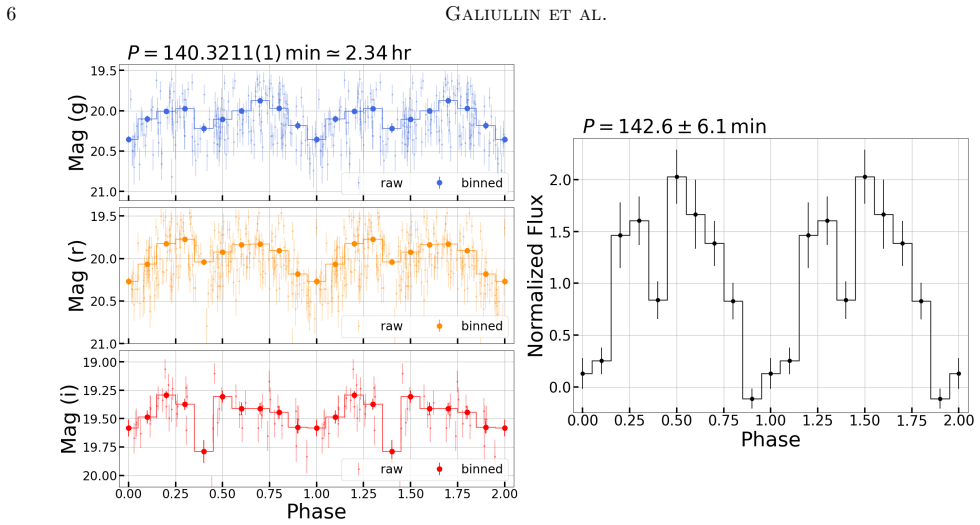
2CXO J050740.7-091337 is a magnetic cataclysmic variable resembling a polar, with a white dwarf magnetic field of approximately 30 MG inferred from prominent cyclotron humps in its optical spectrum. Archival Chandra and XMM-Newton data give an X-ray luminosity of 5.18 times 10 to the 30 erg s to the -1 in the 0.3-10 keV band and a spectrum well described by a thermal plasma at 8 keV with no soft excess or intrinsic absorption. Both X-ray and optical photometry indicate an orbital period of 2.34 hours, and long-term monitoring shows variability of roughly two magnitudes.
What carries the argument
Cyclotron humps in the optical spectrum that directly measure the white dwarf magnetic field strength.
Load-bearing premise
The cyclotron humps seen in the optical spectrum arise from the white dwarf's magnetic field and reliably yield a field strength of about 30 MG, while the detected modulations in X-ray and optical light curves represent the orbital period.
What would settle it
An independent radial-velocity orbit or cyclotron feature measurement that yields a period significantly different from 2.34 hours or a field strength inconsistent with 30 MG would falsify the polar classification.
Figures




read the original abstract
We report the discovery and characterization of a new cataclysmic variable (CV), 2CXO J050740.7-091337 (hereafter 2CXO J0507), identified using the X-ray main sequence through a cross-match between the Chandra Source Catalogue 2.1 and Gaia DR3. Optical spectroscopic follow-up with Keck I/LRIS reveals prominent cyclotron humps and Balmer emission lines, indicating a strongly magnetized white dwarf with a magnetic field strength of $B \approx 30$ MG. Analysis of Chandra and XMM-Newton archival data shows an X-ray luminosity of $L_X = (5.18 \pm 0.88) \times 10^{30}$ erg s$^{-1}$ (0.3-10 keV). The X-ray spectrum is well approximated by a thermal plasma emission model with a temperature of $kT = 7.95^{+3.84}_{-1.85}$ keV, showing no soft excess or intrinsic absorption. 2CXO J0507 exhibits long-term optical variability by $\approx2$ mag (ranging $\approx18-20$ mag) in Zwicky Transient Facility and Asteroid Terrestrial-impact Last Alert System photometric data. Both X-ray and optical modulation suggest an orbital period of 2.34 hr. These properties indicate that 2CXO J0507 is a magnetic CV, most closely resembling a polar. As 2CXO J0507 sits close to the faint limit of current optical time-domain surveys, it serves as a representative example of the large population of faint, magnetic CVs expected to be systematically identified by the Rubin Observatory.
Editorial analysis
A structured set of objections, weighed in public.
Referee Report
Summary. The paper reports the discovery and multiwavelength characterization of the X-ray source 2CXO J050740.7-091337 as a new cataclysmic variable. Optical spectroscopy with Keck/LRIS shows Balmer emission lines and cyclotron humps implying a white dwarf magnetic field B ≈ 30 MG. Archival Chandra and XMM-Newton data yield an X-ray luminosity of (5.18 ± 0.88) × 10^30 erg s^{-1} (0.3-10 keV) with a thermal plasma fit at kT = 7.95^{+3.84}_{-1.85} keV and no soft excess. Long-term optical variability of ~2 mag and periodic modulations at 2.34 hr in both X-ray and optical bands lead to the conclusion that the system is a magnetic CV most closely resembling a polar.
Significance. If the central inferences hold, the work provides a concrete example of identifying faint magnetic CVs via Chandra-Gaia cross-matching and time-domain surveys, supporting expectations for a large undetected population that Rubin Observatory will systematically uncover. The multiwavelength approach and standard spectral/timing methods are appropriate for such discovery papers.
major comments (2)
- [§4] §4 (variability analysis): The claim that the detected 2.34 hr modulation is the orbital period (implying synchronization) rests on archival Chandra/XMM and ZTF/ATLAS light curves. The manuscript must include the periodogram, false-alarm probability, window function, and explicit discussion of aliasing risks from sparse sampling; without radial-velocity confirmation, the polar classification remains insecure.
- [§3] §3 (optical spectroscopy): The identification of cyclotron humps yielding B ≈ 30 MG is load-bearing for the magnetic classification above the IP regime. The spectrum figure, measured hump wavelengths, and explicit application of the cyclotron frequency relation (including any assumptions on harmonic number or viewing angle) must be provided to allow independent verification that the features are not Balmer lines, artifacts, or other emission.
minor comments (2)
- [X-ray analysis] The X-ray spectral fitting section should state the exact plasma model (e.g., apec), any fixed abundances, and the absorption component used when reporting the lack of intrinsic absorption.
- [Abstract and §2] The distance adopted for the X-ray luminosity conversion should be stated explicitly (presumably from Gaia parallax) with its uncertainty propagated.
Simulated Author's Rebuttal
We thank the referee for their thoughtful review and constructive suggestions. We have carefully considered each major comment and provide our responses below. We believe the revisions will strengthen the manuscript.
read point-by-point responses
-
Referee: [§4] §4 (variability analysis): The claim that the detected 2.34 hr modulation is the orbital period (implying synchronization) rests on archival Chandra/XMM and ZTF/ATLAS light curves. The manuscript must include the periodogram, false-alarm probability, window function, and explicit discussion of aliasing risks from sparse sampling; without radial-velocity confirmation, the polar classification remains insecure.
Authors: We agree that the periodicity analysis requires more detailed presentation. In the revised version of the manuscript, we will add the periodogram of the combined X-ray and optical data, along with the false-alarm probability, the window function to assess sampling effects, and an explicit discussion of potential aliasing due to the sparse nature of the archival observations. Regarding the classification, we note that while radial-velocity measurements would provide definitive confirmation of the orbital period and synchronization, the current evidence—including the consistent modulation period in both X-ray and optical bands, the high magnetic field strength inferred from spectroscopy, the X-ray spectral properties without a soft excess, and the long-term variability—collectively supports the identification as a polar. We will clarify in the text that the orbital period is inferred from the photometric and X-ray modulations and discuss the implications for synchronization. We believe this addresses the concern without overclaiming certainty. revision: partial
-
Referee: [§3] §3 (optical spectroscopy): The identification of cyclotron humps yielding B ≈ 30 MG is load-bearing for the magnetic classification above the IP regime. The spectrum figure, measured hump wavelengths, and explicit application of the cyclotron frequency relation (including any assumptions on harmonic number or viewing angle) must be provided to allow independent verification that the features are not Balmer lines, artifacts, or other emission.
Authors: We appreciate this point and will enhance §3 in the revised manuscript. We will include the optical spectrum figure with the cyclotron humps explicitly labeled, provide the measured wavelengths of the identified humps, and detail the application of the cyclotron frequency formula to derive B ≈ 30 MG. This will include specifying the assumed harmonic numbers (typically the first few harmonics) and any assumptions regarding the viewing angle or plasma temperature. These additions will enable readers to verify the identification independently and confirm that the features are distinct from Balmer emission lines or instrumental artifacts. The original spectrum data and fitting will be made available as supplementary material if appropriate. revision: yes
Circularity Check
No circularity: purely observational classification from direct data
full rationale
The paper reports a catalog cross-match discovery followed by Keck spectroscopy (cyclotron humps, Balmer lines) and archival Chandra/XMM/X-ray plus ZTF/ATLAS photometry. No equations, derivations, fitted parameters renamed as predictions, or load-bearing self-citations appear. The B ≈ 30 MG estimate and 2.34 hr period assignment are direct inferences from observed wavelengths and timing, not quantities that reduce to the same inputs by construction. The central claim therefore rests on external data rather than any self-referential chain.
Axiom & Free-Parameter Ledger
free parameters (2)
- X-ray plasma temperature kT =
7.95 keV
- Magnetic field strength B =
30 MG
axioms (2)
- domain assumption Gaia DR3 distance is accurate and can be used to compute X-ray luminosity
- standard math Standard cyclotron emission theory for polars correctly converts hump wavelengths to magnetic field strength
Reference graph
Works this paper leans on
-
[1]
Aizu, K. 1973, Progress of Theoretical Physics, 49, 1184, doi: 10.1143/PTP.49.1184
-
[2]
Arnaud, K. A. 1996, in Astronomical Society of the Pacific Conference Series, Vol. 101, Astronomical Data Analysis Software and Systems V, ed. G. H. Jacoby & J. Barnes, 17 Astropy Collaboration, Robitaille, T. P., Tollerud, E. J., et al. 2013, A&A, 558, A33, doi: 10.1051/0004-6361/201322068 Astropy Collaboration, Price-Whelan, A. M., Sip˝ ocz, B. M., et a...
-
[3]
Bellm, E. C., Kulkarni, S. R., Graham, M. J., et al. 2019, PASP, 131, 018002, doi: 10.1088/1538-3873/aaecbe
-
[4]
Belloni, D., & Schreiber, M. R. 2023, in Handbook of X-ray and Gamma-ray Astrophysics, 129, doi: 10.1007/978-981-16-4544-0 98-1
-
[5]
Belloni, D., Schreiber, M. R., Pala, A. F., et al. 2020, MNRAS, 491, 5717, doi: 10.1093/mnras/stz3413
-
[6]
Thomas, H. C. 2020, A&A, 634, A91, doi: 10.1051/0004-6361/201936626
-
[7]
Boldin, P. A., Tsygankov, S. S., & Lutovinov, A. A. 2013, Astronomy Letters, 39, 375, doi: 10.1134/S1063773713060029
-
[8]
Boller, T., Freyberg, M. J., Tr¨ umper, J., et al. 2016, A&A, 588, A103, doi: 10.1051/0004-6361/201525648
-
[9]
Cash, W. 1979, ApJ, 228, 939, doi: 10.1086/156922
-
[10]
Cordova, F. A., & Mason, K. O. 1984, MNRAS, 206, 879, doi: 10.1093/mnras/206.4.879
-
[11]
1990, SSRv, 54, 195, doi: 10.1007/BF00177799
Cropper, M. 1990, SSRv, 54, 195, doi: 10.1007/BF00177799
-
[12]
Evans, I. N., Evans, J. D., Mart´ ınez-Galarza, J. R., et al. 2024, ApJS, 274, 22, doi: 10.3847/1538-4365/ad6319
-
[13]
Evans, P. A., & Hellier, C. 2007, ApJ, 663, 1277, doi: 10.1086/518552
-
[14]
Ferrario, L., de Martino, D., & G¨ ansicke, B. T. 2015, SSRv, 191, 111, doi: 10.1007/s11214-015-0152-0 F¨ orster, F., Cabrera-Vives, G., Castillo-Navarrete, E., et al. 2021, AJ, 161, 242, doi: 10.3847/1538-3881/abe9bc
-
[15]
Frank, J., King, A., & Raine, D. J. 2002, Accretion Power in Astrophysics: Third Edition
2002
-
[16]
Fruscione, A., McDowell, J. C., Allen, G. E., et al. 2006, in Society of Photo-Optical Instrumentation Engineers (SPIE) Conference Series, Vol. 6270, Observatory Operations: Strategies, Processes, and Systems, ed. D. R. Silva & R. E. Doxsey, 62701V, doi: 10.1117/12.671760
-
[17]
J., et al
Gabriel, C., Denby, M., Fyfe, D. J., et al. 2004, in Astronomical Society of the Pacific Conference Series, Vol. 314, Astronomical Data Analysis Software and Systems (ADASS) XIII, ed. F. Ochsenbein, M. G. Allen, & D. Egret, 759
2004
-
[18]
Galiullin, I., Rodriguez, A. C., El-Badry, K., et al. 2024a, A&A, 690, A374, doi: 10.1051/0004-6361/202450734
-
[19]
Galiullin, I., Rodriguez, A. C., Kulkarni, S. R., et al. 2024b, MNRAS, 528, 676, doi: 10.1093/mnras/stae012
-
[20]
Galiullin, I. I., & Gilfanov, M. R. 2021, Astronomy Letters, 47, 587, doi: 10.1134/S1063773721090048 G¨ ansicke, B. T., Dillon, M., Southworth, J., et al. 2009, MNRAS, 397, 2170, doi: 10.1111/j.1365-2966.2009.15126.x
-
[21]
Garmire, G. P., Bautz, M. W., Ford, P. G., Nousek, J. A., & Ricker, Jr., G. R. 2003, in Society of Photo-Optical Instrumentation Engineers (SPIE) Conference Series, Vol. 4851, X-Ray and Gamma-Ray Telescopes and Instruments for Astronomy., ed. J. E. Truemper & H. D. Tananbaum, 28–44, doi: 10.1117/12.461599
-
[22]
2021, PyXspec: Python interface to XSPEC spectral-fitting program, Astrophysics Source Code Library, record ascl:2101.014
Gordon, C., & Arnaud, K. 2021, PyXspec: Python interface to XSPEC spectral-fitting program, Astrophysics Source Code Library, record ascl:2101.014
2021
-
[23]
Green, M. J., Marsh, T. R., Carter, P. J., et al. 2020, MNRAS, 496, 1243, doi: 10.1093/mnras/staa1509
-
[24]
1995, A&A, 297, L37
Haberl, F., & Motch, C. 1995, A&A, 297, L37
1995
-
[25]
Hambleton, K. M., Bianco, F. B., Street, R., et al. 2023, PASP, 135, 105002, doi: 10.1088/1538-3873/acdb9a
-
[26]
Hameury, J. M. 2020, Advances in Space Research, 66, 1004, doi: 10.1016/j.asr.2019.10.022
-
[27]
Harris, C. R., Millman, K. J., van der Walt, S. J., et al. 2020, Nature, 585, 357, doi: 10.1038/s41586-020-2649-2
-
[28]
Harrison, T. E., & Campbell, R. K. 2015, ApJS, 219, 32, doi: 10.1088/0067-0049/219/2/32 —. 2018, MNRAS, 474, 1572, doi: 10.1093/mnras/stx2881
-
[29]
Howell, S. B., Nelson, L. A., & Rappaport, S. 2001, ApJ, 550, 897, doi: 10.1086/319776
-
[30]
Hunter, J. D. 2007, Computing in Science & Engineering, 9, 90, doi: 10.1109/MCSE.2007.55
-
[31]
2013, A&A Rv, 21, 59, doi: 10.1007/s00159-013-0059-2
Ivanova, N., Justham, S., Chen, X., et al. 2013, A&A Rv, 21, 59, doi: 10.1007/s00159-013-0059-2 Ivezi´ c,ˇZ., Kahn, S. M., Tyson, J. A., et al. 2019, ApJ, 873, 111, doi: 10.3847/1538-4357/ab042c
-
[32]
Kalomeni, B., Pek¨ unl¨ u, E. R., & Yakut, K. 2005, A&A, 439, 823, doi: 10.1051/0004-6361:20041780
-
[33]
Knigge, C. 2006, MNRAS, 373, 484, doi: 10.1111/j.1365-2966.2006.11096.x
-
[34]
Liedahl, D. A., Osterheld, A. L., & Goldstein, W. H. 1995, ApJL, 438, L115, doi: 10.1086/187729
-
[35]
Lomb, N. R. 1976, Ap&SS, 39, 447, doi: 10.1007/BF00648343
-
[36]
Publications of the Astronomical Society of the Pacific , author =
Masci, F. J., Laher, R. R., Rusholme, B., et al. 2019, PASP, 131, 018003, doi: 10.1088/1538-3873/aae8ac
work page internal anchor Pith review doi:10.1088/1538-3873/aae8ac 2019
-
[37]
Meggitt, S. M. A., & Wickramasinghe, D. T. 1982, MNRAS, 198, 71, doi: 10.1093/mnras/198.1.71
-
[38]
R., & van den Oord, G
Mewe, R., Lemen, J. R., & van den Oord, G. H. J. 1986, A&AS, 65, 511
1986
-
[39]
2017, PASP, 129, 062001, doi: 10.1088/1538-3873/aa6736
Mukai, K. 2017, PASP, 129, 062001, doi: 10.1088/1538-3873/aa6736
-
[40]
Mukai, K., Kinkhabwala, A., Peterson, J. R., Kahn, S. M., & Paerels, F. 2003, ApJL, 586, L77, doi: 10.1086/374583 11
-
[41]
Mushotzky, R. F., & Szymkowiak, A. E. 1988, in NATO Advanced Study Institute (ASI) Series C, Vol. 229, Cooling Flows in Clusters and Galaxies, ed. A. C. Fabian, 53, doi: 10.1007/978-94-009-2953-1 6
-
[42]
1972, ApJ, 175, 417, doi: 10.1086/151568
Nauenberg, M. 1972, ApJ, 175, 417, doi: 10.1086/151568
-
[43]
Norton, A. J., Wynn, G. A., & Somerscales, R. V. 2004, ApJ, 614, 349, doi: 10.1086/423333
-
[44]
Oke, J. B., Cohen, J. G., Carr, M., et al. 1995, PASP, 107, 375, doi: 10.1086/133562 Paczy´ nski, B. 1967, AcA, 17, 287
-
[45]
Pala, A. F., G¨ ansicke, B. T., Belloni, D., et al. 2022, MNRAS, 510, 6110, doi: 10.1093/mnras/stab3449
-
[46]
1994, PASP, 106, 209, doi: 10.1086/133375
Patterson, J. 1994, PASP, 106, 209, doi: 10.1086/133375
-
[47]
Perley, D. A. 2019, PASP, 131, 084503, doi: 10.1088/1538-3873/ab215d
-
[48]
R., Nelemans, G., & Steeghs, D
Priedhorsky, W. 2004, MNRAS, 347, 95, doi: 10.1111/j.1365-2966.2004.07242.x
-
[49]
Ramsay, G., Green, M. J., Marsh, T. R., et al. 2018, A&A, 620, A141, doi: 10.1051/0004-6361/201834261
-
[50]
Rappaport, S., Verbunt, F., & Joss, P. C. 1983, ApJ, 275, 713, doi: 10.1086/161569
-
[51]
2008, A&A, 489, 1121, doi: 10.1051/0004-6361:200810213
Sunyaev, R. 2008, A&A, 489, 1121, doi: 10.1051/0004-6361:200810213
-
[52]
Ritter, H., & Kolb, U. 2003, A&A, 404, 301, doi: 10.1051/0004-6361:20030330
-
[53]
Rodriguez, A. C. 2024, PASP, 136, 054201, doi: 10.1088/1538-3873/ad357c
-
[54]
C., Galiullin, I., Gilfanov, M., et al
Rodriguez, A. C., Galiullin, I., Gilfanov, M., et al. 2023a, ApJ, 954, 63, doi: 10.3847/1538-4357/ace698
-
[55]
Rodriguez, A. C., Kulkarni, S. R., Prince, T. A., et al. 2023b, ApJ, 945, 141, doi: 10.3847/1538-4357/acbb6f
-
[56]
Rodriguez, A. C., El-Badry, K., Suleimanov, V., et al. 2025a, PASP, 137, 014201, doi: 10.1088/1538-3873/ada185
-
[57]
C., El-Badry, K., Hakala, P., et al
Rodriguez, A. C., El-Badry, K., Hakala, P., et al. 2025b, PASP, 137, 024202, doi: 10.1088/1538-3873/adb0f1
-
[58]
Scargle, J. D. 1982, ApJ, 263, 835, doi: 10.1086/160554
-
[59]
Smith, P. S. 2001, ApJ, 553, 823, doi: 10.1086/320967
-
[60]
Schreiber, M. R., Belloni, D., & Schwope, A. D. 2024, A&A, 682, L7, doi: 10.1051/0004-6361/202348807
-
[61]
Schwope, A. D. 2025, A&A, 698, A106, doi: 10.1051/0004-6361/202554519
-
[62]
D., Knauff, K., Kurpas, J., et al
Schwope, A. D., Knauff, K., Kurpas, J., et al. 2024, A&A, 690, A243, doi: 10.1051/0004-6361/202450537 Str¨ uder, L., Briel, U., Dennerl, K., et al. 2001, A&A, 365, L18, doi: 10.1051/0004-6361:20000066
-
[63]
2004, AJ, 128, 2443, doi: 10.1086/424540
Szkody, P., Homer, L., Chen, B., et al. 2004, AJ, 128, 2443, doi: 10.1086/424540
-
[64]
Tonry, J. L., Denneau, L., Heinze, A. N., et al. 2018, PASP, 130, 064505, doi: 10.1088/1538-3873/aabadf
-
[65]
2017, A&A, 608, A36, doi: 10.1051/0004-6361/201731323
Tovmassian, G., Gonz´ alez-Buitrago, D., Thorstensen, J., et al. 2017, A&A, 608, A36, doi: 10.1051/0004-6361/201731323
-
[66]
Turner, M. J. L., Abbey, A., Arnaud, M., et al. 2001, A&A, 365, L27, doi: 10.1051/0004-6361:20000087 van Roestel, J., Rodriguez, A. C., Szkody, P., et al. 2025, A&A, 696, A242, doi: 10.1051/0004-6361/202451945
-
[67]
VanderPlas, J. T. 2018, ApJS, 236, 16, doi: 10.3847/1538-4365/aab766
-
[68]
2025, A&A, 698, A321, doi: 10.1051/0004-6361/202452230
Wang, X., & Takata, J. 2025, A&A, 698, A321, doi: 10.1051/0004-6361/202452230
-
[69]
1995, Cambridge Astrophysics, V ol
Warner, B. 2003, Cataclysmic Variable Stars, doi: 10.1017/CBO9780511586491
-
[70]
On the Absorption of X-rays in the Interstellar Medium
Wilms, J., Allen, A., & McCray, R. 2000, ApJ, 542, 914, doi: 10.1086/317016
-
[71]
2018, ApJ, 853, 182, doi: 10.3847/1538-4357/aaa47d
Yu, Z.-l., Xu, X.-j., Li, X.-D., et al. 2018, ApJ, 853, 182, doi: 10.3847/1538-4357/aaa47d
discussion (0)
Sign in with ORCID, Apple, or X to comment. Anyone can read and Pith papers without signing in.