Recognition: 3 theorem links
· Lean TheoremCalculating Domain of Attraction Boundary of Power Systems Based on the Gentlest Ascent Dynamics
Pith reviewed 2026-05-08 17:44 UTC · model grok-4.3
The pith
The domain of attraction boundary in power systems equals the closure of the union of stable manifolds of index-1 critical elements.
A machine-rendered reading of the paper's core claim, the machinery that carries it, and where it could break.
Core claim
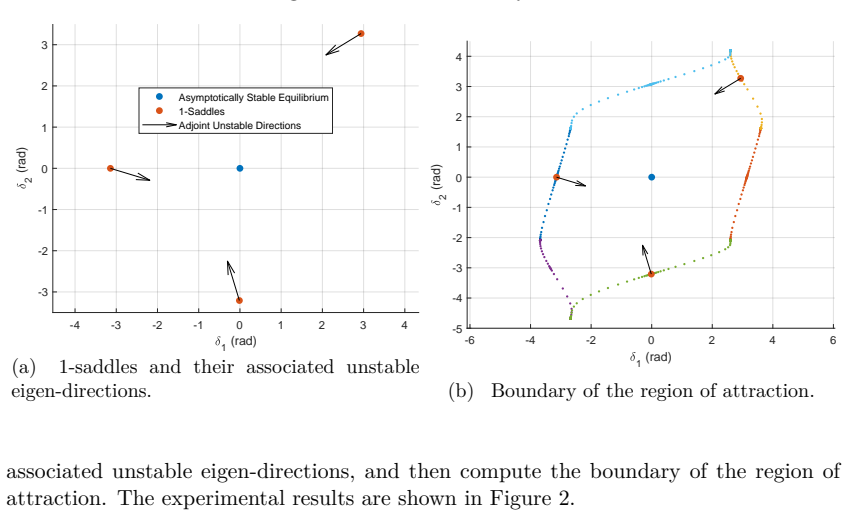
Using a gentlest ascent dynamics method for one-saddle points, an adjoint operator method for periodic orbits, and stable manifold algorithms, the authors transform DOA boundary computation into the task of locating unstable critical elements and their stable manifolds. They prove that, under certain assumptions, the DOA boundary is the closure of the union of these stable manifolds, and they develop a stability theory for a perturbed version of the gentlest ascent dynamics system. Numerical tests on two-machine and three-machine benchmark systems, both with and without periodic orbits, confirm that the computed surfaces accurately reproduce the geometric structure of the boundary.
What carries the argument
Gentlest ascent dynamics (GAD) for locating index-1 saddle points, combined with adjoint methods for periodic orbits and stable manifold construction algorithms.
If this is right
- DOA boundaries can be built by locating a finite set of index-1 critical elements rather than by exhaustive forward simulation of many trajectories.
- The same framework applies to systems whose separatrix contains both saddle points and periodic orbits.
- A stability result for the perturbed GAD flow guarantees that small numerical errors do not destroy the computed manifolds.
- The method supplies a concrete numerical procedure for transient stability assessment on small-scale generator models.
Where Pith is reading between the lines
- If the approach scales to higher-dimensional models that include inverter-based resources, it could support stability assessment for grids with high renewable penetration.
- The manifold-construction step might be reused in other engineering domains where separatrices between competing attractors must be mapped explicitly.
- Real-time monitoring tools could incorporate online updates of the critical elements when system parameters drift.
Load-bearing premise
Certain assumptions on the power system vector field and the nature of its critical elements must hold for the boundary to coincide exactly with the union of the stable manifolds.
What would settle it
A post-fault trajectory that starts inside the computed boundary yet loses synchronism, or one that starts outside yet returns to the stable equilibrium, would show the boundary calculation is incorrect.
Figures






read the original abstract
The power system, a fundamental public utility, is increasingly important due to growing global electricity demand. Recent large-scale blackouts (e.g., Iberian Peninsula, UK) have raised concerns about transient stability under impact faults. Transient stability is determined by post-disturbance synchronizing capability of synchronous generators, formulated as identifying the domain of attraction (DOA) boundary of the asymptotically stable equilibrium. Using a benchmark model of synchronous-generator-dominated power systems, this report employs a gentlest ascent dynamics (GAD) method for 1-saddle points, an adjoint operator method for periodic orbits, and stable manifold algorithms to compute the DOA boundary. These algorithms transform DOA boundary determination into constructing unstable critical elements (saddle points and periodic orbits) and their stable manifolds. Theoretically, under certain assumptions we prove that the DOA boundary is the closure of the union of stable manifolds of index-1 critical elements, and establish a stability theory for a perturbed GAD system. Numerical experiments on two-machine and three-machine systems (with only saddle points or with periodic orbits) validate the effectiveness and accuracy. Results show the algorithms accurately capture the geometric structure of the DOA boundary, providing a new numerical tool for transient stability analysis.
Editorial analysis
A structured set of objections, weighed in public.
Referee Report
Summary. The paper develops a gentlest ascent dynamics (GAD) approach, combined with adjoint methods for periodic orbits and stable manifold algorithms, to compute the boundary of the domain of attraction (DOA) for post-fault equilibria in synchronous-generator-dominated power systems. It claims a theoretical result that, under certain assumptions, the DOA boundary equals the closure of the union of the stable manifolds of all index-1 critical elements (saddles and periodic orbits), together with a stability theory for a perturbed GAD system. The method is illustrated and validated on two-machine and three-machine benchmark systems, with and without periodic orbits.
Significance. If the central theoretical claims hold under the stated assumptions, the work supplies a new, geometrically grounded numerical tool for transient stability assessment in power systems. This is relevant for blackout prevention, as it converts DOA-boundary computation into the construction of unstable critical elements and their stable manifolds. The explicit treatment of both saddle points and periodic orbits, plus the perturbed-GAD stability analysis, extends existing GAD literature to a practically important class of non-gradient systems.
major comments (2)
- [Abstract and theoretical results] Abstract and theoretical results section: the central theorem asserts that the DOA boundary is the closure of the union of stable manifolds of index-1 critical elements 'under certain assumptions,' yet these assumptions are never listed explicitly, nor is it verified that the power-system vector field satisfies them (e.g., hyperbolicity, transversality of manifold intersections, or non-degeneracy of periodic orbits). Without this list, it is impossible to determine whether the two- and three-machine numerical examples lie inside the theorem's regime or what happens when the assumptions fail.
- [Numerical experiments] Numerical validation sections: the reported accuracy on the two- and three-machine systems is presented without quantitative error bounds, comparison against independent DOA-boundary methods (e.g., Lyapunov-function level sets or Monte-Carlo sampling), or discussion of how the computed manifolds were truncated or approximated. This weakens the claim that the algorithms 'accurately capture the geometric structure.'
minor comments (2)
- [Abstract] The abstract refers to 'a benchmark model of synchronous-generator-dominated power systems' without citing the precise swing-equation formulation or parameter values used in the examples; these should be stated explicitly for reproducibility.
- [Method sections] Notation for the perturbed GAD system and the adjoint operator for periodic orbits is introduced without a consolidated table of symbols; a short notation table would improve readability.
Simulated Author's Rebuttal
We thank the referee for the positive assessment of the work's significance and for the constructive major comments. We address each point below, indicating the revisions planned for the manuscript.
read point-by-point responses
-
Referee: [Abstract and theoretical results] Abstract and theoretical results section: the central theorem asserts that the DOA boundary is the closure of the union of stable manifolds of index-1 critical elements 'under certain assumptions,' yet these assumptions are never listed explicitly, nor is it verified that the power-system vector field satisfies them (e.g., hyperbolicity, transversality of manifold intersections, or non-degeneracy of periodic orbits). Without this list, it is impossible to determine whether the two- and three-machine numerical examples lie inside the theorem's regime or what happens when the assumptions fail.
Authors: We agree that the assumptions require explicit listing for clarity. The theoretical development draws on standard hyperbolic dynamical systems assumptions (hyperbolicity of saddles and periodic orbits, transversality of manifold intersections, and non-degeneracy of periodic orbits), but these are referenced rather than collected. In the revised manuscript we will add a dedicated subsection that enumerates all assumptions verbatim and verifies their satisfaction for the two- and three-machine benchmark models under the standard swing-equation vector field. This will delineate the theorem's regime of validity and note the expected behavior when assumptions are violated. revision: yes
-
Referee: [Numerical experiments] Numerical validation sections: the reported accuracy on the two- and three-machine systems is presented without quantitative error bounds, comparison against independent DOA-boundary methods (e.g., Lyapunov-function level sets or Monte-Carlo sampling), or discussion of how the computed manifolds were truncated or approximated. This weakens the claim that the algorithms 'accurately capture the geometric structure.'
Authors: We partially agree that additional quantitative support would strengthen the validation claims. The present manuscript demonstrates accuracy via visual agreement with known DOA boundaries on standard benchmarks and convergence of the stable-manifold algorithm. In revision we will (i) supply residual-based error bounds for the computed manifolds, (ii) add a direct comparison against Lyapunov-function level sets for the two-machine system, and (iii) expand the discussion of manifold truncation and approximation tolerances. Monte-Carlo sampling is omitted because it is computationally prohibitive in these dimensions; we will explain this choice and emphasize the geometric advantages of the manifold approach instead. revision: partial
Circularity Check
No significant circularity; derivation is self-contained
full rationale
The paper claims a new theoretical proof (under unspecified but invoked assumptions) that the DOA boundary equals the closure of the union of stable manifolds of index-1 critical elements, plus a stability theory for the perturbed GAD system. These are presented as results derived within the paper rather than by construction from fitted inputs or prior self-citations. The GAD method, adjoint operator, and stable manifold algorithms are drawn from established external literature and applied to power-system models; no equations or steps reduce the central claims to self-referential definitions, renamed fits, or load-bearing self-citations whose validity depends on this work. The numerical examples on two- and three-machine systems serve as validation rather than the source of the claimed theorems.
Axiom & Free-Parameter Ledger
axioms (1)
- domain assumption Certain assumptions on the power system dynamics and the nature of index-1 critical elements
Lean theorems connected to this paper
-
Foundation.AbsoluteFloorClosure / Cost.FunctionalEquationno parallel; GAD is unrelated to J(x)=½(x+x⁻¹)−1 forcing unclearthis paper applies for the first time the gentlest ascent dynamics method (GAD) for solving 1-saddle points from [14] to the numerical computation of the domain of attraction boundary of power systems
-
n/aswing equations are an external physical model, not derived from a distinction unclearUnder the electromechanical transient model, the system is governed by ... ω̇ᵢ = (fn/Hᵢ)(Pmᵢ − Peᵢ(δ)) − (Dᵢ/2Hᵢ)ωᵢ
Reference graph
Works this paper leans on
-
[1]
Bergen and D.J
A.R. Bergen and D.J. Hill. A structure preserving model for power system stability analysis. IEEE Transactions on Power Apparatus and Systems, PAS-100(1):25–35, January 1981
1981
-
[2]
Rodrigues, L.F.C
H.M. Rodrigues, L.F.C. Alberto, and N.G. Bretas. On the invariance principle: generalizations and applications to synchronization. IEEE Transactions on Circuits and Systems I: Fundamental Theory and Applications, 47(5):730–739, May 2000
2000
-
[3]
Bretas and L.F.C
N.G. Bretas and L.F.C. Alberto. Lyapunov function for power systems with transfer conductances: extension of the invariance principle. IEEE Transactions on Power Systems, 18(2):769–777, May 2003
2003
-
[4]
A spectral operator-theoretic framework for global stability
Alexandre Mauroy and Igor Mezic. A spectral operator-theoretic framework for global stability. In 52nd IEEE Conference on Decision and Control, pages 5234–
-
[5]
Global stability analysis using the eigenfunctions of the koopman operator
Alexandre Mauroy and Igor Mezic. Global stability analysis using the eigenfunctions of the koopman operator. IEEE Transactions on Automatic Control, 61(11):3356– 3369, November 2016. 32
2016
-
[6]
Tsolas, A
N. Tsolas, A. Arapostathis, and P. Varaiya. A structure preserving energy function for power system transient stability analysis. IEEE Transactions on Circuits and Systems, 32(10):1041–1049, October 1985
1985
-
[7]
Energy functions for power systems based on structture preserving models
David Hill and Chong Chi Nai. Energy functions for power systems based on structture preserving models. 1986
1986
-
[8]
A dynamic theory- based method for computing unstable equilibrium points of power systems
Robert Owusu-Mireku, Hsiao-Dong Chiang, and Matt Hin. A dynamic theory- based method for computing unstable equilibrium points of power systems. IEEE Transactions on Power Systems, 35(3):1946–1955, May 2020
1946
-
[9]
Algorithmic construction of lyapunov functions for power system stability analysis
Marian Anghel, Federico Milano, and Antonis Papachristodoulou. Algorithmic construction of lyapunov functions for power system stability analysis. IEEE Transactions on Circuits and Systems I: Regular Papers, 60(9):2533–2546, Septem- ber 2013
2013
-
[10]
Estimation of regions of attraction of power systems by using sum of squares programming
Shinsaku Izumi, Hiroki Somekawa, Xin Xin, and Taiga Yamasaki. Estimation of regions of attraction of power systems by using sum of squares programming. Electrical Engineering, 100(4):2205–2216, May 2018
2018
-
[11]
Analysis of robust transient stability of power systems by using sum of squares programming
Shinsaku Izumi, Hiroki Somekawa, Xin Xin, and Taiga Yamasaki. Analysis of robust transient stability of power systems by using sum of squares programming. In 2018 IEEE Conference on Decision and Control (CDC), pages 8006–8010. IEEE, December 2018
2018
-
[12]
Direct Methods for Stability Analysis of Electric Power Systems
Hsiao Dong Chiang. Direct Methods for Stability Analysis of Electric Power Systems. Wiley, 2011
2011
-
[13]
Hsiao-Dong Chiang and Luis F. C. Alberto. Stability Regions of Nonlinear Dynamical Systems: Theory, Estimation, and Applications. Cambridge, 2015
2015
-
[14]
The gentlest ascent dynamics
Weinan E and Xiang Zhou. The gentlest ascent dynamics. Nonlinearity, 24(6):1831, may 2011
2011
-
[15]
Schneider
Sajjad Azimi, Omid Ashtari, and Tobias M. Schneider. Constructing periodic orbits of high-dimensional chaotic systems by an adjoint-based variational method. Phys. Rev. E, 105:014217, Jan 2022
2022
-
[16]
Estimating critical clearing time of grid faults using da of state-reduction model of power systems
Yang Liu, Zhongyang Chen, Huanjin Yao, Lin Yi, and Q.H.Wu. Estimating critical clearing time of grid faults using da of state-reduction model of power systems. CSEE Journal of Power and Energy Systems, 10(2):807–820, 4 2024
2024
-
[17]
Hirsch, and F.F
Hsiang Dong Chiang, M.W. Hirsch, and F.F. Wu. Stability regions of nonlin- ear autonomous dynamical systems. IEEE Transactions on Automatic Control, 33(1):16–27, January 1988
1988
-
[18]
stability regions of non- linear autonomous dynamical systems
Michael W. Fisher and Ian A. Hiskens. Comments on “stability regions of non- linear autonomous dynamical systems” . IEEE Transactions on Automatic Control, 66(12):6194–6196, December 2021. 33
2021
-
[19]
Fisher and Ian A
Michael W. Fisher and Ian A. Hiskens. Hausdorff continuity of region of attrac- tion boundary under parameter variation with application to disturbance recovery. SIAM Journal on Applied Dynamical Systems, 21(1):327–365, 2022
2022
-
[20]
Introduction to Smooth Manifolds, volume 218 of Graduate Texts in Mathematics
John M Lee. Introduction to Smooth Manifolds, volume 218 of Graduate Texts in Mathematics. Springer, 2nd edition, 2013
2013
-
[21]
Simplified gentlest ascent dynamics for saddle points in non-gradient systems
Shuting Gu and Xiang Zhou. Simplified gentlest ascent dynamics for saddle points in non-gradient systems. Chaos: An Interdisciplinary Journal of Nonlinear Science, 28(12):123106, 12 2018. 34
2018
discussion (0)
Sign in with ORCID, Apple, or X to comment. Anyone can read and Pith papers without signing in.