Recognition: unknown
BOIN Designs for Dose Escalation With Selected Dose Combinations in Oncology Phase I Trials
Pith reviewed 2026-05-08 17:16 UTC · model grok-4.3
The pith
Three extensions adapt the BOIN combination design for trials using only selected dose pairs.
A machine-rendered reading of the paper's core claim, the machinery that carries it, and where it could break.
Core claim
The central claim is that the three proposed extensions to BOIN-C—BOIN-CS for subset accommodation, BOIN-CE for new combination exploration on de-escalation, and BOIN-CB for logistic model-guided tie breaking—deliver designs with satisfactory performance for dose escalation with selected dose combinations.
What carries the argument
The Bayesian Optimal Interval (BOIN) decision framework adapted to incomplete dose-combination matrices through subset generalization, exploration rules, and model-assisted tie resolution.
If this is right
- Researchers can design trials focused on likely safe and effective combinations without evaluating every possible pair.
- The exploration option increases the chance of identifying better dose combinations outside the initial selection.
- Tie-breaking via logistic regression improves selection when data are limited and probabilities are close.
- The designs support both model-free and model-assisted approaches depending on the expected dose-toxicity curve shape.
- Operating characteristics remain robust across a range of assumed toxicity scenarios.
Where Pith is reading between the lines
- These designs may shorten trial duration by concentrating on fewer combinations from the start.
- They could be combined with other adaptive methods to further optimize patient allocation.
- Validation in real trials would require comparing outcomes to historical data from full-grid designs.
- The framework might generalize to trials with more than two agents if subset rules are defined accordingly.
Load-bearing premise
The simulations under various scenarios adequately represent real clinical situations and the logistic relationship for tie-breaking holds in practice.
What would settle it
A clinical trial implementing one of these designs that recommends a dose combination later found to have unacceptable toxicity levels in expanded testing.
Figures



read the original abstract
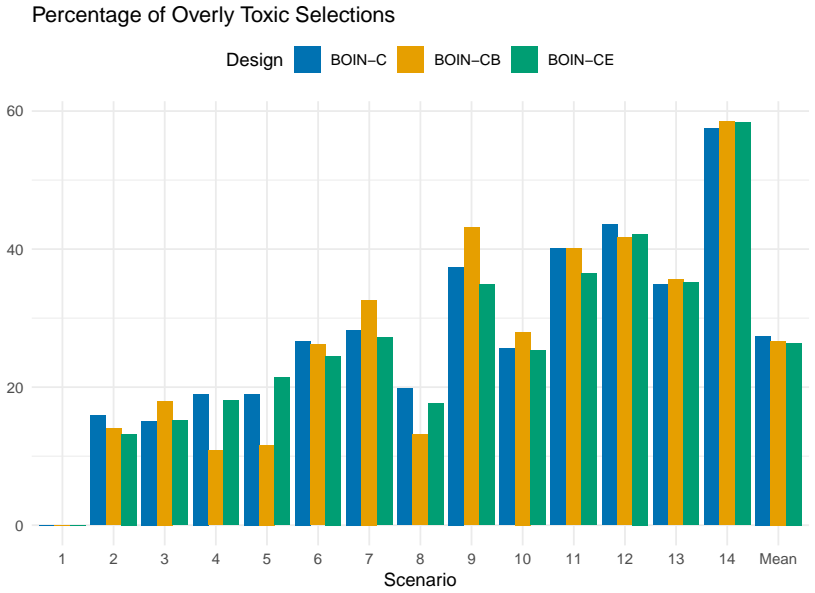
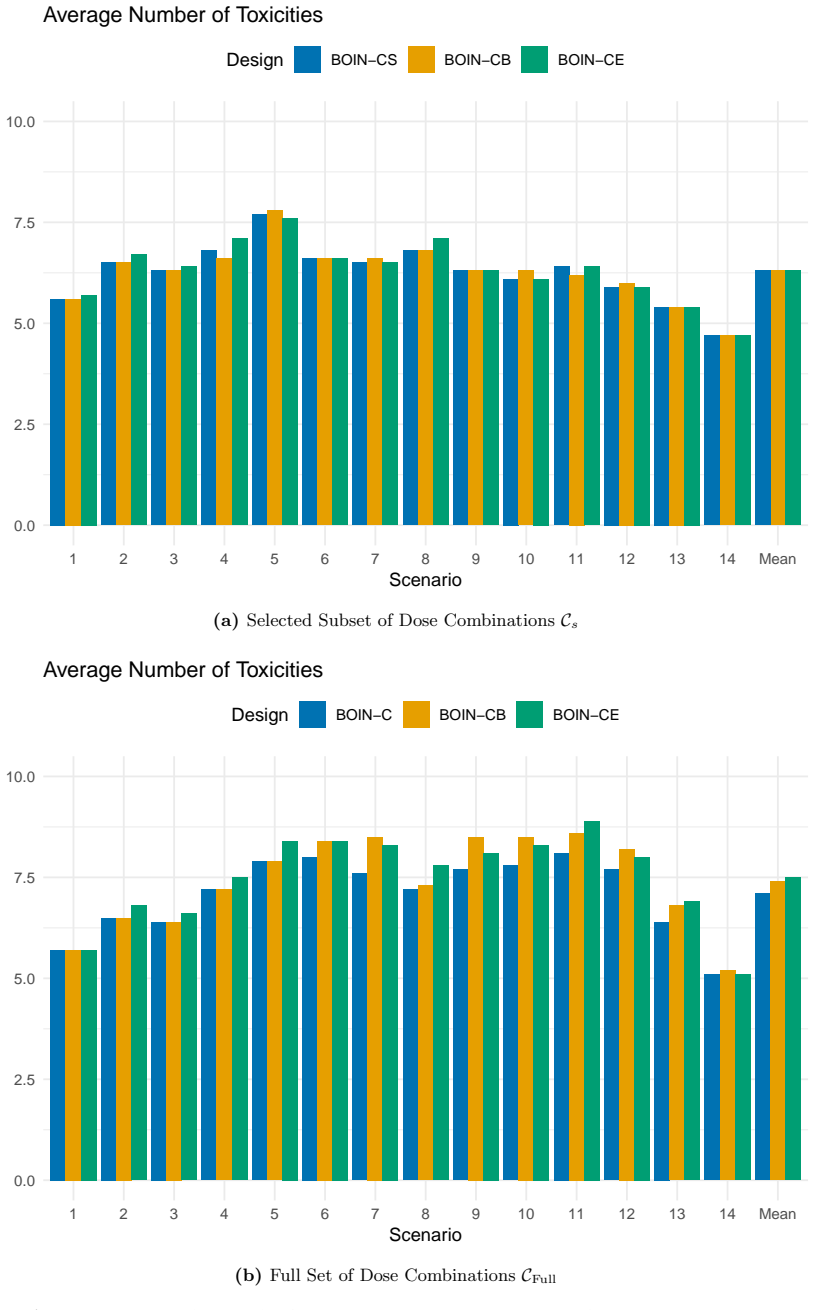
In phase I dose escalation studies for dual-agent combinations, at least one drug often has an established monotherapy dose. Consequently, substantial prior clinical safety data often exist for one or more monotherapies, allowing the study to focus on a subset of selected dose combinations rather than exhaustively evaluating all possible dose combinations for two agents. The Bayesian Optimal Interval (BOIN) design framework is widely recognized for its robust performance and ease of implementation; however, the BOIN for combination design, abbreviated as BOIN-C in this paper, was originally developed to evaluate full combinations and may not be directly applicable for the subset of selected combinations. In this paper, we propose three extensions to the BOIN-C design to address scenarios involving selected dose combinations: (a) BOIN-CS: a generalized BOIN-C design to accommodate any subset of dose combinations. (b) BOIN-CE: Exploration of new off-diagonal dose combinations when de-escalating. This option provides additional opportunities to treat patients with dose combinations that have not been administered. (c) BOIN-CB: Bayesian logistic regression model (BLRM)-guided BOIN design, which uses the BLRM model to break the tie when two dose combinations have an equal posterior probability of being selected. This can be useful when the dose-toxicity relationship is expected to be reasonably aligned with a logistic relationship. These study design options are motivated by practical considerations, and their operating characteristics are evaluated through extensive simulations under various scenarios, demonstrating satisfactory performance.
Editorial analysis
A structured set of objections, weighed in public.
Referee Report
Summary. The manuscript proposes three extensions to the existing BOIN-C design for phase I dose-escalation trials of dual-agent combinations when only a selected subset of dose combinations is under consideration due to prior monotherapy data: (a) BOIN-CS, a generalization to arbitrary subsets; (b) BOIN-CE, which explores off-diagonal combinations during de-escalation; and (c) BOIN-CB, which invokes a Bayesian logistic regression model (BLRM) solely to resolve ties in posterior selection probability. Operating characteristics are assessed exclusively via simulation under various scenarios, with the claim that all three extensions exhibit satisfactory performance.
Significance. If the simulation results are representative, the work supplies immediately usable, simple-to-implement design options that exploit existing safety data and avoid exhaustive grids, addressing a common practical constraint in oncology combination trials. The extensions preserve the interval-based decision rules that make BOIN attractive while adding targeted flexibility; the simulation evaluation, if adequately documented, supplies the primary evidence base for adoption.
major comments (2)
- [Simulation section] Simulation section: the claim of 'satisfactory performance' rests entirely on simulation results, yet the manuscript provides no enumeration of the number of scenarios, the specific toxicity probability matrices (including interaction structures), the range of target toxicity rates, or tabulated quantitative metrics (correct selection percentage, average DLT rate, average sample size, etc.). Without these details the performance claim cannot be verified and is not load-bearing.
- [BOIN-CB description] BOIN-CB description (methods section): the tie-breaking rule invokes a BLRM that assumes a logistic dose-toxicity surface; no sensitivity analysis or robustness check is reported when the true surface deviates from logistic (e.g., non-monotonic or strong agent interaction). This assumption directly affects dose selection in tie cases and therefore the reported operating characteristics.
minor comments (2)
- [Abstract] Abstract: the phrase 'demonstrating satisfactory performance' is used without reference to any specific numerical result or table; a one-sentence summary of key metrics would improve clarity.
- [Methods] Notation: the mapping from subset indices to the full combination grid is not explicitly defined in an equation or table; a small illustrative diagram or matrix would aid readers.
Simulated Author's Rebuttal
We thank the referee for the thoughtful review and constructive comments on our manuscript proposing the BOIN-CS, BOIN-CE, and BOIN-CB extensions. We address each major comment below and will revise the manuscript accordingly to strengthen the presentation of our simulation results and robustness checks.
read point-by-point responses
-
Referee: [Simulation section] Simulation section: the claim of 'satisfactory performance' rests entirely on simulation results, yet the manuscript provides no enumeration of the number of scenarios, the specific toxicity probability matrices (including interaction structures), the range of target toxicity rates, or tabulated quantitative metrics (correct selection percentage, average DLT rate, average sample size, etc.). Without these details the performance claim cannot be verified and is not load-bearing.
Authors: We agree that explicit documentation of the simulation setup and quantitative results is necessary to allow readers to verify the operating characteristics. The original manuscript describes the simulations as 'extensive' and 'under various scenarios' but does not provide the requested enumeration or tables. In the revised version we will add a dedicated subsection (or expanded appendix) that lists the total number of scenarios, the full set of toxicity probability matrices with their interaction structures, the range of target toxicity rates considered, and tabulated metrics including correct selection percentage, average DLT rate, average sample size, and other standard operating characteristics. revision: yes
-
Referee: [BOIN-CB description] BOIN-CB description (methods section): the tie-breaking rule invokes a BLRM that assumes a logistic dose-toxicity surface; no sensitivity analysis or robustness check is reported when the true surface deviates from logistic (e.g., non-monotonic or strong agent interaction). This assumption directly affects dose selection in tie cases and therefore the reported operating characteristics.
Authors: We acknowledge that BOIN-CB uses the BLRM solely for tie-breaking and that no sensitivity analysis under non-logistic surfaces was included. Although the BLRM is applied only in the infrequent tie cases and the core BOIN interval rules remain unchanged, we agree that demonstrating robustness would improve the manuscript. In the revision we will add a sensitivity analysis section that evaluates selected non-logistic scenarios (non-monotonic surfaces and strong agent interactions) and reports the resulting changes in operating characteristics when the BLRM tie-breaker is used. revision: yes
Circularity Check
No circularity detected; extensions and performance claims are independent of inputs by construction.
full rationale
The paper proposes three new decision-rule extensions (BOIN-CS for arbitrary subsets, BOIN-CE for off-diagonal exploration, BOIN-CB for BLRM tie-breaking) to the existing BOIN-C framework and evaluates them exclusively via simulation under user-specified toxicity matrices. No equation or optimality criterion in the manuscript reduces a claimed operating characteristic to a fitted parameter or self-citation that is itself defined by the target result. The logistic surface invoked for tie resolution in BOIN-CB is an explicit modeling assumption whose consequences are tested rather than presupposed; simulation results therefore constitute external evidence rather than a definitional tautology. The derivation chain is self-contained against the stated simulation benchmarks.
Axiom & Free-Parameter Ledger
free parameters (1)
- target toxicity probability
axioms (1)
- domain assumption Dose-toxicity curves are monotonically non-decreasing
Reference graph
Works this paper leans on
-
[1]
The Annals of Statistics , volume=
An algorithm for isotonic regression for two or more independent variables , author=. The Annals of Statistics , volume=. 1982 , publisher=
1982
-
[2]
Biometrics , volume=
Robust meta-analytic-predictive priors in clinical trials with historical control information , author=. Biometrics , volume=. 2014 , publisher=
2014
-
[3]
Biometrics , volume=
SAM: Self-adapting mixture prior to dynamically borrow information from historical data in clinical trials , author=. Biometrics , volume=. 2023 , publisher=
2023
-
[4]
Statistical Methods in Medical Research , volume=
A comparison of model-free phase I dose escalation designs for dual-agent combination therapies , author=. Statistical Methods in Medical Research , volume=. 2024 , publisher=
2024
-
[5]
Statistical Methods in Medical Research , volume=
BOIN-ETC: A Bayesian optimal interval design considering efficacy and toxicity to identify the optimal dose combinations , author=. Statistical Methods in Medical Research , volume=. 2024 , publisher=
2024
-
[6]
Statistical methods in medical research , volume=
Bayesian optimal interval design for dose finding in drug-combination trials , author=. Statistical methods in medical research , volume=. 2017 , publisher=
2017
-
[7]
Cancer Chemotherapy and Pharmacology , volume=
Anti-cancer drug combinations approved by US FDA from 2011 to 2021: main design features of clinical trials and role of pharmacokinetics , author=. Cancer Chemotherapy and Pharmacology , volume=. 2022 , publisher=
2011
-
[8]
Contemporary Clinical Trials , volume=
Keyboard design for phase I drug-combination trials , author=. Contemporary Clinical Trials , volume=. 2020 , publisher=
2020
-
[9]
Statistical methods in medical research , volume=
A surface-free design for phase I dual-agent combination trials , author=. Statistical methods in medical research , volume=. 2020 , publisher=
2020
-
[10]
Statistics in medicine , volume=
A product of independent beta probabilities dose escalation design for dual-agent phase I trials , author=. Statistics in medicine , volume=. 2015 , publisher=
2015
-
[11]
Statistics in medicine , volume=
A practical Bayesian design to identify the maximum tolerated dose contour for drug combination trials , author=. Statistics in medicine , volume=. 2016 , publisher=
2016
-
[12]
Biostatistics , volume=
A benchmark for dose-finding studies with unknown ordering , author=. Biostatistics , volume=. 2022 , publisher=
2022
-
[13]
Statistical methods in drug combination studies , volume=
Bayesian industry approach to phase I combination trials in oncology , author=. Statistical methods in drug combination studies , volume=. 2015 , publisher=
2015
-
[14]
Statistics in medicine , volume=
Critical aspects of the Bayesian approach to phase I cancer trials , author=. Statistics in medicine , volume=. 2008 , publisher=
2008
-
[15]
Biometrics , volume=
Dose-finding with two agents in phase I oncology trials , author=. Biometrics , volume=. 2003 , publisher=
2003
-
[16]
Biometrics , volume=
Continual reassessment method for partial ordering , author=. Biometrics , volume=. 2011 , publisher=
2011
-
[17]
Pharmaceutical statistics , volume=
A Bayesian dose-finding design for drug combination clinical trials based on the logistic model , author=. Pharmaceutical statistics , volume=. 2014 , publisher=
2014
-
[18]
Journal of the Royal Statistical Society Series C: Applied Statistics , volume=
Bayesian dose finding in oncology for drug combinations by copula regression , author=. Journal of the Royal Statistical Society Series C: Applied Statistics , volume=. 2009 , publisher=
2009
-
[19]
Biometrics , volume=
A hierarchical Bayesian design for phase I trials of novel combinations of cancer therapeutic agents , author=. Biometrics , volume=. 2010 , publisher=
2010
-
[20]
Statistics in medicine , volume=
Sequential continual reassessment method for two-dimensional dose finding , author=. Statistics in medicine , volume=. 2008 , publisher=
2008
-
[21]
Annals of Oncology , volume=
Statistical controversies in clinical research: requiem for the 3+ 3 design for phase I trials , author=. Annals of Oncology , volume=. 2015 , publisher=
2015
-
[22]
Biometrics , pages=
Continual reassessment method: a practical design for phase 1 clinical trials in cancer , author=. Biometrics , pages=. 1990 , publisher=
1990
-
[23]
Statistics in Cancer Drug Development , publisher =
Book Chapter: Oncology Dose Optimization Trials , author =. Statistics in Cancer Drug Development , publisher =. 2025 , note =
2025
-
[24]
and Pepe, M
O'Quigley, J. and Pepe, M. and Fisher, M. , title =. Biometrics , year =
-
[25]
Contemporary Clinical Trials , year =
Guo, Wentian and Wang, Sue-Jane and Yang, Shengjie and Lynn, Henry and Ji, Yuan , title =. Contemporary Clinical Trials , year =
-
[26]
and Yuan, Y
Liu, S. and Yuan, Y. , title =. Journal of the Royal Statistical Society: Series C (Applied Statistics) , year =
-
[27]
and Rogatko, A
Tighiouart, M. and Rogatko, A. , title =. Statistical Science , year =
-
[28]
Expansion Cohorts: Use in First-In-Human Clinical Trials to Expedite Development of Oncology Drugs and Biologics: Guidance for Industry , year =
-
[29]
Shen, J. and Swift, B. and Mamelok, R. and Pine, S. and Sinclair, J. and Attar, M. , title =. Clinical and Translational Science , year =. doi:10.1111/cts.12582 , pmid =
-
[30]
and Dubois, F
Riviere, M.K. and Dubois, F. and Zohar, S. , title =. Statistics in Medicine , year =
-
[31]
and Wang, K
Ivanova, A. and Wang, K. , title =. Statistics in Medicine , year =
-
[32]
Biometrics , volume=
Two-dimensional dose finding in discrete dose space , author=. Biometrics , volume=. 2005 , publisher=
2005
-
[33]
and Cui, Y
Mandrekar, S. and Cui, Y. and Sargent, D. , title =. Statistics in Medicine , year =
-
[34]
and Qin, R
Mandrekar, S. and Qin, R. and Sargent, D. , title =. Statistics in Medicine , year =
-
[35]
Journal of Biopharmaceutical Statistics , volume=
Design issues in dose-finding phase I trials for combinations of two agents , author=. Journal of Biopharmaceutical Statistics , volume=. 2009 , publisher=
2009
-
[36]
and Yuan, Y
Yin, G. and Yuan, Y. , title =. Biometrics , year =
-
[37]
and Neuenschwander, B
Bailey, S. and Neuenschwander, B. and Laird, G. and Branson, M. , title =. Journal of Biopharmaceutical Statistics , year =
-
[38]
and Conaway, M
Wages, N. and Conaway, M. and O'Quigley, J. , title =. Biometrics , year =
-
[39]
and Lebecq, A
Kramar, A. and Lebecq, A. and Candale, E. , title =. Statistics in Medicine , year =
-
[40]
and Millikan, R
Thall, P. and Millikan, R. and Mueller, P. and Lee, S.-J. , title =. Biometrics , year =
-
[41]
and Capkun-Niggli, G
Neuenschwander, B. and Capkun-Niggli, G. and Branson, M. and Spiegelhalter, D. J. , title =. Clinical Trials , year =
-
[42]
and Zhou, H
Sui, Z. and Zhou, H. and He, P. , title =
-
[43]
Ji, Yuan and Li, Yisheng and Bekele, B Nebiyou , title =. Clinical Trials , year =. doi:10.1177/1740774510382799 , publisher =
-
[44]
Ananthakrishnan, R. and Lin, R. and He, C. and Chen, Y. and Li, D. and LaValley, M. , title =. Contemporary Clinical Trials Communications , year =. doi:10.1016/j.conctc.2022.100943 , note =
discussion (0)
Sign in with ORCID, Apple, or X to comment. Anyone can read and Pith papers without signing in.