Recognition: unknown
Gamma Factory: A New Experimental Paradigm for CERN's HL-LHC--FCC-ee Transition
Pith reviewed 2026-05-08 17:10 UTC · model grok-4.3
The pith
Partially stripped ions stored in the LHC can be laser-excited to generate gamma-ray beams orders of magnitude more intense than existing sources.
A machine-rendered reading of the paper's core claim, the machinery that carries it, and where it could break.
Core claim
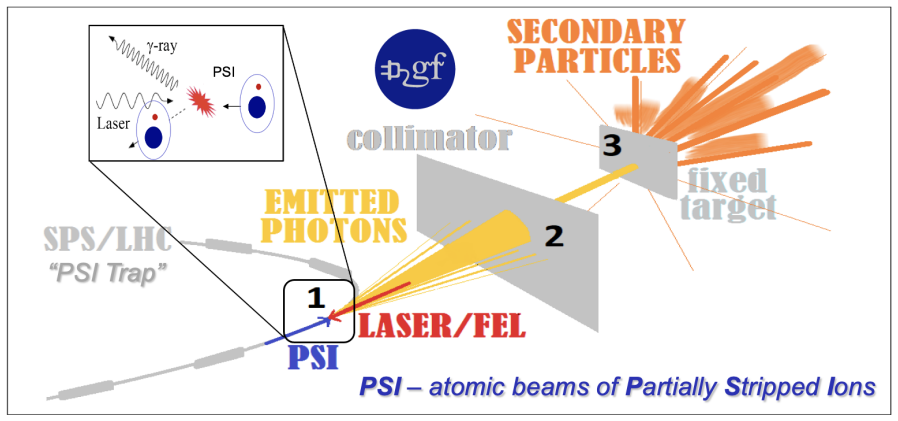
The Gamma Factory proposal establishes that interactions between laser pulses stored in Fabry-Perot cavities and circulating beams of highly relativistic partially stripped ions in the LHC produce high-energy, highly collimated, and polarized secondary photon beams whose intensities exceed those of existing gamma-ray sources by several orders of magnitude. These photon beams can further generate unprecedented-intensity tertiary beams of polarised electrons, positrons, muons, neutrons, radioactive ions, and flavour- or CP-tagged neutrinos. Under a specific configuration the same photon-driven processes may be exploited to generate the plug-power required for LHC operation. Cold relativistic原子
What carries the argument
The Gamma Factory scheme in which highly relativistic partially stripped ions stored in the LHC serve as an effective atomic trap whose internal degrees of freedom are resonantly excited by laser photons, producing intense secondary gamma rays.
If this is right
- High-intensity polarized gamma-ray beams become available for experiments.
- Tertiary beams of polarized electrons, positrons, muons, neutrons, radioactive ions, and tagged neutrinos can be produced at high luminosity.
- New research programs become possible at the intersection of particle, nuclear, atomic, fundamental, and applied physics.
- Photon-driven processes can be configured to generate the electrical power needed for LHC operation.
- The scheme supplies a cost-effective experimental path bridging the HL-LHC era and the future FCC era using current infrastructure.
Where Pith is reading between the lines
- Successful operation would allow precision measurements of nuclear structure or fundamental constants that rely on the extreme collimation and polarization of the gamma beams.
- The ion-beam cooling and laser-cavity technologies developed for the scheme could be transferred to other existing accelerators to expand their scientific reach without new construction.
- The energy-recovery configuration points to a practical route for reducing the net power consumption of future high-energy colliders.
- Demonstration of the tertiary neutrino beams would open a new avenue for studying neutrino properties using flavor-tagged or CP-tagged sources.
- keywords=[
Load-bearing premise
Partially stripped ion beams can be produced, accelerated, cooled, and stored at LHC energies with sufficient lifetime and low enough emittance for resonant laser excitation to produce the required gamma intensities.
What would settle it
Demonstration that partially stripped ions cannot be cooled and stored at LHC energies with the lifetime and emittance needed for resonant laser excitation, or that the resulting gamma-ray intensities fall short of predictions by more than one order of magnitude.
Figures



read the original abstract
The Gamma Factory (GF) proposal \cite{Krasny:2015ffb} is motivated by the recognition of a largely untapped potential of the CERN accelerator complex to enable a new research programme at the intersection of particle, nuclear, atomic, fundamental, and applied physics. The central concept is to produce, accelerate, cool, and store atomic beams of highly relativistic partially stripped ions in the LHC, which would serve as an effective atomic trap. The internal degrees of freedom of these ions are then resonantly excited using laser photons. In the GF scheme, laser-cooled atomic beams serve both as high-precision probes and as low-emittance beam sources for high-luminosity LHC operation in the ion-ion collision mode. Interactions between laser pulses stored in Fabry--Perot cavities and circulating ion beams give rise to high-energy, highly collimated, and polarised secondary photon beams. Their expected intensities exceed those of existing gamma-ray sources by several orders of magnitude. These photon beams can further be used to generate unprecedented-intensity, tertiary beams of polarised electrons, positrons, muons, neutrons, radioactive ions, and flavour- or CP-tagged neutrinos. Furthermore, under a specific configuration, the same photon-driven processes may be exploited in an energy-production scheme generating the requisite plug-power for LHC operation. Together, cold relativistic atomic beams, high-intensity photon beams, and tertiary beams constitute a versatile experimental platform capable of opening a wide range of new scientific opportunities at CERN. By exploiting existing accelerator infrastructure and available state-of-the-art laser technologies, the GF offers a path to a cost-effective and timely programme capable of sustaining experimental innovation and bridging the gap between the HL-LHC era and the future FCC era.
Editorial analysis
A structured set of objections, weighed in public.
Referee Report
Summary. The manuscript proposes the Gamma Factory (GF) as a new experimental paradigm at CERN, using accelerated, cooled, and stored beams of partially stripped relativistic ions in the LHC as an effective atomic trap. Resonant laser excitation via Fabry-Perot cavities produces high-intensity, collimated, polarized gamma-ray beams whose intensities are expected to exceed current sources by several orders of magnitude; these secondary beams can then generate tertiary beams of polarized electrons, positrons, muons, neutrons, radioactive ions, and neutrinos. The proposal emphasizes exploitation of existing HL-LHC infrastructure for a cost-effective program bridging to the FCC era, with an additional configuration for energy production, and positions the combination of cold atomic beams, photon beams, and tertiary beams as a versatile platform for particle, nuclear, atomic, fundamental, and applied physics.
Significance. If the required beam parameters prove achievable, the GF concept could deliver gamma-ray fluxes orders of magnitude above existing facilities, enabling qualitatively new experiments across multiple disciplines while maximizing return on CERN's existing accelerator complex. The interdisciplinary integration of atomic physics with high-energy beams is a notable strength of the vision, and the framing as a bridge between HL-LHC and FCC operations provides a timely context. However, the manuscript remains a high-level conceptual outline without quantitative modeling, so its ultimate significance hinges on subsequent technical validation.
major comments (2)
- [Abstract and GF scheme description] The central claim that laser-cooled partially stripped ion beams can serve as a low-emittance atomic trap for resonant excitation at LHC energies rests on the unquantified assumption that such beams can be produced, accelerated, cooled, and stored with sufficient lifetime and emittance. No beam-dynamics estimates, cooling-rate calculations, or lifetime projections appear in the manuscript to support this load-bearing premise.
- [Abstract] The statement that secondary photon-beam intensities exceed those of existing gamma-ray sources by several orders of magnitude is presented as an expected outcome without any supporting luminosity, cross-section, or cavity-enhancement calculation, nor reference to detailed prior simulations beyond the 2015 citation. This quantitative gap directly affects the asserted scientific reach.
minor comments (2)
- [Overall structure] The manuscript would benefit from a dedicated section or table summarizing the key beam parameters (energy, emittance, intensity, lifetime) required for the scheme and the technological readiness level of each.
- [GF scheme description] Notation for the Fabry-Perot cavity and laser-ion interaction geometry is introduced without a schematic or equation defining the resonance condition, which would aid clarity for readers outside the immediate collaboration.
Simulated Author's Rebuttal
We thank the referee for their careful and constructive review of our manuscript. We appreciate the emphasis on the need for quantitative support for the core assumptions of the Gamma Factory concept. This manuscript is framed as a high-level conceptual outline of the overall paradigm and its scientific opportunities, with detailed technical calculations residing in the cited prior literature. We address each major comment below and have revised the manuscript to strengthen the presentation of supporting references and key parameter summaries.
read point-by-point responses
-
Referee: [Abstract and GF scheme description] The central claim that laser-cooled partially stripped ion beams can serve as a low-emittance atomic trap for resonant excitation at LHC energies rests on the unquantified assumption that such beams can be produced, accelerated, cooled, and stored with sufficient lifetime and emittance. No beam-dynamics estimates, cooling-rate calculations, or lifetime projections appear in the manuscript to support this load-bearing premise.
Authors: We agree that the present manuscript does not reproduce the full set of beam-dynamics simulations. The production, acceleration, laser cooling, and storage of partially stripped relativistic ions, together with the associated emittance, lifetime, and cooling-rate estimates, are quantified in the foundational 2015 proposal and in subsequent dedicated technical papers on relativistic laser cooling and intra-beam scattering at LHC energies. In the revised manuscript we have added a short paragraph in the introduction that explicitly summarizes the key performance parameters (e.g., achievable emittance after laser cooling and expected beam lifetime) and directs the reader to those references for the underlying calculations. This addition makes the supporting evidence more visible while preserving the conceptual scope of the paper. revision: partial
-
Referee: [Abstract] The statement that secondary photon-beam intensities exceed those of existing gamma-ray sources by several orders of magnitude is presented as an expected outcome without any supporting luminosity, cross-section, or cavity-enhancement calculation, nor reference to detailed prior simulations beyond the 2015 citation. This quantitative gap directly affects the asserted scientific reach.
Authors: The orders-of-magnitude intensity gain is obtained from the product of the resonant atomic excitation cross-section, the circulating ion-beam luminosity, and the power-enhancement factor of the Fabry-Perot cavity. These quantities and the resulting gamma-ray flux estimates are calculated in the 2015 reference and in follow-up studies on cavity-enhanced photon production with relativistic ions. We have revised both the abstract and the main text to include a concise statement of the luminosity and cavity-enhancement values together with additional citations to the detailed simulations. The revised wording now makes clear that the intensity claim rests on those prior quantitative results rather than on new calculations presented here. revision: partial
Circularity Check
No significant circularity; conceptual proposal with no derivations
full rationale
The manuscript is a forward-looking conceptual proposal for the Gamma Factory at CERN. It contains no equations, fitted parameters, quantitative derivations, or predictive models that could reduce to inputs by construction. The central claims describe a vision for producing and using partially stripped ion beams, laser excitation, and secondary beams, all framed as contingent on successful future implementation of beam parameters. Self-citation to prior work (Krasny:2015ffb) is present but serves only as background motivation and does not bear the load of any derivation or uniqueness claim within this paper. No self-definitional steps, fitted-input predictions, or ansatz smuggling occur. The argument structure is consistent with a high-level experimental roadmap rather than a closed mathematical or empirical derivation.
Axiom & Free-Parameter Ledger
axioms (2)
- domain assumption The LHC ring can be operated with partially stripped ion beams at relativistic energies while maintaining sufficient beam lifetime and low emittance for laser interactions.
- domain assumption State-of-the-art laser and Fabry-Perot cavity technology can deliver the required photon flux and resonance conditions inside the accelerator environment.
invented entities (1)
-
Gamma Factory
no independent evidence
Reference graph
Works this paper leans on
- [1]
-
[2]
Abada, A.et al.FCC Physics Opportunities: Future Circular Collider Conceptual Design Report V olume 1.Eur. Phys. J. C79, 474, DOI: 10.1140/epjc/s10052-019-6904-3 (2019)
-
[3]
Abada, A.et al.FCC-ee: The Lepton Collider: Future Circular Collider Conceptual Design Report V olume 2.Eur. Phys. J. ST228, 261–623, DOI: 10.1140/epjst/e2019-900045-4 (2019)
-
[4]
Abada, A.et al.FCC-hh: The Hadron Collider: Future Circular Collider Conceptual Design Report V olume 3.Eur. Phys. J. ST228, 755–1107, DOI: 10.1140/epjst/e2019-900087-0 (2019)
-
[5]
Foster, B., D’Arcy, R. & Lindstrom, C. A. A hybrid, asymmetric, linear Higgs factory based on plasma- wakefield and radio-frequency acceleration.New J. Phys.25, 093037, DOI: 10.1088/1367-2630/acf395 (2023). 2303.10150
-
[6]
Monogr.2/2024, 176, DOI: 10.23731/CYRM-2024-002 (2024)
Accettura, C.et al.Interim report for the International Muon Collider Collaboration (IMCC).CERN Yellow Rep. Monogr.2/2024, 176, DOI: 10.23731/CYRM-2024-002 (2024). 2407.12450
-
[7]
Group, T. E. S. THE EUROPEAN STRATEGY FOR PARTICLE PHYSICS: 2026 UPDATE Delibera- tion Document (2026)
2026
-
[8]
Lifetime and Beam Losses Studies of Partially Strip Ions in the SPS (129Xe39+),
S. Hirlaenderet al., “Lifetime and Beam Losses Studies of Partially Strip Ions in the SPS (129Xe39+)," in Proc. IPAC 18, Vancouver, Canada, Apr.-May 2018, pp. 4070–4072. doi:10.18429/JACoW-IPAC2018- THPMF015
-
[9]
Kröger, F. M.et al.Charge state tailoring of relativistic heavy ion beams for the Gamma Factory project at CERN.X Ray Spectrom.49, 25–28, DOI: 10.1002/xrs.3039 (2019)
-
[10]
First partially stripped ions in the LHC ( 208Pb81+),
M. Schaumann, R. Alemany-Fernández, H. Bartosik, T. Bohl, R. Bruce, G. H. Hemelsoet, S. Hirlaen- der, J. Jowett, V . Kain and M. Krasny,et al.“First partially stripped ions in the LHC ( 208Pb81+),” doi:10.18429/JACoW-IPAC2019-MOPRB055
-
[11]
Gorzawski, A.et al.Collimation of partially stripped ions in the CERN Large Hadron Collider.Phys. Rev. Accel. Beams23, 101002, DOI: 10.1103/PhysRevAccelBeams.23.101002 (2020). 2007.12507
-
[12]
APL Photon.10, 070901, DOI: 10.1063/5.0268201 (2025)
Roiková, E.et al.Yb-based high-power frequency combs for high-intensity laser–particle interactions. APL Photon.10, 070901, DOI: 10.1063/5.0268201 (2025)
-
[13]
InCompact EUV & X-ray Light Sources 2024, DOI: 10.1364/euvxray.2024.etu3a.3 (2024)
Granados, E.et al.Prospects for extreme light sources at the CERN accelerator complex. InCompact EUV & X-ray Light Sources 2024, DOI: 10.1364/euvxray.2024.etu3a.3 (2024)
-
[14]
Budker, D.et al.Atomic Physics Studies at the Gamma Factory at CERN.Annalen Phys.532, 2000204, DOI: 10.1002/andp.202000204 (2020). 2003.03855
-
[15]
Jin, J.et al.Excitation and probing of low-energy nuclear states at high-energy storage rings.Phys. Rev. Res.5, 023134, DOI: 10.1103/PhysRevResearch.5.023134 (2023). 2208.05042. 19/23
-
[16]
Krasny, M. W., Petrenko, A. & Płaczek, W. High-luminosity Large Hadron Collider with laser-cooled isoscalar ion beams.Prog. Part. Nucl. Phys.114, 103792, DOI: 10.1016/j.ppnp.2020.103792 (2020). 2003.11407
-
[17]
Krasny, M. W., Petrenko, A. & Płaczek, W. The Gamma Factory path to high-luminosity LHC with isoscalar beams.PoSICHEP2020, 690, DOI: 10.22323/1.390.0690 (2021)
-
[18]
Krasny, M. W. Electron beam for LHC.Nucl. Instrum. Meth. A540, 222–234, DOI: 10.1016/j.nima. 2004.11.022 (2005). hep-ex/0405028
-
[19]
Gschwendtner, E.et al.The AWAKE Run 2 Programme and Beyond †.Symmetry14, 1680, DOI: 10.3390/sym14081680 (2022). 2206.06040
-
[20]
A.et al.Measurement and application of electron stripping of ultrarelativistic 208Pb81+
Cooke, D. A.et al.Measurement and application of electron stripping of ultrarelativistic 208Pb81+. Nucl. Instrum. Meth. A988, 164902, DOI: 10.1016/j.nima.2020.164902 (2021). 2006.16160. 21.R. Alemany Fernándezet al.[PBC], [arXiv:2505.00947 [hep-ex]]
-
[21]
Rep.15, 12562, DOI: 10.1038/s41598-025-96505-6 (2025)
Baolong, H.et al.Efficient transmutation of long-lived fission products in a Gamma Factory beam driven advanced nuclear energy system.Sci. Rep.15, 12562, DOI: 10.1038/s41598-025-96505-6 (2025). 2409.12473
-
[22]
Krasny, M. W. Gamma Factory’s high intensity particle beams and their potential impact on the future accelerator-technology- driven research (2026)
2026
-
[23]
Nichita, D., Balabanski, D. L., Constantin, P., Krasny, M. W. & Płaczek, W. Radioactive Ion Beam Production at the Gamma Factory.Annalen Phys.534, 2100207, DOI: 10.1002/andp.202100207 (2022). 2105.13058
-
[24]
Apyan, A., Krasny, M. W. & Płaczek, W. Gamma Factory high-intensity muon and positron source: Exploratory studies.Phys. Rev. Accel. Beams26, 083401, DOI: 10.1103/PhysRevAccelBeams.26.083401 (2023). 2212.06311
-
[25]
Zurbano Fernandez, I.et al.High-Luminosity Large Hadron Collider (HL-LHC): Technical design report.CERN Yellow Rep. Monogr.10/2020, DOI: 10.23731/CYRM-2020-0010 (2020)
-
[26]
Fischer, W.et al.RHIC Performance with Stochastic Cooling for Ions and Head-on Beam-beam Compensation for Protons. In7th International Particle Accelerator Conference, WEZA01, DOI: 10.18429/JACoW-IPAC2016-WEZA01 (2016)
-
[27]
Płaczek, W. & Krasny, M. W. Gamma Factory and Precision Physics at the LHC.Acta Phys. Polon. Supp.17, A28, DOI: 10.5506/aphyspolbsupp.17.5-a28 (2024)
-
[28]
Krasny, M. W., Jadach, S. & Placzek, W. The Femto-experiment for the LHC: The W-boson beams and their targets.Eur. Phys. J. C44, 333–350, DOI: 10.1140/epjc/s2005-02398-2 (2005). hep-ph/0503215
-
[29]
Krasny, M. W., Fayette, F., Placzek, W. & Siodmok, A. Z-boson as ’the standard candle’ for high precision W-boson physics at LHC.Eur. Phys. J. C51, 607–617, DOI: 10.1140/epjc/s10052-007-0321-8 (2007). hep-ph/0702251. 20/23
-
[30]
Fayette, F., Krasny, M. W., Placzek, W. & Siodmok, A. Measurement ofMW + −MW − at LHC.Eur. Phys. J. C63, 33–56, DOI: 10.1140/epjc/s10052-009-1084-1 (2009). 0812.2571
-
[31]
W., Dydak, F., Fayette, F., Placzek, W
Krasny, M. W., Dydak, F., Fayette, F., Placzek, W. & Siodmok, A.∆MW ≤10MeV/c 2 at the LHC: a forlorn hope?Eur. Phys. J. C69, 379–397, DOI: 10.1140/epjc/s10052-010-1417-0 (2010). 1004.2597
-
[32]
& Franchetti, G
Kruyt, P., Gamba, D. & Franchetti, G. Simulation studies of laser cooling for the Gamma Factory proof-of-principle experiment at the CERN SPS.JACoWIPAC2024, MOPS50, DOI: 10.18429/ JACoW-IPAC2024-MOPS50 (2024)
2024
-
[33]
Zolotorev, M. & Budker, D. Parity Nonconservation in Relativistic Hydrogenic Ions.Phys. Rev. Lett. 78, 4717–4720, DOI: 10.1103/PhysRevLett.78.4717 (1997)
-
[34]
Budker, D., Gorchtein, M., Krasny, M. W., Pálffy, A. & Surzhykov, A. Physics Opportunities with the Gamma Factory.Annalen Phys.534, 2200004, DOI: 10.1002/andp.202200004 (2022)
-
[35]
Serbo, V . G., Surzhykov, A. & V olotka, A. Resonant Scattering of Plane-Wave and Twisted Photons at the Gamma Factory.Annalen Phys.534, 2100199, DOI: 10.1002/andp.202100199 (2022). 2108.01859
-
[36]
Yerokhin, V . A., Patkóš, V . & Pachucki, K. QED calculations of energy levels of heliumlike ions with 5≤Z≤30.Phys. Rev. A106, 022815, DOI: 10.1103/PhysRevA.106.022815 (2022)
-
[37]
Richter, J., Krasny, M. W., Gilles, J. & Surzhykov, A. Resonant photon scattering in the presence of external fields and its applications for the CERN Gamma Factory project.Phys. Rev. A111, 062820, DOI: 10.1103/yysz-444v (2025). 2501.13863
-
[38]
Budker, D.et al.Expanding Nuclear Physics Horizons with the Gamma Factory.Annalen Phys.534, 2100284, DOI: 10.1002/andp.202100284 (2022). 2106.06584
-
[39]
Viatkina, A. V ., Antypas, D., Kozlov, M. G., Budker, D. & Flambaum, V . V . Dependence of atomic parity-violation effects on neutron skins and new physics.Phys. Rev. C100, 034318, DOI: 10.1103/PhysRevC.100.034318 (2019)
-
[40]
Biero´n, J., Krasny, M. W., Płaczek, W. & Pustelny, S. Optical Excitation of Ultra-Relativistic Partially Stripped Ions.Annalen Phys.534, 2100250, DOI: 10.1002/andp.202100250 (2022). 2106.00330
-
[41]
Flambaum, V . V ., Jin, J. & Budker, D. Resonance photoproduction of pionic atoms at the proposed Gamma Factory.Phys. Rev. C103, 054603, DOI: 10.1103/PhysRevC.103.054603 (2021). 2010.06912
-
[42]
Viatkina, A. V ., Mertens, C. G., Ohayon, B., Yerokhin, V . A. & Surzhykov, A. Atomic parity violation in highly charged 40,48Ca and 208Pb ions. (2026). 2602.19962
-
[43]
Wojtsekhowski, B. & Budker, D. Local Lorentz Invariance Tests for Photons and Hadrons at the Gamma Factory.Annalen Phys.534, 2100141, DOI: 10.1002/andp.202100141 (2022). 2104.03784
-
[44]
Karbstein, F. Vacuum Birefringence at the Gamma Factory.Annalen Phys.534, 2100137, DOI: 10.1002/andp.202100137 (2022). 2106.06359
-
[45]
Balkin, R., Krasny, M. W., Ma, T., Safdi, B. R. & Soreq, Y . Probing Axion-Like-Particles at the CERN Gamma Factory.Annalen Phys.534, 2100222, DOI: 10.1002/andp.202100222 (2022). 2105.15072. 21/23
-
[46]
Chakraborti, S., Feng, J. L., Koga, J. K. & Valli, M. Gamma factory searches for extremely weakly interacting particles.Phys. Rev. D104, 055023, DOI: 10.1103/PhysRevD.104.055023 (2021). 2105. 10289
-
[47]
Thirolf, P. G., Seiferle, B. & von der Wense, L. The 229-thorium isomer: doorway to the road from the atomic clock to the nuclear clock.J. Phys. B52, 203001, DOI: 10.1088/1361-6455/ab29b8 (2019)
-
[48]
Schmirander, T.et al.Concept study of a storage ring-based gravitational wave observatory: Gravitational wave strain and synchrotron radiation noise.Phys. Rev. D110, 082002, DOI: 10.1103/PhysRevD.110.082002 (2024). 2408.16374
-
[49]
Richter, J., Maiorova, A. V ., Viatkina, A. V ., Budker, D. & Surzhykov, A. Parity-violation studies with partially stripped ions.Annalen der Physik534, 2100561, DOI: 10.1002/andp.202100561 (2022)
-
[50]
Accelerator Technology and Beam Physics of Future Colliders.Front
Zimmermann, F. Accelerator Technology and Beam Physics of Future Colliders.Front. Phys.10, 888395, DOI: 10.3389/fphy.2022.888395 (2022)
-
[51]
Zimmermann, F.et al.Muon Collider Based on Gamma Factory, FCC-ee and Plasma Target.JACoW IPAC2022, 1691–1694, DOI: 10.18429/JACoW-IPAC2022-WEPOST009 (2022)
-
[52]
Beam Physics Frontier Problems.JACoWeeFACT2022, 42–51, DOI: 10.18429/ JACoW-eeFACT2022-TUY AT0101 (2023)
Zimmermann, F. Beam Physics Frontier Problems.JACoWeeFACT2022, 42–51, DOI: 10.18429/ JACoW-eeFACT2022-TUY AT0101 (2023)
2023
-
[53]
Dutheil, Y .et al.Gamma Factory for CERN initiative - progress report.PoSEPS-HEP2019, 020, DOI: 10.22323/1.364.0020 (2020)
-
[54]
Ramjiawan, Rebecca Louise and Bartosik, Hannes and Dutheil, Yann and Hofle, Wolfgang and Krasny, Mieczyslaw Witold and Martens, Aurelien and Papaphilippou, Yannis and Petrenko, Alexey and Velotti, Francesco Maria SPS MD5044: machine stability characterisation of Gamma Factory SPS Proof-of-Principle Experiment,https://cds.cern.ch/record/2807037
-
[55]
Martens, A.et al.Design of the optical system for the gamma factory proof of principle ex- periment at the CERN Super Proton Synchrotron.Phys. Rev. Accel. Beams25, 101601, DOI: 10.1103/PhysRevAccelBeams.25.101601 (2022)
-
[56]
Y .et al.Stable 500 kW average power of infrared light in a finesse 35 000 enhancement cavity
Lu, X. Y .et al.Stable 500 kW average power of infrared light in a finesse 35 000 enhancement cavity. Appl. Phys. Lett.124, 251105, DOI: 10.1063/5.0213842 (2024)
-
[57]
Y .et al.710 kW stable average power in a 45,000 finesse two-mirror optical cavity.Opt
Lu, X. Y .et al.710 kW stable average power in a 45,000 finesse two-mirror optical cavity.Opt. Lett. 49, 6884–6887, DOI: 10.1364/OL.543388 (2024)
-
[58]
Płaczek, W.et al.Gamma Factory at CERN – Novel Research Tools Made of Light.Acta Phys. Polon. B50, 1191–1203, DOI: 10.5506/APhysPolB.50.1191 (2019). 1903.09032
-
[59]
& Serafini, L
Curatolo, C., Krasny, M., Placzek, W. & Serafini, L. New Simulation Programs for Partially Stripped Ions - Laser Light Collisions. In9th International Particle Accelerator Conference, DOI: 10.18429/ JACoW-IPAC2018-THPMF076 (2018)
2018
-
[60]
Krasny, M. W., Petrenko, A. & Płaczek, W. BE-ABP Gamma Factory Software Workshop (2021). https://indico.cern.ch/event/1076086/. 22/23
-
[61]
W.et al.Gamma Factory Proof-of-Principle experiment
Krasny, M. W.et al.Gamma Factory Proof-of-Principle experiment. Letter-of-Intent (LoI), CERN- SPSC-2019-031, SPSC-I-253,2019. 63.Hayakawa, T.et al.Proposal for selective isotope transmutation of long-lived fission products using quasi-monochromatic γ-ray beams.J. Nucl. Sci. Technol.53, 2064–2071, DOI: 10.1080/00223131.2016. 1194776 (2016)
-
[62]
Future HERA Physics Workshop
Krasny, M. W. Everything you’ve Always Wanted To Know About Nuclei At HERA But You Were Afraid To Ask, Plenary rapporteur talk at the "Future HERA Physics Workshop", Hamburg (1996)
1996
-
[63]
DESY/GSI/NUPECC workshop
Willeke, F. HERA as an electron-nucleus collider. Plenary talk at the joined "DESY/GSI/NUPECC workshop", Seeheim, Germany, March 1997
1997
-
[64]
DESY/GSI/NUPECC workshop
Krasny, M. W. The Future Experimental Programme For HERA. Plenary talk at the joined "DESY/GSI/NUPECC workshop", Seeheim, Germany, March 1997
1997
-
[65]
Krasny, M. W. Electron nucleus collisions at HERA: Selected topics.Nucl. Phys. A622, 95C–109C, DOI: 10.1016/S0375-9474(97)00335-7 (1997)
-
[66]
HERA Workshop on eA Physics
Krasny, M. W. Electron-Nucleus Scattering At HERA. Plenary talk opening the "HERA Workshop on eA Physics", Hamburg, May 1999
1999
-
[67]
Krasny, M. W. Particle and nuclear physics with high-energy leptons.Nucl. Phys. A663, 56–63, DOI: 10.1016/S0375-9474(99)00572-2 (2000). hep-ph/9907410
-
[68]
Second eRHIC workshop on eA and polarized ep Collider Physics
Krasny, M. W. Physics Of eA collisions AT eRHIC. Plenary talk at the "Second eRHIC workshop on eA and polarized ep Collider Physics", Yale (New Heaven), April 2000
2000
-
[69]
Snowmass workshop on the future of High Energy Physics
Krasny, M. W. Physics with lepton–ion colliders Invited talk presented at the “Snowmass workshop on the future of High Energy Physics”, Snowmass, Colorado, July 2001
2001
-
[70]
Snowmass workshop on the future of High Energy Physics
Krasny, M. W. Detector Design Issues of lepton-ion colliders. Invited talk presented at the “Snowmass workshop on the future of High Energy Physics”, Snowmass, Colorado, July 2001
2001
-
[71]
Krasny, M. W. Electron-nucleus Collisions Future Experimental Program And New Challenges For QCD. In34th Rencontres de Moriond: QCD and Hadronic interactions, 257–262 (The Gioi, Hanoi, 2001)
2001
-
[72]
Deshpande, R
Editors: A. Deshpande, R. M. & Venugopalan, R. A whitepaper on The Electron Ion Collider, A high luminosity probe of the partonic substructure of nucleons and nuclei, BNL-Report-No.68933-02/07 Rev, February 2002
2002
-
[73]
Krasny, M. W. Selected design issues of a dedicated facility for generic QCD studies.Nucl. Phys. B Proc. Suppl.105, 185–189, DOI: 10.1016/S0920-5632(01)01978-8 (2002). hep-ex/0110043. 23/23
discussion (0)
Sign in with ORCID, Apple, or X to comment. Anyone can read and Pith papers without signing in.