QUIVER: Cost-Aware Adaptive Preference Querying in Surrogate-Assisted Evolutionary Multi-Objective Optimization
Pith reviewed 2026-06-30 23:48 UTC · model grok-4.3
The pith
QUIVER adaptively allocates budget between objective evaluations and heterogeneous preference queries to minimize final utility regret in multi-objective optimization.
A machine-rendered reading of the paper's core claim, the machinery that carries it, and where it could break.
Core claim
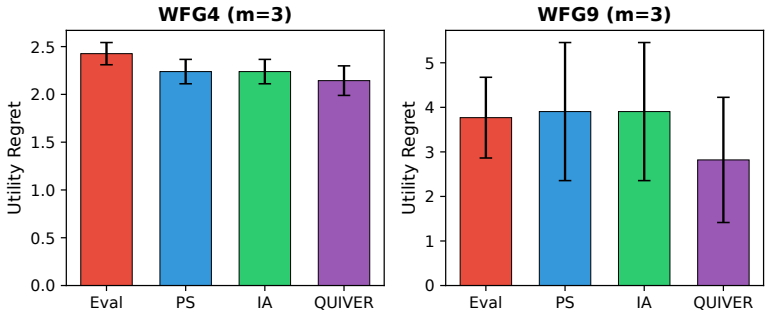
QUIVER selects the next action by maximizing the expected decision-quality improvement per unit total cost, achieving utility regrets of 2.14 on WFG4 and 2.82 on WFG9, a 25% improvement over baselines, while adapting the proportion of pairwise preference and indifference adjustment queries based on problem difficulty.
What carries the argument
The action selection rule that computes expected regret reduction per unit cost for each possible next query or evaluation, using a surrogate model to estimate the effect on the decision quality.
If this is right
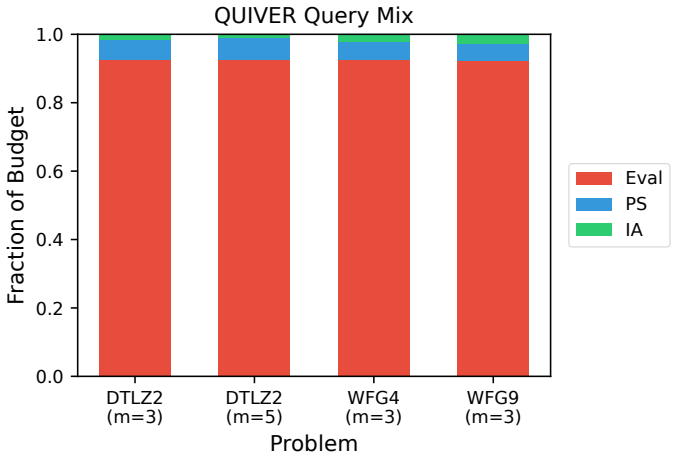
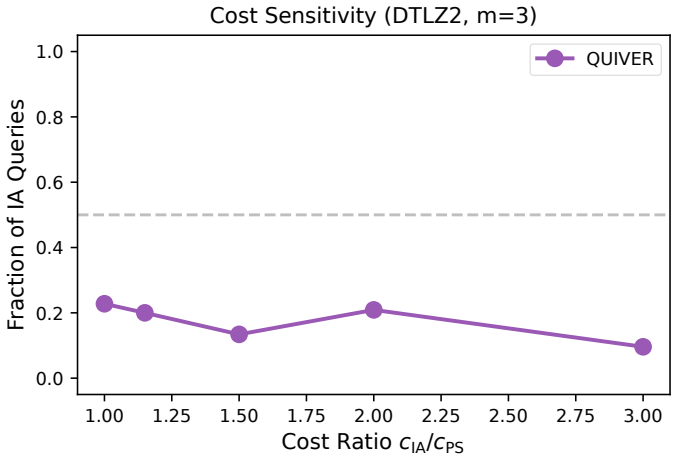
- The proportion of indifference adjustment queries increases with problem difficulty, reaching 65% on the hardest WFG9 instance.
- Single-modality approaches are suboptimal because they cannot adjust to the varying value of different query types.
- The total budget is better allocated when both information content and cognitive cost are considered in the selection.
- Surrogate models enable this by predicting the impact of each possible action without actually performing it.
Where Pith is reading between the lines
- Real-world deployment would require validating the synthetic DM models against actual human responses to see if the cost structures match.
- This approach could extend to other interactive optimization settings where queries have heterogeneous costs.
- Future systems should model the expected value of information from each query type explicitly rather than fixing one modality.
Load-bearing premise
The synthetic decision-maker models used in the experiments accurately capture the information content, noise, and cost structure of real human preference statements and indifference adjustments.
What would settle it
Running the optimizer with actual human decision makers providing preferences and measuring if the adaptive selection still reduces regret compared to fixed strategies.
Figures
read the original abstract
Interactive multi-objective optimization systems face a budget allocation dilemma: one can spend resources on expensive objective evaluations or on eliciting decision-maker preferences that identify the relevant region of the Pareto set. Moreover, preference elicitation itself spans modalities with different information content and cognitive burden, ranging from cheap, noisy pairwise preference statements (PS) to richer but costlier indifference adjustments (IA). We study cost-aware optimization under an unknown scalarization and introduce QUIVER (Query-Informed Value Estimation for Regret), a surrogate-assisted evolutionary multi-objective optimizer that adaptively chooses between objective evaluations and heterogeneous preference queries. At each step, QUIVER selects the next action by maximizing the expected decision-quality improvement per unit total cost. Across DTLZ and WFG benchmarks under synthetic decision-maker models, QUIVER achieves the lowest final utility regret on challenging WFG problems (utility regret of 2.14 on WFG4, 2.82 on WFG9: a 25% improvement over baselines), outperforming all single-modality baselines. We analyze how the optimal mix of PS and IA adapts to problem difficulty: on easy problems (DTLZ2), QUIVER selects 80\% PS queries; on hard problems (WFG9), it shifts to 35% IA queries. This adaptive modality selection demonstrates cost-aware preference learning in action.
Editorial analysis
A structured set of objections, weighed in public.
Referee Report
Summary. The paper introduces QUIVER, a surrogate-assisted evolutionary multi-objective optimizer that adaptively allocates budget between objective evaluations and heterogeneous preference queries (pairwise statements PS and indifference adjustments IA) by selecting the action that maximizes expected decision-quality improvement per unit total cost. Under synthetic decision-maker models on DTLZ and WFG benchmarks, QUIVER reports the lowest final utility regret on challenging WFG instances (2.14 on WFG4, 2.82 on WFG9, a 25% improvement over single-modality baselines) and shows an adaptive shift in query mix (80% PS on easy problems to 35% IA on hard problems).
Significance. If the synthetic models prove representative, the work supplies a practical, cost-aware mechanism for balancing expensive evaluations against preference elicitation in interactive MO optimization. The explicit per-cost expected-improvement selection rule and the observed modality adaptation constitute concrete algorithmic contributions. The provision of specific numerical regret values on standard benchmarks is a positive feature for assessing the magnitude of the claimed gains.
major comments (1)
- [Abstract / experimental evaluation] Abstract / experimental evaluation: the headline utility-regret reductions (2.14 on WFG4, 2.82 on WFG9, 25% better than baselines) and the reported shift from 80% PS to 35% IA queries are obtained exclusively under synthetic decision-maker models. No validation is supplied that these models reproduce the information content, noise structure, or per-query cognitive costs of real human statements; if the models are misspecified, both the regret improvements and the adaptive-mix observations become simulation artifacts rather than robust properties of the algorithm.
minor comments (2)
- [Abstract] The abstract states concrete regret numbers but supplies no mention of the number of independent runs, error bars, or statistical tests used to support the 25% improvement claim.
- A brief discussion of the limitations of the chosen synthetic DM models and of the conditions under which the observed modality adaptation would be expected to transfer to real users would strengthen the manuscript.
Simulated Author's Rebuttal
We thank the referee for the constructive comment on the scope of our experimental validation. We address the concern below and outline targeted revisions to the manuscript.
read point-by-point responses
-
Referee: [Abstract / experimental evaluation] Abstract / experimental evaluation: the headline utility-regret reductions (2.14 on WFG4, 2.82 on WFG9, 25% better than baselines) and the reported shift from 80% PS to 35% IA queries are obtained exclusively under synthetic decision-maker models. No validation is supplied that these models reproduce the information content, noise structure, or per-query cognitive costs of real human statements; if the models are misspecified, both the regret improvements and the adaptive-mix observations become simulation artifacts rather than robust properties of the algorithm.
Authors: We agree that all reported numerical results and the observed adaptive query mix (80% PS to 35% IA) are obtained exclusively under the synthetic decision-maker models described in the paper. These models follow standard practice in the interactive MO literature to enable controlled, reproducible isolation of the cost-aware selection rule and its effect on regret. We do not claim or provide evidence that the models exactly reproduce human information content, noise, or cognitive costs. In the revised manuscript we will (i) add an explicit limitations paragraph in the discussion section stating that the reported gains and modality adaptations are conditional on the synthetic models, (ii) qualify the abstract and experimental claims to read “under synthetic decision-maker models,” and (iii) include a short future-work paragraph on the value of human-subject studies. These changes will prevent over-interpretation while preserving the algorithmic contribution of the per-cost expected-improvement selection mechanism. revision: partial
Circularity Check
No significant circularity in derivation or results
full rationale
The paper defines QUIVER via an explicit selection rule of maximizing expected decision-quality improvement per unit total cost, then evaluates the resulting algorithm on standard DTLZ/WFG benchmarks under separately specified synthetic DM models for PS and IA queries. No quoted equations, parameter fits, or self-citations reduce the reported utility regret values, modality mix, or performance claims to the inputs by construction; the regret metric is computed from the known true utility in the simulation and is not used to fit the selection rule itself. The synthetic models constitute an evaluation assumption rather than a self-definitional loop, leaving the derivation self-contained against external benchmarks.
Axiom & Free-Parameter Ledger
Reference graph
Works this paper leans on
-
[1]
Scalable test problems for evolutionary multiobjective optimization
Bradley, R. A., and Terry, M. E. (1952) Rank analysis of incomplete block designs: I. the method of paired comparisons. Biometrika, 39(3/4), pp. 324–345. A vailable at: https://doi.org/10.2307/2334029. Branke, J., Greco, S., Slowinski, R., and Zielniewicz, P. (2015) Learning value functions in interactive evolutionary multiobjective optimization. IEEE Tra...
-
[2]
Operations Research, 66(1), pp
Learning to optimize via information-directed sampling. Operations Research, 66(1), pp. 230–252. A vailable at: https://doi.org/10. 1287/opre.2017.1663. Settles, B. (2009) Active Learning Literature Survey . University of Wisconsin-Madison. Zhang, Q., Liu, W., Tsang, E., and Virginas, B. (2010) Expensive multiobjective optimiza- tion by MOEA/D with Gaussi...
discussion (0)
Sign in with ORCID, Apple, or X to comment. Anyone can read and Pith papers without signing in.