Recognition: 2 theorem links
· Lean TheoremA Mean Curvature Approach to Boundary Detection: Geometric Insights for Unsupervised Learning
Pith reviewed 2026-05-12 02:47 UTC · model grok-4.3
The pith
Mean curvature from local nearest-neighbor patches identifies boundary points in data manifolds.
A machine-rendered reading of the paper's core claim, the machinery that carries it, and where it could break.
Core claim
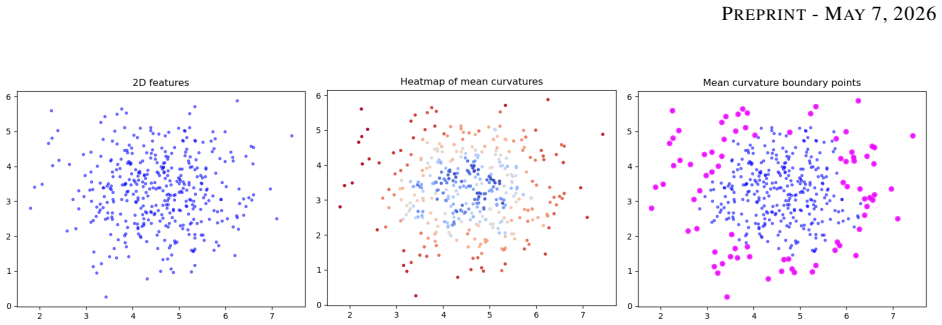
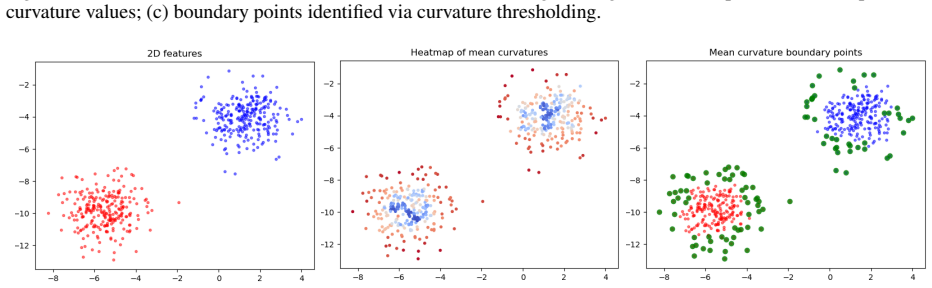
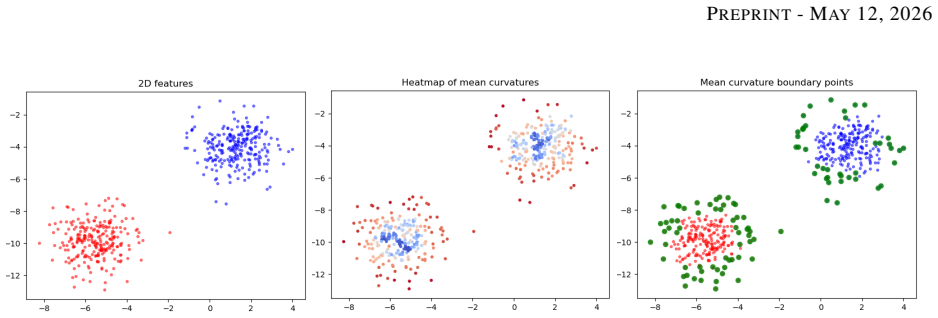
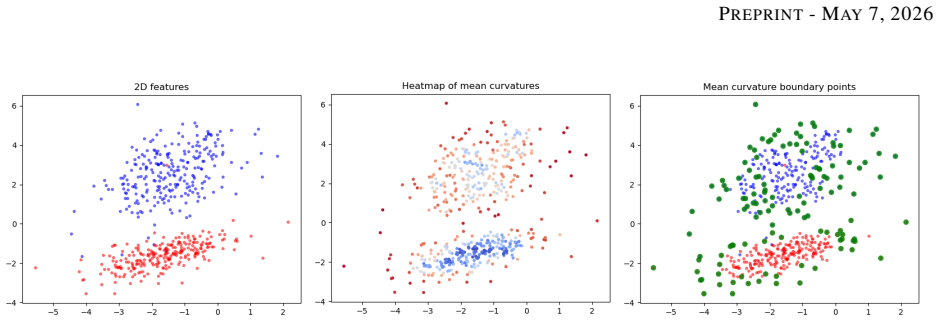
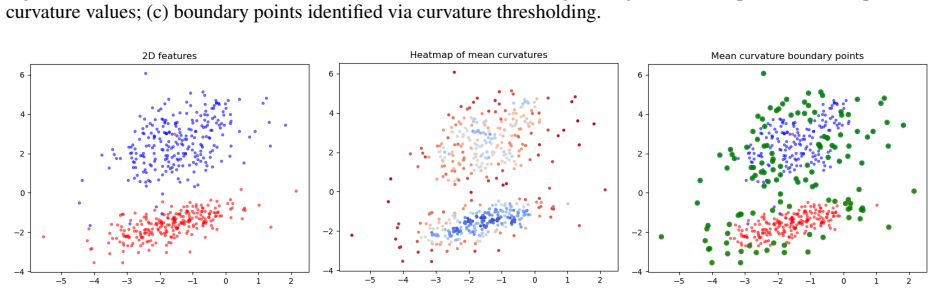
MCBP uses a discrete approximation of the shape operator estimated from local k-nearest neighbor patches to compute pointwise mean curvature, which acts as a descriptor where high values mark transitions between clusters, geometric irregularities, and low-density interfaces, enabling multiscale boundary extraction via percentile thresholding and a curvature-driven decomposition that separates data into smooth and boundary subsets to enhance downstream unsupervised tasks.
What carries the argument
Discrete approximation of the shape operator from k-nearest neighbor patches for computing pointwise mean curvature on the data manifold.
If this is right
- High-curvature regions correspond to cluster transitions, irregularities, and low-density interfaces.
- Percentile-based thresholding enables multiscale boundary extraction independent of density parameters.
- Curvature-driven decomposition separates samples into smooth low-curvature and boundary high-curvature subsets.
- This separation acts as a non-linear geometric filter that improves cluster separability and algorithm robustness.
Where Pith is reading between the lines
- The same local curvature calculation might apply to anomaly detection or dimensionality reduction beyond the clustering focus.
- Extending the approach to other curvature measures such as Gaussian curvature could capture additional manifold features.
- Direct comparison against exact curvature on low-dimensional synthetic manifolds would test the reliability of the discrete estimator.
Load-bearing premise
The k-nearest neighbor based discrete approximation of the shape operator accurately reflects the true mean curvature of the underlying data manifold.
What would settle it
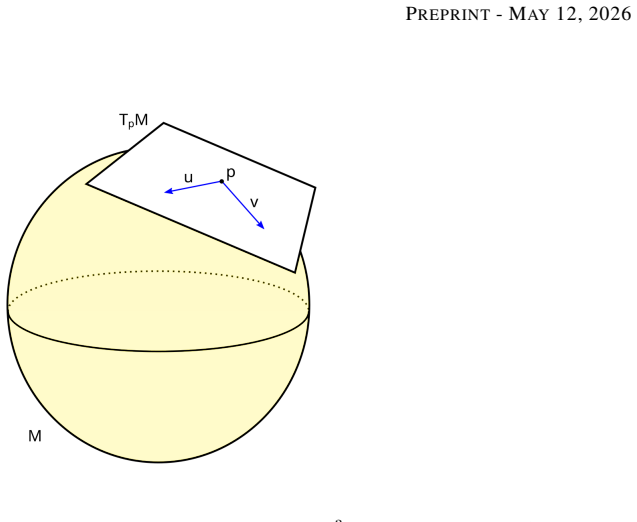
If applying MCBP to points sampled from a sphere or other known manifold shows high-curvature points failing to align with expected boundaries or yields no measurable gain in clustering accuracy after decomposition.
Figures





read the original abstract
Accurate boundary detection in high-dimensional data remains a central challenge in unsupervised learning, particularly in the presence of non-linear structures and heterogeneous densities. In this work, we introduce Mean Curvature Boundary Points (MCBP), a novel geometric framework grounded in Geometric Machine Learning that departs from traditional density-based approaches by explicitly modeling the intrinsic curvature of the data manifold. The method relies on a discrete approximation of the shape operator, estimated from local k-nearest neighbor patches, to compute pointwise mean curvature without requiring explicit manifold parametrization. The key insight of MCBP is to use mean curvature as a principled descriptor of boundary structure: high-curvature regions naturally correspond to transitions between clusters, geometric irregularities, and low-density interfaces. This yields a unified geometric interpretation of boundary, outlier, and transition points. We further introduce an adaptive percentile-based thresholding scheme that enables multiscale boundary extraction without relying on ad hoc density parameters. Beyond detection, we propose a curvature-driven data decomposition that separates samples into smooth (low-curvature) and boundary (high-curvature) subsets, effectively acting as a non-linear geometric filtering mechanism. This representation enhances cluster separability and improves the robustness of downstream unsupervised algorithms. Extensive experiments on synthetic and real-world datasets demonstrate that MCBP consistently improves clustering performance, particularly in complex and high-dimensional scenarios. These results position MCBP as a concrete contribution to Geometric Machine Learning, highlighting the potential of curvature-aware analysis as a unifying paradigm bridging differential geometry and data-driven modeling.
Editorial analysis
A structured set of objections, weighed in public.
Referee Report
Summary. The manuscript introduces Mean Curvature Boundary Points (MCBP), a geometric framework for boundary detection in high-dimensional unsupervised learning. It approximates the shape operator from local k-nearest-neighbor patches to compute pointwise mean curvature without explicit parametrization, uses this as a descriptor for transitions and low-density interfaces, applies adaptive percentile thresholding for multiscale extraction, and proposes curvature-driven decomposition to separate smooth and boundary subsets, claiming improved clustering on synthetic and real datasets.
Significance. If the discrete curvature estimator is accurate, MCBP could supply a principled geometric alternative to density-based boundary methods, offering a unified view of outliers, transitions, and manifold boundaries that enhances downstream unsupervised tasks. The adaptive thresholding and decomposition are practical contributions, but the absence of error analysis or convergence results limits the immediate theoretical impact within Geometric Machine Learning.
major comments (2)
- [§3] §3 (discrete shape-operator approximation): the central claim that high mean curvature reliably identifies manifold boundaries rests on the kNN-patch estimator recovering the intrinsic second fundamental form. No derivation, stability analysis, or error bounds are supplied for non-uniform sampling or high codimension; the approximation implicitly assumes locally uniform density and stable tangent-space recovery, both of which are load-bearing for the geometric interpretation.
- [§4] §4 (experiments and validation): the reported clustering improvements are presented without ablation on the curvature estimator itself (e.g., comparison against ground-truth curvature on synthetic manifolds with known geometry) or sensitivity analysis to the free parameters k and percentile threshold. This leaves open whether performance gains derive from the geometric primitive or from the thresholding heuristic alone.
minor comments (2)
- [Abstract] The abstract and introduction use the phrase 'parameter-free' for the adaptive thresholding; clarify whether the percentile threshold is treated as a hyper-parameter or derived from data statistics.
- [§3] Notation for the discrete mean-curvature estimator (e.g., symbols for the local patch covariance or projection) should be defined once and used consistently across equations.
Simulated Author's Rebuttal
We thank the referee for the detailed and constructive review. The comments highlight important areas for strengthening the geometric foundations and experimental rigor of MCBP. We address each major comment below and outline the revisions we will incorporate.
read point-by-point responses
-
Referee: [§3] §3 (discrete shape-operator approximation): the central claim that high mean curvature reliably identifies manifold boundaries rests on the kNN-patch estimator recovering the intrinsic second fundamental form. No derivation, stability analysis, or error bounds are supplied for non-uniform sampling or high codimension; the approximation implicitly assumes locally uniform density and stable tangent-space recovery, both of which are load-bearing for the geometric interpretation.
Authors: We agree that the current presentation of the discrete shape-operator approximation is primarily descriptive and lacks a full derivation or error analysis. In the revised manuscript we will add a new subsection that derives the estimator step-by-step: local PCA for tangent-space recovery, followed by a finite-difference approximation of the second fundamental form from the kNN patch, leading to the mean-curvature scalar. We will explicitly list the local-uniform-density and stable-tangent-space assumptions and provide a brief perturbation analysis showing first-order stability under small density variations. A complete convergence theorem for arbitrary non-uniform sampling in high codimension is beyond the scope of the present work and will be stated as a limitation; however, we will include additional synthetic experiments that quantify estimator error on manifolds with known geometry and controlled density gradients. revision: partial
-
Referee: [§4] §4 (experiments and validation): the reported clustering improvements are presented without ablation on the curvature estimator itself (e.g., comparison against ground-truth curvature on synthetic manifolds with known geometry) or sensitivity analysis to the free parameters k and percentile threshold. This leaves open whether performance gains derive from the geometric primitive or from the thresholding heuristic alone.
Authors: We accept this criticism. The revised version will contain two new experimental sections. First, we will evaluate the curvature estimator directly against analytically computed ground-truth mean curvature on synthetic manifolds (unit sphere, torus, and cylinder) with both uniform and non-uniform sampling, reporting pointwise error statistics. Second, we will present sensitivity plots for the parameters k and the percentile threshold, showing how boundary detection quality and downstream clustering metrics (ARI, NMI) vary across reasonable ranges of these values on both synthetic and real datasets. These additions will clarify the contribution of the curvature primitive versus the adaptive thresholding step. revision: yes
- A full theoretical convergence analysis and rigorous error bounds for the kNN-based discrete curvature estimator under arbitrary non-uniform sampling and high codimension.
Circularity Check
No significant circularity in derivation chain
full rationale
The paper defines MCBP via a discrete kNN-based approximation to the shape operator for computing pointwise mean curvature on the data manifold, then applies an adaptive percentile threshold to label high-curvature points as boundaries. This chain is a forward geometric procedure: the curvature estimator is a numerical primitive independent of the downstream boundary label, and the thresholding operates on the computed values without refitting or re-using the same quantities as both input and output. No equations reduce a claimed prediction to a fitted parameter by construction, no self-citations carry load-bearing uniqueness theorems, and no ansatz is smuggled via prior work. The central geometric claim (high curvature marks manifold transitions) is an interpretive modeling choice, not a self-referential identity.
Axiom & Free-Parameter Ledger
free parameters (2)
- k (nearest neighbors)
- percentile threshold
axioms (1)
- domain assumption High-dimensional data can be treated as samples from a manifold on which mean curvature is intrinsically defined and discretely approximable via local patches.
Lean theorems connected to this paper
-
IndisputableMonolith/Foundation/AlexanderDuality.leanalexander_duality_circle_linking unclear?
unclearRelation between the paper passage and the cited Recognition theorem.
mean curvature H(p) = 1/d ∑ κ_i(p) … δX H d(M) = −∫ H(p) ⟨X(p),n(p)⟩ dH^d(p)
What do these tags mean?
- matches
- The paper's claim is directly supported by a theorem in the formal canon.
- supports
- The theorem supports part of the paper's argument, but the paper may add assumptions or extra steps.
- extends
- The paper goes beyond the formal theorem; the theorem is a base layer rather than the whole result.
- uses
- The paper appears to rely on the theorem as machinery.
- contradicts
- The paper's claim conflicts with a theorem or certificate in the canon.
- unclear
- Pith found a possible connection, but the passage is too broad, indirect, or ambiguous to say the theorem truly supports the claim.
Reference graph
Works this paper leans on
-
[1]
A density-based algorithm for discovering clusters in large spatial databases with noise
27 PREPRINT- MAY12, 2026 Martin Ester, Hans-Peter Kriegel, Jörg Sander, and Xiaowei Xu. A density-based algorithm for discovering clusters in large spatial databases with noise. InProceedings of the Second International Conference on Knowledge Discovery and Data Mining (KDD), pages 226–231, 1996a. Markus M Breunig, Hans-Peter Kriegel, Raymond T Ng, and Jö...
work page 2026
-
[2]
doi: https://doi.org/10.1002/aaai. 12210. Mathilde Papillon, Sophia Sanborn, Johan Mathe, Louisa Cornelis, Abby Bertics, Domas Buracas, Hansen J. Lillemark, Christian Shewmake, Fatih Dinc, Xavier Pennec, and Nina Miolane. Beyond Euclid: An illustrated guide to modern machine learning with geometric, topological, and algebraic structures.Machine Learning: ...
-
[3]
Bao-Zhi Qiu, Feng Yue, and Jun-Yi Shen
doi: 10.1088/2632-2153/adf375. Bao-Zhi Qiu, Feng Yue, and Jun-Yi Shen. Brim: An efficient boundary points detecting algorithm. In Zhi-Hua Zhou, Hang Li, and Qiang Yang, editors,Advances in Knowledge Discovery and Data Mining, pages 761–768, Berlin, Heidelberg,
-
[4]
Breunig, Hans-Peter Kriegel, Raymond T
Markus M. Breunig, Hans-Peter Kriegel, Raymond T. Ng, and Jörg Sander. Lof: identifying density-based local outliers. InProceedings of the 2000 ACM SIGMOD International Conference on Management of Data, SIGMOD ’00, page 93–104, New York, NY , USA, 2000b. Association for Computing Machinery. Qingsong Tang, Mingzhi Yang, Ziyi Wang, Wenhao Dong, and Yang Liu...
work page 2000
-
[5]
The Mathematical Association of America, New York, 2 edition,
28 PREPRINT- MAY12, 2026 John Oprea.Differential Geometry and its Applications. The Mathematical Association of America, New York, 2 edition,
work page 2026
-
[6]
doi: 10.1007/s10618-014-0356-z
ISSN 1384-5810. doi: 10.1007/s10618-014-0356-z. Joseph F. Hair-Jr., William C. Black, Barry J. Babin, and Rolph E. Anderson.Mulivariate Data Analysis. Cengage, New York, 8 edition,
-
[7]
doi: 10.1214/19-EJS1551. URL https://doi.org/10.1214/19-EJS1551. Christopher R. Genovese, Marco Perone-Pacifico, Isabella Verdinelli, and Larry Wasserman. Manifold estimation and singular deconvolution under Hausdorff loss.The Annals of Statistics, 40(2):941 – 963,
-
[8]
URLhttps://doi.org/10.1214/12-AOS994
doi: 10.1214/ 12-AOS994. URLhttps://doi.org/10.1214/12-AOS994. A. Singer and H.-T. Wu. Vector diffusion maps and the connection laplacian.Communications on Pure and Applied Mathematics, 65(8):1067–1144,
-
[9]
Eddie Aamari and Clément Levrard
doi: https://doi.org/10.1002/cpa.21395. Eddie Aamari and Clément Levrard. Nonasymptotic rates for manifold, tangent space and curvature estimation. The Annals of Statistics, 47(1):177 – 204,
-
[10]
URL https://doi.org/10.1214/ 18-AOS1685
doi: 10.1214/18-AOS1685. URL https://doi.org/10.1214/ 18-AOS1685. Yariv Aizenbud and Barak Sober. Non-parametric estimation of manifolds from noisy data.arXiv preprint arXiv:2105.04754,
-
[11]
doi: 10.1007/978-1-4612-0711-5
ISBN 978-0-387-94618-4. doi: 10.1007/978-1-4612-0711-5. Fan R. K. Chung.Spectral Graph Theory, volume 92 ofCBMS Regional Conference Series in Mathematics. American Mathematical Society, Providence, RI,
-
[12]
URLhttp://www.jstor.org/stable/2313748
ISSN 00029890, 19300972. URLhttp://www.jstor.org/stable/2313748. Ulrike von Luxburg. A tutorial on spectral clustering.Statistics and Computing, 17(4):395–416,
-
[13]
29 PREPRINT- MAY12, 2026 Amit Singer
URL https://proceedings.neurips.cc/paper_files/paper/2006/file/ 5848ad959570f87753a60ce8be1567f3-Paper.pdf. 29 PREPRINT- MAY12, 2026 Amit Singer. From graph to manifold Laplacian: the convergence rate.Applied and Computational Harmonic Analysis, 21(1):128–134,
work page 2006
discussion (0)
Sign in with ORCID, Apple, or X to comment. Anyone can read and Pith papers without signing in.