Learning-based Statistical Refinement for Denoising
Pith reviewed 2026-05-08 17:21 UTC · model grok-4.3
The pith
A Bayesian formulation of an auxiliary signal refines any denoiser's output to better match the noise statistics present in the input data.
A machine-rendered reading of the paper's core claim, the machinery that carries it, and where it could break.
Core claim
The central claim is that a Bayesian formulation of an auxiliary signal embedded in the noisy observations can evaluate the statistical consistency of a given denoising result with the noise properties of the input. Under the assumption that noise is conditionally pixel-wise independent given the clean signal, this evaluation enables a learning-based refinement step that improves consistency and denoising quality without requiring precise knowledge of the noise distribution, clean images, or calibration data.
What carries the argument
The Bayesian formulation of an auxiliary signal in the noisy data, which quantifies consistency between the denoising output and input noise statistics to drive the refinement.
If this is right
- The refined output will show residuals whose statistical properties align more closely with the noise in the original input.
- Existing denoisers can be applied in a plug-and-play fashion followed by this step to gain performance in unknown-noise regimes.
- Statistical consistency is improved without needing clean reference images or explicit noise models.
- Denoising quality rises by correcting deviations that stem from imperfect modeling or unreliable assumptions.
Where Pith is reading between the lines
- The same auxiliary-signal consistency check could be inserted as a post-processing module after any learned denoiser in a production pipeline.
- The technique might transfer to related inverse problems such as deblurring or inpainting when noise statistics are uncertain.
- Iterated application of the refinement step could further tighten the match between output and input noise properties.
- In domains like medical or scientific imaging, the method offers a way to reduce artifacts that arise from mismatched noise assumptions.
Load-bearing premise
The noise is conditionally pixel-wise independent given the clean signal.
What would settle it
On real noisy data with a known noise distribution, compare the empirical distribution or moments of the residual (noisy input minus output) before and after refinement; the claim is falsified if the refined residual shows no closer match to the known noise statistics.
Figures


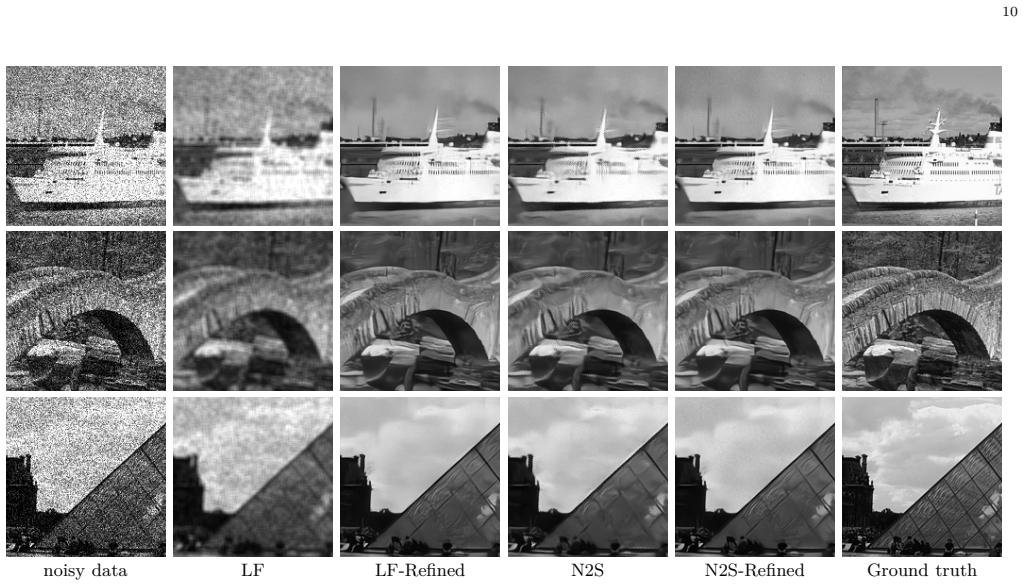


read the original abstract
This work proposes a learning-based statistical refinement method for improving the denoising results of a given denoiser without knowing the precise noise distribution or accessing clean images or calibration data. While there are many existing successful denoising approaches for handling different kinds of noise, they typically require accurate modelling of the images and the noise (implicitly or explicitly), and hence the denoising results can be suboptimal due to different practical factors such as imperfect models, unreliable noise assumptions, or low quality data. In particular, when clean image samples are not available and there is a lack of knowledge of the underlying noise distribution, which is the case in various practical situations, the results may not well align with the noise statistics. The unawareness of the useful statistical information leads to suboptimal results. This work aims to make the best use of the statistical information to improve the consistency between the given denoising results and the noise statistics, under the assumption that the noise is conditionally pixel-wise independent given the clean signal. A method, based on a Bayesian formulation of an auxiliary signal in the noisy data, is proposed for evaluating the consistency of the denoising results, without precise information on noise distribution. By leveraging the statistical information from noisy data, the method enhances the statistical noise consistency and improves denoising quality.
Editorial analysis
A structured set of objections, weighed in public.
Referee Report
Summary. The paper proposes a learning-based statistical refinement method for improving the output of a given denoiser. It introduces a Bayesian formulation of an auxiliary signal derived from the noisy observations alone to evaluate and enforce consistency between the denoised result and the underlying noise statistics, without requiring knowledge of the precise noise distribution, clean images, or calibration data. The approach operates under the assumption that noise is conditionally pixel-wise independent given the clean signal and claims to enhance both statistical consistency and overall denoising quality by leveraging data-driven statistical information.
Significance. If the central construction holds and the refinement demonstrably improves results without introducing circular bias, the work could provide a practical post-processing tool for real-world denoising scenarios where noise models are imperfect or unavailable. The data-driven Bayesian auxiliary signal idea is a potentially useful way to extract consistency checks from noisy inputs alone.
major comments (2)
- Abstract: The central claim that the Bayesian auxiliary signal enables an independent consistency evaluation rests on the learning-based refinement fitting to statistical information extracted from the noisy data itself. This raises a load-bearing risk of circularity, where any reported improvement may partly reflect re-fitting to the same observations rather than genuine refinement of the denoiser output.
- Abstract: The method is derived under the explicit assumption that the noise is conditionally pixel-wise independent given the clean signal, which permits per-pixel statistical separation. No sensitivity analysis, robustness checks, or alternative modeling is provided for cases with spatial correlations (common in sensors, compression, or demosaicing), which would invalidate the marginal statistics of the auxiliary signal and could cause the refinement step to increase rather than decrease residual error.
minor comments (1)
- Abstract: The description of the proposed method is high-level and lacks any outline of the learning model architecture, training procedure, or loss function, which hinders assessment of reproducibility and implementation details.
Simulated Author's Rebuttal
We thank the referee for the constructive comments on our manuscript. We address each major comment below and indicate the revisions we will make to improve clarity and address the concerns raised.
read point-by-point responses
-
Referee: Abstract: The central claim that the Bayesian auxiliary signal enables an independent consistency evaluation rests on the learning-based refinement fitting to statistical information extracted from the noisy data itself. This raises a load-bearing risk of circularity, where any reported improvement may partly reflect re-fitting to the same observations rather than genuine refinement of the denoiser output.
Authors: We appreciate the referee highlighting this important consideration. The Bayesian auxiliary signal is derived exclusively from the noisy observations via a formulation that isolates marginal statistics under the stated independence assumption, without reference to the denoiser output. The subsequent learning-based refinement uses this signal as a fixed consistency target to adjust the given denoiser result, rather than re-optimizing or fitting the original denoiser to the input data. This separation ensures the process functions as post-processing rather than circular re-use of the same observations for model training. We will revise the abstract and add a clarifying paragraph in the method section to explicitly articulate this distinction and reduce the risk of misinterpretation. revision: yes
-
Referee: Abstract: The method is derived under the explicit assumption that the noise is conditionally pixel-wise independent given the clean signal, which permits per-pixel statistical separation. No sensitivity analysis, robustness checks, or alternative modeling is provided for cases with spatial correlations (common in sensors, compression, or demosaicing), which would invalidate the marginal statistics of the auxiliary signal and could cause the refinement step to increase rather than decrease residual error.
Authors: We agree that the derivation relies on the conditional pixel-wise independence assumption, which enables the per-pixel separation in the auxiliary signal. We acknowledge that spatial correlations, as arise in real sensor data, compression artifacts, or demosaicing, would violate the marginal statistics and could degrade performance. The manuscript focuses on the core method under this assumption and does not include sensitivity analysis or alternative modeling for correlated cases. In the revised version we will add a limitations subsection discussing the assumption, its practical implications, and directions for extension (e.g., patch-based or covariance-aware variants). revision: yes
Circularity Check
No significant circularity detected
full rationale
The derivation relies on a Bayesian formulation of an auxiliary signal extracted from noisy observations under the explicit conditional pixel-wise independence assumption. This produces a consistency metric and refinement step that operates directly on observed marginal statistics without reducing to a re-fit of the target denoising output or to any self-citation chain. No equations or sections in the provided material exhibit self-definitional closure, fitted parameters renamed as predictions, or imported uniqueness results. The method therefore remains self-contained: the improvement claim is an independent consequence of the auxiliary-signal construction rather than a tautology.
Axiom & Free-Parameter Ledger
free parameters (1)
- parameters of the learning-based refinement model
axioms (1)
- domain assumption The noise is conditionally pixel-wise independent given the clean signal.
invented entities (1)
-
auxiliary signal in the noisy data
no independent evidence
Reference graph
Works this paper leans on
-
[1]
Gökhan H Bakır, Jason Weston, and Bernhard Schölkopf. Learning to find pre-images. Advances in neural information processing systems, 16(449-456):1, 2004
work page 2004
-
[2]
Noise2self: Blind denoising by self-supervision
Joshua Batson and Loic Royer. Noise2self: Blind denoising by self-supervision. In International Conference on Machine Learning, pages 524–533, 2019
work page 2019
-
[3]
Handbook of image and video processing
Alan C Bovik. Handbook of image and video processing. Academic press, 2010
work page 2010
-
[4]
Kristian Bredies, Karl Kunisch, and Thomas Pock. Total generalized variation. SIAM Journal on Imaging Sciences, 3(3):492–526, 2010
work page 2010
-
[5]
A non- local algorithm for image denoising
Antoni Buades, Bartomeu Coll, and Jean-Michel Morel. A non- local algorithm for image denoising. In 2005 IEEE Computer Society Conference on Computer Vision and Pattern Recogni- tion, volume 2, pages 60–65. IEEE, 2005
work page 2005
-
[6]
Salt- and-pepper noise removal by median-type noise detectors and detail-preserving regularization
Raymond H Chan, Chung-Wa Ho, and Mila Nikolova. Salt- and-pepper noise removal by median-type noise detectors and detail-preserving regularization. IEEE Transactions on image processing, 14(10):1479–1485, 2005
work page 2005
-
[7]
Yunjin Chen and Thomas Pock. Trainable nonlinear reaction diffusion: A flexible framework for fast and effective image restoration. IEEE transactions on pattern analysis and machine intelligence, 39(6):1256–1272, 2016
work page 2016
-
[8]
Adaptive bayesian wavelet shrinkage
Hugh A Chipman, Eric D Kolaczyk, and Robert E McCulloch. Adaptive bayesian wavelet shrinkage. Journal of the American Statistical Association, 92(440):1413–1421, 1997
work page 1997
-
[9]
Translation-invariant de-noising
Ronald R Coifman and David L Donoho. Translation-invariant de-noising. In Wavelets and statistics, pages 125–150. Springer, 1995
work page 1995
-
[10]
Image denoising by sparse 3-d transform- domain collaborative filtering
Kostadin Dabov, Alessandro Foi, Vladimir Katkovnik, and Karen Egiazarian. Image denoising by sparse 3-d transform- domain collaborative filtering. IEEE Transactions on image processing, 16(8):2080–2095, 2007
work page 2080
-
[11]
Adapting to unknown smoothness via wavelet shrinkage
David L Donoho and Iain M Johnstone. Adapting to unknown smoothness via wavelet shrinkage. Journal of the american statistical association, 90(432):1200–1224, 1995
work page 1995
-
[12]
Statistical nearest neighbors for image denoising
Iuri Frosio and Jan Kautz. Statistical nearest neighbors for image denoising. IEEE Transactions on Image Processing, 28(2):723–738, 2018
work page 2018
-
[13]
Image restoration by denoising diffusion models with iteratively preconditioned guidance
Tomer Garber and Tom Tirer. Image restoration by denoising diffusion models with iteratively preconditioned guidance. In Proceedings of the IEEE/CVF conference on computer vision and pattern recognition, pages 25245–25254, 2024
work page 2024
-
[14]
Rafael C. Gonzalez and Richard E. Woods. Digital image processing. Prentice Hall, Upper Saddle River, N.J., 2008
work page 2008
-
[15]
Neighbor2neighbor: a self-supervised framework for deep image denoising
Tao Huang, Songjiang Li, Xu Jia, Huchuan Lu, and Jianzhuang Liu. Neighbor2neighbor: a self-supervised framework for deep image denoising. IEEE Transactions on Image Processing, 31:4023–4038, 2022
work page 2022
-
[16]
Denoising criterion for variational auto-encoding frame- work
Daniel Im Im, Sungjin Ahn, Roland Memisevic, and Yoshua Bengio. Denoising criterion for variational auto-encoding frame- work. In Proceedings of the AAAI conference on artificial intelligence, volume 31, 2017
work page 2017
-
[17]
Observation-driven method based on iir wiener filter for microseismic data denoising
Naveed Iqbal, Azzedine Zerguine, SanLinn Kaka, and Abdullatif Al-Shuhail. Observation-driven method based on iir wiener filter for microseismic data denoising. Pure and Applied Geophysics, 175(6):2057–2075, 2018
work page 2057
-
[18]
Denoising diffusion restoration models
Bahjat Kawar, Michael Elad, Stefano Ermon, and Jiaming Song. Denoising diffusion restoration models. Advances in Neural Information Processing Systems, 35:23593–23606, 2022
work page 2022
-
[19]
Deep variation prior: Joint image denoising and noise variance estimation without clean data
Rihuan Ke. Deep variation prior: Joint image denoising and noise variance estimation without clean data. IEEE Transac- tions on Image Processing, 33:2908–2923, 2024
work page 2024
-
[20]
Unsupervised image restoration using partially linear denoisers
Rihuan Ke and Carola-Bibiane Schönlieb. Unsupervised image restoration using partially linear denoisers. IEEE Transactions on Pattern Analysis and Machine Intelligence, 44(9):5796–5812, 2021
work page 2021
-
[21]
Opti- mal whitening and decorrelation
Agnan Kessy, Alex Lewin, and Korbinian Strimmer. Opti- mal whitening and decorrelation. The American Statistician, 72(4):309–314, 2018
work page 2018
-
[22]
Adam: A Method for Stochastic Optimization
Diederik P Kingma and Jimmy Ba. Adam: A method for stochastic optimization. arXiv preprint arXiv:1412.6980, 2014
work page internal anchor Pith review arXiv 2014
-
[23]
Noise2void-learning denoising from single noisy images
Alexander Krull, Tim-Oliver Buchholz, and Florian Jug. Noise2void-learning denoising from single noisy images. In 14 Proceedings of the IEEE Conference on Computer Vision and Pattern Recognition, pages 2129–2137, 2019
work page 2019
-
[24]
Noise learning-based denoising autoencoder
Woong-Hee Lee, Mustafa Ozger, Ursula Challita, and Ki Won Sung. Noise learning-based denoising autoencoder. IEEE Communications Letters, 25(9):2983–2987, 2021
work page 2021
-
[25]
Noise2noise: Learning image restoration without clean data
Jaakko Lehtinen, Jacob Munkberg, Jon Hasselgren, Samuli Laine, Tero Karras, Miika Aittala, and Timo Aila. Noise2noise: Learning image restoration without clean data. In International Conference on Machine Learning, pages 2965–2974, 2018
work page 2018
-
[26]
A fast blind zero-shot denoiser
Jason Lequyer, Reuben Philip, Amit Sharma, Wen-Hsin Hsu, and Laurence Pelletier. A fast blind zero-shot denoiser. Nature Machine Intelligence, 4(11):953–963, 2022
work page 2022
-
[27]
Image de- noising in mixed poisson–gaussian noise
Florian Luisier, Thierry Blu, and Michael Unser. Image de- noising in mixed poisson–gaussian noise. IEEE Transactions on image processing, 20(3):696–708, 2010
work page 2010
-
[28]
David Martin, Charless Fowlkes, Doron Tal, and Jitendra Malik. A database of human segmented natural images and its appli- cation to evaluating segmentation algorithms and measuring ecological statistics. In Proceedings Eighth IEEE International Conference on Computer Vision. ICCV 2001, volume 2, pages 416–423. IEEE, 2001
work page 2001
-
[29]
Unsupervised learning with stein’s un- biased risk estimator
Christopher A Metzler, Ali Mousavi, Reinhard Heckel, and Richard G Baraniuk. Unsupervised learning with stein’s un- biased risk estimator. arXiv preprint arXiv:1805.10531, 2018
-
[30]
Adaptive principal components and image denoising
D Darian Muresan and Thomas W Parks. Adaptive principal components and image denoising. In Proceedings 2003 interna- tional conference on image processing (Cat. No. 03CH37429), volume 1, pages I–101. IEEE, 2003
work page 2003
-
[31]
Abdullah Othman, Naveed Iqbal, Sherif M Hanafy, and Umair Bin Waheed. Automated event detection and denoising method for passive seismic data using residual deep convolu- tional neural networks. IEEE Transactions on Geoscience and Remote Sensing, 60:1–11, 2021
work page 2021
-
[32]
Fast samplers for inverse problems in iterative refinement models
Kushagra Pandey, Ruihan Yang, and Stephan Mandt. Fast samplers for inverse problems in iterative refinement models. Advances in Neural Information Processing Systems, 37:26872– 26914, 2024
work page 2024
-
[33]
Estimation of gaussian, poissonian–gaussian, and processed visual noise and its level function
Meisam Rakhshanfar and Maria A Amer. Estimation of gaussian, poissonian–gaussian, and processed visual noise and its level function. IEEE Transactions on Image Processing, 25(9):4172–4185, 2016
work page 2016
-
[34]
U-net: Convolutional networks for biomedical image segmentation
Olaf Ronneberger, Philipp Fischer, and Thomas Brox. U-net: Convolutional networks for biomedical image segmentation. In Medical image computing and computer-assisted intervention– MICCAI 2015: 18th international conference, Munich, Ger- many, October 5-9, 2015, proceedings, part III 18, pages 234–
work page 2015
-
[35]
Nonlinear total variation based noise removal algorithms
Leonid I Rudin, Stanley Osher, and Emad Fatemi. Nonlinear total variation based noise removal algorithms. Physica D: nonlinear phenomena, 60(1-4):259–268, 1992
work page 1992
-
[36]
Image super-resolution via iterative refinement
Chitwan Saharia, Jonathan Ho, William Chan, Tim Salimans, David J Fleet, and Mohammad Norouzi. Image super-resolution via iterative refinement. IEEE transactions on pattern analysis and machine intelligence, 45(4):4713–4726, 2022
work page 2022
-
[37]
Training deep learn- ing based denoisers without ground truth data
Shakarim Soltanayev and Se Young Chun. Training deep learn- ing based denoisers without ground truth data. In Advances in Neural Information Processing Systems, pages 3257–3267, 2018
work page 2018
-
[38]
An iterative mean filter for image denoising
Dang Ngoc Hoang Thanh, Serdar Engínoğlu, et al. An iterative mean filter for image denoising. IEEE Access, 7:167847–167859, 2019
work page 2019
-
[39]
Dmitry Ulyanov, Andrea Vedaldi, and Victor Lempitsky. Deep image prior. In Proceedings of the IEEE Conference on Computer Vision and Pattern Recognition, pages 9446–9454, 2018
work page 2018
-
[40]
Extracting and composing robust features with denoising autoencoders
Pascal Vincent, Hugo Larochelle, Yoshua Bengio, and Pierre- Antoine Manzagol. Extracting and composing robust features with denoising autoencoders. In Proceedings of the 25th international conference on Machine learning, pages 1096–1103, 2008
work page 2008
-
[41]
Image quality assessment: from error visibility to structural similarity
Zhou Wang, Alan C Bovik, Hamid R Sheikh, and Eero P Simoncelli. Image quality assessment: from error visibility to structural similarity. IEEE transactions on image processing, 13(4):600–612, 2004
work page 2004
-
[42]
Deblurring via stochastic refinement
Jay Whang, Mauricio Delbracio, Hossein Talebi, Chitwan Sa- haria, Alexandros G Dimakis, and Peyman Milanfar. Deblurring via stochastic refinement. In Proceedings of the IEEE/CVF conference on computer vision and pattern recognition, pages 16293–16303, 2022
work page 2022
-
[43]
Yue Wu, Brian Tracey, Premkumar Natarajan, and Joseph P Noonan. Probabilistic non-local means. IEEE Signal Processing Letters, 20(8):763–766, 2013
work page 2013
-
[44]
Dreamclean: Restoring clean image using deep diffusion prior
Jie Xiao, Ruili Feng, Han Zhang, Zhiheng Liu, Zhantao Yang, Yurui Zhu, Xueyang Fu, Kai Zhu, Yu Liu, and Zheng-Jun Zha. Dreamclean: Restoring clean image using deep diffusion prior. In The Twelfth International Conference on Learning Representations, 2024
work page 2024
-
[45]
Diversified image inpainting with transformers and denoising iterative refinement
Shuzhen Xu, Wenlong Xiang, Cuicui Lv, Shuo Wang, and Guanhua Liu. Diversified image inpainting with transformers and denoising iterative refinement. IEEE Access, 2024
work page 2024
-
[46]
Manifold modeling in embedded space: An inter- pretable alternative to deep image prior
Tatsuya Yokota, Hidekata Hontani, Qibin Zhao, and Andrzej Cichocki. Manifold modeling in embedded space: An inter- pretable alternative to deep image prior. IEEE Transactions on Neural Networks and Learning Systems, 33(3):1022–1036, 2022
work page 2022
-
[47]
Low-rankness guided group sparse repre- sentation for image restoration
Zhiyuan Zha, Bihan Wen, Xin Yuan, Jiantao Zhou, Ce Zhu, and Alex Chichung Kot. Low-rankness guided group sparse repre- sentation for image restoration. IEEE Transactions on Neural Networks and Learning Systems, 34(10):7593–7607, 2023
work page 2023
-
[48]
Practical blind image denoising via swin-conv-unet and data synthesis
Kai Zhang, Yawei Li, Jingyun Liang, Jiezhang Cao, Yulun Zhang, Hao Tang, Deng-Ping Fan, Radu Timofte, and Luc Van Gool. Practical blind image denoising via swin-conv-unet and data synthesis. Machine Intelligence Research, 20(6):822–836, 2023
work page 2023
-
[49]
Beyond a gaussian denoiser: Residual learning of deep cnn for image denoising
Kai Zhang, Wangmeng Zuo, Yunjin Chen, Deyu Meng, and Lei Zhang. Beyond a gaussian denoiser: Residual learning of deep cnn for image denoising. IEEE Transactions on Image Processing, 26(7):3142–3155, 2017
work page 2017
-
[50]
Two-stage image denoising by principal component analysis with local pixel grouping
Lei Zhang, Weisheng Dong, David Zhang, and Guangming Shi. Two-stage image denoising by principal component analysis with local pixel grouping. Pattern recognition, 43(4):1531–1549, 2010
work page 2010
-
[51]
Residual dense network for image restoration
Yulun Zhang, Yapeng Tian, Yu Kong, Bineng Zhong, and Yun Fu. Residual dense network for image restoration. IEEE Transactions on Pattern Analysis and Machine Intelligence, 2020
work page 2020
discussion (0)
Sign in with ORCID, Apple, or X to comment. Anyone can read and Pith papers without signing in.