Recognition: unknown
Delay-induced chimera transitions via mode selection in a multiplex FitzHugh Nagumo network
Pith reviewed 2026-05-08 16:54 UTC · model grok-4.3
The pith
Inter-layer delay in a two-layer FitzHugh-Nagumo network selects spatial modes to drive transitions from incoherence to chimera-like states and then to coherent traveling waves.
A machine-rendered reading of the paper's core claim, the machinery that carries it, and where it could break.
Core claim
The central claim is that deterministic inter-layer delay alone functions as a control parameter for spatial coherence. Systematic simulations show a clear progression with increasing delay: fragmented incoherence evolves into chimera-like partial coherence and finally into a coherent traveling-wave state, documented by spatial snapshots, space-time plots, and mean phase velocity profiles. Linear stability analysis of spatial Fourier modes around the incoherent state demonstrates that the delay term inserts a mode-dependent exponential factor into the characteristic equation; this factor produces non-monotonic stability shifts that selectively destabilize a subset of modes at intermediate延迟,
What carries the argument
The mode-dependent exponential factor that the delay inserts into the characteristic equation of each spatial Fourier mode, which produces non-monotonic stability changes and thereby selects which patterns persist.
If this is right
- At intermediate delays, selective destabilization of a subset of modes produces the coexistence of coherent and incoherent domains that defines chimera-like states.
- At larger delays, suppression of the remaining incoherent modes restores global coherence in the form of a traveling wave.
- The same delay value that creates partial coherence at one set of parameters can be increased to eliminate incoherence entirely.
- Inter-layer delay supplies a simple, parameter-efficient mechanism for steering pattern formation in multiplex excitable networks.
Where Pith is reading between the lines
- The same mode-selection logic may operate in other multiplex systems where only the timing offset between layers is varied, suggesting a general route to chimera states without altering connection topology.
- In biological settings such as layered neural tissue, natural propagation delays between layers could spontaneously generate chimera-like activity patterns.
- Electronic or optogenetic realizations of the network could be used to test whether the predicted delay thresholds match observed transitions in real excitable media.
- The mechanism offers a way to connect delay-induced pattern control to questions of synchronization in larger networks that contain both local and long-range connections.
Load-bearing premise
Linear stability analysis of Fourier modes around the incoherent state accurately predicts the nonlinear chimera and traveling-wave states seen in direct simulations.
What would settle it
If numerical simulations with increasing inter-layer delay fail to exhibit the reported sequence of incoherence to chimera-like states to traveling waves, or if the delay values at which transitions occur deviate substantially from the stability thresholds predicted by the characteristic equation, the mode-selection mechanism would be falsified.
Figures

read the original abstract
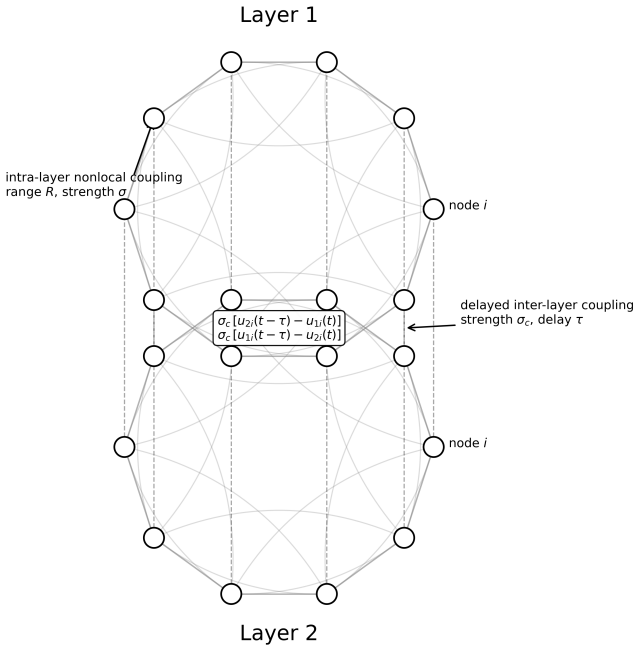
We investigate delay-induced collective dynamics in a two-layer multiplex FitzHugh Nagumo network with nonlocal intra layer coupling and delayed inter layer interactions. While delay effects are often treated as secondary, we show that deterministic inter-layer delay alone can act as a control mechanism for spatial coherence. Through systematic numerical simulations, we observe a clear transition as the delay parameter increases: fragmented incoherence evolves into chimera-like partial coherence, and eventually into a coherent traveling-wave state. This transition is consistently captured by spatial snapshots, space-time plots, and mean phase velocity profiles. To explain this behavior, we analyze the stability of spatial Fourier modes and show that the delay term introduces a mode-dependent exponential factor in the characteristic equation. This term induces non-monotonic changes in modal stability, effectively acting as a mode-selection mechanism: intermediate delays selectively destabilize a subset of modes, producing chimera-like coexistence, while larger delays suppress incoherent modes and restore global coherence. Our results demonstrate that inter-layer delay provides a simple and robust mechanism for controlling pattern formation in multiplex excitable networks, offering new insight into delay driven synchronization phenomena.
Editorial analysis
A structured set of objections, weighed in public.
Referee Report
Summary. The paper investigates delay-induced collective dynamics in a two-layer multiplex FitzHugh-Nagumo network with nonlocal intra-layer coupling and delayed inter-layer interactions. It reports transitions from fragmented incoherence to chimera-like partial coherence and then to coherent traveling-wave states as the inter-layer delay increases. These are observed in numerical simulations via spatial snapshots, space-time plots, and mean phase velocity profiles. The transitions are attributed to linear stability analysis of spatial Fourier modes, where the delay term introduces a mode-dependent exponential factor in the characteristic equation that induces non-monotonic changes in modal stability, acting as a mode-selection mechanism for chimera states at intermediate delays.
Significance. If the mode-selection interpretation holds, the work demonstrates that inter-layer delay alone can serve as a simple control parameter for pattern formation and coherence transitions in multiplex excitable networks. This offers insight into delay-driven synchronization with potential relevance to biological systems. Strengths include the systematic numerical exploration of delay effects combined with Fourier-mode stability analysis; these elements provide a clear mechanistic proposal that could be tested further.
major comments (1)
- [Stability analysis of spatial Fourier modes and associated numerical results] The central claim that the delay-induced mode-dependent factor in the characteristic equation (arising from the stability analysis of spatial Fourier modes) selectively destabilizes modes to produce the observed chimera-like coexistence requires explicit verification. No comparison is shown between the wave-numbers predicted to lose stability at intermediate delays and the actual spatial Fourier spectrum of the simulated chimera states. Without this, it remains possible that the nonlinear evolution produces structures (e.g., modulated waves) whose spectrum does not match the linearly unstable band, weakening the causal account of mode selection.
minor comments (3)
- [Abstract and simulation descriptions] The abstract and main text would benefit from explicit statements of the key parameter values (e.g., coupling strengths, network size, delay range) used in the simulations, along with any quantitative measures of transition points.
- [Figures and results presentation] Space-time plots and mean phase velocity profiles should include clear axis labels, color scales, and any averaging details to improve reproducibility and readability.
- [Model and analysis sections] Notation for the delay parameter and wave-number should be checked for consistency between the model equations, characteristic equation, and figure captions.
Simulated Author's Rebuttal
We thank the referee for the positive assessment of our work and the constructive major comment. We address the point regarding verification of the mode-selection mechanism below.
read point-by-point responses
-
Referee: The central claim that the delay-induced mode-dependent factor in the characteristic equation (arising from the stability analysis of spatial Fourier modes) selectively destabilizes modes to produce the observed chimera-like coexistence requires explicit verification. No comparison is shown between the wave-numbers predicted to lose stability at intermediate delays and the actual spatial Fourier spectrum of the simulated chimera states. Without this, it remains possible that the nonlinear evolution produces structures (e.g., modulated waves) whose spectrum does not match the linearly unstable band, weakening the causal account of mode selection.
Authors: We agree that a direct comparison between the linearly unstable wave-numbers and the Fourier spectrum of the simulated states would provide stronger support for the mode-selection interpretation. Our stability analysis demonstrates that the delay introduces a mode-dependent factor leading to non-monotonic stability, with a subset of modes destabilized at intermediate delays. However, the original manuscript does not include an explicit overlay of the predicted unstable band with the spatial Fourier spectrum extracted from the chimera simulations. In the revised version, we will add this verification: we will compute the spatial Fourier transform of representative chimera states at intermediate delays and compare the dominant wave-numbers to those identified as unstable by the characteristic equation. This will confirm that the observed patterns arise from the linearly selected modes rather than unrelated nonlinear structures, thereby reinforcing the causal account. revision: yes
Circularity Check
No circularity: derivation follows directly from model linearization
full rationale
The paper derives the mode-dependent exponential factor in the characteristic equation by standard linearization of the delayed multiplex FHN equations around the incoherent state; this step is a direct algebraic consequence of the model and independent of simulation outcomes. The subsequent interpretation of non-monotonic modal stability as a mode-selection mechanism for chimeras is presented as an explanatory link rather than a fitted or self-referential result. No parameters are tuned to data and relabeled as predictions, no self-citations bear the central claim, and no ansatz or uniqueness theorem is smuggled in. The simulations illustrate the analytically predicted transitions but do not enter the derivation chain, leaving the analysis self-contained.
Axiom & Free-Parameter Ledger
axioms (1)
- domain assumption Incoherent state treated as uniform fixed point whose stability follows from linearized Fourier-mode equations.
Reference graph
Works this paper leans on
-
[1]
J. K. Hale and S. M. Verduyn Lunel.Introduction to Functional Differential Equations. Springer, 1993. 11
1993
-
[2]
Michiels and S.-I
W. Michiels and S.-I. Niculescu.Stability and Stabilization of Time-Delay Systems. SIAM, 2007
2007
-
[3]
Erneux.Applied Delay Differential Equations
T. Erneux.Applied Delay Differential Equations. Springer, 2009
2009
-
[4]
Stepan.Retarded Dynamical Systems
G. Stepan.Retarded Dynamical Systems. Longman, 1989
1989
-
[5]
S. H. Strogatz. From kuramoto to crawford: exploring synchronization.Physica D, 143:1–20, 2000
2000
-
[6]
Arenas, A
A. Arenas, A. Diaz-Guilera, J. Kurths, Y. Moreno, and C. Zhou. Synchronization in complex networks.Physics Reports, 469:93–153, 2008
2008
-
[7]
Kuramoto.Chemical Oscillations, Waves, and Turbulence
Y. Kuramoto.Chemical Oscillations, Waves, and Turbulence. Springer, 1984
1984
-
[8]
D. M. Abrams and S. H. Strogatz. Chimera states for coupled oscillators.Phys. Rev. Lett., 93:174102, 2004
2004
-
[9]
M. J. Panaggio and D. M. Abrams. Chimera states: coexistence of coherence and incoherence. Nonlinearity, 28:R67–R87, 2015
2015
-
[10]
Kivel¨ a et al
M. Kivel¨ a et al. Multilayer networks.J. Complex Networks, 2:203–271, 2014
2014
-
[11]
Boccaletti et al
S. Boccaletti et al. The structure and dynamics of multilayer networks.Physics Reports, 544:1–122, 2014
2014
-
[12]
Majumdar and D
A. Majumdar and D. Ghosh. Chimera states in multiplex networks.Chaos, 26:103107, 2016
2016
-
[13]
Ghosh, T
S. Ghosh, T. Banerjee, and S. K. Dana. Chimera states in multiplex networks.Phys. Rev. E, 94:032215, 2016
2016
-
[14]
FitzHugh
R. FitzHugh. Impulses and physiological states.Biophysical Journal, 1:445–466, 1961
1961
-
[15]
Nagumo, S
J. Nagumo, S. Arimoto, and S. Yoshizawa. An active pulse transmission line.Proc. IRE, 50:2061–2070, 1962
2061
-
[16]
Omelchenko, A
I. Omelchenko, A. Provata, P. H¨ ovel, and E. Sch¨ oll. Robustness of chimera states in fhn networks.Phys. Rev. E, 91:022917, 2015. 12
2015
discussion (0)
Sign in with ORCID, Apple, or X to comment. Anyone can read and Pith papers without signing in.