Recognition: 2 theorem links
· Lean TheoremDiffCap-Bench: A Comprehensive, Challenging, Robust Benchmark for Image Difference Captioning
Pith reviewed 2026-05-08 17:52 UTC · model grok-4.3
The pith
DiffCap-Bench supplies ten difference categories and an LLM-as-judge protocol to test how accurately models describe changes between image pairs.
A machine-rendered reading of the paper's core claim, the machinery that carries it, and where it could break.
Core claim
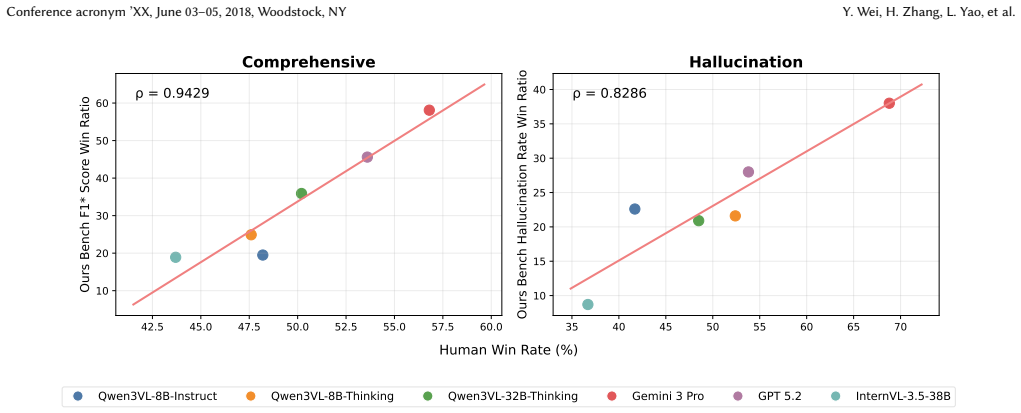
DiffCap-Bench is a benchmark for image difference captioning that covers ten distinct difference categories to ensure diversity and compositional complexity, paired with an LLM-as-a-Judge evaluation protocol based on human-validated Difference Lists, which reveals performance gaps in state-of-the-art multimodal large language models and correlates with downstream image editing quality.
What carries the argument
The DiffCap-Bench collection of image pairs spanning ten difference categories together with the LLM-as-a-Judge protocol that scores generated captions for semantic consistency and hallucination against human-validated difference lists.
If this is right
- Proprietary multimodal models outperform open-source models by a large margin on the benchmark.
- Strong reasoning ability is required for models to produce accurate difference descriptions.
- Increasing model scale alone does not close the performance gaps observed.
- Benchmark scores serve as a predictor of how well model outputs can be used to build image-editing datasets.
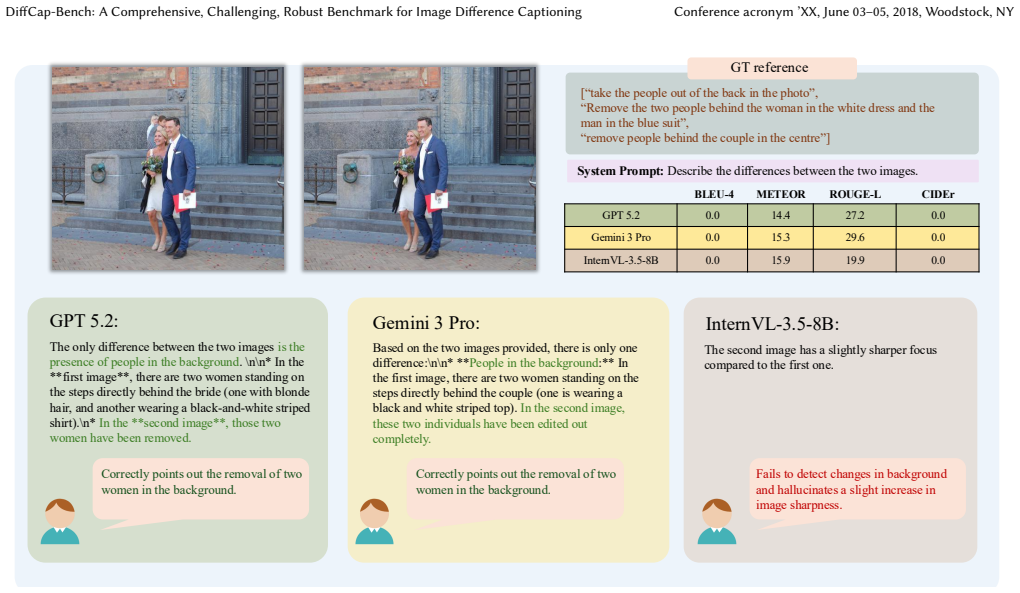
- The framework supplies a more reliable way to measure fine-grained visual change perception than lexical overlap metrics.
Where Pith is reading between the lines
- Developers could use the ten-category breakdown to diagnose and improve specific weaknesses in multimodal reasoning rather than relying only on scale.
- The same human-validated list plus LLM-judge approach could be adapted to create evaluation sets for other fine-grained vision-language tasks.
- Widespread adoption would shift standard practice away from BLEU-style scores toward semantic checks that better reflect real utility.
- Downstream image-editing systems could select captioning models by running them through DiffCap-Bench first to improve the quality of their training data.
Load-bearing premise
The ten difference categories are assumed to supply enough variety and the LLM judge is assumed to match human judgment when measuring semantic accuracy and penalizing hallucinations.
What would settle it
A side-by-side study in which human experts assign substantially different quality rankings to the same model captions than the LLM-as-judge protocol produces on DiffCap-Bench, or a result showing that model rankings remain unchanged from earlier simpler benchmarks.
Figures



read the original abstract
Image Difference Captioning (IDC) generates natural language descriptions that precisely identify differences between two images, serving as a key benchmark for fine-grained change perception, cross-modal reasoning, and image editing data construction. However, existing benchmarks lack diversity and compositional complexity, and standard lexical-overlap metrics (e.g., BLEU, METEOR) fail to capture semantic consistency or penalize hallucinations, which together prevent a comprehensive and robust evaluation of multimodal large language models (MLLMs) on IDC. To address these gaps, we introduce DiffCap-Bench, a comprehensive IDC benchmark covering ten distinct difference categories to ensure diversity and compositional complexity. Furthermore, we propose an LLM-as-a-Judge evaluation protocol grounded in human-validated Difference Lists, enabling a robust assessment of models' ability to both capture and describe visual changes. Through extensive evaluation of state-of-the-art MLLMs, we reveal significant performance gaps between proprietary and open-source models, highlight the critical importance of reasoning capability, and identify clear limitations in model scaling. Our framework also demonstrates strong alignment with human expert judgments and strong correlation with downstream image editing data construction quality. These findings establish DiffCap-Bench as both a reliable IDC evaluation framework and a practical predictor of downstream utility. The benchmark and code will be made publicly available to support further research.
Editorial analysis
A structured set of objections, weighed in public.
Referee Report
Summary. The paper introduces DiffCap-Bench, a new benchmark for Image Difference Captioning (IDC) comprising ten difference categories chosen to increase diversity and compositional complexity over prior datasets. It proposes an LLM-as-a-Judge evaluation protocol grounded in human-validated Difference Lists to assess semantic consistency and penalize hallucinations more effectively than lexical metrics such as BLEU or METEOR. Extensive experiments on state-of-the-art MLLMs reveal performance gaps between proprietary and open-source models, underscore the role of reasoning capability, and report limitations in model scaling; the framework is claimed to show strong alignment with human expert judgments and strong correlation with downstream image-editing data-construction quality.
Significance. If the validation details and correlations hold, DiffCap-Bench would supply a materially more reliable evaluation framework for fine-grained visual change description, directly benefiting MLLM development for image-editing pipelines. The explicit linkage to downstream utility is a notable strength that few existing vision-language benchmarks attempt.
major comments (3)
- [§3] §3 (Benchmark Construction): The ten difference categories are asserted to deliver sufficient diversity and compositional complexity, yet no quantitative measures (category overlap statistics, coverage of multi-object or relational changes, or inter-category entropy) are provided to substantiate this central premise.
- [§4.2] §4.2 (LLM-as-a-Judge Protocol): The claim of “strong alignment with human expert judgments” rests on human-validated Difference Lists, but the manuscript does not report inter-annotator agreement, the exact rubric used for validation, or results on held-out examples; without these, the protocol’s reliability cannot be assessed.
- [§5.3] §5.3 (Downstream Correlation): The reported correlation between DiffCap-Bench scores and image-editing data-construction quality is presented as evidence of practical utility, yet the precise correlation coefficient, statistical significance, and controls for confounding factors (e.g., model size) are not shown, weakening the predictor claim.
minor comments (2)
- [Table 1, Figure 2] Table 1 and Figure 2: axis labels and category names are inconsistently capitalized between the text and visuals, complicating direct comparison.
- [§2] §2 (Related Work): Several recent IDC papers (post-2023) are cited only by title; full bibliographic details should be added for completeness.
Simulated Author's Rebuttal
We thank the referee for the constructive and detailed feedback. We address each major comment below and will revise the manuscript accordingly to improve clarity and rigor.
read point-by-point responses
-
Referee: The ten difference categories are asserted to deliver sufficient diversity and compositional complexity, yet no quantitative measures (category overlap statistics, coverage of multi-object or relational changes, or inter-category entropy) are provided to substantiate this central premise.
Authors: We agree that quantitative measures would strengthen the claim. The ten categories were chosen based on prior IDC literature and pilot annotations to maximize coverage of visual change types. In the revised manuscript, we will add: (1) category distribution and pairwise overlap statistics, (2) explicit counts of multi-object and relational changes per category, and (3) inter-category entropy computed over the Difference Lists. These additions will be placed in §3. revision: yes
-
Referee: The claim of “strong alignment with human expert judgments” rests on human-validated Difference Lists, but the manuscript does not report inter-annotator agreement, the exact rubric used for validation, or results on held-out examples; without these, the protocol’s reliability cannot be assessed.
Authors: We acknowledge the omission of these validation details. The Difference Lists were created and validated by three human experts following a rubric that scores semantic completeness, accuracy, and hallucination avoidance. In the revised §4.2 we will report: the full rubric, inter-annotator agreement (Fleiss’ kappa), and accuracy on a held-out subset of 200 examples. This will directly support the reliability of the LLM-as-a-Judge protocol. revision: yes
-
Referee: The reported correlation between DiffCap-Bench scores and image-editing data-construction quality is presented as evidence of practical utility, yet the precise correlation coefficient, statistical significance, and controls for confounding factors (e.g., model size) are not shown, weakening the predictor claim.
Authors: We thank the referee for this observation. The correlation analysis used Pearson’s r between DiffCap-Bench scores and downstream editing metrics. In the revised §5.3 we will report the exact coefficient, associated p-value, and additional regressions that control for model size and other potential confounders. These details will be added to strengthen the downstream-utility claim. revision: yes
Circularity Check
No circularity: benchmark categories and LLM-judge protocol are constructed independently of model outputs.
full rationale
The paper defines DiffCap-Bench via ten difference categories and an LLM-as-a-Judge protocol explicitly grounded in separately collected human-validated Difference Lists. These inputs are presented as external human annotations rather than derived from the models under test or from any fitted parameters. Claims of alignment with human judgments and correlation with downstream editing quality are framed as empirical results from separate evaluations, not as quantities that reduce by construction to the benchmark definition itself. No self-citations, ansatzes, or renamings of prior results are invoked as load-bearing steps in the provided text.
Axiom & Free-Parameter Ledger
axioms (1)
- domain assumption Human-validated Difference Lists serve as reliable ground truth for assessing caption quality
Reference graph
Works this paper leans on
-
[1]
Shuai Bai, Yuxuan Cai, Ruizhe Chen, Keqin Chen, Xionghui Chen, Zesen Cheng, Lianghao Deng, Wei Ding, Chang Gao, Chunjiang Ge, Wenbin Ge, Zhifang Guo, Qidong Huang, Jie Huang, Fei Huang, Binyuan Hui, Shutong Jiang, Zhaohai Li, Mingsheng Li, Mei Li, Kaixin Li, Zicheng Lin, Junyang Lin, Xuejing Liu, Jiawei Liu, Chenglong Liu, Yang Liu, Dayiheng Liu, Shixuan ...
work page internal anchor Pith review arXiv 2025
-
[2]
Satanjeev Banerjee and Alon Lavie. 2005. METEOR: An automatic metric for MT evaluation with improved correlation with human judgments. InProceedings of the acl workshop on intrinsic and extrinsic evaluation measures for machine translation and/or summarization. 65–72
2005
-
[3]
Ozan Caglayan, Pranava Swaroop Madhyastha, and Lucia Specia. 2020. Curious case of language generation evaluation metrics: A cautionary tale. InProceedings of the 28th International Conference on Computational Linguistics. 2322–2328
2020
-
[4]
Jiali Chen, Xusen Hei, Yuqi Xue, Yuancheng Wei, Jiayuan Xie, Yi Cai, and Qing Li. 2024. Learning to Correction: Explainable Feedback Generation for Visual Commonsense Reasoning Distractor. InProceedings of the 32nd ACM International Conference on Multimedia(Melbourne VIC, Australia)(MM ’24). Association for Computing Machinery, New York, NY, USA, 8209–821...
-
[5]
Jiali Chen, Yujie Jia, Zihan Wu, Jinyu Yang, Jianpeng Chen, Xusen Hei, Jiayuan Xie, Yi Cai, and Qing Li. 2025. ExpStar: Towards Automatic Commentary Gener- ation for Multi-discipline Scientific Experiments. InProceedings of the 33rd ACM International Conference on Multimedia. 6576–6585
2025
-
[6]
Gheorghe Comanici, Eric Bieber, Mike Schaekermann, Ice Pasupat, Noveen Sachdeva, Inderjit Dhillon, Marcel Blistein, Ori Ram, Dan Zhang, Evan Rosen, et al. 2025. Gemini 2.5: Pushing the frontier with advanced reasoning, multi- modality, long context, and next generation agentic capabilities.arXiv preprint arXiv:2507.06261(2025)
work page Pith review arXiv 2025
-
[7]
Yin Cui, Guandao Yang, Andreas Veit, Xun Huang, and Serge Belongie. 2018. Learning to evaluate image captioning. InProceedings of the IEEE conference on computer vision and pattern recognition. 5804–5812
2018
-
[8]
Zonglin Di, Jing Shi, Yifei Fan, Hao Tan, Alexander Black, John Collomosse, and Yang Liu. 2025. DiffTell: A High-Quality Dataset for Describing Image Manipulation Changes. InProceedings of the IEEE/CVF International Conference on Computer Vision. 24580–24590
2025
-
[9]
Jiawei Gu, Xuhui Jiang, Zhichao Shi, Hexiang Tan, Xuehao Zhai, Chengjin Xu, Wei Li, Yinghan Shen, Shengjie Ma, Honghao Liu, et al . 2024. A survey on llm-as-a-judge.The Innovation(2024)
2024
-
[10]
Dong Guo, Faming Wu, Feida Zhu, Fuxing Leng, Guang Shi, Haobin Chen, Haoqi Fan, Jian Wang, Jianyu Jiang, Jiawei Wang, et al . 2025. Seed1. 5-vl technical report.arXiv preprint arXiv:2505.07062(2025)
work page internal anchor Pith review arXiv 2025
-
[11]
Erdong Hu, Longteng Guo, Tongtian Yue, Zijia Zhao, Shuning Xue, and Jing Liu
-
[12]
InProceedings of the Asian Conference on Computer Vision
Onediff: A generalist model for image difference captioning. InProceedings of the Asian Conference on Computer Vision. 2439–2455
- [13]
- [14]
-
[15]
Harsh Jhamtani and Taylor Berg-Kirkpatrick. 2018. Learning to Describe Differ- ences Between Pairs of Similar Images. InProceedings of the 2018 Conference on Empirical Methods in Natural Language Processing (EMNLP)
2018
-
[16]
Hoeseong Kim, Jongseok Kim, Hyungseok Lee, Hyunsung Park, and Gunhee Kim. 2021. Agnostic change captioning with cycle consistency. InProceedings of the IEEE/CVF International Conference on Computer Vision. 2095–2104
2021
- [17]
-
[18]
Black Forest Labs, Stephen Batifol, Andreas Blattmann, Frederic Boesel, Saksham Consul, Cyril Diagne, Tim Dockhorn, Jack English, Zion English, Patrick Esser, et al. 2025. FLUX. 1 Kontext: Flow Matching for In-Context Image Generation and Editing in Latent Space.arXiv preprint arXiv:2506.15742(2025)
work page internal anchor Pith review arXiv 2025
-
[19]
Long Lian, Yifan Ding, Yunhao Ge, Sifei Liu, Hanzi Mao, Boyi Li, Marco Pavone, Ming-Yu Liu, Trevor Darrell, Adam Yala, et al. 2025. Describe anything: Detailed localized image and video captioning. InProceedings of the IEEE/CVF International Conference on Computer Vision. 21766–21777
2025
-
[20]
Chin-Yew Lin. 2004. Rouge: A package for automatic evaluation of summaries. InText summarization branches out. 74–81
2004
-
[21]
Yuan Liu, Saihui Hou, Saijie Hou, Jiabao Du, Shibei Meng, and Yongzhen Huang
-
[22]
InProceedings of the IEEE/CVF International Conference on Computer Vision
OmniDiff: A Comprehensive Benchmark for Fine-grained Image Difference Captioning. InProceedings of the IEEE/CVF International Conference on Computer Vision. 21440–21449
- [23]
-
[24]
Chao Pang, Xingxing Weng, Jiang Wu, Jiayu Li, Yi Liu, Jiaxing Sun, Weijia Li, Shuai Wang, Litong Feng, Gui-Song Xia, et al. 2025. Vhm: Versatile and honest vision language model for remote sensing image analysis. InProceedings of the AAAI Conference on Artificial Intelligence, Vol. 39. 6381–6388
2025
-
[25]
Kishore Papineni, Salim Roukos, Todd Ward, and Wei-Jing Zhu. 2002. Bleu: a method for automatic evaluation of machine translation. InProceedings of the 40th annual meeting of the Association for Computational Linguistics. 311–318
2002
-
[26]
Dong Huk Park, Trevor Darrell, and Anna Rohrbach. 2019. Robust change captioning. InProceedings of the IEEE/CVF International Conference on Computer Vision. 4624–4633
2019
- [27]
-
[28]
Aaditya Singh, Adam Fry, Adam Perelman, Adam Tart, Adi Ganesh, Ahmed El-Kishky, Aidan McLaughlin, Aiden Low, AJ Ostrow, Akhila Ananthram, et al
-
[29]
Openai gpt-5 system card.arXiv preprint arXiv:2601.03267(2025)
work page internal anchor Pith review Pith/arXiv arXiv 2025
-
[30]
Hao Tan, Franck Dernoncourt, Zhe Lin, Trung Bui, and Mohit Bansal. 2019. Expressing visual relationships via language. InProceedings of the 57th Annual Meeting of the Association for Computational Linguistics. 1873–1883
2019
-
[31]
Kimi Team, Tongtong Bai, Yifan Bai, Yiping Bao, SH Cai, Yuan Cao, Y Charles, HS Che, Cheng Chen, Guanduo Chen, et al . 2026. Kimi K2. 5: Visual Agentic Intelligence.arXiv preprint arXiv:2602.02276(2026)
work page internal anchor Pith review arXiv 2026
-
[32]
Ramakrishna Vedantam, C Lawrence Zitnick, and Devi Parikh. 2015. Cider: Consensus-based image description evaluation. InProceedings of the IEEE confer- ence on computer vision and pattern recognition. 4566–4575
2015
-
[33]
Oriol Vinyals, Alexander Toshev, Samy Bengio, and Dumitru Erhan. 2015. Show and tell: A neural image caption generator. InProceedings of the IEEE conference on computer vision and pattern recognition. 3156–3164
2015
-
[34]
Weiyun Wang, Zhangwei Gao, Lixin Gu, Hengjun Pu, Long Cui, Xingguang Wei, Zhaoyang Liu, Linglin Jing, Shenglong Ye, Jie Shao, et al. 2025. InternVL3. 5: Advancing Open-Source Multimodal Models in Versatility, Reasoning, and Efficiency.arXiv preprint arXiv:2508.18265(2025)
work page internal anchor Pith review arXiv 2025
- [35]
- [36]
-
[37]
Linli Yao, Yuancheng Wei, Yaojie Zhang, Lei Li, Xinlong Chen, Feifan Song, Ziyue Wang, Kun Ouyang, Yuanxin Liu, Lingpeng Kong, et al. 2026. TimeChat- Captioner: Scripting Multi-Scene Videos with Time-Aware and Structural Audio- Visual Captions.arXiv preprint arXiv:2602.08711(2026)
-
[38]
Junyan Ye, Dongzhi Jiang, Zihao Wang, Leqi Zhu, Zhenghao Hu, Zilong Huang, Jun He, Zhiyuan Yan, Jinghua Yu, Hongsheng Li, Conghui He, and Weijia Li. 2025. Echo-4o: Harnessing the Power of GPT-4o Synthetic Images for Improved Image Generation.https://arxiv.org/abs/2508.09987(2025)
-
[39]
ImgEdit: A Unified Image Editing Dataset and Benchmark
Yang Ye, Xianyi He, Zongjian Li, Bin Lin, Shenghai Yuan, Zhiyuan Yan, Bohan Hou, and Li Yuan. 2025. Imgedit: A unified image editing dataset and benchmark. arXiv preprint arXiv:2505.20275(2025). Conference acronym ’XX, June 03–05, 2018, Woodstock, NY Y. Wei, H. Zhang, L. Yao, et al. A Overview • Section Bdetails the image pair quality filtering procedure,...
work page internal anchor Pith review arXiv 2025
-
[40]
Forward Checking (Key-change-centered): Iterate through the Key Change List and evaluate each key change item. Assign one of the following hit statuses: (1) Hit and Correct: prediction mentions the corresponding change accurately (object, attribute, direction, quantity, spatial relation, etc.) (2) Hit but Incorrect: refers to the same change category but ...
-
[41]
Perform semantic decomposition: (1) Treat each independent change as a minimal evaluation unit (2) Split multiple changes in one description into separate units
Backward Checking (Prediction-centered): Examine predicted descriptions that donothit any key change item. Perform semantic decomposition: (1) Treat each independent change as a minimal evaluation unit (2) Split multiple changes in one description into separate units
-
[42]
Not in keypoint list
Extra Description Status Determination: For each extra change, assign: (1) Matches Indistinguishable Items: corresponds to an indistinguishable item (2) Extra Correct Description: truly exists from original to target but not recorded in keypoints (3) Hallucination: describes non-existent or unchanged changes, or clearly contradicts visual facts Important:...
2018
-
[43]
(object, spatial, camera)
Adjust the earring to a front-facing view / change the perspective to straight . (object, spatial, camera)
-
[44]
(spatial)
Align the earrings horizontally / replace with a horizontally symmetrical arrangement. (spatial)
-
[45]
(object) Indistinguishable Items: None Image Pair Qwen3VL-8B-Instruct
Hide the earring post. (object) Indistinguishable Items: None Image Pair Qwen3VL-8B-Instruct
-
[46]
Reposition the left earring so that it is aligned horizontally with the right earring, both facing forward
-
[47]
Rotate the left earring to show its front view, matching the orientation of the right earring
-
[48]
Adjust the lighting to enhance the highlights and reflections on the surface of both earrings
-
[49]
Increase the overall sharpness and clarity of the image
-
[50]
Qwen3VL-8B-Thinking So, let's compare the two images
Remove the visible shadow beneath the left earring. Qwen3VL-8B-Thinking So, let's compare the two images. First, check the objects. In Image A, there are two earrings: one is a clover-shaped earring with a post (the back part), and the other is a clover-shaped earring with a post (the front part).Wait, no, looking at Image A: left side is an earring with ...
-
[51]
Remove the posts (stems) from both earrings, making the posts no longer visible
-
[52]
Reposition the left earring to display the front view (previously the back view), aligning it with the right earring's front view orientation
-
[53]
</answer> Judging Result for Qwen3VL-8B-Thinking
Adjust the spatial arrangement so that both earrings are positioned side by side with identical front-facing orientations. </answer> Judging Result for Qwen3VL-8B-Thinking
-
[54]
- Status: Correct - Reason: ‘Reposition the left earring to display the front view…’
Adjust the earring to a front-facing view. - Status: Correct - Reason: ‘Reposition the left earring to display the front view…’
-
[55]
- Status: Correct - Reason: ‘Adjust the spatial arrangement so that both earrings are …’
Align the earrings horizontally. - Status: Correct - Reason: ‘Adjust the spatial arrangement so that both earrings are …’
-
[56]
- Status: Correct - Reason: ‘Remove the posts (stems) from both earrings....’ Hallucination: None Judging Result for Qwen3VL-8B-Instruct
Hide the earring post. - Status: Correct - Reason: ‘Remove the posts (stems) from both earrings....’ Hallucination: None Judging Result for Qwen3VL-8B-Instruct
-
[57]
- Status: Correct - Reason: ‘Reposition the left earring so that it is aligned horizontally with the right earring, both facing forward
Adjust the earring to a front-facing view. - Status: Correct - Reason: ‘Reposition the left earring so that it is aligned horizontally with the right earring, both facing forward
-
[58]
- Status: Correct - Reason: ‘Reposition the left earring so that it is aligned horizontally with the right earring, both facing forward
Align the earrings horizontally. - Status: Correct - Reason: ‘Reposition the left earring so that it is aligned horizontally with the right earring, both facing forward
-
[59]
- Status: Missed Hallucination: 1
Hide the earring post. - Status: Missed Hallucination: 1. Adjust the lighting… 2. Increase the overall sharpness
-
[60]
take the people out of the back in the photo
Remove the visible shadow… Figure 5: Qualitative case study comparing Qwen3VL-8B-Instruct and Qwen3VL-8B-Thinking on the same sample, evaluated using the judge model on DiffCap-Bench. Qwen3VL-8B-Instruct outputs a list of differences directly, missing one true difference and producing three hallucinations. In contrast, Qwen3VL-8B-Thinking employs a think-...
2018
discussion (0)
Sign in with ORCID, Apple, or X to comment. Anyone can read and Pith papers without signing in.