Recognition: unknown
Differential measurements of γγtoττ and constraints on τ-lepton electromagnetic moments in Pb+Pb collisions at sqrt{s_{_NN}} = 5.02 TeV with ATLAS
Pith reviewed 2026-05-08 16:26 UTC · model grok-4.3
The pith
Differential measurements of photon-induced tau pair production in lead-lead collisions are used to set limits on the tau lepton anomalous magnetic moment and electric dipole moment.
A machine-rendered reading of the paper's core claim, the machinery that carries it, and where it could break.
Core claim
The paper establishes the first differential measurements of the γγ→ττ process in intact Pb+Pb collisions and uses a maximum-likelihood fit to the muon transverse momentum distributions in three fiducial regions to determine the tau-lepton anomalous magnetic moment a_τ and electric dipole moment d_τ, obtaining the observed intervals -0.057 < a_τ < 0.035 and |d_τ| < 2.7 × 10^{-16} e cm at 95% confidence level.
What carries the argument
A maximum-likelihood fit to the muon transverse-momentum distributions before unfolding, using theoretical templates that include the effects of non-zero electromagnetic moments on the tau pair kinematics.
If this is right
- The measurements allow tests of photon flux models and spin correlation effects in the predictions.
- Comparisons to next-to-leading-order electroweak predictions are made in the muon-electron channel.
- The extracted limits constrain possible beyond-Standard-Model contributions to tau electromagnetic properties.
- The differential information in multiple variables strengthens the constraints compared to rate-only measurements.
Where Pith is reading between the lines
- The same data could be reanalyzed with improved theoretical models to potentially tighten the bounds on d_τ.
- This method provides a new avenue for studying lepton electromagnetic moments that complements measurements from other experiments.
- Future LHC runs with higher integrated luminosity in heavy-ion mode could significantly improve these constraints.
Load-bearing premise
The theoretical templates accurately capture how non-zero a_τ and d_τ values modify the observed muon transverse momentum distributions, including all effects from photon flux, spin correlations, backgrounds, and detector response.
What would settle it
An independent measurement or reanalysis of the Pb+Pb data that finds the best-fit values of a_τ or d_τ outside the stated 95% CL intervals after using the same or better modeling would show the current limits to be incorrect.
Figures
read the original abstract
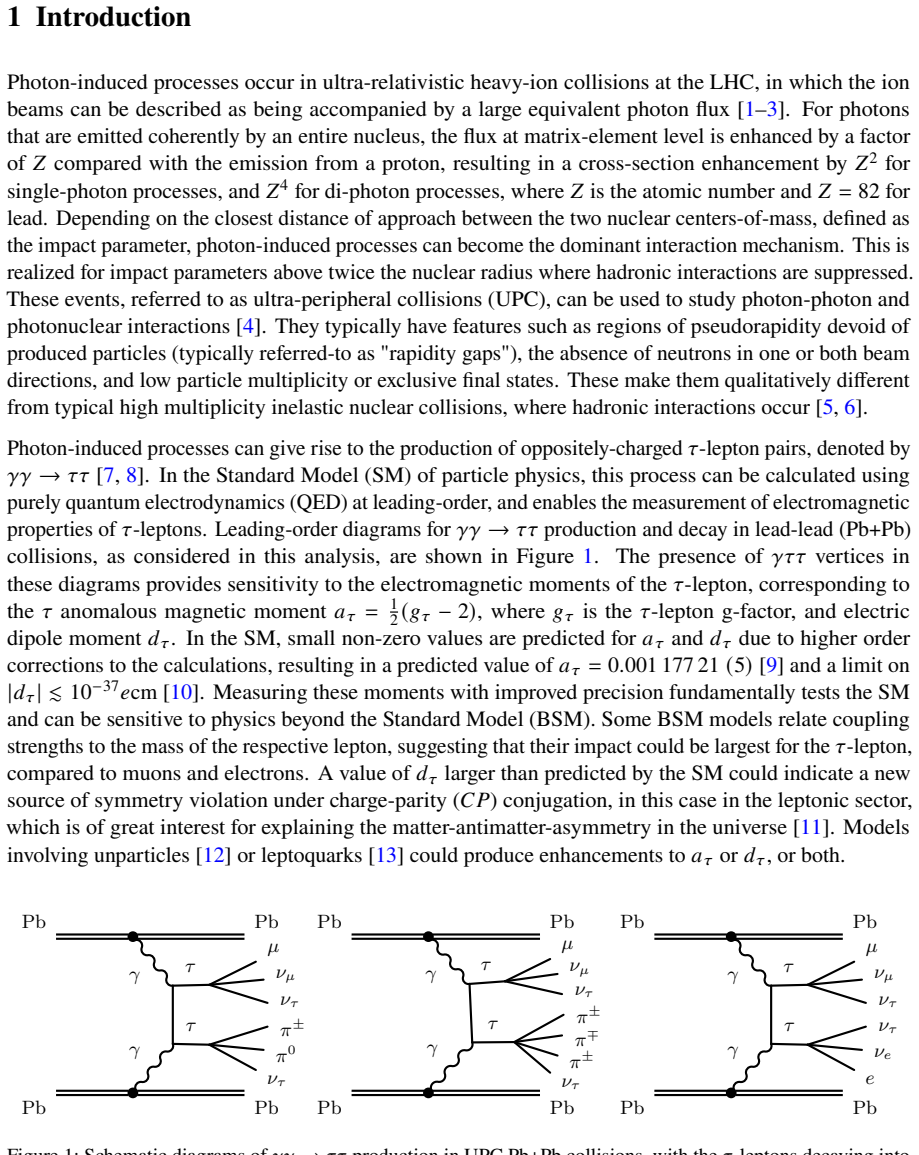
This paper presents the first differential fiducial measurements of $\gamma\gamma\to\tau\tau$ using 1.93 nb$^{-1}$ of Pb+Pb data at $\sqrt{s_{_\text{NN}}} = 5.02$ TeV recorded by the ATLAS detector. Events in which one of the $\tau$-leptons decays into a muon and two neutrinos $\tau\to\nu_\tau\bar{\nu}_\mu\mu$ are selected and are categorized into three regions by the presence of an electron or either one or three charged-particle track(s) from the second $\tau$-lepton decay. The measurement is performed in events where both Pb ions remain intact and no neutrons are emitted. Differential cross-sections are measured for seven variables in three fiducial regions at particle level. The measurements are compared to theory predictions with different photon flux models and spin correlation effects. For the fiducial region with one muon and one electron in the final state, comparisons to next-to-leading-order electroweak predictions are also made. The transverse momentum ($p_\text{T}$) of the decay muon, the $p_\text{T}$ of the visible decay particles of the other $\tau$-lepton, the total $p_\text{T}$, invariant mass, and pseudorapidity of the visible particles from the di-$\tau$ system, and the rapidity and acoplanarity of the visible decay particles from either $\tau$-lepton are measured. A maximum-likelihood fit to the muon transverse-momentum distributions in the three regions before unfolding is performed to extract the $\tau$-lepton anomalous magnetic moment $a_{\tau}$ and electric dipole moment $d_{\tau}$, the latter for the first time in heavy ion collisions. The observed 95% confidence level intervals are $-0.057 <a_{\tau}< 0.035$ and $|d_{\tau}|< 2.7 \times 10^{-16}~e\text{cm}$.}
Editorial analysis
A structured set of objections, weighed in public.
Referee Report
Summary. The manuscript reports the first differential fiducial measurements of the γγ→ττ process in ultraperipheral Pb+Pb collisions at √s_NN = 5.02 TeV with the ATLAS detector, using 1.93 nb^{-1} of data. Events are selected with one τ decaying to μνν and categorized into three regions according to the second τ decay (electron, one track, or three tracks). Differential cross sections are measured for seven kinematic variables in three fiducial regions at particle level and compared to predictions with varying photon-flux models and spin correlations; NLO electroweak predictions are also shown for the μe channel. A maximum-likelihood fit to the muon p_T distributions in the three regions (performed before unfolding) extracts 95% CL intervals on the τ anomalous magnetic moment a_τ and electric dipole moment d_τ (the latter for the first time in heavy-ion collisions): -0.057 < a_τ < 0.035 and |d_τ| < 2.7 × 10^{-16} e cm.
Significance. If the central extraction holds, the work supplies the first differential γγ→ττ data in heavy-ion collisions together with the first d_τ constraint from this channel. The differential distributions test photon-flux modeling and spin correlations in ultraperipheral collisions, while the direct fit to muon p_T provides competitive limits on the τ electromagnetic moments. These results are relevant for BSM searches and for validating theoretical tools used in future UPC studies.
major comments (2)
- [maximum-likelihood fit procedure] The maximum-likelihood fit to the muon p_T distributions (described in the abstract and the results section): the reported 95% CL intervals on a_τ and d_τ rest on the assumption that the theoretical templates accurately propagate the effects of non-zero moments into the observed p_T shapes, including the chosen photon-flux model, spin correlations, backgrounds, and detector response. The manuscript notes comparisons to alternative photon-flux models and NLO electroweak predictions in one channel, but does not quantify the impact of these variations (or of residual mismatches in moment-induced kinematics, especially for d_τ) on the fitted intervals. This modeling step is load-bearing for the central claim.
- [differential cross-section results] Differential cross-section measurements in the three fiducial regions: the paper performs unfolding after the fit, yet provides limited detail on the unfolding method, regularization, and propagation of systematic uncertainties from the three regions into the final distributions. Without this, it is difficult to assess whether the reported agreement with theory predictions is robust or whether unaccounted biases affect the subsequent moment extraction.
minor comments (2)
- The abstract states the integrated luminosity as 1.93 nb^{-1}; ensure this value and the corresponding uncertainty are repeated with the same precision in the main text and tables.
- [event selection] Clarify the exact definition of the three fiducial regions (electron, one-track, three-track) in a dedicated table or equation to avoid ambiguity when readers compare to the fit inputs.
Simulated Author's Rebuttal
We thank the referee for their thorough review and for recognizing the significance of our results on the first differential measurements of γγ→ττ in heavy-ion collisions and the constraints on τ electromagnetic moments. We address the major comments below and will revise the manuscript accordingly to improve clarity and robustness.
read point-by-point responses
-
Referee: [maximum-likelihood fit procedure] The maximum-likelihood fit to the muon p_T distributions (described in the abstract and the results section): the reported 95% CL intervals on a_τ and d_τ rest on the assumption that the theoretical templates accurately propagate the effects of non-zero moments into the observed p_T shapes, including the chosen photon-flux model, spin correlations, backgrounds, and detector response. The manuscript notes comparisons to alternative photon-flux models and NLO electroweak predictions in one channel, but does not quantify the impact of these variations (or of residual mismatches in moment-induced kinematics, especially for d_τ) on the fitted intervals. This modeling step is load-bearing for the central claim.
Authors: We agree that quantifying the impact of modeling variations on the extracted intervals is important for assessing the robustness of the limits. In the revised version, we will add a dedicated study in the results section that evaluates the variation in the 95% CL intervals for a_τ and d_τ when using alternative photon-flux models (such as those compared in the differential cross-section measurements) and when incorporating NLO electroweak corrections for the μe channel. For d_τ, we will include a discussion of the sensitivity to potential kinematic mismatches in the templates. This will demonstrate that the central intervals are stable within the quoted uncertainties. revision: yes
-
Referee: [differential cross-section results] Differential cross-section measurements in the three fiducial regions: the paper performs unfolding after the fit, yet provides limited detail on the unfolding method, regularization, and propagation of systematic uncertainties from the three regions into the final distributions. Without this, it is difficult to assess whether the reported agreement with theory predictions is robust or whether unaccounted biases affect the subsequent moment extraction.
Authors: We acknowledge the need for more detailed documentation of the unfolding procedure. The revised manuscript will include an expanded description of the unfolding method, including the algorithm employed, the regularization procedure and its validation through closure tests, and the full propagation of systematic uncertainties from the three analysis regions to the unfolded distributions. We will also add information on how the post-unfolding distributions are used to validate the modeling assumptions underlying the moment extraction. revision: yes
Circularity Check
No circularity: extraction is a direct fit to data using external templates
full rationale
The paper performs differential cross-section measurements in fiducial regions and then conducts a maximum-likelihood fit directly to the observed muon p_T distributions (before unfolding) to extract a_τ and d_τ limits. This fit uses theoretical templates that incorporate the moments, photon flux, spin correlations, backgrounds, and detector response. No step reduces by the paper's own equations to a self-definition, a prior fit renamed as prediction, or a load-bearing self-citation chain; the reported 95% CL intervals are independent outputs from the data. The derivation chain is self-contained against external benchmarks and modeling assumptions.
Axiom & Free-Parameter Ledger
axioms (1)
- domain assumption Standard Model predictions for tau lepton decays and photon flux in ultra-peripheral collisions are sufficiently accurate for template construction
Reference graph
Works this paper leans on
-
[1]
Breit and J
G. Breit and J. A. Wheeler,Collision of Two Light Quanta, Phys. Rev.46(1934) 1087
1934
-
[2]
W. Heisenberg and H. Euler,Folgerungen aus der Diracschen Theorie des Positrons, Zeitschrift für Physik98(1936) 714, arXiv:physics/0605038
-
[3]
Schwinger,On Gauge Invariance and Vacuum Polarization, Phys
J. Schwinger,On Gauge Invariance and Vacuum Polarization, Phys. Rev.82(1951) 664
1951
- [4]
- [5]
-
[6]
J. de Favereau de Jeneret et al.,High energy photon interactions at the LHC, (2009), arXiv:0908.2020 [hep-ph]
-
[7]
V. M. Budnev, I. F. Ginzburg, G. V. Meledin, and V. G. Serbo,The two-photon particle production mechanism. Physical problems. Applications. Equivalent photon approximation, Phys. Rept.15(1975) 181
1975
-
[8]
M.-S. Chen, I. J. Muzinich, H. Terazawa, and T. P. Cheng, Lepton Pair Production from Two-Photon Processes, Phys. Rev. D7(1973) 3485
1973
-
[9]
S. Eidelman and M. Passera,Theory of the𝜏lepton anomalous magnetic moment, Mod. Phys. Lett.A22(2007) 159, arXiv:hep-ph/0701260 [hep-ph]. 30
-
[10]
Yamaguchi and N
Y. Yamaguchi and N. Yamanaka,Large Long-Distance Contributions to the Electric Dipole Moments of Charged Leptons in the Standard Model, Phys. Rev. Lett.125(24 2020) 241802
2020
-
[11]
A. D. Sakharov,Violation of CP Invariance, C asymmetry, and baryon asymmetry of the universe, Pisma Zh. Eksp. Teor. Fiz.5(1967) 32
1967
-
[12]
Moyotl and G
A. Moyotl and G. Tavares-Velasco,Weak properties of the𝜏lepton via a spin-0 unparticle, Phys. Rev. D86(1 2012) 013014
2012
-
[13]
S. Iguro and T. Kitahara,Electric dipole moments as probes of the𝑅𝐷 (∗) anomaly, Phys. Rev. D110(2024) 075008, arXiv:2307.11751 [hep-ph]
- [14]
- [15]
- [16]
- [17]
-
[18]
Acciarri et al.,Production of𝑒,𝜇and𝜏pairs in untagged two photon collisions at LEP, Phys
M. Acciarri et al.,Production of𝑒,𝜇and𝜏pairs in untagged two photon collisions at LEP, Phys. Lett. B407(1997) 341
1997
-
[19]
Achard et al.,Muon-pair and tau-pair production in two-photon collisions at LEP, Phys
P. Achard et al.,Muon-pair and tau-pair production in two-photon collisions at LEP, Phys. Lett. B585(2004) 53, arXiv:hep-ex/0402037
- [20]
- [21]
-
[22]
L3 Collaboration, Measurement of the anomalous magnetic and electric dipole moments of the tau lepton, Phys. Lett. B434(1998) 169
1998
- [23]
- [24]
-
[25]
del Aguila, F
F. del Aguila, F. Cornet, and J. I. Illana,The possibility of using a large heavy-ion collider for measuring the electromagnetic properties of the tau lepton, Phys. Lett. B271(1991) 256
1991
-
[26]
L. Beresford and J. Liu,New physics and tau𝑔−2using LHC heavy ion collisions, Phys. Rev. D102(2020) 113008, arXiv:1908.05180 [hep-ph]. 31
- [27]
-
[28]
K. Bhide and V. Lang, Probing optimal measurements of the electromagnetic dipole moments of the𝜏lepton, (2024), arXiv:2410.23070 [hep-ph]
- [29]
-
[30]
Burmasov, E
N. Burmasov, E. Kryshen, P. Bühler, and R. Lavicka,Feasibility Studies of Tau-Lepton Anomalous Magnetic Moment Measurements in Ultraperipheral Collisions at the LHC, Physics of Particles and Nuclei54(2023) 590
2023
-
[31]
M. Verducci, C. Roda, V. Cavasinni, and N. Vignaroli,Study of the measurement of the𝜏lepton anomalous magnetic moment in high energy lead-lead collisions at the LHC, Phys. Rev. D110(2024) 052001, arXiv:2307.15160 [hep-ph]
-
[32]
N. A. Burmasov, Search for New Physics in Ultraperipheral Collisions at the Large Hadron Collider, Physics of Atomic Nuclei85(2022) 942
2022
- [33]
-
[34]
S. Atağ and A. A. Billur,Possibility of determining𝜏lepton electromagnetic moments in 𝛾𝛾→𝜏 +𝜏− process at the CERN-LHC, JHEP11(2010) 060, arXiv:1005.2841 [hep-ph]
-
[35]
L. Beresford, S. Clawson, and J. Liu, Strategy to measure tau g-2 via photon fusion in LHC proton collisions, Phys. Rev. D110(2024) 092016, arXiv:2403.06336 [hep-ph]
- [36]
- [37]
- [38]
-
[39]
Bernabéu, G.A
J. Bernabéu, G.A. González-Sprinberg, J. Papavassiliou and J. Vidal, Tau anomalous magnetic moment form factor at super B/flavor factories, Nuclear Physics B790(2008) 160,issn: 0550-3213
2008
-
[40]
Bernabéu, G.A
J. Bernabéu, G.A. González-Sprinberg and J. Vidal, Tau spin correlations and the anomalous magnetic moment, Journal of High Energy Physics2009(2009) 062. 32
2009
-
[41]
S. Eidelman, D. Epifanov, M. Fael, L. Mercolli, and M. Passera, 𝜏dipole moments via radiative leptonic𝜏decays, JHEP03(2016) 140, arXiv:1601.07987 [hep-ph]
- [42]
-
[43]
Fu et al.,Novel Method for the Direct Measurement of the𝜏Lepton Dipole Moments, Phys
J. Fu et al.,Novel Method for the Direct Measurement of the𝜏Lepton Dipole Moments, Phys. Rev. Lett.123(2019) 011801, arXiv:1901.04003 [hep-ex]
-
[44]
ATLAS Collaboration,The ATLAS Experiment at the CERN Large Hadron Collider, JINST3(2008) S08003
2008
- [45]
-
[46]
B. Abbott et al.,Production and integration of the ATLAS Insertable B-Layer, JINST13(2018) T05008, arXiv:1803.00844 [physics.ins-det]
- [47]
-
[48]
Avoni et al., The new LUCID-2 detector for luminosity measurement and monitoring in ATLAS, JINST13(2018) P07017
G. Avoni et al., The new LUCID-2 detector for luminosity measurement and monitoring in ATLAS, JINST13(2018) P07017
2018
-
[49]
ATLAS Collaboration,Performance of the ATLAS trigger system in 2015, Eur. Phys. J. C77(2017) 317, arXiv:1611.09661 [hep-ex]
work page Pith review arXiv 2015
- [50]
- [51]
- [52]
- [53]
-
[54]
T. Sjöstrand et al.,An introduction to PYTHIA 8.2, Comput. Phys. Commun.191(2015) 159, arXiv:1410.3012 [hep-ph]
work page internal anchor Pith review arXiv 2015
-
[55]
Jadach, Z
S. Jadach, Z. Was, R. Decker, and J. H. Kühn,The𝜏decay library TAUOLA, version 2.4, Comput. Phys. Commun.76(1993) 361
1993
-
[56]
N. Davidson, G. Nanava, T. Przedzinski, E. Richter-Was, and Z. Was, Universal interface of TAUOLA: Technical and physics documentation, Comput. Phys. Commun.183(2012) 821, arXiv:1002.0543 [hep-ph]. 33
-
[57]
N. Davidson, T. Przedzinski, and Z. Was, PHOTOS interface in C++: Technical and Physics Documentation, Comput. Phys. Commun.199(2016) 86, arXiv:1011.0937 [hep-ph]
- [58]
-
[59]
T. Przedzinski, E. Richter-Was, and Z. Was,Documentation of𝑇 𝑎𝑢𝑆 𝑝𝑖𝑛𝑛𝑒𝑟 algorithms: program for simulating spin effects in𝜏-lepton production at LHC, Eur. Phys. J. C79(2019) 91, arXiv:1802.05459 [hep-ph]
-
[60]
Z. Czyczula, T. Przedzinski, and Z. Was, TauSpinner Program for Studies on Spin Effect in tau Production at the LHC, Eur. Phys. J. C72(2012) 1988, arXiv:1201.0117 [hep-ph]
-
[61]
H.-S. Shao and D. d’Enterria,gamma-UPC: automated generation of exclusive photon-photon processes in ultraperipheral proton and nuclear collisions with varying form factors, JHEP09(2022) 248, arXiv:2207.03012 [hep-ph]
-
[62]
J. Alwall et al.,The automated computation of tree-level and next-to-leading order differential cross sections, and their matching to parton shower simulations, JHEP07(2014) 079, arXiv:1405.0301 [hep-ph]
work page internal anchor Pith review arXiv 2014
- [63]
- [64]
- [65]
-
[66]
Fermi,Über die Theorie des Stoßes zwischen Atomen und elektrisch geladenen Teilchen, Zeitschrift für Physik29(1924) 315
E. Fermi,Über die Theorie des Stoßes zwischen Atomen und elektrisch geladenen Teilchen, Zeitschrift für Physik29(1924) 315
1924
-
[67]
E. Fermi,Sulla teoria dell’ urto tra atomi e corpuscoli elettrici, Il Nuovo Cimento (1924-1942)2(1925) 143, ed. by W. J. Marciano and S. White, arXiv:hep-th/0205086
-
[68]
Weizsäcker,Ausstrahlung bei Stößen sehr schneller Elektronen, Zeitschrift für Physik88(1934) 612
C. Weizsäcker,Ausstrahlung bei Stößen sehr schneller Elektronen, Zeitschrift für Physik88(1934) 612
1934
-
[69]
E. J. Williams,Correlation of certain collision problems with radiation theory, Kong. Dan. Vid. Sel. Mat. Fys. Med.13N4(1935) 1, url:https://gymarkiv.sdu.dk/MFM/kdvs/mfm%2010-19/mfm-13-4.pdf
1935
- [70]
- [71]
-
[72]
The Monte Carlo Event Generator DPMJET-III,
S. Roesler, R. Engel, and J. Ranft, “The Monte Carlo Event Generator DPMJET-III,” International Conference on Advanced Monte Carlo for Radiation Physics, Particle Transport Simulation and Applications (MC 2000), 2001 1033, arXiv:hep-ph/0012252
-
[73]
Agostinelli et al.,Geant4– a simulation toolkit, Nucl
S. Agostinelli et al.,Geant4– a simulation toolkit, Nucl. Instrum. Meth. A506(2003) 250
2003
-
[74]
ATLAS Collaboration,The ATLAS Simulation Infrastructure, Eur. Phys. J. C70(2010) 823, arXiv:1005.4568 [physics.ins-det]
work page Pith review arXiv 2010
- [75]
- [76]
- [77]
-
[78]
Akesson et al.,ATLAS tracking event data model, (2006), url:https://cds.cern.ch/record/973401
F. Akesson et al.,ATLAS tracking event data model, (2006), url:https://cds.cern.ch/record/973401
2006
- [79]
- [80]
discussion (0)
Sign in with ORCID, Apple, or X to comment. Anyone can read and Pith papers without signing in.