Recognition: unknown
A Generalized Framework of Antisymmetric Polyspectral Indices for Identifying High-Order Neural Interactions
Pith reviewed 2026-05-08 16:31 UTC · model grok-4.3
The pith
A family of antisymmetric cross-polyspectral indices quantifies high-order harmonic dependencies in neural signals while canceling instantaneous mixing effects.
A machine-rendered reading of the paper's core claim, the machinery that carries it, and where it could break.
Core claim
A general family of antisymmetric cross-polyspectral indices can quantify harmonic dependencies in which a frequency f_N equals the sum of N-1 earlier frequencies across multiple time series, and these indices remain intrinsically robust to instantaneous mixing because their antisymmetric construction forces cancellation of zero-lag contributions.
What carries the argument
The family of antisymmetric cross-polyspectral indices, constructed so that their sign-reversal symmetry under frequency permutation cancels the effects of instantaneous linear mixing while retaining sensitivity to true nonlinear phase relations.
If this is right
- Higher-order frequency interactions become measurable in multi-channel recordings without separate correction for volume conduction.
- Standard bispectral and trispectral tools can be extended systematically to arbitrary numbers of frequencies through the same antisymmetric construction.
- Empirical EEG data can reveal multi-frequency dependencies that conventional cross-frequency coupling measures miss due to zero-lag artifacts.
- Targeted multi-site stimulation protocols can monitor and modulate specific harmonic network interactions identified by these indices.
Where Pith is reading between the lines
- The same antisymmetric construction could be tested on MEG or intracranial recordings to check whether the detected interactions generalize across measurement modalities.
- If the indices prove stable, they offer a direct way to compare high-order coupling strength between resting state and task conditions or between healthy and clinical populations.
- One could simulate networks with known higher-order terms beyond cubic nonlinearities to determine the range of interaction orders the indices can isolate.
Load-bearing premise
The antisymmetric cancellation properties derived in theory continue to hold when the indices are applied to non-stationary, noisy, and physiologically complex EEG recordings rather than ideal stationary signals.
What would settle it
Apply the indices to EEG data containing only known linear mixing and cubic nonlinearities; if significant nonzero values appear where the mixing alone should produce exact cancellation, the robustness claim is falsified.
Figures
read the original abstract
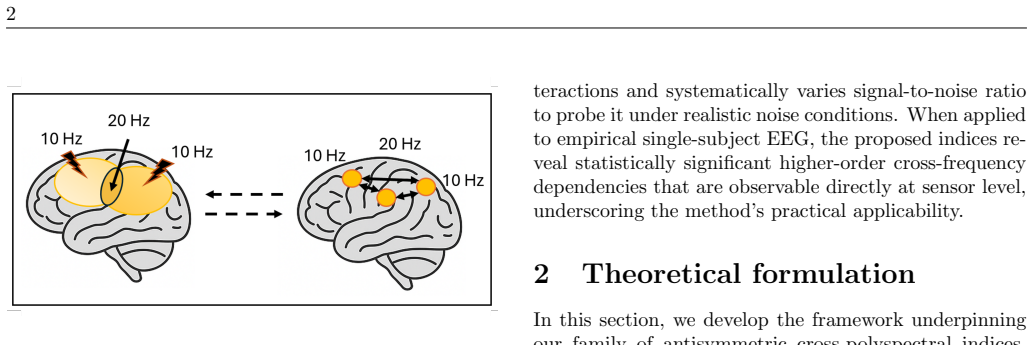
Cross-frequency interactions are fundamental brain mechanisms for integrating information across temporal scales. However, accurate identification of these couplings is hindered by complex multi-frequency nonlinearities and by spurious, zero-lag artifacts caused by volume conduction. To our knowledge, conventional metrics lack a robust framework to characterize genuine interactions among multiple time series where a frequency of interest $f_N$ arises from the combination of $N-1$ components such that $f_N = \sum_{i=1}^{N-1} f_i$. We introduce a general family of antisymmetric cross-polyspectral indices designed to quantify these harmonic dependencies while being intrinsically robust to instantaneous mixing. We derive the theoretical properties of these quantities and validate them through simulations of cubic nonlinearities. As a proof of concept, we apply the indices to empirical EEG recordings; the results reveal significant higher-order dependencies that elude standard analytical approaches. We further discuss how these indices can inform novel, personalized multi-site transcranial magnetic stimulation (mTMS) protocols by enabling the selective monitoring and modulation of specific multi-frequency network interactions.
Editorial analysis
A structured set of objections, weighed in public.
Referee Report
Summary. The paper introduces a generalized family of antisymmetric cross-polyspectral indices to quantify high-order harmonic neural interactions where a frequency f_N arises as the sum of N-1 component frequencies, claiming these indices are intrinsically robust to instantaneous mixing (e.g., volume conduction) due to their antisymmetry. It derives theoretical properties of the indices, validates them in simulations of cubic nonlinearities, and applies them as a proof-of-concept to EEG recordings to detect higher-order dependencies not captured by standard methods, with discussion of applications to multi-site TMS protocols.
Significance. If the antisymmetry-based cancellation of mixing effects holds, the framework would offer a useful advance for identifying genuine multi-frequency couplings in neural data, addressing a key limitation of conventional polyspectra. The provision of a general (N-way) family, explicit theoretical derivations, and simulation validation are strengths that could support reproducible extensions; however, the non-stationarity of real EEG raises a substantive risk to the robustness claim.
major comments (2)
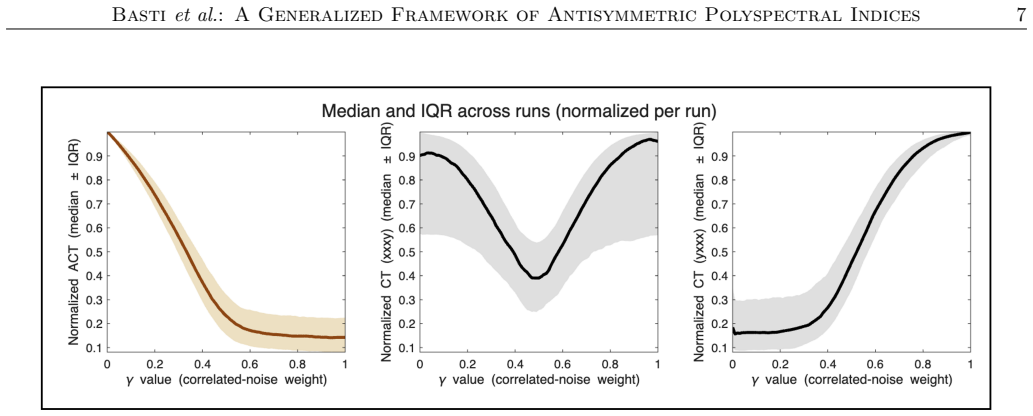
- [Theoretical properties derivation and simulation validation] The central robustness claim—that antisymmetry cancels instantaneous mixing for any N-way relation f_N = sum f_i—relies on properties of higher-order spectra that are typically derived under wide-sense stationarity. The cubic-nonlinearity simulations are stationary by construction and therefore do not probe whether the cancellation persists under the non-stationary conditions of EEG (multiple timescales, transient events). This assumption is load-bearing for the empirical proof-of-concept and the claimed advantage over standard bispectrum/trispectrum estimators.
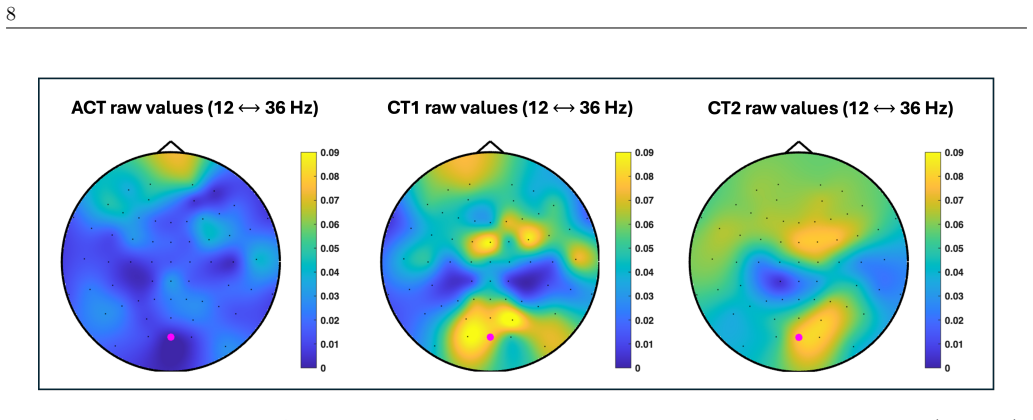
- [Empirical EEG proof-of-concept] The EEG application reports significant higher-order dependencies, but without explicit details on stationarity testing, artifact rejection criteria, or statistical controls for multiple comparisons across frequencies and channels, it is unclear whether the detected interactions survive the same non-stationarity that could break the mixing cancellation. This directly affects the strength of the proof-of-concept.
minor comments (2)
- [Methods / index definition] Clarify the precise definition of the antisymmetric index for general N (e.g., explicit formula or recursion) and how it reduces for the bispectral (N=3) and trispectral (N=4) cases; this would aid reproducibility.
- [Abstract] The abstract states that the indices are 'intrinsically robust to instantaneous mixing' but does not specify the mixing model (e.g., linear instantaneous vs. convolutive); add a brief statement of the assumed mixing operator.
Simulated Author's Rebuttal
We thank the referee for their constructive comments, which highlight key considerations for the stationarity assumptions in our theoretical framework and the transparency needed in the EEG analysis. We address each major comment point by point below, outlining revisions that strengthen the manuscript while preserving its core contributions.
read point-by-point responses
-
Referee: [Theoretical properties derivation and simulation validation] The central robustness claim—that antisymmetry cancels instantaneous mixing for any N-way relation f_N = sum f_i—relies on properties of higher-order spectra that are typically derived under wide-sense stationarity. The cubic-nonlinearity simulations are stationary by construction and therefore do not probe whether the cancellation persists under the non-stationary conditions of EEG (multiple timescales, transient events). This assumption is load-bearing for the empirical proof-of-concept and the claimed advantage over standard bispectrum/trispectrum estimators.
Authors: We acknowledge that the derivations of the antisymmetric polyspectral indices follow the standard wide-sense stationarity framework used for higher-order spectra. The antisymmetry property itself arises from the odd symmetry under instantaneous linear mixing, which holds pointwise in time even if the signals are non-stationary; however, the statistical estimation and interpretation of the indices do rely on stationarity for consistent averaging. The simulations were intentionally stationary to isolate the core cancellation mechanism. In the revised manuscript we will add an explicit limitations subsection discussing the stationarity assumption, its implications for EEG, and possible extensions (e.g., short-time or adaptive estimators). This will qualify the robustness claim without requiring new simulations at this stage. revision: partial
-
Referee: [Empirical EEG proof-of-concept] The EEG application reports significant higher-order dependencies, but without explicit details on stationarity testing, artifact rejection criteria, or statistical controls for multiple comparisons across frequencies and channels, it is unclear whether the detected interactions survive the same non-stationarity that could break the mixing cancellation. This directly affects the strength of the proof-of-concept.
Authors: We agree that greater methodological detail is required. The revised manuscript will include: (i) the stationarity tests applied to the analyzed EEG segments, (ii) the artifact rejection pipeline (including ICA-based removal of ocular and myogenic components and the criteria for segment exclusion), and (iii) the multiple-comparison correction procedure (FDR control across frequency bins and channel combinations). These additions will allow readers to evaluate whether the reported interactions remain credible under the non-stationarity present in the data. revision: yes
Circularity Check
No significant circularity in derivation chain
full rationale
The abstract and provided text describe the introduction of antisymmetric cross-polyspectral indices, followed by derivation of their theoretical properties, validation via cubic nonlinearity simulations, and empirical EEG application. No equations, definitions, or self-citations are available to inspect for reductions by construction, fitted inputs renamed as predictions, or load-bearing self-referential arguments. The claimed robustness to instantaneous mixing is presented as arising from the antisymmetric formulation, but without explicit paper text showing that the 'result' is tautological with the definition or inputs, the derivation chain remains self-contained and non-circular per the analysis criteria.
Axiom & Free-Parameter Ledger
axioms (1)
- standard math Standard properties of polyspectra and antisymmetry under instantaneous mixing
Reference graph
Works this paper leans on
-
[1]
Bartz, S., Andreou, C., and Nolte, G. (2020). Beyond pairwise interactions: The totally antisymmetric part of the bispectrum as coupling measure of at least three interacting sources. Frontiers in Neuroinformatics, 14, 573750
2020
-
[2]
Basti, A., Nili, H., Hauk, O., Marzetti, L., and Hen- son, R. N. (2020). Multi-dimensional connectivity: a conceptual and mathematical review. NeuroImage, 221, 117179
2020
-
[3]
and Marzetti, L
Basti, A., Chella, F., Guidotti, R., Ermolova, M., D’Andrea, A., Stenroos, M., ... and Marzetti, L. (2022). Looking through the windows: a study about the dependency of phase-coupling estimates on the data length. Journal of Neural Engineering, 19(1), 016039
2022
-
[4]
J., Romani, G
Basti, A., Nolte, G., Guidotti, R., Ilmoniemi, R. J., Romani, G. L., Pizzella, V., and Marzetti, L. (2024). A bicoherence approach to analyze multi-dimensional cross-frequency coupling in EEG/MEG data. Scien- tific Reports, 14(1), 8461
2024
-
[5]
S., and Sporns, O
Bassett, D. S., and Sporns, O. (2017). Network neu- roscience. Nature neuroscience, 20(3), 353-364
2017
-
[6]
L., and Menon, V
Bressler, S. L., and Menon, V. (2010). Large-scale brain networks in cognition: emerging methods and principles. Trends in cognitive sciences, 14(6), 277- 290
2010
-
[7]
Buzsaki, G., and Draguhn, A. (2004). Neuronal oscil- lations in cortical networks. science, 304(5679), 1926- 1929
2004
-
[8]
T., and Knight, R
Canolty, R. T., and Knight, R. T. (2010). The func- tional role of cross-frequency coupling. Trends in cog- nitive sciences, 14(11), 506-515
2010
-
[9]
Chella, F., Marzetti, L., Pizzella, V., Zappasodi, F., & Nolte, G. (2014). Third order spectral analysis ro- bust to mixing artifacts for mapping cross-frequency interactions in EEG/MEG. Neuroimage, 91, 146-161
2014
-
[10]
Chella, F., Pizzella, V., Zappasodi, F., Nolte, G., & Marzetti, L. (2016). Bispectral pairwise interact- ing source analysis for identifying systems of cross- frequency interacting brain sources from electroen- cephalographic or magnetoencephalographic signals. Physical Review E, 93(5), 052420
2016
-
[11]
V., Griffis, J
Favaretto, C., Allegra, M., Deco, G., Metcalf, N. V., Griffis, J. C., Shulman, G. L., ... and Corbetta, M. (2022). Subcortical-cortical dynamical states of the human brain and their breakdown in stroke. Nature communications, 13(1), 5069. 10
2022
-
[12]
K., and Nolte, G
G¨ oschl, F., Kaziki, D., Leicht, G., Engel, A. K., and Nolte, G. (2025). Source to sensor coupling (SoSeC) as an effective tool to localize interacting sources from EEG and MEG data. Journal of Neuroscience Meth- ods, 110494
2025
-
[13]
L., Spronk, M., Kulkarni, K., Repovˇ s, G., An- ticevic, A., and Cole, M
Ji, J. L., Spronk, M., Kulkarni, K., Repovˇ s, G., An- ticevic, A., and Cole, M. W. (2019). Mapping the human brain’s cortical-subcortical functional network organization. NeuroImage, 185, 35-57
2019
-
[14]
M., Nieminen, J
Koponen, L. M., Nieminen, J. O., and Ilmoniemi, R. J. (2018). Multi-locus transcranial magnetic stimula- tion—theory and implementation. Brain Stimulation, 11(4), 849-855
2018
-
[15]
Z., Pizzella, V., Nolte, G., de Pasquale, F.,
Marzetti, L., Della Penna, S., Snyder, A. Z., Pizzella, V., Nolte, G., de Pasquale, F., ... and Corbetta, M. (2013). Frequency specific interactions of MEG rest- ing state activity within and across brain networks as revealed by the multivariate interaction measure. Neuroimage, 79, 172-183
2013
-
[16]
Marzetti, L., Basti, A., Chella, F., D’Andrea, A., Syrj¨ al¨ a, J., and Pizzella, V. (2019). Brain functional connectivity through phase coupling of neuronal oscil- lations: a perspective from magnetoencephalography. Frontiers in neuroscience, 13, 964
2019
-
[17]
O., Sinisalo, H., Souza, V
Nieminen, J. O., Sinisalo, H., Souza, V. H., Malmi, M., Yuryev, M., Tervo, A. E., ... and Ilmoniemi, R. J. (2022). Multi-locus transcranial magnetic stimulation system for electronically targeted brain stimulation. Brain Stimulation, 15(1), 116-124
2022
-
[18]
Nolte, G., Bai, O., Wheaton, L., Mari, Z., Vorbach, S., & Hallett, M. (2004). Identifying true brain in- teraction from EEG data using the imaginary part of coherency. Clinical neurophysiology, 115(10), 2292- 2307
2004
-
[19]
J., Souza, V
Rissanen, I. J., Souza, V. H., Nieminen, J. O., Koponen, L. M., and Ilmoniemi, R. J. (2023). Ad- vanced pipeline for designing multi-locus TMS coils with current density constraints. IEEE Transactions on Biomedical Engineering, 70(7), 2025-2034
2023
-
[20]
Shahbazi, F., Ewald, A., & Nolte, G. (2014). Uni- variate normalization of bispectrum using H¨ older’s in- equality. Journal of neuroscience methods, 233, 177- 186
2014
-
[21]
H., Arnulfo, G., Lampinen, A., Nobili, L., Palva, J
Siebenh¨ uhner, F., Wang, S. H., Arnulfo, G., Lampinen, A., Nobili, L., Palva, J. M., and Palva, S. (2020). Genuine cross-frequency coupling networks in human resting-state electrophysiological recordings. PLoS Biology, 18(5), e3000685
2020
-
[22]
P., Souza, V
Sinisalo, H., Rissanen, I., Kahilakoski, O. P., Souza, V. H., Tommila, T., Laine, M., ... and Ilmoniemi, R. J. (2024). Modulating brain networks in space and time: Multi-locus transcranial magnetic stimulation. Clinical Neurophysiology, 158, 218-224
2024
-
[23]
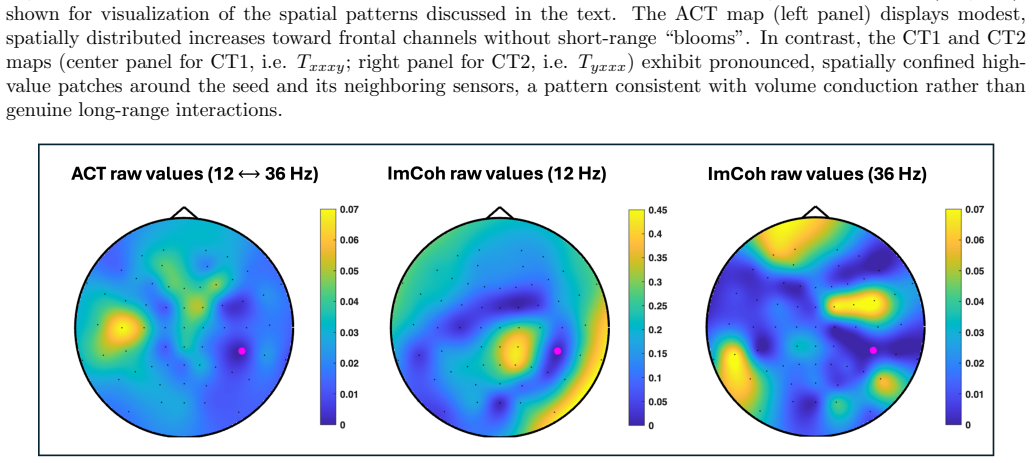
Venkadesh, S., and Van Horn, J. D. (2021). Inte- grative models of brain structure and dynamics: con- cepts, challenges, and methods. Frontiers in Neuro- science, 15, 752332. Bastiet al.: A Generalized Framework of Antisymmetric Polyspectral Indices11 Figure S1: Thresholded single-subject connectome for ACT, shown as a collection of seed-based maps displa...
2021
discussion (0)
Sign in with ORCID, Apple, or X to comment. Anyone can read and Pith papers without signing in.