Traveling-wave behavior for Fisher-KPP equations in the hyperbolic space
Pith reviewed 2026-05-08 17:17 UTC · model grok-4.3
The pith
Fisher-KPP solutions in hyperbolic space with symmetry converge in shape to Euclidean minimal-speed traveling waves in a moving frame determined by the isometry subgroup.
A machine-rendered reading of the paper's core claim, the machinery that carries it, and where it could break.
Core claim
We prove that if the initial datum is invariant under a cohomogeneity one subgroup of isometries, then in the propagation case the solution converges in shape to an Euclidean traveling wave of minimal speed in an appropriate moving frame. The frame depends on whether the subgroup is elliptic, hyperbolic or parabolic. The asymptotic spreading speed depends on the dimension, while the coefficient of the logarithmic correction in the location of the front does not depend on the underlying isometry.
What carries the argument
Symmetry reduction to a one-dimensional problem using invariance under elliptic, hyperbolic or parabolic subgroups of isometries, followed by comparison with Euclidean traveling waves in a suitably translated frame.
If this is right
- The solution propagates if the reaction term dominates the infimum of the spectrum of the Laplace-Beltrami operator.
- Vanishing occurs when diffusion is sufficiently strong relative to reaction.
- The shape convergence holds specifically for the reduced unidimensional equation.
- The logarithmic correction coefficient is universal across different symmetry types.
Where Pith is reading between the lines
- If the symmetry assumption is dropped, full multidimensional convergence might still hold but would require different techniques.
- These results could extend to other reaction-diffusion models on spaces of constant negative curvature.
- The dimension dependence of speed highlights how geometry influences propagation rates in curved spaces.
Load-bearing premise
The initial condition must possess invariance under one of the specified subgroups of isometries to reduce the problem to one spatial dimension.
What would settle it
Observing that the front location deviates from the predicted position including the dimension-dependent speed and universal log correction for a symmetric initial datum would contradict the result.
Figures



read the original abstract
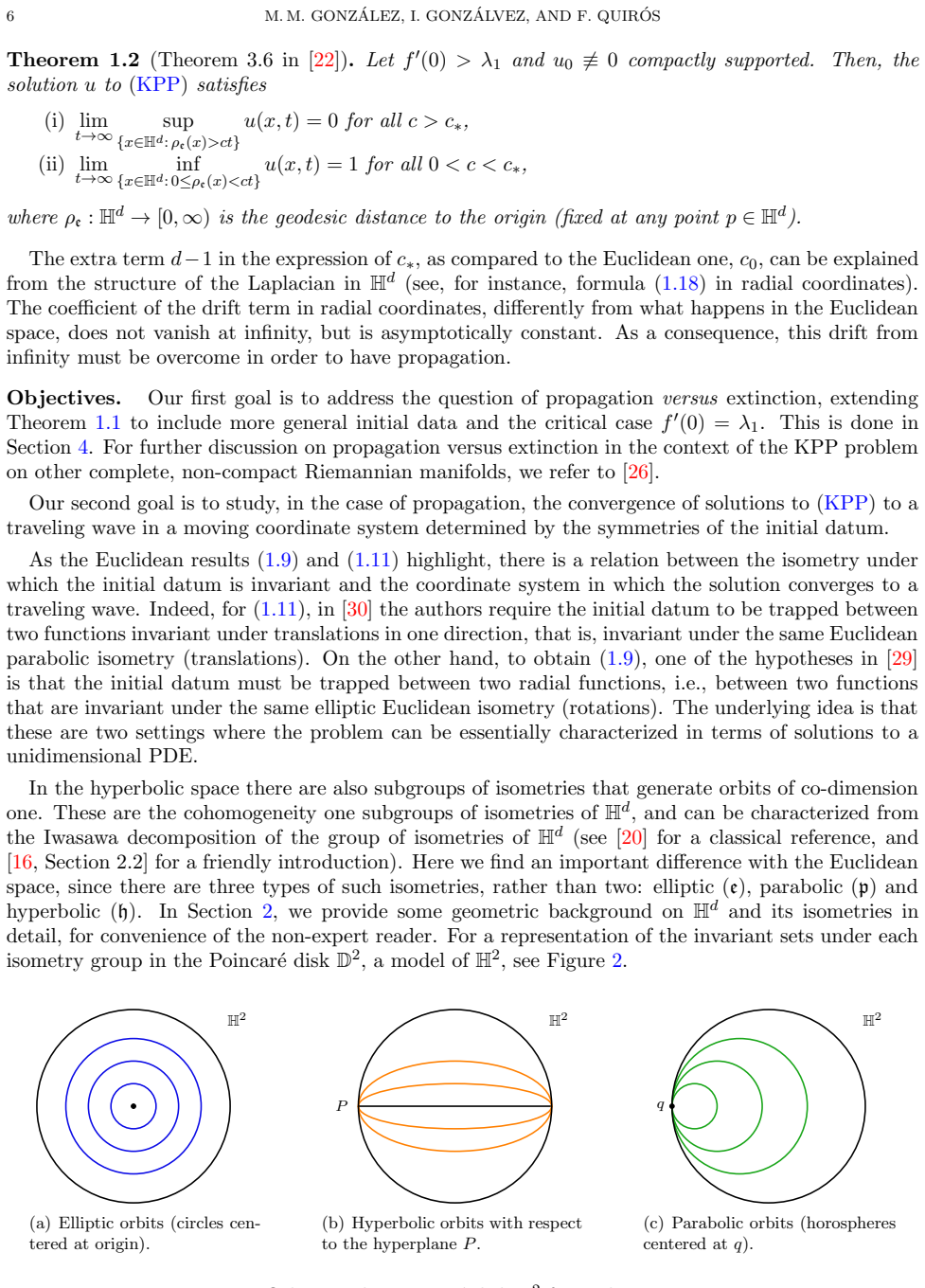
We study the Cauchy problem in the hyperbolic space for the heat equation with a Fisher-KPP type forcing term. Depending on the relative strength of diffusion, measured by the infimum of the spectrum of the Laplace-Beltrami operator, as compared to the growth due to the forcing term, solutions may propagate or vanish as time passes. We prove new results concerning this dichotomy that include the critical case where diffusion and reaction are of the same order. If the initial datum possesses some symmetry (invariance under a cohomogeneity one subgroup of the group of isometries of the hyperbolic space), the problem reduces to a unidimensional one. In the case of propagation, the solution to this unidimensional problem converges in shape to an Euclidean traveling wave of minimal speed in an appropriate moving frame. The choice of this frame depends on the subgroup of isometries (elliptic, hyperbolic or parabolic) under which the initial datum is invariant. In contrast with the Euclidean case, the asymptotic spreading speed (in due coordinates) depends on the dimension, while the coefficient of the logarithmic correction in the location of the front does not, no matter the underlying isometry.
Editorial analysis
A structured set of objections, weighed in public.
Referee Report
Summary. The paper studies the Cauchy problem for the Fisher-KPP equation on hyperbolic space. It proves a dichotomy between propagation and extinction (including the critical regime where the reaction term strength equals the bottom of the Laplace-Beltrami spectrum). For initial data invariant under a cohomogeneity-one isometry subgroup, the PDE reduces to a one-dimensional problem; in the propagation case the solution converges in shape to a Euclidean minimal-speed traveling wave in a moving frame whose choice depends on the symmetry type (elliptic, hyperbolic or parabolic). The asymptotic spreading speed (in adapted coordinates) depends on dimension, while the coefficient of the logarithmic correction to the front location is independent of the isometry type.
Significance. If the proofs hold, the work extends classical traveling-wave theory for Fisher-KPP equations to curved geometries, showing how the negative curvature of hyperbolic space and the choice of symmetry affect both the spreading speed and the frame in which shape convergence occurs. The treatment of the critical case and the separation between dimension-dependent speed and universal logarithmic correction constitute genuine additions to the literature; the symmetry reduction to a unidimensional problem is a technically clean device that permits direct comparison with the Euclidean minimal-speed wave.
major comments (2)
- The central claim that shape convergence occurs to the Euclidean minimal-speed wave after a symmetry-dependent frame shift is load-bearing; the manuscript should supply an explicit statement (with reference to the appropriate theorem) of the precise change of variables that maps the reduced one-dimensional hyperbolic problem onto the Euclidean traveling-wave ODE, including the precise form of the logarithmic correction term.
- In the critical regime (reaction strength equal to the bottom of the spectrum), the dichotomy proof necessarily relies on delicate spectral estimates and comparison principles; the manuscript should verify that the error estimates controlling the transition from extinction to propagation remain uniform across the three symmetry classes and do not introduce post-hoc choices of constants.
minor comments (2)
- The abstract states that the spreading speed depends on dimension while the logarithmic coefficient does not; a short comparative table or remark contrasting the three symmetry cases with the Euclidean setting would improve readability.
- Notation for the moving frame (especially the time-dependent shift that absorbs the logarithmic correction) should be introduced once and used consistently in all statements of the main theorems.
Simulated Author's Rebuttal
We thank the referee for the careful reading of the manuscript and for recommending minor revision. We address each major comment below.
read point-by-point responses
-
Referee: The central claim that shape convergence occurs to the Euclidean minimal-speed wave after a symmetry-dependent frame shift is load-bearing; the manuscript should supply an explicit statement (with reference to the appropriate theorem) of the precise change of variables that maps the reduced one-dimensional hyperbolic problem onto the Euclidean traveling-wave ODE, including the precise form of the logarithmic correction term.
Authors: We agree that an explicit statement of the change of variables will improve readability. In the revised manuscript we will add a dedicated paragraph immediately after the symmetry reduction (in the section introducing the three cases), referencing the main shape-convergence theorem. The paragraph will state, for each symmetry class, the precise moving-frame transformation that converts the reduced one-dimensional hyperbolic equation into the standard Euclidean minimal-speed traveling-wave ODE, together with the explicit form of the dimension-dependent speed and the logarithmic correction term whose coefficient is independent of the isometry type. revision: yes
-
Referee: In the critical regime (reaction strength equal to the bottom of the spectrum), the dichotomy proof necessarily relies on delicate spectral estimates and comparison principles; the manuscript should verify that the error estimates controlling the transition from extinction to propagation remain uniform across the three symmetry classes and do not introduce post-hoc choices of constants.
Authors: The spectral estimates and comparison principles used in the critical case are formulated in the reduced one-dimensional setting and rely only on the common bottom of the Laplace-Beltrami spectrum; they therefore apply uniformly to the elliptic, hyperbolic and parabolic reductions without symmetry-specific adjustments. To make this uniformity fully transparent we will add a short remark (or a brief appendix paragraph) confirming that the constants appearing in the error estimates are chosen independently of the symmetry class and do not involve post-hoc selections. revision: yes
Circularity Check
No significant circularity
full rationale
The derivation relies on symmetry reduction of the Fisher-KPP equation under cohomogeneity-one isometry subgroups (elliptic, hyperbolic, parabolic), followed by application of standard comparison principles, traveling-wave stability, and spectral properties of the Laplace-Beltrami operator on hyperbolic space. These tools are independent of the target result; the claimed convergence in shape to a Euclidean minimal-speed traveling wave (with dimension-dependent speed but universal logarithmic correction) follows directly from the reduced 1D problem without self-definitional equations, fitted parameters renamed as predictions, or load-bearing self-citations. The abstract and described claims are internally consistent with classical Fisher-KPP techniques once the symmetry assumption is granted.
Axiom & Free-Parameter Ledger
axioms (2)
- domain assumption The infimum of the spectrum of the Laplace-Beltrami operator on hyperbolic space controls the effective diffusion strength relative to the reaction term.
- standard math Standard comparison and maximum principles for parabolic equations hold on hyperbolic space.
Reference graph
Works this paper leans on
-
[1]
Partial differential equations and related topics (Program, Tulane Univ., New Orleans, La., 1974)
Aronson, D. G.; Weinberger, H. F.Nonlinear diffusion in population genetics, combustion, and nerve pulse propagation.In “Partial differential equations and related topics (Program, Tulane Univ., New Orleans, La., 1974)”, pp. 5–49, Lecture Notes in Math., Vol. 446, Springer, Berlin-New York, 1975
1974
-
[2]
G.; Weinberger, H
Aronson, D. G.; Weinberger, H. F.Multidimensional nonlinear diffusion arising in population genetics.Adv. in Math. 30 (1978), no. 1, 33–76
1978
-
[3]
Berchio, E.; Bonforte, M.; Ganguly, D.; Grillo, G.The fractional porous medium equation on the hyperbolic space.Calc. Var. Partial Differential Equations 59 (2020), no. 5, Paper No. 169, 36 pp
2020
-
[4]
Nonlinear Stud
Bir´ o, Z.Stability of travelling waves for degenerate reaction-diffusion equations of KPP-type.Adv. Nonlinear Stud. 2 (2002), no. 4, 357–371
2002
-
[5]
D.Maximal displacement of branching Brownian motion.Comm
Bramson, M. D.Maximal displacement of branching Brownian motion.Comm. Pure Appl. Math. 31 (1978), no. 5, 531–581
1978
-
[6]
Bramson, M.Convergence of solutions of the Kolmogorov equation to travelling waves.Mem. Amer. Math. Soc. 44 (1983), no. 285
1983
-
[7]
Birindelli, I.; Mazzeo, R.Symmetry for solutions of two-phase semilinear elliptic equations on hyperbolic space.Indiana Univ. Math. J. 58 (2009), no. 5, 2347–2368
2009
-
[8]
Chossat, P.; Faye, G.Pattern formation for the Swift-Hohenberg equation on the hyperbolic plane. J. Dynam. Differential Equations 27 (2015), no. 3-4, 485–531
2015
-
[9]
Heat kernels and spectral theory
Davies, E. B. “Heat kernels and spectral theory.” Cambridge Tracts in Mathematics, 92. Cam- bridge University Press, Cambridge, 1990. ISBN: 0-521-40997-7
1990
-
[10]
Du, Y.; G´ arriz, A.; Quir´ os, F.Precise travelling-wave behaviour in problems with doubly nonlinear diffusion.J. Eur. Math. Soc. (2025), published online first, DOI: 10.4171/JEMS/1590. 32 M. M. GONZ ´ALEZ, I. GONZ ´ALVEZ, AND F. QUIR ´OS
-
[11]
Du, Y.; Quir´ os, F.; Zhou, M.Logarithmic corrections in Fisher-KPP problems for the porous medium equation.J. Math. Pures Appl. 136 (2020), no. 3, 415–455
2020
-
[12]
C.; McLeod, J
Fife, P. C.; McLeod, J. B.The approach of solutions of nonlinear diffusion equations to travelling front solutions.Arch. Rational Mech. Anal. 65 (1977), no. 4, 335–361
1977
-
[13]
A.The wave of advance of advantageous genes.Ann
Fisher, R. A.The wave of advance of advantageous genes.Ann. Eugenics 7 (1937), 355–369
1937
-
[14]
195 (2020), 111736, 23 pp
G´ arriz, A.Propagation of solutions of the Porous Medium Equation with reaction and their trav- elling wave behaviour.Nonlinear Anal. 195 (2020), 111736, 23 pp
2020
-
[15]
G¨ artner, J.Location of wave fronts for the multidimensional KPP equation and Brownian first exit densities.Math. Nachr. 105 (1982), 317–351
1982
-
[16]
Gonz´ alez, M. d. M.; S´ aez, M. Fractional Laplacians and extension problems: the higher rank case.Trans. Amer. Math. Soc., 370(11):8171–8213, 2018
2018
-
[17]
London Math
Grigor’yan, A.; Noguchi, M.The heat kernel on hyperbolic space.Bull. London Math. Soc. 30 (1998), no. 6, 643–650
1998
-
[18]
Hamel, F.; Nolen, J.; Roquejoffre, J.-M.; Ryzhik, L.A short proof of the logarithmic Bramson correction in Fisher-KPP equations.Netw. Heterog. Media 8 (2013), no. 1, 275–289
2013
-
[19]
I.Stabilization of solutions of the Cauchy problem for equations encountered in com- bustion theory.(Russian) Mat
Kanel’, Ja. I.Stabilization of solutions of the Cauchy problem for equations encountered in com- bustion theory.(Russian) Mat. Sb. (N.S.) 59 (101) (1962 suppl.), 245–288
1962
-
[20]
Differential geometry, Lie groups, and symmetric spaces
Helgason, S. “Differential geometry, Lie groups, and symmetric spaces”. Corrected reprint of the 1978 original. Graduate Studies in Mathematics, vol. 34. American Mathematical Society, Providence, RI, 2001
1978
-
[21]
N.; Petrovsky, I
Kolmogorov, A. N.; Petrovsky, I. G.; Piskunov, N. S. ´Etude de l’´ equation de la diffusion avec croissance de la quantit´ e de mati` ere et son application ` a un probl` eme biologique.Bull. Univ.´Etat Moscou, S´ er. Inter. A 1 (1937), 1–26
1937
-
[22]
Matano, H.; Punzo, F.; Tesei, A.Front propagation for nonlinear diffusion equations on the hyperbolic space.J. Eur. Math. Soc. (JEMS) 17 (2015), no. 5, 1199–1227
2015
-
[23]
Mazzeo, R.; Saez, M.Multiple-layer solutions to the Allen-Cahn equation on hyperbolic space. Proc. Amer. Math. Soc. 142 (2014), no. 8, 2859–2869
2014
-
[24]
Nolen, J.; Roquejoffre, J.-M.; Ryzhik, L.Convergence to a single wave in the Fisher-KPP equa- tion.Chinese Ann. Math. Ser. B 38 (2017), no. 2, 629–646
2017
-
[25]
A.; Punzo, F.; Tesei, A.Uniqueness and nonuniqueness of solutions to parabolic prob- lems with singular coefficients.Discrete Contin
Pozio, M. A.; Punzo, F.; Tesei, A.Uniqueness and nonuniqueness of solutions to parabolic prob- lems with singular coefficients.Discrete Contin. Dyn. Syst. 30 (2011), no. 3, 891–916
2011
-
[26]
131 (2016), 325–345
Punzo, F.Propagation and extinction of fronts for semilinear parabolic equations on Riemannian manifolds.Nonlinear Anal. 131 (2016), 325–345
2016
-
[27]
Foundations of hyperbolic manifolds
Ratcliffe, J. G. “Foundations of hyperbolic manifolds”. Third edition. Graduate Texts in Mathe- matics, 149. Springer, Cham, 2019
2019
-
[28]
The dynamics of front propagation in nonlocal reaction–diffusion equations
Roquejoffre, J.-M. “The dynamics of front propagation in nonlocal reaction–diffusion equations”. Lecture Notes on Mathematical Modelling in the Life Sciences, Springer, Cham, 2024
2024
-
[29]
Roquejoffre, J.-M.; Rossi, L.; Roussier-Michon, V.Sharp large time behaviour inN-dimensional Fisher-KPP equations.Discrete Contin. Dyn. Syst. 39 (2019), no. 12, 7265–7290
2019
-
[30]
7, 3284–3307
Roquejoffre, J.-M.; Roussier-Michon, V.Nontrivial dynamics beyond the logarithmic shift in two- dimensional Fisher-KPP equations.Nonlinearity 31 (2018), no. 7, 3284–3307
2018
-
[31]
Rossi, L.Symmetrization and anti-symmetrization in parabolic equations.Proc. Amer. Math. Soc. 145 (2017), no. 6, 2527–2537
2017
-
[32]
N.On two types of moving front in quasilinear diffusion.Math
Stokes, A. N.On two types of moving front in quasilinear diffusion.Math. Biosci. 31 (1976), no. 3–4, 307–315
1976
-
[33]
Uchiyama, K.The behavior of solutions of some nonlinear diffusion equations for large time.J. Math. Kyoto Univ. 18 (1978), no. 3, 453–508
1978
-
[34]
Rational Mech
Uchiyama, K.Asymptotic behavior of solutions of reaction-diffusion equations with varying drift coefficients.Arch. Rational Mech. Anal. 90 (1985), no. 4, 291–311
1985
-
[35]
L.Asymptotic behaviour for the heat equation in hyperbolic space.Comm
V´ azquez, J. L.Asymptotic behaviour for the heat equation in hyperbolic space.Comm. Anal. Geom. 30 (2022), no. 9, 2123–2156
2022
-
[36]
L.Asymptotic behavior methods for the Heat Equation
V´ azquez, J. L.Asymptotic behavior methods for the Heat Equation. Convergence to the Gaussian. Preprint (2017). Available atarXiv:1706.10034 [math.AP]. KPP EQUATIONS IN THE HYPERBOLIC SPACE 33
-
[37]
L.Fundamental solution and long time behavior of the porous medium equation in hyperbolic space.J
V´ azquez, J. L.Fundamental solution and long time behavior of the porous medium equation in hyperbolic space.J. Math. Pures Appl. (9) 104 (2015), no. 3, 454–484. (M. M. Gonz´ alez)Departamento de Matem´aticas, Universidad Aut´onoma de Madrid & Instituto de Cien- cias Matem´aticas ICMAT (CSIC-UAM-UCM-UC3M). Campus de Cantoblanco, 28049 Madrid, Spain Email...
2015
discussion (0)
Sign in with ORCID, Apple, or X to comment. Anyone can read and Pith papers without signing in.