Recognition: unknown
A Separation Between Optimal Demand-Oblivious and Demand-Aware Network Throughput
Pith reviewed 2026-05-08 16:41 UTC · model grok-4.3
The pith
Demand-aware network topologies achieve at least 5/8 asymptotic throughput, outperforming the roughly 1/2 limit of demand-oblivious topologies.
A machine-rendered reading of the paper's core claim, the machinery that carries it, and where it could break.
Core claim
The central claim is a separation for the classic throughput definition: by choosing a topology that matches the demand, the achievable throughput asymptotically approaches at least 5/8, whereas demand-oblivious topologies are bounded by n/(2n-1) which approaches 1/2. The same separation holds under both direct and general routing. In addition, computing the demand-aware weak throughput is NP-hard while the direct variants admit polynomial-time algorithms.
What carries the argument
Classic throughput under demand-aware topology selection, contrasted with demand-oblivious performance, across direct (single-hop) and general (multi-hop) routing models.
If this is right
- Worst-case throughput rises from approximately 1/2 to at least 5/8 once topologies may adapt to demands.
- Direct-routing optimal topologies can be found efficiently in polynomial time.
- Weak-throughput optimization remains NP-hard, so practical solvers must rely on heuristics or approximations.
- The performance gap between adaptive and fixed topologies persists as the network grows.
Where Pith is reading between the lines
- Datacenter operators could use these bounds to decide when reconfigurable hardware justifies its cost.
- Similar separation arguments may apply to other adaptive systems such as wireless or software-defined networks.
- The NP-hardness result suggests studying approximation algorithms or restricted demand classes for faster practical deployment.
Load-bearing premise
Any desired topology can be realized exactly to serve the given demand matrix without limits on ports or reconfiguration speed.
What would settle it
A family of demand matrices on n nodes for which the maximum classic throughput achievable by any demand-aware topology stays below 5/8 - epsilon for large n would disprove the lower bound.
Figures




read the original abstract
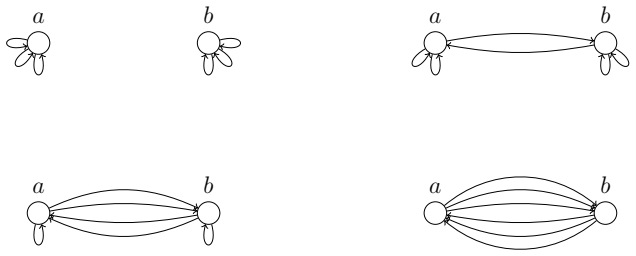
The performance of distributed applications often critically depends on the interconnecting network or more specifically on its throughput: how fast data can be carried across a network. Over the last years, great progress has been made in understanding demand-oblivious throughput: how fast a given demand matrix describing pairwise communication requirements can be served on a given network. However, surprisingly little is known today about the achievable demand-aware throughput: the throughput on a network topology which can be optimized toward the demand. Such demand-aware networks have recently gained popularity in datacenters and are enabled by emerging reconfigurable optical technologies. In this paper, we are interested in both the achievable demand-aware throughput bounds as well as in the computational complexity of finding a throughput-optimizing network topology. We take a systematic approach and investigate four variants of demand-aware throughput: we analyze, and derive bounds for, two definitions of throughput, the classic throughput usually considered in the literature, and a new generalized definition which we call weak throughput; for each of them, we consider two routing models, a direct one, where demand can only be served on a single hop, and a general one, where multi-hop routing is allowed. Our main result is a separation result which solves an open problem in the literature about the classic throughput definition, showing that demand-aware topologies can outperform demand-oblivious topologies even in the worst case: the demand-aware throughput asymptotically approaches at least 5/8, while it is known that the demand-oblivious throughput is n/(2n-1), which is roughly 1/2. In terms of computational complexity, we show that computing the demand-aware weak throughput is NP-hard, but computing the demand-aware (weak) direct throughput is polynomial-time solvable.
Editorial analysis
A structured set of objections, weighed in public.
Referee Report
Summary. The paper analyzes four variants of demand-aware network throughput (classic vs. weak definitions, each under direct single-hop and general multi-hop routing) and establishes a separation from demand-oblivious throughput. Its central claim is that demand-aware classic throughput achieves an asymptotic worst-case guarantee of at least 5/8, improving on the known demand-oblivious bound of n/(2n-1) ≈ 1/2; it further shows that computing demand-aware weak throughput is NP-hard while the direct-throughput variants are polynomial-time solvable.
Significance. If the separation and complexity results hold, the work resolves an open question by proving that demand-aware topologies can strictly outperform demand-oblivious ones even in the worst case over demand matrices. This has direct implications for reconfigurable optical datacenter networks. The paper's strength is its clean graph-theoretic derivation of the 5/8 lower bound and the matching complexity dichotomy, both obtained without fitted parameters or circular definitions.
minor comments (2)
- The abstract states that the demand-aware throughput 'asymptotically approaches at least 5/8' but does not explicitly indicate the limit (e.g., as n → ∞). Adding this clarification would prevent misinterpretation.
- A summary table listing the four variants together with their proven bounds and complexity status would improve readability and allow readers to compare the results at a glance.
Simulated Author's Rebuttal
We thank the referee for the careful reading, positive summary, and recommendation of minor revision. We are pleased that the separation result and complexity dichotomy are viewed as resolving an open question with implications for reconfigurable datacenter networks. Since no specific major comments were raised, we address the overall feedback below and will incorporate any minor editorial suggestions in the revised version.
Circularity Check
No significant circularity detected
full rationale
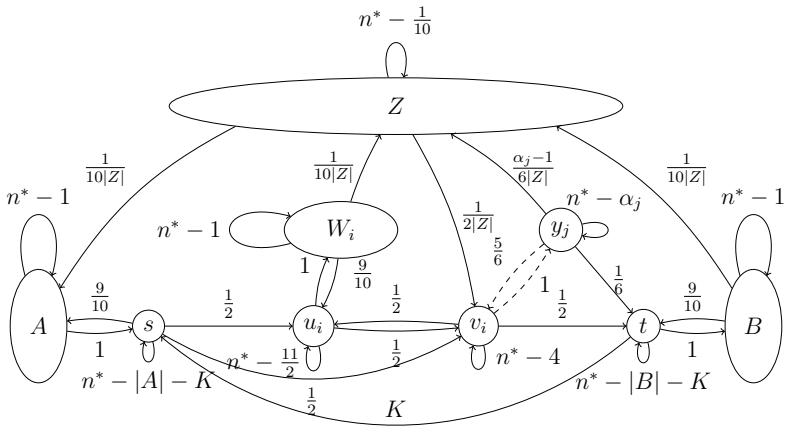
The derivation of the 5/8 asymptotic lower bound on demand-aware classic throughput and the n/(2n-1) comparison to demand-oblivious throughput rests on explicit worst-case analysis over arbitrary demand matrices and topology choices under the direct/general routing models. Complexity results (NP-hardness for weak throughput, polynomial-time for direct) are obtained via standard reductions on bipartite matching and flow problems. No equation or claim reduces by construction to a fitted parameter, self-definition, or load-bearing self-citation; all bounds are externally falsifiable combinatorial statements independent of the paper's own inputs.
Axiom & Free-Parameter Ledger
axioms (2)
- standard math Networks are modeled as undirected graphs with unit-capacity edges.
- domain assumption Demand matrices are arbitrary non-negative real matrices representing pairwise communication requirements.
Reference graph
Works this paper leans on
-
[1]
Vamsi Addanki, Chen Avin, and Stefan Schmid. Mars: Near-optimal through- put with shallow buffers in reconfigurable datacenter networks.Proceedings of the ACM on Measurement and Analysis of Computing Systems, 7(1):2:1–2:43, 2023. doi: 10.1145/3579312
-
[2]
Vamsi Addanki, Chen Avin, Goran Dario Knabe, Giannis Patronas, Dimitris Syriv- elis, Nikos Terzenidis, Paraskevas Bakopoulos, Ilias Marinos, and Stefan Schmid. Ver- 32 milion: A traffic-aware reconfigurable optical interconnect with formal throughput guarantees.CoRR, abs/2504.09892, 2025. doi: 10.48550/ARXIV.2504.09892
-
[3]
Binkert, Al Davis, Moray McLaren, and Robert S
Jung Ho Ahn, Nathan L. Binkert, Al Davis, Moray McLaren, and Robert S. Schreiber. Hyperx: Topology, routing, and packaging of efficient large-scale net- works. InProceedings of the 2009 International Conference for High Performance Computing, Networking, Storage and Analysis (SC), pages 1–11. ACM, 2009. doi: 10.1145/1654059.1654101
-
[4]
Ahuja, Thomas L
Ravindra K. Ahuja, Thomas L. Magnanti, and James B. Orlin.Network flows – Theory, algorithms and applications. Prentice Hall, 1993. ISBN 978-0-13-617549-0
1993
-
[5]
Mohammad Al-Fares, Alexander Loukissas, and Amin Vahdat. A scalable, commod- ity data center network architecture. InProceedings of the ACM SIGCOMM 2008 Conference, pages 63–74. ACM, 2008. doi: 10.1145/1402958.1402967
-
[6]
Optimal oblivious reconfigurable networks
Daniel Amir, Tegan Wilson, Vishal Shrivastav, Hakim Weatherspoon, Robert Klein- berg, and Rachit Agarwal. Optimal oblivious reconfigurable networks. InProceedings of the 54th Annual ACM SIGACT Symposium on Theory of Computing (STOC), pages 1339–1352. ACM, 2022. doi: 10.1145/3519935.3520020
-
[7]
Chen Avin and Stefan Schmid. Revolutionizing datacenter networks via reconfigurable topologies.Communications of the ACM, 68(6):44–53, 2025. doi: 10.1145/3708980
-
[8]
Demand-aware network designs of bounded degree.Distributed Computing, 33(3-4):311–325, 2020
Chen Avin, Kaushik Mondal, and Stefan Schmid. Demand-aware network designs of bounded degree.Distributed Computing, 33(3-4):311–325, 2020. doi: 10.1007/S00446- 019-00351-5
-
[9]
Chen Avin, Kaushik Mondal, and Stefan Schmid. Demand-aware network design with minimal congestion and route lengths.IEEE/ACM Transactions on Networking, 30 (4):1838–1848, 2022. doi: 10.1109/TNET.2022.3153586
-
[10]
Navid Hamed Azimi, Zafar Ayyub Qazi, Himanshu Gupta, Vyas Sekar, Samir R. Das, Jon P. Longtin, Himanshu Shah, and Ashish Tanwer. Firefly: A reconfigurable wireless data center fabric using free-space optics. InProceedings of the ACM SIGCOMM 2014 Conference, pages 319–330. ACM, 2014. doi: 10.1145/2619239.2626328
-
[11]
Universal connection schedules for reconfigurable networking
Shaleen Baral, Robert Kleinberg, Sylvan Martin, Henry Rogers, Tegan Wilson, and Ruogu Zhang. Universal connection schedules for reconfigurable networking. InPro- ceedings of the 37th Annual ACM-SIAM Symposium on Discrete Algorithms (SODA), pages 4996–5026. SIAM, 2026. doi: 10.1137/1.9781611978971.18
-
[12]
Curtis, Tommy Carpenter, Mustafa Elsheikh, Alejandro L´ opez-Ortiz, and Srinivasan Keshav
Andrew R. Curtis, Tommy Carpenter, Mustafa Elsheikh, Alejandro L´ opez-Ortiz, and Srinivasan Keshav. REWIRE: An optimization-based framework for unstructured data center network design. InProceedings of the 31st Annual Joint Conference of the IEEE Computer and Communications Societies (INFOCOM), pages 1116–1124. IEEE, 2012. doi: 10.1109/INFCOM.2012.6195470. 33
-
[13]
Shafayat Rahman, Xin Yuan, Scott Pakin, and Mike Lang
Peyman Faizian, Md Atiqul Mollah, Md. Shafayat Rahman, Xin Yuan, Scott Pakin, and Mike Lang. Throughput models of interconnection networks: The good, the bad, and the ugly. InProceedings of the 25th IEEE Annual Symposium on High- Performance Interconnects (HOTI), pages 33–40. IEEE Computer Society, 2017. doi: 10.1109/HOTI.2017.21
-
[14]
Helios: A hybrid electrical/optical switch architecture for modular data centers
Nathan Farrington, George Porter, Sivasankar Radhakrishnan, Hamid Hajabdolali Bazzaz, Vikram Subramanya, Yeshaiahu Fainman, George Papen, and Amin Vahdat. Helios: A hybrid electrical/optical switch architecture for modular data centers. In Proceedings of the ACM SIGCOMM 2010 Conference, pages 339–350. ACM, 2010. doi: 10.1145/1851182.1851223
-
[15]
Nathan Farrington, Alex Forencich, George Porter, P.-C. Sun, Joseph E. Ford, Yesha- iahu Fainman, George C. Papen, and Amin Vahdat. A multiport microsecond optical circuit switch for data center networking.IEEE Photonics Technology Letters, 25(16): 1589–1592, 2013. doi: 10.1109/LPT.2013.2270462
-
[16]
Rajiv Gandhi, Samir Khuller, Srinivasan Parthasarathy, and Aravind Srinivasan. De- pendent rounding and its applications to approximation algorithms.Journal of the ACM, 53(3):324–360, 2006. doi: 10.1145/1147954.1147956
-
[17]
Garey and David S
Michael R. Garey and David S. Johnson.Computers and Intractability: A Guide to the Theory of NP-Completeness. W. H. Freeman, 1979. ISBN 0-7167-1044-7
1979
-
[18]
Monia Ghobadi, Ratul Mahajan, Amar Phanishayee, Nikhil R. Devanur, Janardhan Kulkarni, Gireeja Ranade, Pierre-Alexandre Blanche, Houman Rastegarfar, Madeleine Glick, and Daniel C. Kilper. ProjecToR: Agile reconfigurable data center interconnect. InProceedings of the ACM SIGCOMM 2016 Conference, pages 216–229. ACM, 2016. doi: 10.1145/2934872.2934911
-
[19]
Albert G. Greenberg, James R. Hamilton, Navendu Jain, Srikanth Kandula, Changhoon Kim, Parantap Lahiri, David A. Maltz, Parveen Patel, and Sudipta Sen- gupta. VL2: A scalable and flexible data center network.Communications of the ACM, 54(3):95–104, 2011. doi: 10.1145/1897852.1897877
-
[20]
Chen Griner, Johannes Zerwas, Andreas Blenk, Manya Ghobadi, Stefan Schmid, and Chen Avin. Cerberus: The power of choices in datacenter topology design – A through- put perspective.Proceedings of the ACM on Measurement and Analysis of Computing Systems, 5(3):38:1–38:33, 2021. doi: 10.1145/3491050
-
[21]
A survey of reconfigurable optical networks.Optical Switching and Network- ing, 41:100621, 2021
Matthew Nance Hall, Klaus-Tycho Foerster, Stefan Schmid, and Ramakrishnan Du- rairajan. A survey of reconfigurable optical networks.Optical Switching and Network- ing, 41:100621, 2021. doi: 10.1016/J.OSN.2021.100621. 34
-
[22]
Nikhil Jain, Abhinav Bhatele, Xiang Ni, Nicholas J. Wright, and Laxmikant V. Kal´ e. Maximizing throughput on a dragonfly network. InProceedings of the 2014 Interna- tional Conference for High Performance Computing, Networking, Storage and Analy- sis (SC), pages 336–347. IEEE Computer Society, 2014. doi: 10.1109/SC.2014.33
-
[23]
Measuring and understanding throughput of network topologies
Sangeetha Abdu Jyothi, Ankit Singla, Brighten Godfrey, and Alexandra Kolla. Measuring and understanding throughput of network topologies. InProceedings of the 2016 International Conference for High Performance Computing, Networking, Storage and Analysis (SC), pages 761–772. IEEE Computer Society, 2016. doi: 10.1109/SC.2016.64
-
[24]
Isaac Keslassy, Cheng-Shang Chang, Nick McKeown, and Duan-Shin Lee. Optimal load-balancing. InProceedings of the 24th Annual Joint Conference of the IEEE Computer and Communications Societies (INFOCOM), pages 1712–1722. IEEE, 2005. doi: 10.1109/INFCOM.2005.1498452
-
[25]
HPCC: high precision congestion control,
Yuliang Li, Rui Miao, Hongqiang Harry Liu, Yan Zhuang, Fei Feng, Lingbo Tang, Zheng Cao, Ming Zhang, Frank Kelly, Mohammad Alizadeh, and Minlan Yu. HPCC: High precision congestion control. InProceedings of the ACM SIGCOMM 2019 Con- ference, pages 44–58. ACM, 2019. doi: 10.1145/3341302.3342085
-
[26]
Mellette, Rob McGuinness, Arjun Roy, Alex Forencich, George Papen, Alex C
William M. Mellette, Rob McGuinness, Arjun Roy, Alex Forencich, George Papen, Alex C. Snoeren, and George Porter. Rotornet: A scalable, low-complexity, optical datacenter network. InProceedings of the ACM SIGCOMM 2017 Conference, pages 267–280. ACM, 2017. doi: 10.1145/3098822.3098838
-
[27]
Jeffrey C. Mogul and Lucian Popa. What we talk about when we talk about cloud network performance.Computer Communication Review, 42(5):44–48, 2012. doi: 10.1145/2378956.2378964
-
[28]
Cambridge Uni- versity Press, 1995
Rajeev Motwani and Prabhakar Raghavan.Randomized Algorithms. Cambridge Uni- versity Press, 1995. ISBN 0-521-47465-5
1995
-
[29]
A throughput-centric view of the performance of datacenter topologies
Pooria Namyar, Sucha Supittayapornpong, Mingyang Zhang, Minlan Yu, and Ramesh Govindan. A throughput-centric view of the performance of datacenter topologies. In Proceedings of the ACM SIGCOMM 2021 Conference, pages 349–369. ACM, 2021. doi: 10.1145/3452296.3472913
-
[30]
Randomized distributed edge coloring via an extension of the
Alessandro Panconesi and Aravind Srinivasan. Randomized distributed edge coloring via an extension of the Chernoff-Hoeffding bounds.SIAM Journal on Computing, 26 (2):350–368, 1997. doi: 10.1137/S0097539793250767
-
[31]
Leon Poutievski, Omid Mashayekhi, Joon Ong, Arjun Singh, Muhammad Mukar- ram Bin Tariq, Rui Wang, Jianan Zhang, Virginia Beauregard, Patrick Conner, Steve D. Gribble, Rishi Kapoor, Stephen Kratzer, Nanfang Li, Hong Liu, Karthik Nagaraj, Jason Ornstein, Samir Sawhney, Ryohei Urata, Lorenzo Vicisano, Kevin 35 Yasumura, Shidong Zhang, Junlan Zhou, and Amin V...
-
[32]
High throughput data center topology design
Ankit Singla, Philip Brighten Godfrey, and Alexandra Kolla. High throughput data center topology design. InProceedings of the 11th USENIX Symposium on Networked Systems Design and Implementation (NSDI), pages 29–41. USENIX Association, 2014
2014
-
[33]
LFTI: A new performance metric for assessing interconnect designs for extreme-scale HPC sys- tems
Xin Yuan, Santosh Mahapatra, Michael Lang, and Scott Pakin. LFTI: A new performance metric for assessing interconnect designs for extreme-scale HPC sys- tems. InProceedings of the 28th IEEE International Parallel and Distributed Pro- cessing Symposium (IPDPS), pages 273–282. IEEE Computer Society, 2014. doi: 10.1109/IPDPS.2014.38
-
[34]
Johannes Zerwas, Csaba Gy¨ orgyi, Andreas Blenk, Stefan Schmid, and Chen Avin. Duo: A high-throughput reconfigurable datacenter network using local routing and control.Proceedings of the ACM on Measurement and Analysis of Computing Systems, 7(1):20:1–20:25, 2023. doi: 10.1145/3579449. 36
discussion (0)
Sign in with ORCID, Apple, or X to comment. Anyone can read and Pith papers without signing in.