Recognition: unknown
Lithium enrichment threatens to curb fusion deployment
Pith reviewed 2026-05-08 16:42 UTC · model grok-4.3
The pith
Enriched lithium inventories turn fuel into a major capital cost for fusion reactors.
A machine-rendered reading of the paper's core claim, the machinery that carries it, and where it could break.
Core claim
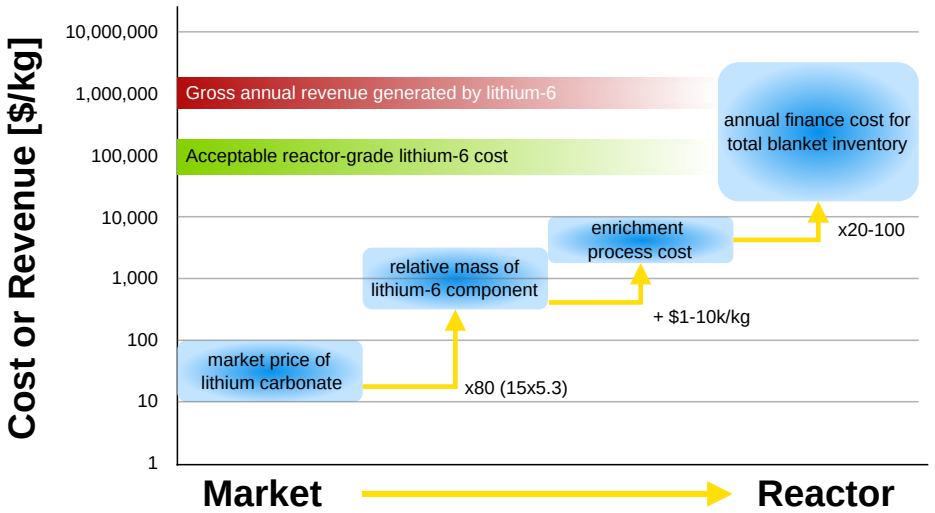
Lithium isotopic enrichment, required for tritium breeding, necessitates 50-100 tonne inventories of highly enriched material per reactor, converting what appears to be low-consumption fuel into a dominant capital expenditure while current enrichment technologies remain expensive, unscalable, and environmentally risky.
What carries the argument
The tritium breeding blanket lithium inventory combined with the isotopic enrichment step that supplies it.
Load-bearing premise
That tritium breeding inefficiencies cannot be reduced enough by reactor redesign to shrink the required lithium inventory volumes substantially.
What would settle it
Demonstration of a tritium breeding ratio above 1.1 in a blanket using natural unenriched lithium while keeping total lithium inventory below 20 tonnes.
Figures

read the original abstract
The impact of lithium isotopic enrichment on the global deployment of nuclear fusion energy is analysed. Lithium - the 6Li isotope in particular - is essentially one of two elemental fuels required by fusion reactors for tritium breeding. Whilst variable consumption of lithium is low enough to present negligible cost, it is instead the large stored inventory volume (50-100 tonnes) and its required enrichment that compound to significantly drive capital costs. These costs are driven by the inefficiency of the tritium breeding process, making this challenge fundamental to almost all fusion power plant concepts. Financing would further compound these effects, making lithium fusion fuels more akin to an upfront capital expenditure than operational expenditure. Other potential barriers to fusion deployment created by lithium are also discussed: enrichment technologies of today are shown to be too expensive, not scalable, and environmentally risky, and highly enriched 6Li is a controlled substance. Mitigating actions include: developing alternative enrichment technologies that are affordable, scalable, and do not rely on mercury; incorporating lithium enrichment as an explicit cost driver in reactor design processes, producing more compact reactors with smaller lithium inventories; establishing distinct enrichment levels to enable supply chain monitoring for misuse; and the most radical solution: breeding blankets that use natural, unenriched lithium. These actions may impact tritium breeding capabilities, which calls for an urgent re-assessment of the tritium breeding paradigm. Whatever solution is sought, lithium supply is a mission-critical issue that needs urgently addressing.
Editorial analysis
A structured set of objections, weighed in public.
Referee Report
Summary. The paper claims that lithium (particularly 6Li) is a key fuel for tritium breeding in fusion reactors, but the large required stored inventory (50-100 tonnes) combined with isotopic enrichment requirements significantly drives capital costs, rendering lithium more akin to an upfront CAPEX item than OPEX. Current mercury-based enrichment methods are described as too expensive, unscalable, and environmentally risky, with highly enriched 6Li being a controlled substance. The authors discuss other barriers and propose mitigations including new enrichment technologies, compact reactor designs with smaller inventories, supply-chain monitoring via distinct enrichment levels, and the radical option of natural-lithium breeding blankets, while calling for urgent re-assessment of the tritium-breeding paradigm.
Significance. If the cost claims can be placed on a quantitative footing, the work would usefully flag a mission-critical supply-chain and financing issue for fusion deployment that has received limited attention. The explicit framing of inventory volume as a CAPEX driver due to breeding inefficiency, together with the regulatory and environmental discussion, provides a constructive starting point for design trade-offs. The paper also earns credit for enumerating concrete mitigating actions and for highlighting the controlled-substance status of enriched 6Li.
major comments (3)
- [Abstract] Abstract: the central assertion that the 50-100 tonne lithium inventory plus required 6Li enrichment 'significantly drive capital costs' and are 'akin to an upfront capital expenditure' is presented without any explicit cost figures, scaling with enrichment level, or comparison against typical GW-scale plant overnight capital costs ($5-10 B). This quantitative gap is load-bearing for the threat-to-deployment claim.
- [Abstract] Abstract and discussion of mitigating actions: the statements that today's enrichment technologies are 'too expensive, not scalable, and environmentally risky' remain qualitative; no specific cost data, throughput limits, or quantified environmental metrics are supplied, which is required to assess the practicality of the proposed alternative enrichment routes.
- [Abstract] Abstract: the 50-100 tonne inventory range is stated without derivation from specific reactor designs or sensitivity analysis showing how variations in this volume (or in tritium-breeding ratio) propagate into the cost conclusions.
minor comments (1)
- [Abstract] The abstract would be clearer if it explicitly separated the negligible variable-consumption cost from the inventory-related financing cost.
Simulated Author's Rebuttal
We thank the referee for their thoughtful review and constructive suggestions. The comments highlight the need for greater quantitative rigor in our claims, which we will address in the revised manuscript.
read point-by-point responses
-
Referee: [Abstract] Abstract: the central assertion that the 50-100 tonne lithium inventory plus required 6Li enrichment 'significantly drive capital costs' and are 'akin to an upfront capital expenditure' is presented without any explicit cost figures, scaling with enrichment level, or comparison against typical GW-scale plant overnight capital costs ($5-10 B). This quantitative gap is load-bearing for the threat-to-deployment claim.
Authors: We acknowledge this limitation in the abstract. The full manuscript provides context on lithium costs based on market prices for enriched isotopes, but we agree that explicit figures and a comparison to typical plant capital costs ($5-10B) would better support the claim. In the revision, we will include an estimate of the capital cost associated with the lithium inventory (using approximate current prices for highly enriched 6Li) and discuss its significance relative to overall plant costs, including how financing amplifies the effect. This will be added to both the abstract and the main discussion. revision: yes
-
Referee: [Abstract] Abstract and discussion of mitigating actions: the statements that today's enrichment technologies are 'too expensive, not scalable, and environmentally risky' remain qualitative; no specific cost data, throughput limits, or quantified environmental metrics are supplied, which is required to assess the practicality of the proposed alternative enrichment routes.
Authors: The manuscript draws on historical evidence from nuclear programs to characterize current mercury-based enrichment as costly and environmentally challenging, but we recognize the need for more specific data. We will revise the relevant sections to include available quantitative information, such as estimated costs per kg from past operations, throughput capacities of existing facilities, and metrics like mercury consumption volumes or waste generation. For the proposed alternatives, we will reference literature on new methods and note their potential advantages with supporting references. revision: yes
-
Referee: [Abstract] Abstract: the 50-100 tonne inventory range is stated without derivation from specific reactor designs or sensitivity analysis showing how variations in this volume (or in tritium-breeding ratio) propagate into the cost conclusions.
Authors: The 50-100 tonne range is based on typical values reported in fusion reactor design studies for breeding blankets in devices of DEMO scale, assuming a tritium breeding ratio (TBR) of approximately 1.05-1.1 to account for inefficiencies and losses. We will add a derivation in the main text, citing specific design references, and include a sensitivity discussion on how changes in inventory size or TBR would affect the overall cost impact and deployment implications. revision: yes
Circularity Check
No circularity; claims rest on external volumes and technology limits
full rationale
The paper asserts that 50-100 tonne lithium inventories plus 6Li enrichment drive capital costs due to tritium breeding inefficiency, but provides no equations, fitted parameters, or self-referential derivations. All load-bearing statements cite external reactor design parameters and known enrichment process constraints rather than reducing any prediction to an internal fit or definition by construction. No self-citation chains, ansatzes, or renamings of known results appear in the derivation chain.
Axiom & Free-Parameter Ledger
free parameters (1)
- lithium inventory volume =
50-100 tonnes
axioms (2)
- domain assumption Tritium breeding in fusion blankets requires enriched 6Li and large stored inventories due to process inefficiency
- domain assumption Current lithium enrichment technologies are too expensive, unscalable, and environmentally risky
Reference graph
Works this paper leans on
-
[1]
The Availability & Supply of Critical Natural Resources for the Realization of a Fusion Pilot Plant: Fuels for Fusion
Richard J Pearson. The Availability & Supply of Critical Natural Resources for the Realization of a Fusion Pilot Plant: Fuels for Fusion. 2022, 2022
2022
-
[2]
Schleisner, T
L. Schleisner, T. Hamacher, H. Cabal, B. Hallberg, Y. Lech´ on, R. Korhonen, and R. M. S´ aez. Energy, material and land requirement of a fusion plant. Fusion Engineering and Design , 58-59, 2001
2001
-
[3]
Re-examining the role of nuclear fusion in a renewables-based energy mix
TEG Nicholas, TP Davis, F Federici, J Leland, BS Patel, C Vincent, and SH Ward. Re-examining the role of nuclear fusion in a renewables-based energy mix. Energy Policy , 149:112043, 2021
2021
-
[4]
Giegerich, K
T. Giegerich, K. Battes, J. C. Schwenzer, and C. Day. Development of a viable route for lithium-6 supply of DEMO and future fusion power plants. Fusion Engineering and Design , 149(July):111339, 2019
2019
-
[5]
Lithium Isotope Enrichment: Feasible Domestic Enrichment Alternatives
T Ault. Lithium Isotope Enrichment: Feasible Domestic Enrichment Alternatives. Technical report, 2012
2012
-
[6]
New Trends in Separation Techniques of Lithium Isotopes: A Review of Chemical Separation Methods
Silviu Laurentiu Badea, Violeta Carolina Niculescu, and Andreea Maria Iordache. New Trends in Separation Techniques of Lithium Isotopes: A Review of Chemical Separation Methods. Materials, 16(10), 2023
2023
-
[7]
Free, and Prashant K
Arun Murali, Zongliang Zhang, Michael L. Free, and Prashant K. Sarswat. A Comprehensive Review of Selected Major Categories of Lithium Isotope Separation Techniques. Physica Status Solidi (A) Applications and Materials Science , 218(19):1–21, 2021
2021
-
[8]
Experimental and theoretical investigations of lithium isotopes separation using 10-hydroxybenzoquinoline
Zhanqin Wang, Yongzhong Jia, Bing Liu, Mi Xiang Qi, Yan Jing, and Ying Yao. Experimental and theoretical investigations of lithium isotopes separation using 10-hydroxybenzoquinoline. Journal of Radioanalytical and Nuclear Chemistry , 331(7):3155– 3165, 2022
2022
-
[9]
A new technique of lithium isotope extraction and separation: Flotation complexation extraction
Zhanqin Wang, Yongzhong Jia, Bing Liu, Yan Jing, and Ying Yao. A new technique of lithium isotope extraction and separation: Flotation complexation extraction. Chemical Physics , 563(September):111689, 2022
2022
-
[10]
Lithium isotopes separation by using benzo-15-crown-5 in eco-friendly extraction system
Jiang Xiao, Yongzhong Jia, Chenglong Shi, Xingquan Wang, Su Wang, Ying Yao, and Yan Jing. Lithium isotopes separation by using benzo-15-crown-5 in eco-friendly extraction system. Journal of Molecular Liquids , 241:946–951, 2017
2017
-
[11]
R. A. Mulder, Y. G. Melese, and N. J. Lopes Cardozo. Plant efficiency: A sensitivity analysis of the capacity factor for fusion power plants with high recirculated power. Nuclear Fusion, 61(4):1–9, 2021
2021
-
[12]
A. M. Bradshaw, T. Hamacher, and U. Fischer. Is nuclear fusion a sustainable energy form? Fusion Engineering and Design , 86(9-11):2770–2773, 2011
2011
-
[13]
Statistical Review of World Energy (2024)
Energy Institute. Statistical Review of World Energy (2024). 2023
2024
-
[14]
Approximation of the economy of fusion energy
Slavomir Entler, Jan Horacek, Tomas Dlouhy, and Vaclav Dostal. Approximation of the economy of fusion energy. Energy, 152:489–497, 2018
2018
-
[15]
The commercialisation of fusion for the energy market: a review of socio-economic studies
Thomas Griffiths, Richard Pearson, Michael Bluck, and Shutaro Takeda. The commercialisation of fusion for the energy market: a review of socio-economic studies. Progress in Energy , 4(4):042008, 2022
2022
-
[16]
No quick switch to low-carbon energy
Gert Jan Kramer and Martin Haigh. No quick switch to low-carbon energy. Nature, 462(7273):568–569, 2009
2009
-
[17]
N. J. Lopes Cardozo, A. G G Lange, and G. J. Kramer. Fusion: Expensive and Taking Forever? Journal of Fusion Energy , 35(1):94–101, 2016
2016
-
[18]
N. J. Lopes Cardozo. Economic aspects of the deployment of fusion energy: the valley of death and the innovation cycle. Philo- sophical Transactions of the Royal Society A: Mathematical, Physical and Engineering Sciences , 377(2141):20170444, mar 2019
2019
-
[19]
European research roadmap to the realisation of fusion energy
EUROfusion. European research roadmap to the realisation of fusion energy. pages 1–76, 2018
2018
-
[20]
El-Guebaly
Laila A. El-Guebaly. Interim report of the committee on a strategic plan for U.S. Burning Plasma Research . 2018
2018
-
[21]
Towards Fusion Energy
UK Department for Business Energy and Industrial Strategy. Towards Fusion Energy. (June), 2022
2022
-
[22]
Trimble, and Timothy M
United States Government Accountability Office, David C. Trimble, and Timothy M. Persons. Managing Critical Isotopes: Stew- ardship of Lithium-7 Is Needed to Ensure a Stable Supply. page 31, 2013. 10
2013
-
[23]
North Korea’s Lithium 6 Production for Nuclear Weapons
Mark Gorwitz David Albright, Sarah Burkhard and Allison Lach. North Korea’s Lithium 6 Production for Nuclear Weapons. Institute for Science and International Security , 2017
2017
-
[24]
DOE prepares major upgrade of its lithium-6 operations
David Kramer. DOE prepares major upgrade of its lithium-6 operations. Physics Today, 71(5):29–31, 2018
2018
-
[25]
Brooks and George R
Scott C. Brooks and George R. Southworth. History of mercury use and environmental contamination at the Oak Ridge Y-12 Plant. Environmental Pollution , 159(1):219–228, 2011
2011
-
[26]
Global Mercury Assessment 2018: Key Findings
UNEP. Global Mercury Assessment 2018: Key Findings. Https://Www.Unenvironment.Org/Resources/Publication/ Global- Mercury-Assessment-2018., page 6, 2018
2018
-
[27]
Projected global mercury supply, demand, and excess to 2050 based on impacts of the minamata convention
Reiko Sodeno. Projected global mercury supply, demand, and excess to 2050 based on impacts of the minamata convention. Journal of Material Cycles and Waste Management , 25(6):3608–3624, 2023
2050
-
[28]
E. A. Symons. Lithium Isotope Separation: A Review of Possible Techniques. Separation Science and Technology , 20(9-10):633– 651, 1985
1985
-
[29]
D´ ıaz-Alejo, Victoria L´ opez-Rodas, Camino Garc´ ıa-Balboa, Francisco Tar´ ın, Ana I
H´ ector M. D´ ıaz-Alejo, Victoria L´ opez-Rodas, Camino Garc´ ıa-Balboa, Francisco Tar´ ın, Ana I. Barrado, Estefan´ ıa Conde, and Eduardo Costas. The upcoming6li isotope requirements might be supplied by a microalgal enrichment process. Microorganisms, 9(8), 2021
2021
-
[30]
Valuing maintenance strategies for fusion plants as part of a future electricity grid
Jacob A Schwartz, W Ricks, E Kolemen, and JD Jenkins. Valuing maintenance strategies for fusion plants as part of a future electricity grid. arXiv preprint arXiv:2405.01514 , 2024
-
[31]
Neutronic analyses of design issues affecting the tritium breeding performance in different DEMO blanket concepts
Pavel Pereslavtsev, Christian Bachmann, and Ulrich Fischer. Neutronic analyses of design issues affecting the tritium breeding performance in different DEMO blanket concepts. Fusion Engineering and Design , 109-111(633053):1207–1211, 2016
2016
-
[32]
Tritium-lean startup - an analytical approach (forthcoming)
Niek J Lopes Cardozo. Tritium-lean startup - an analytical approach (forthcoming)
-
[33]
Aqueous tritium breeding blanket with natural lithium
Masabumi Nishikawa, Toshihiko Kawano, Kenzo Munakata, Yukinori Kanda, and Hideki Nakashima. Aqueous tritium breeding blanket with natural lithium. Fusion Engineering and Design , 8(C):201–205, 1989
1989
-
[34]
Fierro, F
A. Fierro, F. Sordo, I. A. Carbajal-Ramos, J. M. Perlado, and A. Rivera. Conceptual design of a ceramic breeding blanket for laser fusion power plants with online tunable tritium breeding ratio based on a variable neutron reflector: Remarkable no need of isotopic enrichment. Fusion Engineering and Design , 155(September 2019):111648, 2020
2019
-
[35]
Neutronics optimization study on the first wall design of CFETR for TBR enhancement
Tao Dai, Liangzhi Cao, Qingming He, Hongchun Wu, Haoyu Zhang, Kaiming Feng, and Qixiang Cao. Neutronics optimization study on the first wall design of CFETR for TBR enhancement. Fusion Engineering and Design , 172(28):112721, 2021
2021
-
[36]
Value-led fusion technology: A framework for guiding fusion commercialisation strategy (forthcoming)
Samuel H Ward and Niek J Lopes Cardozo. Value-led fusion technology: A framework for guiding fusion commercialisation strategy (forthcoming)
-
[37]
The great downside dilemma for risky emerging technologies
Seth D Baum. The great downside dilemma for risky emerging technologies. Physica Scripta , 89(12):128004, 2014. 11
2014
discussion (0)
Sign in with ORCID, Apple, or X to comment. Anyone can read and Pith papers without signing in.