Recognition: unknown
On the Complexity of Minimum Riesz s-Energy Subset Selection in Euclidean and Ultrametric Spaces
Pith reviewed 2026-05-08 16:13 UTC · model grok-4.3
The pith
Minimum Riesz s-energy k-subset selection is NP-hard in the Euclidean plane but solvable exactly on ultrametric trees.
A machine-rendered reading of the paper's core claim, the machinery that carries it, and where it could break.
Core claim
The central claim is that cardinality-constrained minimum Riesz s-energy subset selection is NP-hard for Euclidean points in the plane when s is part of the input, extending prior general-metric hardness, while the identical problem on rooted binary ultrametric trees with n leaves admits an exact O(n k squared) dynamic programming solution that recurses over subtrees while tracking the number of selected points.
What carries the argument
Dynamic programming recursion over subtrees of a rooted binary ultrametric tree that maintains states for the number of selected points in each subtree and accumulates the Riesz energy contributions.
If this is right
- Exact optimal dispersion subsets can be computed without approximation whenever the input metric satisfies the ultrametric inequality on a binary tree.
- Applications that select diverse points from hierarchical data structures become solvable to optimality in quadratic time.
- The one-dimensional Euclidean line separates the bottleneck minimum-pairwise-distance objective, which admits simple dynamic programming, from the full additive Riesz energy, which does not.
- Practical dispersion tasks in the plane must rely on heuristics or approximation schemes once s varies with the instance.
Where Pith is reading between the lines
- The ultrametric tractability may extend to other hierarchical or tree-like distance structures common in clustering or phylogenetic data.
- Resolving whether hardness persists for any fixed s would clarify the complexity of common choices such as inverse-square energy.
- The geometric separation between plane and tree metrics suggests exploring approximation algorithms that exploit low doubling dimension or other intermediate properties.
- Hybrid methods could combine the tree dynamic program on embedded hierarchies with local Euclidean adjustments for mixed data sets.
Load-bearing premise
The NP-hardness result in the Euclidean plane requires that the exponent s can be chosen as part of the input rather than fixed in advance.
What would settle it
Either an algorithm that solves minimum Riesz s-energy k-subset selection in polynomial time for points in the Euclidean plane with any fixed constant s, or a reduction establishing NP-hardness for some fixed s.
Figures



read the original abstract
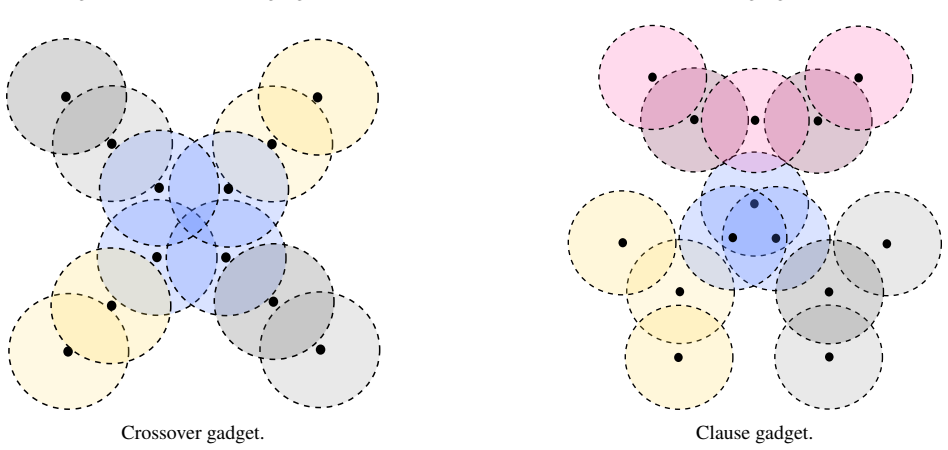
We study the computational complexity of exact cardinality-constrained minimum Riesz $s$-energy subset selection in finite metric spaces: given $n$ points, select $k<n$ points of minimum Riesz $s$-energy. The objective sums inverse-power pair interactions and therefore promotes well-separated subsets; as $s$ becomes large, it increasingly approaches a bottleneck criterion governed by the closest selected pair, linking it to minimum pairwise distance (MPD). Building on the general-metric NP-hardness result of Pereverdieva et al. (2025), we prove that NP-hardness persists for point sets in the Euclidean plane when $s$ is part of the input. In contrast, finite ultrametric spaces form an exact tractable regime: on rooted binary ultrametric trees with $n$ leaves, an optimal size-$k$ subset can be computed by dynamic programming in $O(nk^2)$ time. We also discuss the ordered one-dimensional Euclidean case, where the classical MPD objective admits simple dynamic programming, but the additive Riesz energy does not appear to allow the same state compression. Finally, we explain why one natural route to fixed-$s$ Euclidean hardness does not close: Fowler-style 3SAT gadgets, together with zeta-function bounds for far-field interactions, show why this approach still requires an exponent depending on $k$. Together, these results provide a compact complexity landscape for a natural diversity or dispersion objective, distinguishing Euclidean hardness, ultrametric tractability, and the ordered one-dimensional case.
Editorial analysis
A structured set of objections, weighed in public.
Referee Report
Summary. The paper studies the complexity of exact minimum Riesz s-energy k-subset selection in finite metric spaces. It proves NP-hardness for Euclidean-plane instances when s is part of the input (via reduction from general-metric hardness), shows that the problem is solvable in O(n k^2) time by dynamic programming on rooted binary ultrametric trees, discusses why the ordered 1D Euclidean case does not admit the same compression as the minimum-pairwise-distance objective, and explains why Fowler-style 3SAT gadgets with zeta-function bounds fail to establish fixed-s Euclidean hardness independent of k.
Significance. If the stated reductions and DP recurrence hold, the work supplies a compact and useful complexity landscape for a natural dispersion objective, cleanly separating Euclidean hardness (with variable s) from ultrametric tractability. The explicit, self-contained DP and the transparent discussion of the fixed-s limitation are concrete strengths that strengthen the contribution.
minor comments (2)
- §3 (ultrametric DP): the recurrence is stated for binary trees; a brief remark on whether the same O(n k^2) bound extends to general ultrametric spaces (or requires a different tree representation) would improve clarity.
- The abstract and §4 note that fixed-s hardness remains open; a short sentence summarizing the precise obstruction (exponent depending on k) in the main text would help readers locate the limitation quickly.
Simulated Author's Rebuttal
We thank the referee for the positive assessment, accurate summary of the contributions, and recommendation to accept. The report correctly identifies the separation between Euclidean hardness (with variable s) and ultrametric tractability, as well as the discussion of fixed-s limitations.
Circularity Check
No significant circularity; derivation is self-contained
full rationale
The paper derives its core results through explicit reductions (general-metric NP-hardness extended to Euclidean plane with s as input) and a self-contained dynamic program (O(nk²) DP on binary ultrametric trees exploiting uniform cross terms). These steps rely on standard algorithmic constructions and complexity arguments rather than fitted parameters, self-definitional loops, or predictions that collapse to inputs. The cited prior result on general metrics provides background but is not load-bearing for the new Euclidean or ultrametric claims, which are independently verified within the manuscript. Limitations for fixed-s hardness are discussed transparently without circular justification.
Axiom & Free-Parameter Ledger
axioms (2)
- standard math P ≠ NP for the purpose of hardness statements
- domain assumption Ultrametric spaces satisfy the strong triangle inequality d(x,z) ≤ max(d(x,y), d(y,z))
Reference graph
Works this paper leans on
-
[1]
P. K. Agarwal, M. van Kreveld, and S. Suri. Label placement by maximum independent set in rectangles. Computational Geometry, 11(3–4):209–218, 1998
1998
-
[2]
P. K. Agarwal, M. Overmars, and M. Sharir, Computing maximally separated sets in the plane,SIAM Journal on Computing, 36(3):815–834, 2006
2006
-
[3]
S. Atta. Riesz Energy Minimization Facility Location Problem in the Plane: Complexity and a Polynomial-Time Approximation Scheme.Theoretical Computer Science, 1070:115833, 2026. doi:10.1016/j.tcs.2026.115833
-
[4]
Unit disk graphs,
B. N. Clark, C. J. Colbourn, and D. S. Johnson, “Unit disk graphs,”Discrete Mathematics, 86(1–3):165–177, 1990
1990
-
[5]
S. V . Borodachov, D. P. Hardin, and E. B. Saff.Discrete Energy on Rectifiable Sets. Springer Monographs in Mathematics. Springer, New York, 2019. doi:10.1007/978-0-387-84808-0
-
[6]
Emmerich, M. (2026). Exact Dynamic Programming for Solow–Polasky Diversity Subset Selection on Lines and Staircases. arXiv:2604.26929
work page internal anchor Pith review Pith/arXiv arXiv 2026
-
[7]
Arenas, T
M. Arenas, T. C. Merkl, R. Pichler, and C. Riveros. Towards Tractability of the Diversity of Query Answers: Ultrametrics to the Rescue.Proceedings of the ACM on Management of Data, 2(5):215:1–215:26, 2024
2024
-
[8]
J. S. Brauchart and P. J. Grabner. Distributing many points on spheres: minimal energy and designs.Journal of Complexity, 31(3):293–326, 2015. doi:10.1016/j.jco.2015.02.001
-
[9]
B. N. Clark, C. J. Colbourn, and D. S. Johnson. Unit disk graphs.Discrete Mathematics, 86(1–3):165–177, 1990
1990
- [10]
-
[11]
G. N. Frederickson and D. B. Johnson. Generalized selection and ranking: Sorted matrices.SIAM Journal on Computing, 13(1):14–30, 1984. doi: 10.1137/0213002
-
[12]
J. G. Falc ´on-Cardona, L. Uribe, and P. Rosas. Rieszs-Energy as a Diversity Indicator in Evolution- ary Multi-Objective Optimization.IEEE Transactions on Evolutionary Computation, early online, 2024. doi:10.1109/TEVC.2024.3405197
-
[13]
J. G. Falc ´on-Cardona, J. Ju´arez, L. A. M´arquez-Vega, and M. T. M. Emmerich. Fast High-Diversity Subset Se- lection for Multi-Objective Optimization by Rieszs-Energy.IEEE Transactions on Evolutionary Computation, early online, 2025. doi:10.1109/TEVC.2025.3570938
-
[14]
R. J. Fowler, M. S. Paterson, and S. L. Tanimoto. Optimal packing and covering in the plane are NP-complete. Information Processing Letters, 12(3):133–137, 1981
1981
-
[15]
Fejes T ´oth
L. Fejes T ´oth. ¨Uber die dichteste Kugellagerung.Mathematische Zeitschrift, 48:676–684, 1943
1943
-
[16]
J. B. Ghosh. Computational aspects of the maximum diversity problem.Operations Research Letters, 19(4):175– 181, 1996. doi:10.1016/0167-6377(96)00025-9
-
[17]
L. A. Glazko and M. Nei. Estimation of divergence times for major lineages of primate species.Molecular Biology and Evolution, 20(3):424–434, 2003. doi:10.1093/molbev/msg050
-
[18]
K. Hartmann and M. Steel. Maximizing phylogenetic diversity in biodiversity conservation: greedy solutions to the Noah’s Ark problem.Systematic Biology, 55(4):644–651, 2006. doi:10.1080/10635150600873876
-
[19]
K. Manson, C. Semple, and M. Steel. Counting and optimising maximum phylogenetic diversity sets.Journal of Mathematical Biology, 85:11, 2022. doi:10.1007/s00285-022-01779-3
-
[20]
B. Q. Minh, S. Klaere, and A. von Haeseler. Phylogenetic Diversity within Seconds.Systematic Biology, 55(5):769–773, 2006. doi:10.1080/10635150600981604
-
[21]
K. Pereverdieva, A. Deutz, T. Ezendam, T. B ¨ack, H. Hofmeyer, and M. T. M. Emmerich. Comparative analysis of indicators for multi-objective diversity optimization. InEvolutionary Multi-Criterion Optimization, volume 15513 ofLecture Notes in Computer Science, pages 58–71. Springer, 2025. doi:10.1007/978-981-96-3538-2 5
-
[22]
S. S. Ravi, D. J. Rosenkrantz, and G. K. Tayi. Heuristic and special case algorithms for dispersion problems. Operations Research, 42(2):299–310, 1994. doi:10.1287/opre.42.2.299
-
[23]
A. Stivala, G. Robins, Y . Kashima, and M. Kirley. Ultrametric distribution of culture vectors in an extended Axelrod model of cultural dissemination.Scientific Reports, 4:4870, 2014. doi:10.1038/srep04870. 15
discussion (0)
Sign in with ORCID, Apple, or X to comment. Anyone can read and Pith papers without signing in.