Recognition: 1 theorem link
· Lean TheoremHamilton decompositions of all directed tori at odd modulus
Pith reviewed 2026-05-12 01:59 UTC · model grok-4.3
The pith
The arc set of every directed d-torus with odd cycle length m partitions into d directed Hamilton cycles.
A machine-rendered reading of the paper's core claim, the machinery that carries it, and where it could break.
Core claim
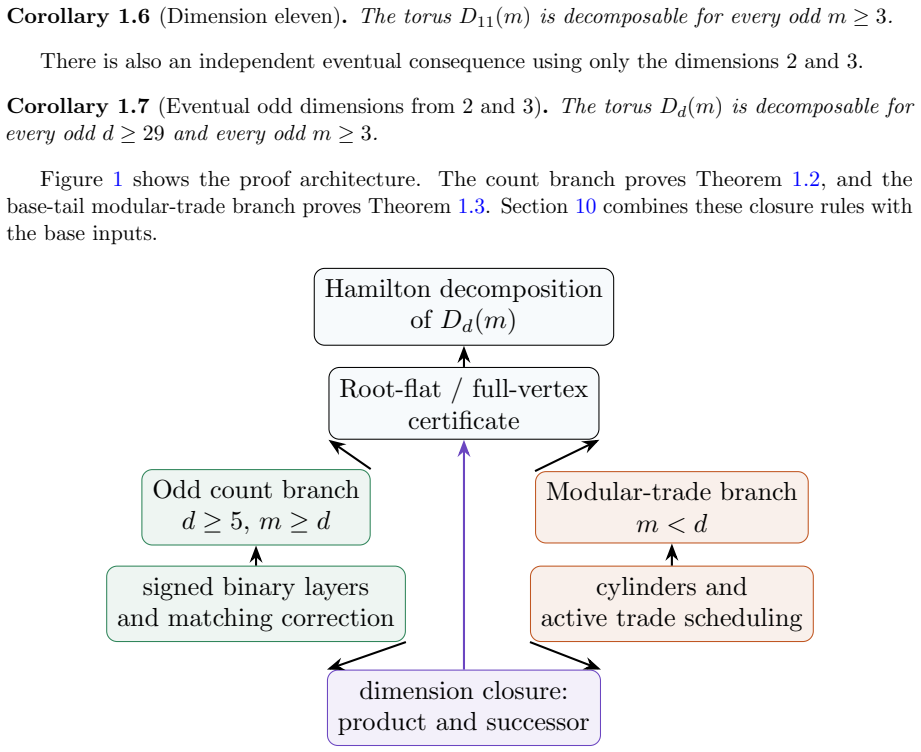
We prove that the directed Cayley graph D_d(m) on (Z/mZ)^d with generators the standard basis vectors admits a decomposition of its arcs into d directed Hamilton cycles whenever m is odd and d ≥ 2. The result follows from combining the root flat certificate theorem with a prefix count primitivity criterion and a modular trade lifting theorem, using closure under Cartesian products and the map b to 2b+1 to extend from base dimensions 2, 3, 5, 7 to all d. The critical boundary cases D_7(3) and D_7(5) are settled by explicit non-prefix root flat certificates.
What carries the argument
The modular trade lifting theorem together with closure under Cartesian product and the successor step, which propagate Hamilton decompositions from low dimensions using root flat certificates.
Load-bearing premise
The explicit root flat certificates constructed for D_7(3) and D_7(5) are correct, and the prefix-count primitivity criterion accurately identifies the needed primitive elements.
What would settle it
An explicit check that the arc set of D_7(3) cannot be partitioned into 7 directed Hamilton cycles, or a failure of the primitivity criterion in one of the lifted constructions for some larger d.
Figures








read the original abstract
Let $D_d(m) = \mathrm{Cay}((\mathbb{Z}/m\mathbb{Z})^d, {e_0, \ldots, e_{d-1}})$ denote the directed Cayley graph on the positive coordinate basis, equivalently the Cartesian product of $d$ directed cycles of length $m$. The equal side directed Hamilton decomposition problem asks when the arc set of $D_d(m)$ partitions into $d$ directed Hamilton cycles. We prove that such a decomposition exists for every $d \geq 2$ and every odd $m \geq 3$, settling the equal side directed Hamilton decomposition problem at all odd moduli. The proof combines root flat certificate theorem, a prefix count primitivity criterion, and a modular trade lifting theorem with two closure principles: the Cartesian product and the successor step $b \mapsto 2b+1$. Together these propagate the small base dimensions $d \in {2, 3, 5, 7}$ to all $d \geq 2$. The boundary cases $D_7(3)$ and $D_7(5)$, where the prefix-count family saturates its zero symbol budget, are handled by explicit non prefix zero set root flat certificates whose zero set compiler. An accompanying Lean 4 formalization verifies the main theorem and the finite certificate predicates.
Editorial analysis
A structured set of objections, weighed in public.
Referee Report
Summary. The paper proves that the directed Cayley graph D_d(m) = Cay((Z/mZ)^d, {e_0, …, e_{d-1}}) admits an arc decomposition into d directed Hamilton cycles for every d ≥ 2 and every odd m ≥ 3. The argument proceeds by establishing a root-flat-certificate theorem, a prefix-count primitivity criterion, and a modular-trade lifting theorem, then applying two closure principles (Cartesian product and the successor map b ↦ 2b+1) to reduce the problem to base dimensions d ∈ {2,3,5,7}; the remaining boundary cases D_7(3) and D_7(5) are discharged by explicit non-prefix zero-set certificates. All steps, including the finite certificate predicates, are verified by an accompanying Lean 4 formalization.
Significance. The result settles the equal-side directed Hamilton decomposition problem for all odd moduli, completing the classification for this infinite family of directed tori. The explicit machine-checked formalization of the main theorem, the lifting theorems, the primitivity criterion, and the two boundary certificates constitutes a substantial strength: it removes the usual manual-verification gap and supplies a fully auditable combinatorial existence proof.
minor comments (2)
- [Abstract] Abstract, final sentence: the clause “whose zero set compiler” is grammatically incomplete and should be rephrased to indicate that the zero-set predicates of the boundary certificates are themselves formalized.
- [Section 2] The notation for elements of the group ring Z[(Z/mZ)^d] is introduced only informally; a short displayed definition of the support and the zero-set of a certificate would improve readability when the prefix-count criterion is first stated.
Simulated Author's Rebuttal
We thank the referee for their positive and accurate summary of the manuscript, which correctly identifies the main theorem, the proof strategy via root-flat certificates, lifting theorems, and closure principles, as well as the role of the accompanying Lean 4 formalization. We are grateful for the recommendation to accept.
Circularity Check
No significant circularity; derivation self-contained via machine-checked formalization
full rationale
The paper establishes the existence of Hamilton decompositions for all directed tori D_d(m) with d ≥ 2 and odd m ≥ 3 by combining the root flat certificate theorem, prefix count primitivity criterion, modular trade lifting theorem, and two closure principles (Cartesian product and successor step). These are propagated from verified base cases D_7(3) and D_7(5) using explicit certificates. An accompanying Lean 4 formalization verifies the main theorem, all supporting lemmas, and the finite certificate predicates, rendering the argument independent of any fitted parameters, self-definitional reductions, or load-bearing self-citations that encode the target result. No step reduces by construction to its inputs; the formal verification supplies external, machine-checked evidence.
Axiom & Free-Parameter Ledger
axioms (3)
- domain assumption Root flat certificate theorem
- domain assumption Prefix count primitivity criterion
- domain assumption Modular trade lifting theorem
Reference graph
Works this paper leans on
-
[1]
B. Alspach, J.-C. Bermond, and D. Sotteau, Decomposition into cycles I: Hamilton decom- positions, inCycles and Rays, NATO ASI Series C, vol. 301, Kluwer Academic Publishers, Dordrecht, 1990, pp. 9–18. 63
work page 1990
-
[2]
K. Aquino-Michaels, Completing Claude’s cycles: multi-agent structured exploration on an open combinatorial problem, Version v1.0.0, Zenodo, 2026. doi:10.5281/zenodo.19737970
-
[3]
J. Aubert and B. Schneider, D´ ecomposition de la somme cart´ esienne d’un cycle et de l’union de deux cycles hamiltoniens en cycles hamiltoniens,Discrete Mathematics38 (1982), 7–16
work page 1982
-
[4]
Z. Baranyai and G. R. Sz´ asz, Hamiltonian decomposition of lexicographic product,Journal of Combinatorial Theory, Series B31 (1981), 253–261
work page 1981
-
[5]
J.-C. Bermond, O. Favaron, and M. Mah´ eo, Hamiltonian decomposition of Cayley graphs of degree 4,Journal of Combinatorial Theory, Series B46 (1989), 142–153
work page 1989
-
[6]
Z. R. Bogdanowicz, On decomposition of the Cartesian product of directed cycles into cycles of equal lengths,Discrete Applied Mathematics229 (2017), 148–150
work page 2017
-
[7]
Z. R. Bogdanowicz, Identifying Hamilton cycles in the Cartesian product of directed cycles, AKCE International Journal of Graphs and Combinatorics17 (2020), no. 1, 534–538
work page 2020
-
[8]
S. J. Curran and J. A. Gallian, Hamiltonian cycles and paths in Cayley graphs and digraphs–a survey,Discrete Mathematics156 (1996), 1–18
work page 1996
-
[9]
S. J. Curran and D. Witte, Hamilton paths in Cartesian products of directed cycles, inCycles in Graphs, Annals of Discrete Mathematics 27 (1985), 35–74
work page 1985
-
[10]
I. Darijani, B. Miraftab, and D. Witte Morris, Arc-disjoint Hamiltonian paths in Cartesian products of directed cycles,Ars Mathematica Contemporanea25 (2025), no. 2, Paper P2.10
work page 2025
-
[11]
M. F. Foregger, Hamiltonian decompositions of products of cycles,Discrete Mathematics24 (1978), 251–260
work page 1978
-
[12]
Gale, A theorem on flows in networks,Pacific Journal of Mathematics7 (1957), 1073–1082
D. Gale, A theorem on flows in networks,Pacific Journal of Mathematics7 (1957), 1073–1082
work page 1957
-
[13]
K. Keating, Multiple-ply Hamiltonian graphs and digraphs,Cycles in Graphs, Annals of Discrete Mathematics 27 (1985), 81–88
work page 1985
-
[14]
D. E. Knuth, Claude’s cycles, Preprint, revised April 2026. https://www-cs-faculty. stanford.edu/~knuth/papers/claude-cycles.pdf
work page 2026
-
[15]
A. Kotzig, Every Cartesian product of two circuits is decomposable into two Hamiltonian circuits, Centre de Recherches Math´ ematiques, Montr´ eal, Rapport 233, 1973
work page 1973
-
[16]
A. Lacaze-Masmonteil, Hamiltonian decompositions of the wreath product of Hamiltonian decomposable digraphs,Discrete Mathematics349 (2026), no. 6, Article 115012
work page 2026
-
[17]
G. H. J. Lanel, H. K. Pallage, J. K. Ratnayake, S. Thevasha, and B. A. K. Welihinda, A survey on Hamiltonicity in Cayley graphs and digraphs on different groups,Discrete Mathematics, Algorithms and Applications11 (2019), no. 5, 1930002
work page 2019
-
[18]
J. Liu, Hamiltonian decompositions of Cayley graphs on Abelian groups,Discrete Mathematics 131 (1994), 163–171
work page 1994
-
[19]
J. Liu, Hamiltonian decompositions of Cayley graphs on Abelian groups of odd order,Journal of Combinatorial Theory, Series B66 (1996), 75–86. 64
work page 1996
-
[20]
J. Liu, Hamiltonian decompositions of Cayley graphs on abelian groups of even order,Journal of Combinatorial Theory, Series B88 (2003), 305–321
work page 2003
-
[21]
J. Meng and Q. Huang, Hamiltonian cycles and decompositions of Cayley digraphs of finite abelian groups,Applied Mathematics–A Journal of Chinese Universities12 (1997), 259–266
work page 1997
-
[22]
L. L. Ng, Hamiltonian decomposition of lexicographic products of digraphs,Journal of Combinatorial Theory, Series B73 (1998), 119–129
work page 1998
- [23]
-
[24]
SangHyun Park, Hamilton decompositions of the directed 5-torus for odd modulus, arXiv:2604.27140v1, 2026
work page internal anchor Pith review Pith/arXiv arXiv 2026
-
[25]
SangHyun Park, Hamilton decompositions of the directed 7-torus at odd modulus via root-flat certificates and a prefix-count construction, arXiv:2605.00660v1, 2026
work page internal anchor Pith review Pith/arXiv arXiv 2026
-
[26]
SangHyun Park,Torus-Hamilton-Decomposition-Program, Lean 4 formalisation repository, release tag0.0.3.1-odd-anc, commit0a00a8a, 2026
work page 2026
-
[27]
H. J. Ryser,Combinatorial Mathematics, Carus Mathematical Monographs 14, Mathematical Association of America, 1963
work page 1963
-
[28]
R. Stong, Hamilton decompositions of Cartesian products of graphs,Discrete Mathematics 90 (1991), 169–190
work page 1991
-
[29]
Stong, Hamilton decompositions of directed cubes and products,Discrete Mathematics 306 (2006), no
R. Stong, Hamilton decompositions of directed cubes and products,Discrete Mathematics 306 (2006), no. 18, 2186–2204
work page 2006
-
[30]
W. T. Trotter, Jr. and P. Erd˝ os, When the Cartesian product of directed cycles is Hamiltonian, Journal of Graph Theory2 (1978), no. 2, 137–142
work page 1978
-
[31]
E. E. Westlund, J. Liu, and D. L. Kreher, 6-regular Cayley graphs on abelian groups of odd order are Hamiltonian decomposable,Discrete Mathematics309 (2009), 5106–5110
work page 2009
-
[32]
D. Witte and J. A. Gallian, A survey: Hamiltonian cycles in Cayley graphs,Discrete Mathematics51 (1984), no. 3, 293–304. 65
work page 1984
discussion (0)
Sign in with ORCID, Apple, or X to comment. Anyone can read and Pith papers without signing in.