Recognition: unknown
Exact solutions, trajectories and radiation patterns in the classical relativistic St\"{o}rmer problem
Pith reviewed 2026-05-08 16:17 UTC · model grok-4.3
The pith
Exact parametric solutions exist for the planar trajectories of charged particles moving relativistically in a magnetic dipole field.
A machine-rendered reading of the paper's core claim, the machinery that carries it, and where it could break.
Core claim
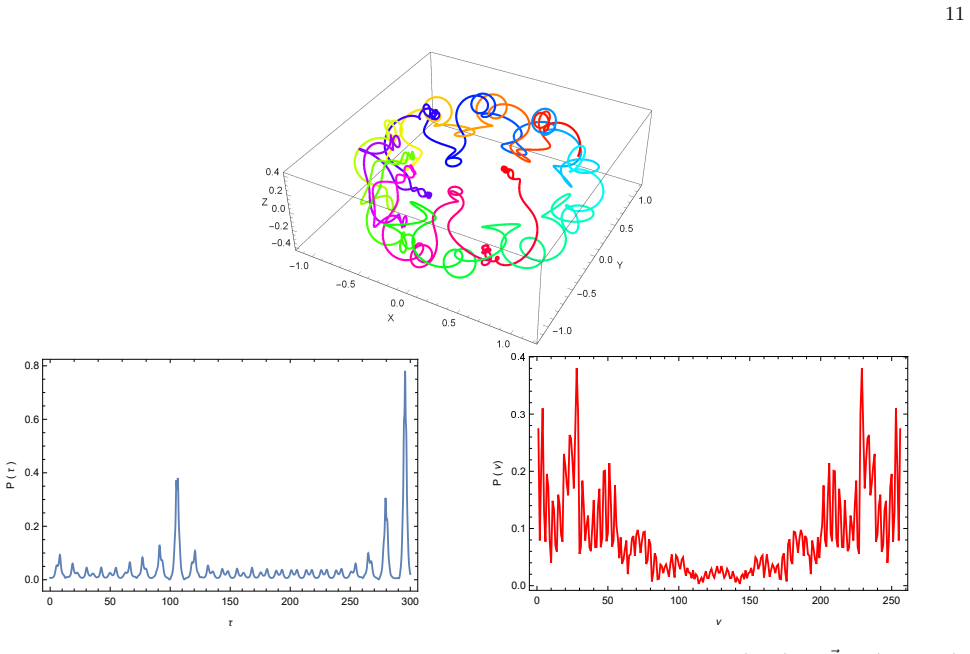
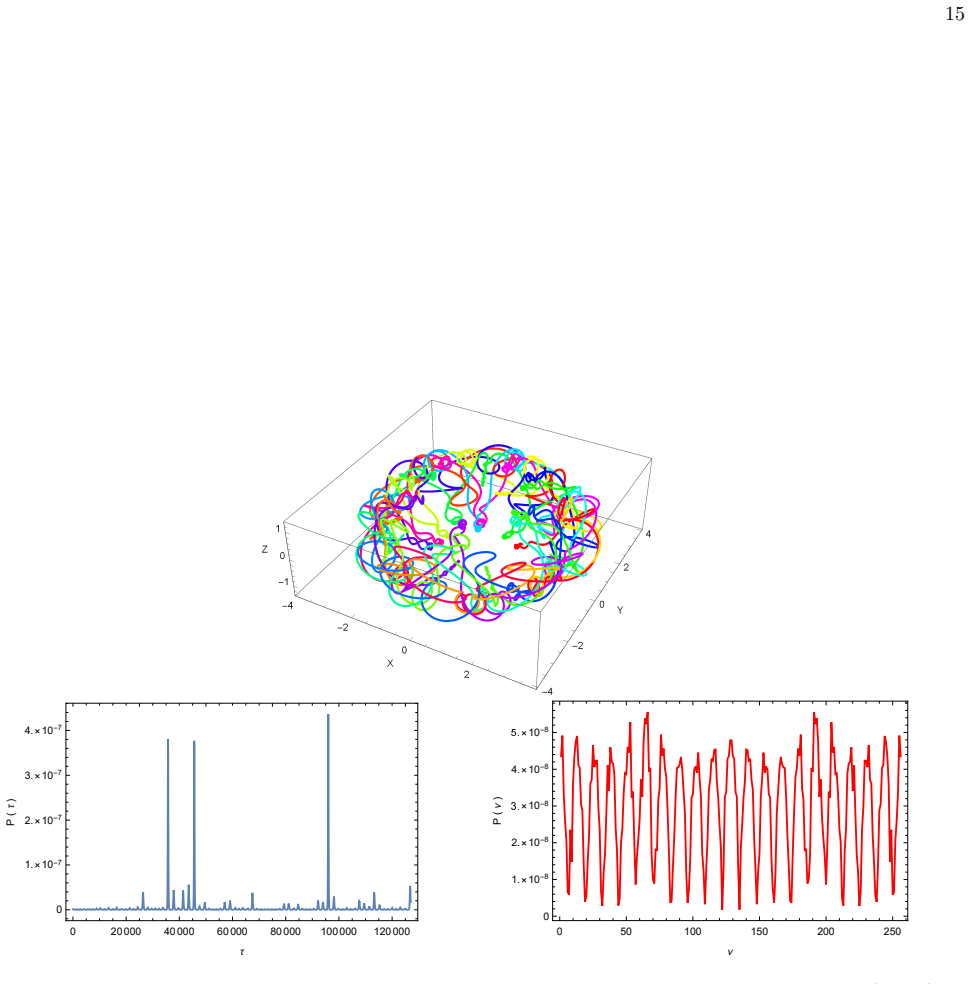
The relativistic Störmer problem admits an exact solution for planar motions that is written in parametric form; the solution follows directly from the covariant Lorentz-force equations and their associated integrals of motion. Numerical integration across regimes confirms that relativistic corrections alter orbit shapes while the emitted radiation’s power spectral density exhibits distinct peaks at preferred frequencies.
What carries the argument
The relativistic Lorentz-force equations together with their conserved energy and angular-momentum integrals, which reduce the planar case to a parametric exact solution.
If this is right
- Particle trajectories in dipole fields can be classified analytically by the value of a single relativistic parameter instead of case-by-case numerical runs.
- The radiated power varies periodically with the orbital frequency, producing a spectrum whose peaks are set by the dipole strength and initial conditions.
- Relativistic corrections remain small at low speeds but systematically widen the range of trapped orbits compared with the non-relativistic limit.
- The existence of preferred radiation frequencies implies that broadband detectors would see narrowband features from ensembles of such particles.
Where Pith is reading between the lines
- The planar solution supplies a benchmark against which three-dimensional or chaotic orbits can be compared to quantify the onset of non-integrable behavior.
- Because the spectral peaks survive across a range of initial conditions, they may serve as a diagnostic signature even when the full three-dimensional motion is only known numerically.
- Laboratory reproduction of a controlled magnetic dipole and measurement of the emitted spectrum would directly test the radiation calculation without astrophysical complications.
Load-bearing premise
The background is taken to be an unchanging, purely magnetic dipole with no electric component, no higher multipoles, and no back-reaction from the particle’s own current.
What would settle it
A high-precision numerical integration of the full relativistic equations that produces planar trajectories differing from the reported parametric expressions at moderate Lorentz factors would falsify the exact-solution claim.
Figures




read the original abstract
We investigate the relativistic generalization of the classical St\"{o}rmer problem, which describes the motion of charged particles in a purely magnetic dipole field. By incorporating special relativistic effects, the particle dynamics is governed by a strongly nonlinear system of second-order differential equations derived from the Lorentz force law. We present a rigorous and fully covariant derivation of the relativistic equations of motion, together with the associated conservation laws. An exact solution for planar motions is obtained in parametric form, providing analytical insight into the structure of the trajectories. In addition, we perform a detailed numerical analysis of the particle dynamics across both nonrelativistic and relativistic regimes, exploring a range of initial conditions and highlighting the impact of relativistic corrections. The electromagnetic radiation emitted by the accelerated charges is also examined. We compute the time dependence of the total radiated power and determine the corresponding frequency spectrum. Our results provide a comprehensive characterization of magnetic dipole--type radiation associated with St\"{o}rmer-like motion. In particular, the power spectral density consistently exhibits distinct peaks, indicating the presence of preferred frequency bands in the emitted radiation.
Editorial analysis
A structured set of objections, weighed in public.
Referee Report
Summary. The manuscript investigates the relativistic generalization of the classical Störmer problem for a charged particle in a purely magnetic dipole field. It derives the equations of motion from the covariant Lorentz force law, identifies the associated conservation laws, obtains an exact parametric solution for planar motions, performs numerical integrations of trajectories across relativistic and non-relativistic regimes, and computes the time-dependent radiated power together with the frequency spectrum, which exhibits distinct peaks.
Significance. If the parametric solution and spectral results hold, the work supplies an analytical handle on relativistic trajectories and radiation patterns in dipole fields that is relevant to astrophysical applications such as cosmic-ray propagation and pulsar magnetospheres. The combination of an exact parametric form with numerical radiation spectra is a clear strength when the derivations are reproducible.
minor comments (4)
- [Section presenting the exact solution] The abstract states that an exact parametric solution is obtained, yet the main text should include an explicit verification that the parametric expressions satisfy the relativistic Lorentz-force equations (e.g., by direct substitution or reduction to the conserved quantities).
- [Numerical analysis section] The numerical trajectory integrations and radiation calculations would benefit from a direct comparison between the parametric planar solution and the numerical results for the same initial conditions to quantify integration accuracy.
- [Radiation section] The frequency-spectrum plots show distinct peaks; the manuscript should state the frequency resolution, windowing method, and number of orbits used in the Fourier transform to allow reproducibility.
- Notation for the dipole field strength and the particle charge-to-mass ratio should be introduced once and used consistently; several symbols appear to be redefined in different sections.
Simulated Author's Rebuttal
We thank the referee for the positive summary of our work on the relativistic Störmer problem, for highlighting its potential relevance to cosmic-ray propagation and pulsar magnetospheres, and for recommending minor revision. No specific major comments were raised in the report.
Circularity Check
No significant circularity; derivation is self-contained
full rationale
The paper derives the relativistic equations of motion directly from the Lorentz force in a fixed magnetic dipole background, identifies standard conserved quantities (energy and angular momentum), and reduces planar motion to a parametric quadrature using those integrals. The numerical trajectories, radiated power, and spectral peaks are obtained by direct integration and Fourier analysis of the resulting accelerations. None of these steps reduce by the paper's own equations to fitted parameters, self-referential normalizations, or load-bearing self-citations; the parametric solution is a standard exact integration technique that does not presuppose the final results. The analysis remains internally consistent with the problem definition and does not invoke uniqueness theorems or ansatzes from the authors' prior work in a circular manner.
Axiom & Free-Parameter Ledger
axioms (2)
- domain assumption The electromagnetic field is a pure magnetic dipole field
- standard math Motion obeys the special-relativistic Lorentz force law
Reference graph
Works this paper leans on
-
[1]
Equations of motion 4
-
[2]
Relativistic trajectories and radiation emission in CRSP: Exact solutions 5 A
Radiative power loss 5 III. Relativistic trajectories and radiation emission in CRSP: Exact solutions 5 A. Exact solutions of the relativistic St¨ ormer problem 6 B. An exact parametric solution of the CRSP 6
-
[3]
The extreme relativistic limit 7
-
[4]
The case C ≪ 1/ (γξ) 9
-
[5]
Numerical analysis 10 IV. Relativistic trajectories and radiation emission in CRSP-numerical results 11 A. Two-dimensional planar motions 12 B. Non-relativistic 3D motions 12 C. Relativistic motions 13 V. Discussions and final remarks 13 ∗ tiberiu.harko@aira.astro.ro † fslobo@ciencias.ulisboa.pt Acknowledgments 16 References 16 I. INTRODUCTION The St¨ orme...
work page internal anchor Pith review Pith/arXiv arXiv 2026
-
[6]
Equations of motion The relativistic dynamics of a charged particle in a pre- scribed electromagnetic field are elegantly encoded in the Euler-Lagrange equations derived from the action princi- ple. For the Lagrangian (15) the variation with respect to the time component u0 immediately yields a first integral − 1 2mcu 0 = − 1 2mc2dt ds = − 1 2 E c = constan...
-
[7]
Radiative power loss The relativistic generalization of Larmor’s formula for the power radiated by a transversely accelerated particle is P = 2 3 e2 c3 γ 4 ( d⃗ v dt ) 2 . (39) In the dimensionless variables introduced above, the emitted power can be expressed as P = 2 3 e4M 2 m2c5R6 0 γ 4 [ ( d2X dτ2 ) 2 + ( d2Y dτ2 ) 2 + ( d2Z dτ2 ) 2] = P0γ 4 ˜P, (40) ...
-
[8]
This solution describes sim- ple harmonic oscillations along the X and Y axes, i.e., a perfectly circular trajectory of constant dimensionless radius R0
= 1/ (γ(X 2 0 +Y 2 0 )). This solution describes sim- ple harmonic oscillations along the X and Y axes, i.e., a perfectly circular trajectory of constant dimensionless radius R0. The emitted electromagnetic power for this orbit is P =P0γ 4R2 0ω 4 =P0γ 4V 2ω 2. (48) The trajectory of the particle is strictly circular, with constant dimensionless radius R0....
-
[9]
The extreme relativistic limit Whenγ ≫ 1, the term 1/ (γξ) in the effective potential becomes negligible compared to the constant C (assum- ing C ̸= 0). In this ultra-relativistic regime the integral 8 -100 0 100 200 -200 -100 0 100 200 X Y 0.00 0.02 0.04 0.06 0.08 0.10 0 2 4 6 8 10 12 τ P ( τ ) 0 50 100 150 200 250 0 1 2 3 4 5 6 7 ν P ( ν ) Figure 1. Traj...
-
[10]
× 10-10 τ P ( τ ) 0 50 100 150 200 250 0 5 × 10-11
-
[11]
Trajectories, radiation powers, and radiation sp ectrum of the Classical Relativistic St¨ ormer Problem (CRS P) for ⃗R0 = (5
× 10-10 1 5 × 10⁻¹⁰ ν P ( ν ) Figure 2. Trajectories, radiation powers, and radiation sp ectrum of the Classical Relativistic St¨ ormer Problem (CRS P) for ⃗R0 = (5 . 7, 1. 9, 0), R(0) = 6 . 608, ⃗V0 = (0 . 001, 0. 002, 0), V (0) = 0 . 0022, and for different values of γ: γ = 1 (solid blue curve), γ = 3 (solid red curve), and γ = 5 (solid brown curve), res...
-
[12]
centrifugal
The case C ≪ 1/ (γξ) If the integration constant C is chosen to be negligibly small compared to the term 1 / (γξ), the dynamics sim- plify considerably. Physically, this limit describes par- ticles for which the “centrifugal” contribution associated withC is dominated by the γ-dependent part of the effec- tive potential. In this regime the radial motion re...
-
[13]
Numerical analysis The radial motion described by Eq. (56) can be inter- preted as the one-dimensional motion of a particle of unit mass in the effective potential Veff (R) = 1 2R2 [ C + 1 γR ]2 , (85) with conserved energy ǫ =V 2/ 2, so that 1 2R′2 +Veff (R) = ǫ. (86) The shape of Veff controls whether the particle is trapped at finite distance or escapes to ...
-
[14]
× 10-7 2.5 × 10⁻⁷ 3 × 10⁻⁷ 3 × 10⁻⁷ τ P ( τ ) 0 50 100 150 200 250 0
-
[15]
Trajectory, radiation power, and radiation spect rum for the Classical Relativistic St¨ ormer Problem (CRSP) for ⃗R0 = (0
× 10-7 × 10- 4 × 10- ν P ( ν ) Figure 6. Trajectory, radiation power, and radiation spect rum for the Classical Relativistic St¨ ormer Problem (CRSP) for ⃗R0 = (0. 7, 0. 8, 0), ⏐ ⏐ ⏐ ⃗R0 ⏐ ⏐ ⏐ = 1. 063, ⃗V0 = (0. 010, 0, 0), V0 = ⏐ ⏐ ⏐⃗V0 ⏐ ⏐ ⏐ = 0. 01, and γ = 16. 0 20 000 40 000 60 000 80 000
-
[16]
× 10-8 1.2 × 10⁻⁸ τ P ( τ ) 0 50 100 150 200 250 0
-
[17]
Trajectory, radiation power, and radiation spect rum for the Classical Relativistic St¨ ormer Problem (CRSP) for ⃗R0 = (0
× 10-8 ν P ( ν) Figure 7. Trajectory, radiation power, and radiation spect rum for the Classical Relativistic St¨ ormer Problem (CRSP) for ⃗R0 = (0. 7, 0. 8, 0), ⏐ ⏐ ⏐ ⃗R0 ⏐ ⏐ ⏐ = 1. 063, ⃗V0 = (10 − 4, 10− 3, 10− 3), V0 = ⏐ ⏐ ⏐⃗V0 ⏐ ⏐ ⏐ = 0. 0014, and γ = 25. 15 0 20 000 40 000 60 000 80 000 100 000 120 000 0
-
[18]
× 10-7 τ P ( τ ) 0 50 100 150 200 250 0
-
[19]
× 10-8 % $ × 10-8 ν P ( ν ) Figure 8. Trajectory, radiation power, and radiation spect rum for the Classical Relativistic St¨ ormer Problem (CRSP) for ⃗R0 = (1. 9, 1. 9, 0. 9), ⏐ ⏐ ⏐ ⃗R0 ⏐ ⏐ ⏐ = 2. 833, ⃗V0 = (10 − 3, 2 × 10− 3, 3 × 10− 3), V0 = ⏐ ⏐ ⏐⃗V0 ⏐ ⏐ ⏐ = 0. 0037, and γ = 5. 16 with the solution X(τ) = X0 +V0Xτ, Y (τ) = Y0 +V0Yτ, Z(τ) = Z0 +V0Zτ. T...
-
[20]
St¨ ormer,Arch
C. St¨ ormer,Arch. Sci. Phys. Nat. 1907, 24, 5
1907
-
[21]
St¨ ormer,Arch
C. St¨ ormer,Arch. Sci. Phys. Nat. 1907, 24, 113
1907
-
[22]
St¨ ormer,Arch
C. St¨ ormer,Arch. Sci. Phys. Nat. 1907, 24, 221
1907
-
[23]
St¨ ormer,Astrophysical Journal 1913, 38, 311
C. St¨ ormer,Astrophysical Journal 1913, 38, 311
1913
-
[24]
St¨ ormer,Geofys ´ ısk Publikationer1921, 1, 269
C. St¨ ormer,Geofys ´ ısk Publikationer1921, 1, 269
-
[25]
St¨ ormer, Terrestrial Magnetism and Atmospheric Electricity 1917, 22, 97
C. St¨ ormer, Terrestrial Magnetism and Atmospheric Electricity 1917, 22, 97
1917
-
[26]
St¨ ormer,Astrophysica Norvegica 1934, 1, 1
C. St¨ ormer,Astrophysica Norvegica 1934, 1, 1
1934
-
[27]
St¨ ormer,The Polar Aurora, Clarendon Press, Oxford, UK, 1955
C. St¨ ormer,The Polar Aurora, Clarendon Press, Oxford, UK, 1955
1955
-
[28]
Dragt, Rev
A. Dragt, Rev. Geophys. 1965, 3, 255
1965
-
[29]
Dragt and J
A. Dragt and J. M. Finn, J. Geophys. Res. 1976, 81, 2327
1976
-
[30]
Walt, Introduction to Geomagnetically Trapped Ra- diation, Cambridge Atmospheric and Space Science Se- ries, Cambridge University Press, 1994
M. Walt, Introduction to Geomagnetically Trapped Ra- diation, Cambridge Atmospheric and Space Science Se- ries, Cambridge University Press, 1994
1994
-
[31]
J. D. Jackson, Classical Electrodynamics, John Wiley & Sons, Hoboken, NJ, USA, 1999 17
1999
-
[32]
L. D. Landau and E. M. Lifshitz, The classical theory of fields, Pergamon Press, Oxford, UK, 1994
1994
-
[33]
M. A. Almeida, I. C. Moreira, and H. Yoshida, J. Phys. A Math. Gen. 1992, 25, L227
1992
-
[34]
Dil˜ ao and R
R. Dil˜ ao and R. Alves-Pires (2007), Chaos in the St¨ ormer Problem. In: Staicu, V. (eds) Differential Equations, Chaos and Variational Problems. Progress in Nonlinear Differential Equations and Their Applications, vol 75. Birkh¨ auser, Basel, pp 175-194
2007
-
[35]
Y. Y. Shprits et al., Nature Physics 9, 699-703 (2013)
2013
-
[36]
J. H. Zhang, L. Y. Li, Y. W. Yao, K. X. Cheng, and L. Yang, Journal of High Energy Astrophysics 52, 100568 (2026)
2026
-
[37]
Schuster and K
R. Schuster and K. O. Thielheim, J. Phys. A: Math. Gen. 1987, 20, 5511
1987
-
[38]
J. E. Howard, M. Hor´ anyi, and G. R. Stewart,Phys. Rev. Lett. 1999, 83, 3993
1999
-
[39]
H. R. Dullin, M. Hor´ anyi, J. E. Howard,Physica D 2002, 171, 178
2002
-
[40]
et al.,Physica D 2004, 197, 242
I˜ narrea M. et al.,Physica D 2004, 197, 242
2004
-
[41]
et al.,Chaos, Solitons and Fractals 2009, 42, 155
I˜ narrea M. et al.,Chaos, Solitons and Fractals 2009, 42, 155
2009
-
[42]
V. Epp, M. A. Masterova, Astrophysics and Space Sci- ence 2014, 353, 473
2014
-
[43]
V. Epp, O. N. Pervukhina, Monthly Notices of the Royal Astronomical Society 2018, 474, 5330
2018
-
[44]
V. V. Markellos and A. A. Halioulias, Astrophysics and Space Science 1977, 51, 177
1977
-
[45]
V. V. Markellos and C. Zagouras, Astronomy and Astro- physics 1977, 61, 505-514
1977
-
[46]
M. K. ¨Ozt¨ urk,American Journal of Physics 2012, 80(5), 420
2012
-
[47]
E. Pina, E. Cort´ es, European Journal of Physics 2016, 37, 065009
2016
-
[48]
E. K. Kolesnikov, Geomagnetism and Aeronomy 2017, 57, 137
2017
-
[49]
Leghmouche, N
A. Leghmouche, N. Mebarki, A. Benslama, New Astron- omy 2023, 98, 101931
2023
-
[50]
Ershkov, E
S. Ershkov, E. Prosviryakov, D. Leshchenko, N. Bur- masheva, Mathematical Methods in the Applied Sciences 2023, 46, 19364
2023
-
[51]
Asadi-Zeydabadi, C
M. Asadi-Zeydabadi, C. S. Zaidins Results in Physics 2019, 12, 2213
2019
-
[52]
S. V. Ershkov, J. Appl. Comput. Mech. 2026, 12, 31
2026
-
[53]
Harko and G
T. Harko and G. R. Mocanu, Annalen der Physik 2025, 537 , e00415
2025
- [54]
-
[55]
K. S. Thorne, Astrophysical Journal Supplement 1963, 8, 1
1963
-
[56]
D. B. Papadopoulos, I. Contopoulos, K. D. Kokkotas, N. Stergioulas, General Relativity and Gravitation 2015, 47, 49
2015
-
[57]
T. M. Burinskaya, M. M. Shevelev, Plasma Physics Re- ports 2016, 42, 929
2016
-
[58]
T. M. Burinskaya, M. M. Shevelev, Plasma Physics Re- ports 2017, 43, 910
2017
discussion (0)
Sign in with ORCID, Apple, or X to comment. Anyone can read and Pith papers without signing in.