Recognition: unknown
Bayesian parameter estimation for the Core-bounce phase of Rapidly Rotating Core-Collapse Supernovae in real interferometric data
Pith reviewed 2026-05-08 16:06 UTC · model grok-4.3
The pith
An extended phenomenological model recovers the rotational energy ratio in core-bounce supernova signals from real gravitational-wave noise.
A machine-rendered reading of the paper's core claim, the machinery that carries it, and where it could break.
Core claim
We extend a previous phenomenological model of the core-bounce gravitational-wave signal by introducing an additional parameter that captures the signal timescale. The improved model achieves a higher median fitting factor of 90.83% when compared to numerical waveform databases. Parameter estimation via Markov Chain Monte Carlo on real O3a L1 noise recovers the rotational parameter β for 452 simulated signals with a median relative error of 11.93% and an uncertainty of 1.083 × 10^{-3} at 10 kpc. Real interferometric noise can introduce biases up to 11.9%, reducible to 0.6% with optimized priors.
What carries the argument
Extended phenomenological template that includes a timescale parameter to model the core-bounce gravitational-wave signal from rapidly rotating stars.
If this is right
- Improved waveform templates enable more precise extraction of progenitor properties from gravitational-wave observations of supernovae.
- Bayesian methods applied to real noise data provide realistic uncertainty estimates for the rotational energy ratio.
- Accounting for noise biases is essential when applying such models to actual detector data.
- Optimized priors can enhance the accuracy of parameter recovery without changing the model.
Where Pith is reading between the lines
- Applying this method to actual detected events could help distinguish between different supernova explosion mechanisms.
- Future gravitational-wave detectors might resolve smaller errors in β, allowing tests of specific equations of state.
- Combining this with electromagnetic or neutrino observations could give a fuller picture of the progenitor star's rotation.
Load-bearing premise
The extended phenomenological model with the added timescale parameter adequately approximates the true core-bounce waveforms from numerical relativity simulations across the relevant range of progenitor parameters and equations of state.
What would settle it
A direct comparison of recovered β values against the known input values from a new set of numerical relativity simulations spanning different progenitor masses and equations of state would test if the reported errors and uncertainties hold.
Figures



read the original abstract
We present a novel methodology to estimate the ratio of kinetic to gravitational potential energy in core-collapse supernova progenitors and to assess the equation of state (EOS) using gravitational-wave signals from the core-bounce phase of rapidly rotating stars in real interferometric data. We extend a previous phenomenological model by introducing an additional parameter that captures the signal timescale. The agreement between our template and numerical waveform databases is evaluated through fitting factors and Bayesian model comparison, also assessing consistency across datasets. The improved model increases the median fitting factor from 88.88% to 90.83%. Parameter estimation is performed via Markov Chain Monte Carlo using real O3aL1 noise. For 452 simulated signals, the rotational parameter $\beta$ is recovered with a median relative error of 11.93% (95th percentile: 38.41%) and an uncertainty of $\sigma_\beta = 1.083 \times 10^{-3}$ at 10 kpc, improving over previous matched-filtering results. We further analyze the impact of prior choices and noise properties, finding that real interferometric noise introduces biases up to 11.9%, while optimized priors can reduce them to 0.6%.
Editorial analysis
A structured set of objections, weighed in public.
Referee Report
Summary. The manuscript extends a phenomenological model for the core-bounce gravitational-wave signal from rapidly rotating core-collapse supernovae by adding a signal timescale parameter. It reports improved median fitting factors (88.88% to 90.83%) against numerical-relativity databases and performs MCMC-based Bayesian parameter estimation on 452 simulated signals injected into real O3aL1 noise, recovering the rotational parameter β with median relative error 11.93% (95th percentile 38.41%) and uncertainty σ_β = 1.083 × 10^{-3} at 10 kpc, while analyzing prior and noise effects.
Significance. If the extended model proves sufficiently faithful to NR waveforms and the recovery statistics hold under independent tests, the work would offer a concrete Bayesian pipeline for extracting β and EOS information from future CCSN detections in real interferometric data, improving on matched-filtering baselines. The provision of quantitative metrics from injections into actual detector noise is a positive step toward practical applicability.
major comments (3)
- [parameter estimation results] Parameter estimation section (results on 452 injections): the manuscript must explicitly state the origin of the 452 simulated signals (whether generated from the extended phenomenological model itself or from independent NR simulations). If the former, the reported median relative error of 11.93% for β and the bias figures (up to 11.9% from real noise) only characterize statistical performance inside the model manifold and leave untested the propagation of residual mismatch (even at the improved 90.83% fitting factor) into systematic offsets in recovered β. This is load-bearing for the claim that the method is ready for real data.
- [fitting factors and Bayesian model comparison] Fitting-factor and model-comparison section: the coverage of the NR waveform database (progenitor masses, rotation rates, EOS variants) and any post-hoc selection criteria applied to the 452 cases or the fitting-factor calculations are not detailed. Without this, it is difficult to assess whether the median improvement from 88.88% to 90.83% and the consistency across datasets are representative or could be affected by limited sampling.
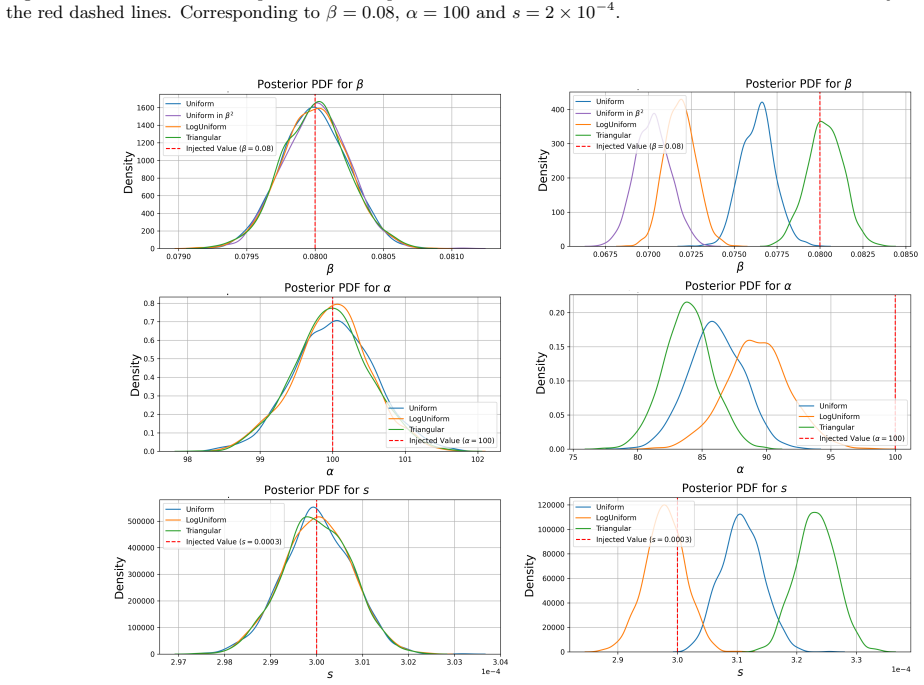
- [abstract and prior/noise analysis] Abstract and results on prior/noise impact: the claim that optimized priors reduce biases to 0.6% while real noise introduces up to 11.9% requires explicit linkage to the corresponding posterior distributions or tables; the current presentation leaves unclear how these percentages are computed (e.g., median absolute relative deviation from injected values) and whether they incorporate the new timescale parameter.
minor comments (2)
- [model extension] Notation for the new timescale parameter should be introduced with a clear symbol and units in the model section to avoid ambiguity when comparing to prior work.
- [abstract] The abstract states improvement over 'previous matched-filtering results' without a specific citation or quantitative comparison table; adding this would strengthen the claim.
Simulated Author's Rebuttal
We thank the referee for their thorough and constructive review of our manuscript. We address each of the major comments in detail below, providing clarifications and committing to revisions where necessary to enhance the manuscript's clarity and rigor.
read point-by-point responses
-
Referee: Parameter estimation section (results on 452 injections): the manuscript must explicitly state the origin of the 452 simulated signals (whether generated from the extended phenomenological model itself or from independent NR simulations). If the former, the reported median relative error of 11.93% for β and the bias figures (up to 11.9% from real noise) only characterize statistical performance inside the model manifold and leave untested the propagation of residual mismatch (even at the improved 90.83% fitting factor) into systematic offsets in recovered β. This is load-bearing for the claim that the method is ready for real data.
Authors: The 452 simulated signals were generated from the extended phenomenological model itself, with parameters sampled across the relevant physical parameter space covered by the NR database. We will explicitly state this origin in the revised Parameter Estimation section. While we agree that this means the recovery statistics characterize performance within the model manifold, the high fitting factors (median 90.83%) indicate that the template is a good approximation to NR waveforms, minimizing the impact of mismatch. The biases reported (up to 11.9% from real noise) are measured in the presence of actual detector noise. We will add a new paragraph discussing the potential for systematic errors due to model mismatch and how the fitting factor relates to expected parameter biases, thereby addressing the readiness for real data. revision: partial
-
Referee: Fitting-factor and model-comparison section: the coverage of the NR waveform database (progenitor masses, rotation rates, EOS variants) and any post-hoc selection criteria applied to the 452 cases or the fitting-factor calculations are not detailed. Without this, it is difficult to assess whether the median improvement from 88.88% to 90.83% and the consistency across datasets are representative or could be affected by limited sampling.
Authors: We will expand the Fitting-factor and model-comparison section to provide details on the coverage of the NR waveform database in terms of progenitor masses, rotation rates, and EOS variants. The 452 cases for the parameter estimation were selected to be representative of the database, with no post-hoc selection criteria applied beyond the requirements for injection into real noise data. We will include this information to allow assessment of representativeness. revision: yes
-
Referee: Abstract and results on prior/noise impact: the claim that optimized priors reduce biases to 0.6% while real noise introduces up to 11.9% requires explicit linkage to the corresponding posterior distributions or tables; the current presentation leaves unclear how these percentages are computed (e.g., median absolute relative deviation from injected values) and whether they incorporate the new timescale parameter.
Authors: We will revise both the abstract and the results section on prior/noise impact to include direct references to the relevant figures and tables showing the posterior distributions. The bias figures are computed as the median absolute relative error across all 452 injections. These calculations fully incorporate the new timescale parameter as it is part of the extended model used in all MCMC runs. We will add explicit text clarifying the definition of the bias metric and confirm the inclusion of the timescale parameter. revision: yes
Circularity Check
Standard MCMC recovery on model-generated injections; fitting factors evaluated separately against NR databases
full rationale
The paper extends a prior phenomenological model (with an added timescale parameter) and quantifies its agreement to numerical-relativity databases via fitting factors, raising the median from 88.88% to 90.83%. It then performs standard Bayesian MCMC parameter estimation on 452 simulated signals injected into real O3aL1 noise, reporting median relative error 11.93% and uncertainty for the rotational parameter β. These recovery statistics characterize statistical performance and noise biases inside the model manifold; they are obtained from explicit MCMC sampling rather than reducing by construction to any fitted parameter or self-citation. The central claims rest on independent numerical results (fitting-factor computations and MCMC chains) and do not invoke load-bearing self-citations or uniqueness theorems. Minor self-citation to the base model exists but is not load-bearing for the reported improvements or error figures.
Axiom & Free-Parameter Ledger
free parameters (1)
- signal timescale parameter
axioms (1)
- domain assumption Core-bounce gravitational-wave signals from rapidly rotating progenitors can be adequately represented by the extended phenomenological template across the relevant parameter space
Reference graph
Works this paper leans on
-
[1]
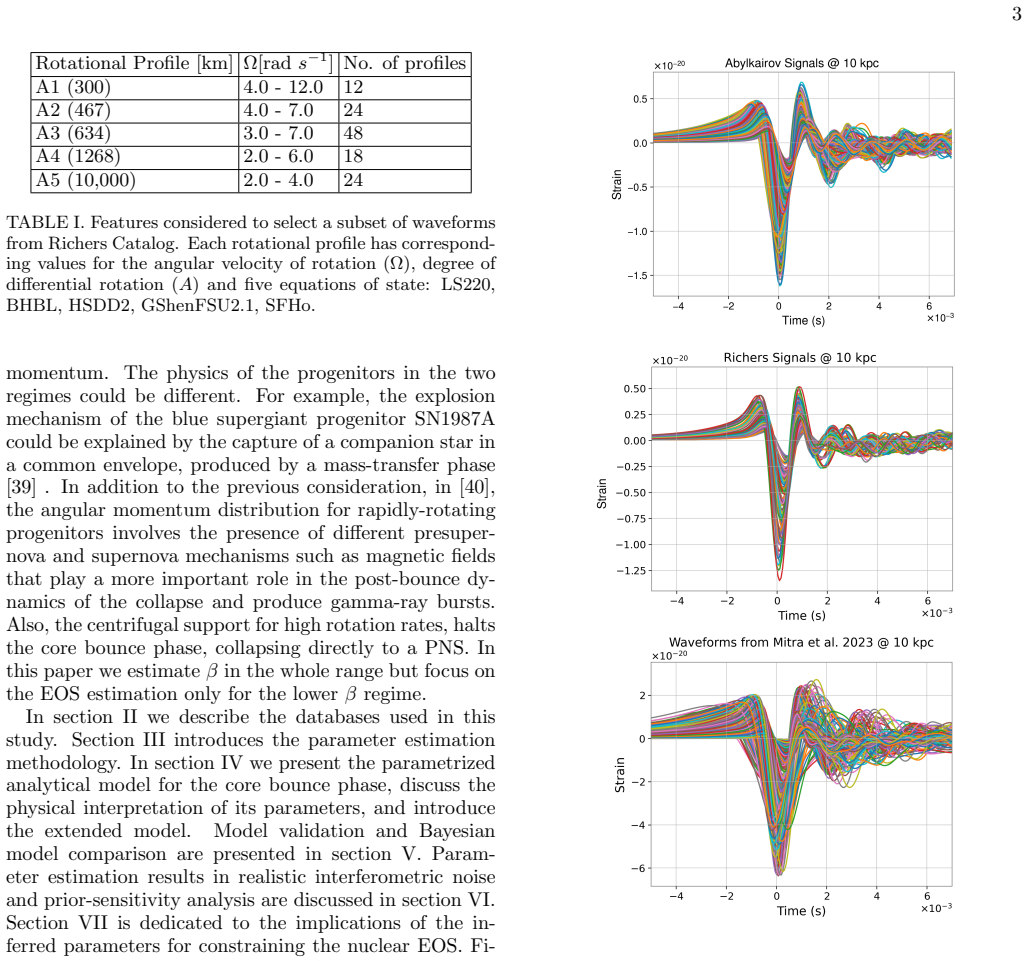
interferometric noise. We find that the rotational parameterβestimation for 452 Abylkairov signals [2] has a median absolute relative error of 11.93% with a 95th percentile of 38.41%, an overall uncertainty ofσ β = 1.083×10 −3 at 10 kpc. This was an improvement compared with estimated values using matched filtering and Maximum Likelihood Estimation (MLE) ...
2009
-
[2]
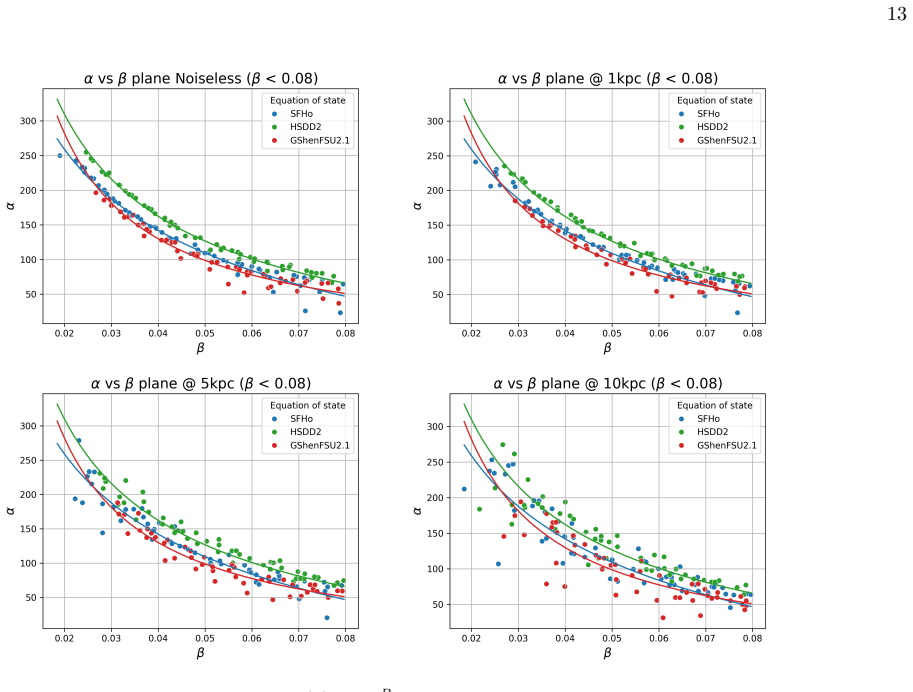
about the physics of collapsing compact objects, for a non-static star we can estimate the free-fall time when arXiv:2605.04852v1 [astro-ph.HE] 6 May 2026 2 there is no pressure to support it against gravitational collapse, and moreover, if it oscillates or expands. This timescale is inversely proportional to√Gρ. Following the results yielded by the princ...
work page internal anchor Pith review Pith/arXiv arXiv 2026
-
[3]
In Pastor-Marcos et al
where they performed a principal component analy- sis in Gaussian colored noise based on LIGO power spec- tral density [37], and discussed the dependence of the bounce and post-bounce signal on the rotational rateβ. In Pastor-Marcos et al. (2024) [38], a bayesian param- eter estimation analysis was performed using zero-mean Gaussian colored noise based on...
2024
-
[4]
Also, the centrifugal support for high rotation rates, halts the core bounce phase, collapsing directly to a PNS
In addition to the previous consideration, in [40], the angular momentum distribution for rapidly-rotating progenitors involves the presence of different presuper- nova and supernova mechanisms such as magnetic fields that play a more important role in the post-bounce dy- namics of the collapse and produce gamma-ray bursts. Also, the centrifugal support f...
2017
-
[5]
Ligo scientific collaboration, virgo collaboration, and kagra collabora- tion
R Abbott, TD Abbott, and F Acernese. Ligo scientific collaboration, virgo collaboration, and kagra collabora- tion. Phys. Rev. D, 105:102001, 2022
2022
-
[6]
Assessing the distance for probing the nuclear equation of state with supernova gravitational waves
Y Sultan Abylkairov, Matthew C Edwards, Artyom Os- trikov, Yersultan Tleukhanov, Alejandro Torres-Forn´ e, Pablo Cerd´ a-Dur´ an, Jos´ e Antonio Font, Marek J Szczepa´ nczyk, and Ernazar Abdikamalov. Assessing the distance for probing the nuclear equation of state with supernova gravitational waves. arXiv preprint arXiv:2510.15102, 2025
-
[7]
Parameter esti- mation from the core-bounce phase of rotating core col- lapse supernovae in real interferometer noise
Laura O Villegas, Claudia Moreno, Michael A Pajkos, Michele Zanolin, and Javier M Antelis. Parameter esti- mation from the core-bounce phase of rotating core col- lapse supernovae in real interferometer noise. Classical and Quantum Gravity, 42(11):115001, 2025
2025
-
[8]
Observing gravi- tational waves from core-collapse supernovae in the ad- vanced detector era
SE Gossan, Patrick Sutton, A Stuver, Michele Zanolin, Kiranjyot Gill, and Christian D Ott. Observing gravi- tational waves from core-collapse supernovae in the ad- vanced detector era. Physical Review D, 93(4):042002, 2016
2016
-
[9]
Multimessenger analysis strategy for core-collapse supernova search: gravitational waves and low-energy neutrinos
Odysse Halim, Claudio Casentini, Marco Drago, Vi- viana Fafone, Kate Scholberg, Carlo Francesco Vigorito, and Giulia Pagliaroli. Multimessenger analysis strategy for core-collapse supernova search: gravitational waves and low-energy neutrinos. Journal of Cosmology and Astroparticle Physics, 2021(11):021, 2021
2021
-
[10]
Core-collapse supernova gravitational-wave search and deep learning classification
Alberto Iess, Elena Cuoco, Filip Morawski, and Jade Powell. Core-collapse supernova gravitational-wave search and deep learning classification. Machine Learning: Science and Technology, 1(2):025014, 2020
2020
-
[11]
Anthony Mezzacappa and Michele Zanolin. Gravita- tional waves from neutrino-driven core collapse super- novae: predictions, detection, and parameter estimation. arXiv preprint arXiv:2401.11635, 2024
-
[12]
High-resolution three-dimensional simulations of core-collapse super- novae in multiple progenitors
Sean M Couch and Evan P O’Connor. High-resolution three-dimensional simulations of core-collapse super- novae in multiple progenitors. The Astrophysical Journal, 785(2):123, 2014
2014
-
[13]
Gravitational wave signals from 3d neutrino hydrodynamics simulations of core-collapse supernovae
Haakon Andresen, Bernhard M¨ uller, Ewald M¨ uller, and H-Th Janka. Gravitational wave signals from 3d neutrino hydrodynamics simulations of core-collapse supernovae. Monthly Notices of the Royal Astronomical Society, 468(2):2032–2051, 2017
2032
-
[14]
Rotation-supported neutrino-driven supernova explosions in three dimensions and the crit- ical luminosity condition
Alexander Summa, Hans-Thomas Janka, Tobias Melson, and Andreas Marek. Rotation-supported neutrino-driven supernova explosions in three dimensions and the crit- ical luminosity condition. The Astrophysical Journal, 852(1):28, 2018
2018
-
[15]
Gravitational wave burst signal from core collapse of rotating stars
Harald Dimmelmeier, Christian D Ott, Andreas Marek, and H-Thomas Janka. Gravitational wave burst signal from core collapse of rotating stars. Physical Review D—Particles, Fields, Gravitation, and Cosmology, 78(6):064056, 2008
2008
-
[16]
Supernova seismology: gravita- tional wave signatures of rapidly rotating core collapse
Jim Fuller, Hannah Klion, Ernazar Abdikamalov, and Christian D Ott. Supernova seismology: gravita- tional wave signatures of rapidly rotating core collapse. Monthly Notices of the Royal Astronomical Society, 450(1):414–427, 2015
2015
-
[17]
Three-dimensional core-collapse supernova simulations of massive and ro- tating progenitors
Jade Powell and Bernhard M¨ uller. Three-dimensional core-collapse supernova simulations of massive and ro- tating progenitors. Monthly Notices of the Royal Astronomical Society, 494(4):4665–4675, 2020
2020
-
[18]
Gravitational waves from magnetorotational core-collapse supernovae using 3d grmhd simulations: effect of rotation and magnetic fields
Sophia C Schnauck, Swapnil Shankar, Philipp M¨ osta, Roland Haas, and Erik Schnetter. Gravitational waves from magnetorotational core-collapse supernovae using 3d grmhd simulations: effect of rotation and magnetic fields. Monthly Notices of the Royal Astronomical Society, page stag056, 2026
2026
-
[19]
Three-dimensional grmhd simulations of rapidly rotating stellar core collapse
Shota Shibagaki, Takami Kuroda, Kei Kotake, Tomoya Takiwaki, and Tobias Fischer. Three-dimensional grmhd simulations of rapidly rotating stellar core collapse. Monthly Notices of the Royal Astronomical Society, 531(3):3732–3743, 2024
2024
-
[20]
Toward realistic models of core collapse supernovae: A brief review
Anthony Mezzacappa. Toward realistic models of core collapse supernovae: A brief review. Proceedings of the International Astronomical Union, 16(S362):215–227, 2020
2020
-
[21]
Equation of state effects on gravitational waves from rotating core collapse
Sherwood Richers, Christian D Ott, Ernazar Abdika- malov, Evan O’Connor, and Chris Sullivan. Equation of state effects on gravitational waves from rotating core collapse. Physical Review D, 95(6):063019, 2017
2017
-
[22]
Core-collapse supernovae: Reflections and directions
Hans-Thomas Janka, Florian Hanke, Lorenz H¨ udepohl, Andreas Marek, Bernhard M¨ uller, and Martin Ober- gaulinger. Core-collapse supernovae: Reflections and directions. Progress of Theoretical and Experimental Physics, 2012(1):01A309, 2012
2012
-
[23]
Physical, numerical, and computational challenges of modeling neutrino trans- port in core-collapse supernovae
Anthony Mezzacappa, Eirik Endeve, OE Bronson Messer, and Stephen W Bruenn. Physical, numerical, and computational challenges of modeling neutrino trans- port in core-collapse supernovae. Living Reviews in Computational Astrophysics, 6(1):4, 2020
2020
-
[24]
Core collapse supernova gravita- tional wave sourcing and characterization based on three- dimensional models
R Daniel Murphy, Anthony Mezzacappa, Eric J Lentz, and Pedro Marronetti. Core collapse supernova gravita- tional wave sourcing and characterization based on three- dimensional models. Physical Review D, 112(6):063062, 2025
2025
-
[25]
Stability of standing accretion shocks, with an eye toward core-collapse supernovae
John M Blondin, Anthony Mezzacappa, and Christine DeMarino. Stability of standing accretion shocks, with an eye toward core-collapse supernovae. The Astrophysical Journal, 584(2):971–980, 2003
2003
-
[26]
The gravitational wave signal from core-collapse supernovae
Viktoriya Morozova, David Radice, Adam Burrows, and David Vartanyan. The gravitational wave signal from core-collapse supernovae. The Astrophysical Journal, 861(1):10, 2018
2018
-
[27]
Alejandro Torres-Forn´ e, Pablo Cerd´ a-Dur´ an, Martin Obergaulinger, Bernhard M¨ uller, and Jos´ e A Font. Uni- 16 versal relations for gravitational-wave asteroseismology of proto-neutron stars. arXiv preprint arXiv:1902.10048, 2019
-
[28]
Measuring the angular momentum distribution in core-collapse supernova pro- genitors with gravitational waves
Ernazar Abdikamalov, Sarah Gossan, Alexandra M De- Maio, and Christian D Ott. Measuring the angular momentum distribution in core-collapse supernova pro- genitors with gravitational waves. Physical Review D, 90(4):044001, 2014
2014
-
[29]
A new gravitational-wave signature of low-t/— w— instability in rapidly rotating stellar core collapse
Shota Shibagaki, Takami Kuroda, Kei Kotake, and To- moya Takiwaki. A new gravitational-wave signature of low-t/— w— instability in rapidly rotating stellar core collapse. Monthly Notices of the Royal Astronomical Society: Letters, 493(1):L138–L142, 2020
2020
-
[30]
Bayesian reconstruction of gravitational wave burst signals from simulations of rotating stellar core col- lapse and bounce
Christian R¨ over, Marie-Anne Bizouard, Nelson Chris- tensen, Harald Dimmelmeier, Ik Siong Heng, and Renate Meyer. Bayesian reconstruction of gravitational wave burst signals from simulations of rotating stellar core col- lapse and bounce. Physical Review D—Particles, Fields, Gravitation, and Cosmology, 80(10):102004, 2009
2009
-
[31]
Black holes, white dwarfs and neutron stars: the physics of compact objects
Stuart L Shapiro and Saul A Teukolsky. Black holes, white dwarfs and neutron stars: the physics of compact objects. John Wiley & Sons, 2024
2024
-
[32]
Exploring super- nova gravitational waves with machine learning.Monthly Notices of the Royal Astronomical Society, 520(2):2473– 2483, 2023
Ayan Mitra, Bekdaulet Shukirgaliyev, Y Sultan Abylkairov, and Ernazar Abdikamalov. Exploring super- nova gravitational waves with machine learning.Monthly Notices of the Royal Astronomical Society, 520(2):2473– 2483, 2023
2023
-
[33]
Evaluating machine learning models for su- pernova gravitational wave signal classification
Y Sultan Abylkairov, Matthew C Edwards, Daniil Orel, Ayan Mitra, Bekdaulet Shukirgaliyev, and Ernazar Ab- dikamalov. Evaluating machine learning models for su- pernova gravitational wave signal classification. Machine Learning: Science and Technology, 5(4):045077, 2025
2025
-
[34]
Rotating collapse of stellar iron cores in general relativity
Christian D Ott, Harald Dimmelmeier, Andreas Marek, Hans-Thomas Janka, Burkhard Zink, Ian Hawke, and Erik Schnetter. Rotating collapse of stellar iron cores in general relativity. Classical and Quantum Gravity, 24(12):S139, 2007
2007
-
[35]
Magnetorotational core-collapse supernovae in three dimensions
Philipp M¨ osta, Sherwood Richers, Christian D Ott, Roland Haas, Anthony L Piro, Kristen Boydstun, Ernazar Abdikamalov, Christian Reisswig, and Erik Schnetter. Magnetorotational core-collapse supernovae in three dimensions. The Astrophysical Journal Letters, 785(2):L29, 2014
2014
-
[36]
Core-collapse supernova equations of state based on neutron star observations
Andrew W Steiner, Matthias Hempel, and Tobias Fis- cher. Core-collapse supernova equations of state based on neutron star observations. The Astrophysical Journal, 774(1):17, 2013
2013
-
[37]
A generalized equation of state for hot, dense matter
James M Lattimer and F Douglas Swesty. A generalized equation of state for hot, dense matter. Nuclear Physics A, 535(2):331–376, 1991
1991
-
[38]
A statis- tical model for a complete supernova equation of state
Matthias Hempel and J¨ urgen Schaffner-Bielich. A statis- tical model for a complete supernova equation of state. Nuclear Physics A, 837(3-4):210–254, 2010
2010
-
[39]
Second relativis- tic mean field and virial equation of state for astrophys- ical simulations
G Shen, CJ Horowitz, and E O’connor. Second relativis- tic mean field and virial equation of state for astrophys- ical simulations. Physical Review C—Nuclear Physics, 83(6):065808, 2011
2011
-
[40]
Symmetry parameter constraints from a lower bound on neutron-matter energy
Ingo Tews, James M Lattimer, Akira Ohnishi, and Ev- geni E Kolomeitsev. Symmetry parameter constraints from a lower bound on neutron-matter energy. The Astrophysical Journal, 848(2):105, 2017
2017
-
[41]
The updated advanced ligo design curve
Lisa Barsotti, S Gras, Matthew Evans, and P Fritschel. The updated advanced ligo design curve. LIGO Document: LIGO-T1800044, 2018
2018
-
[42]
Bayesian inference from gravitational waves in fast-rotating, core-collapse supernovae
Carlos Pastor-Marcos, Pablo Cerd´ a-Dur´ an, Daniel Walker, Alejandro Torres-Forn´ e, Ernazar Abdikamalov, Sherwood Richers, and Jos´ e A Font. Bayesian inference from gravitational waves in fast-rotating, core-collapse supernovae. Physical Review D, 109(6):063028, 2024
2024
-
[43]
A merger model for sn 1987 a
Ph Podsiadlowski, PC Joss, and Sl Rappaport. A merger model for sn 1987 a. Astronomy and Astrophysics (ISSN 0004-6361), vol. 227, no. 1, Jan. 1990, p. L9-L12., 227:L9– L12, 1990
1987
-
[44]
Presupernova evolution of rotating massive stars
A Heger, N Langer, and SE Woosley. Presupernova evolution of rotating massive stars. i. numerical method and evolution of the internal stellar structure. The Astrophysical Journal, 528(1):368–396, 2000
2000
-
[45]
Correlated gravitational wave and neutrino signals from general-relativistic¡? format?¿ rapidly ro- tating iron core collapse
Christian D Ott, E Abdikamalov, E O’Connor, C Reis- swig, R Haas, P Kalmus, S Drasco, A Burrows, and E Schnetter. Correlated gravitational wave and neutrino signals from general-relativistic¡? format?¿ rapidly ro- tating iron core collapse. Physical Review D—Particles, Fields, Gravitation, and Cosmology, 86(2):024026, 2012
2012
-
[46]
Construction of a template family for the detection of gravitational waves from coa- lescing binaries
Theocharis A Apostolatos. Construction of a template family for the detection of gravitational waves from coa- lescing binaries. Physical Review D, 54(4):2421, 1996
1996
-
[47]
Gravitational-wave physics and astronomy: An introduction to theory, experiment and data analysis
Jolien DE Creighton and Warren G Anderson. Gravitational-wave physics and astronomy: An introduction to theory, experiment and data analysis. John Wiley & Sons, 2012
2012
-
[48]
Gravitation
Kip S Thorne, Charles W Misner, and John Archibald Wheeler. Gravitation. Freeman San Francisco, 2000
2000
-
[49]
A neyman-pearson approach to statistical learning
Clayton Scott and Robert Nowak. A neyman-pearson approach to statistical learning. IEEE Transactions on Information Theory, 51(11):3806–3819, 2005
2005
-
[50]
Gravitational waves from merging compact binaries: How accurately can one extract the binary’s parameters from the inspiral wave- form? Physical Review D, 49(6):2658, 1994
Curt Cutler and Eanna E Flanagan. Gravitational waves from merging compact binaries: How accurately can one extract the binary’s parameters from the inspiral wave- form? Physical Review D, 49(6):2658, 1994
1994
-
[51]
Application of asymptotic expansions for maximum likelihood estima- tors’ errors to gravitational waves from inspiraling bi- nary systems: The network case
Salvatore Vitale and Michele Zanolin. Application of asymptotic expansions for maximum likelihood estima- tors’ errors to gravitational waves from inspiraling bi- nary systems: The network case. Physical Review D—Particles, Fields, Gravitation, and Cosmology, 84(10):104020, 2011
2011
-
[52]
Bayesian approach to the detection problem in gravitational wave astronomy
Tyson B Littenberg and Neil J Cornish. Bayesian approach to the detection problem in gravitational wave astronomy. Physical Review D—Particles, Fields, Gravitation, and Cosmology, 80(6):063007, 2009
2009
-
[53]
Detection, measurement, and gravitational radiation
Lee S Finn. Detection, measurement, and gravitational radiation. Physical Review D, 46(12):5236, 1992
1992
-
[54]
Measuring viola- tions of general relativity from single gravitational wave detection by nonspinning binary systems: Higher-order asymptotic analysis
Rhondale Tso and Michele Zanolin. Measuring viola- tions of general relativity from single gravitational wave detection by nonspinning binary systems: Higher-order asymptotic analysis. Physical Review D, 93(12):124033, 2016
2016
-
[55]
The impact of astrophysical priors on parame- ter inference for gw230529
Debatri Chattopadhyay, Sama Al-Shammari, Fabio An- tonini, Stephen Fairhurst, Benjamin Miles, and Vivien Raymond. The impact of astrophysical priors on parame- ter inference for gw230529. Monthly Notices of the Royal Astronomical Society: Letters, 536(1):L19–L25, 2025
2025
-
[56]
Nested sampling for physical scientists
Greg Ashton, Noam Bernstein, Johannes Buchner, Xi Chen, G´ abor Cs´ anyi, Andrew Fowlie, Farhan Feroz, Matthew Griffiths, Will Handley, Michael Habeck, et al. Nested sampling for physical scientists. Nature Reviews Methods Primers, 2(1):39, 2022
2022
-
[57]
Data analysis recipes: Using markov chain monte carlo
David W Hogg and Daniel Foreman-Mackey. Data analysis recipes: Using markov chain monte carlo. 17 The Astrophysical Journal Supplement Series, 236(1):11, 2018
2018
-
[58]
An introduction to bayesian inference in gravitational-wave astronomy: pa- rameter estimation, model selection, and hierarchical models
Eric Thrane and Colm Talbot. An introduction to bayesian inference in gravitational-wave astronomy: pa- rameter estimation, model selection, and hierarchical models. Publications of the Astronomical Society of Australia, 36:e010, 2019
2019
-
[59]
Bilby-mcmc: an mcmc sampler for gravitational-wave inference
Gregory Ashton and Colm Talbot. Bilby-mcmc: an mcmc sampler for gravitational-wave inference. Monthly Notices of the Royal Astronomical Society, 507(2):2037– 2051, 2021
2037
-
[60]
The theory of probability
Harold Jeffreys. The theory of probability. OuP Oxford, 1998
1998
-
[61]
Analysis of gravitational-wave data, volume 29
Piotr Jaranowski and Andrzej Kr´ olak. Analysis of gravitational-wave data, volume 29. Cambridge Univer- sity Press, 2009
2009
discussion (0)
Sign in with ORCID, Apple, or X to comment. Anyone can read and Pith papers without signing in.