Recognition: unknown
W-state graphs: Structure and Algorithms
Pith reviewed 2026-05-08 16:55 UTC · model grok-4.3
The pith
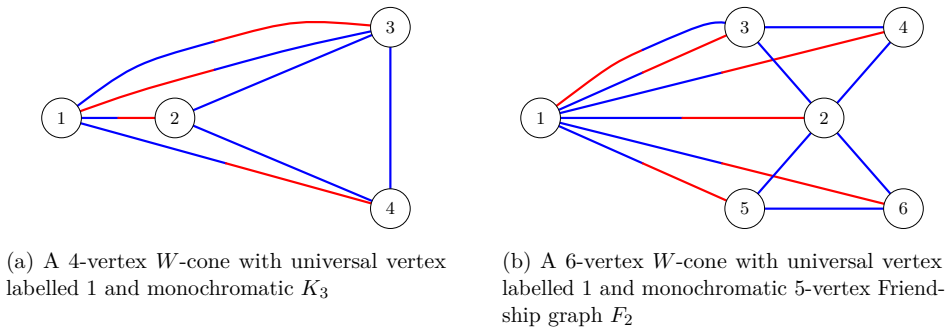
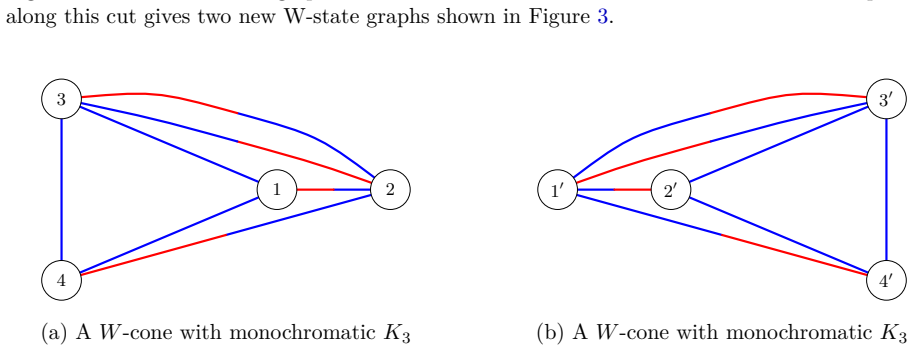
A graph is a W-state graph exactly when each 3-connected component is a W-cone built from a universal vertex over a factor-critical base.
A machine-rendered reading of the paper's core claim, the machinery that carries it, and where it could break.
Core claim
A graph equipped with a half-edge 2-colouring is a W-state graph if and only if each of its 3-connected components is a W-cone. A W-cone consists of one universal vertex joined to every vertex of a factor-critical base graph, and this local structure fully determines the global matching conditions required for W-states.
What carries the argument
The W-cone, a graph formed by a universal vertex adjacent to all vertices of a factor-critical graph, which serves as the indivisible building block that enforces the single bichromatic edge per perfect matching and the red half-edge per vertex.
If this is right
- No W-state graph can be simple.
- Recognition reduces to verifying the matching-covered property plus inspecting 3-connected components.
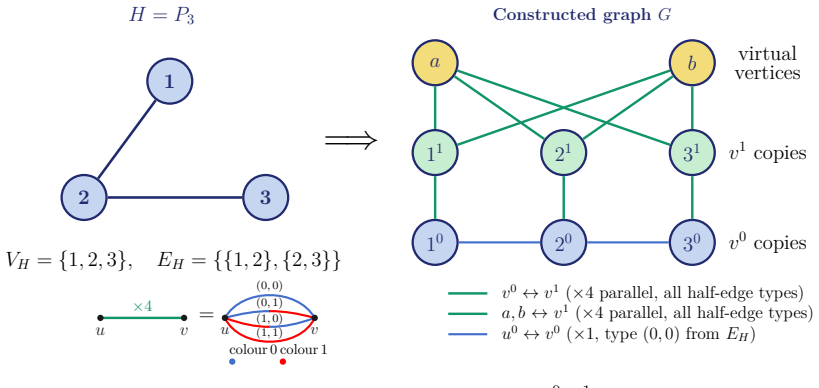
- Verification of one of the two defining conditions for Dicke-state graphs is coNP-complete.
Where Pith is reading between the lines
- The block decomposition suggests a modular way to assemble larger W-state experiments from smaller W-cone units.
- Analogous structural results may exist for graph models of other multipartite entangled states under similar abstraction.
Load-bearing premise
Abstracting away physical amplitudes and phases from the quantum photonic experiments yields a graph class whose properties exactly correspond to the ability to generate idealized W-states.
What would settle it
A matching-covered half-edge 2-coloured graph in which every perfect matching contains exactly one bichromatic edge and every vertex meets a red half-edge, yet at least one 3-connected component fails to be a W-cone.
Figures


read the original abstract
We study the class of edge-coloured graphs arising from the graph-theoretic representation of quantum photonic experiments that generate multipartite W-states. Abstracting away physical amplitudes and phases, we introduce W-state graphs: matching-covered graphs equipped with a half-edge 2-colouring such that every perfect matching contains exactly one bichromatic edge and every vertex is incident with a red half-edge. Our main contribution is a complete structural characterization of W-state graphs. We show that a graph is a W-state graph if and only if each of its 3-connected components is a W-cone, a simple and rigid building block defined by a universal vertex and a factor-critical base. This characterization implies that no W-state graph is simple and yields a recognition algorithm running as fast as verifying whether a graph is matching-covered. We also show that the natural generalization to Dicke states encounters a complexity barrier: verifying one of the two Dicke state conditions is itself coNP-complete, resolving an open problem of Vardi and Zhang [IJCAI 2023]. Our results place W-state graphs firmly within classical matching theory and precisely delineate the combinatorial structures capable of realizing idealized W-states in the experiment-graph framework.
Editorial analysis
A structured set of objections, weighed in public.
Referee Report
Summary. The paper introduces W-state graphs as matching-covered graphs with a half-edge 2-colouring where every perfect matching has exactly one bichromatic edge and every vertex is incident to a red half-edge. It claims a complete structural characterization: a graph is a W-state graph if and only if each of its 3-connected components is a W-cone (a universal vertex joined to a factor-critical base). This implies no W-state graph is simple and yields a recognition algorithm as fast as verifying matching-covered graphs. It further shows that verifying one of the two conditions for the natural generalization to Dicke states is coNP-complete, resolving an open problem from Vardi and Zhang (IJCAI 2023).
Significance. If the claimed equivalence holds, the work successfully embeds the combinatorial structures underlying idealized W-state generation into classical matching theory, using standard results on factor-critical graphs and 3-connected components. The direct corollary that no W-state graph is simple follows immediately from the W-cone structure. The efficient recognition algorithm and the coNP-completeness result for Dicke states are concrete, falsifiable contributions that delineate the boundary between tractable and intractable cases in the experiment-graph framework.
minor comments (3)
- [Abstract] Abstract: the definition of a W-cone is given only as 'a simple and rigid building block defined by a universal vertex and a factor-critical base'; a one-sentence parenthetical expansion would improve readability for readers outside matching theory.
- [Abstract] The abstract states that 'verifying one of the two Dicke state conditions is itself coNP-complete' but does not identify which condition; the main text should make this explicit in the statement of the complexity result.
- [References] The reference to Vardi and Zhang [IJCAI 2023] appears in the abstract; the bibliography entry should be checked for completeness and consistency with the journal's citation style.
Simulated Author's Rebuttal
We thank the referee for the careful summary of our work and the positive assessment of its significance. The recommendation for minor revision is noted. No specific major comments were raised in the report, so we have no individual points requiring detailed rebuttal or revision at this stage.
Circularity Check
No significant circularity
full rationale
The derivation defines W-state graphs directly from matching-covered graphs plus two explicit colouring conditions on perfect matchings and half-edges; the claimed iff characterization then decomposes the graph into 3-connected components that are W-cones built from a universal vertex and a factor-critical base. Both directions are stated to follow from classical results on factor-critical graphs and 3-connected components rather than from any self-referential equation or fitted parameter. No step renames a known empirical pattern, imports a uniqueness theorem from the authors' prior work, or smuggles an ansatz via self-citation; the recognition algorithm is a direct corollary of the decomposition and does not loop back to the original colouring conditions by construction. The entire argument therefore remains self-contained within standard matching theory.
Axiom & Free-Parameter Ledger
axioms (2)
- standard math Properties of matching-covered graphs and 3-connected components from classical graph theory.
- domain assumption The half-edge 2-colouring and perfect matching conditions accurately model the combinatorial aspects of W-state generation in photonic experiments.
invented entities (2)
-
W-state graph
no independent evidence
-
W-cone
no independent evidence
Reference graph
Works this paper leans on
-
[1]
Infor- mation flow in parameterized quantum circuits.Quantum Science and Technology, 9, 2024
Abhinav Anand, Lasse Kristensen, Felix Frohnert, Sukin Sim, and Alán Aspuru-Guzik. Infor- mation flow in parameterized quantum circuits.Quantum Science and Technology, 9, 2024. doi:10.1088/2058-9565/ad3eab
-
[2]
Jueming Bao, Zhaorong Fu, Tanumoy Pramanik, Jun Mao, Yulin Chi, Yingkang Cao, Chonghao Zhai, Yifei Mao, Tianxiang Dai, Xiaojiong Chen, Xinyu Jia, Leshi Zhao, Yun Zheng, Bo Tang, Zhihua Li, Jun Luo, Wenwu Wang, Yan Yang, Yingying Peng, and Jianwei Wang. Very- large-scale integrated quantum graph photonics.Nature Photonics, pages 1–9, 2023.doi: 10.1038/s415...
-
[3]
De Carvalho and Joseph Cheriyan
Marcelo H. De Carvalho and Joseph Cheriyan. AnO(VE )algorithm for ear decompositions of matching-covered graphs.ACM Trans. Algorithms, 1(2):324–337, October 2005. doi: 10.1145/1103963.1103969
-
[4]
Design of quantum opti- cal experiments with logic artificial intelligence.Quantum, 6:836, 2022
Alba Cervera-Lierta, Mario Krenn, and Alán Aspuru-Guzik. Design of quantum opti- cal experiments with logic artificial intelligence.Quantum, 6:836, 2022. doi:10.22331/ q-2022-10-13-836
2022
-
[5]
Sunil Chandran and Rishikesh Gajjala
L. Sunil Chandran and Rishikesh Gajjala. Edge-coloured graphs with only monochromatic perfect matchings and their connection to quantum physics.arXiv, 2022. doi:10.48550/ arXiv.2202.05562
-
[6]
Sunil Chandran and Rishikesh Gajjala
L. Sunil Chandran and Rishikesh Gajjala. Graph-theoretic insights on the constructability of complex entangled states.Quantum, 8:1396, 2024.doi:10.22331/Q-2024-07-03-1396
-
[7]
Sunil Chandran, Rishikesh Gajjala, and Abraham M
L. Sunil Chandran, Rishikesh Gajjala, and Abraham M. Illickan. Krenn-Gu conjecture for sparse graphs. In49th International Symposium on Mathematical Foundations of Computer Science, MFCS, volume 306 ofLIPIcs, pages 41:1–41:15, 2024.doi:10.4230/LIPICS.MFCS.2024.41
-
[8]
W. Dür, G. Vidal, and J. I. Cirac. Three qubits can be entangled in two inequivalent ways. Phys. Rev. A, 62:062314, Nov 2000. URL:https://link.aps.org/doi/10.1103/PhysRevA. 62.062314,doi:10.1103/PhysRevA.62.062314
-
[9]
Jack Edmonds, László Lovász, and William R. Pulleyblank. Brick decompositions and the matching rank of graphs.Comb., 2(3):247–274, 1982.doi:10.1007/BF02579233
-
[10]
Lan-Tian Feng, Ming Zhang, Di Liu, Yu-Jie Cheng, Guo-Ping Guo, Dao-Xin Dai, Guang-Can Guo, Mario Krenn, and Xi-Feng Ren. On-chip quantum interference between the origins of a multi-photon state.Optica, 10(1):105–109, 2023.doi:10.1364/OPTICA.474750
-
[11]
Michael Fleischhauer and M. Lukin. Quantum memory for photons: Dark state polaritons. Physical Review A, 65, 01 2002.doi:10.1103/PhysRevA.65.022314
-
[12]
Quantum experiments and graphs
Xuemei Gu, Lijun Chen, Anton Zeilinger, and Mario Krenn. Quantum experiments and graphs. III. high-dimensional and multiparticle entanglement.Physical Review A, 99, 2019. doi:10.1103/PhysRevA.99.032338
-
[13]
Xuemei Gu, Manuel Erhard, Anton Zeilinger, and Mario Krenn. Quantum experiments and graphs II: Quantum interference, computation, and state generation.Proceedings of the National Academy of Sciences, 116(10):4147–4155, 2019.doi:10.1073/pnas.1815884116. 26
-
[14]
A linear time implementation of spqr-trees
Carsten Gutwenger and Petra Mutzel. A linear time implementation of spqr-trees. In Joe Marks, editor,Graph Drawing, 8th International Symposium, GD 2000, Colonial Williamsburg, VA, USA, September 20-23, 2000, Proceedings, Lecture Notes in Computer Science, pages 77–90. Springer, 2000.doi:10.1007/3-540-44541-2\_8
-
[15]
Hopcroft and Robert Endre Tarjan
John E. Hopcroft and Robert Endre Tarjan. Dividing a graph into triconnected components. SIAM J. Comput., 2(3):135–158, 1973.doi:10.1137/0202012
-
[16]
Mario Krenn, Xuemei Gu, and Anton Zeilinger. Quantum experiments and graphs: Multiparty states as coherent superpositions of perfect matchings.Phys. Rev. Lett., 119:240403, 2017. doi:10.1103/PhysRevLett.119.240403
-
[17]
Kottmann, Nora Tischler, and Alán Aspuru-Guzik
Mario Krenn, Jakob S. Kottmann, Nora Tischler, and Alán Aspuru-Guzik. Conceptual understanding through efficient automated design of quantum optical experiments.Phys. Rev. X, 11:031044, 2021.doi:10.1103/PhysRevX.11.031044
-
[18]
Matching structure and the matching lattice.J
László Lovász. Matching structure and the matching lattice.J. Comb. Theory B, 43(2):187–222, 1987.doi:10.1016/0095-8956(87)90021-9
-
[19]
Plummer.Matching Theory
László Lovász and Michael D. Plummer.Matching Theory. North-Holland Mathematics Studies. North-Holland, Amsterdam, 1986
1986
-
[20]
Cláudio L. Lucchesi and U. S. R. Murty.Perfect Matchings: A Theory of Matching Covered Graphs. Springer, 2024.doi:10.1007/978-3-031-47504-7
-
[21]
In: Berenbrink, P., Bouyer, P., Dawar, A., Kant´ e, M.M
Nicolas El Maalouly. Exact matching: Algorithms and related problems. In Petra Berenbrink, Patricia Bouyer, Anuj Dawar, and Mamadou Moustapha Kanté, editors,40th International Symposium on Theoretical Aspects of Computer Science, STACS 2023, Hamburg, Germany, March 7-9, 2023, volume 254 ofLIPIcs, pages 29:1–29:17. Schloss Dagstuhl - Leibniz-Zentrum für In...
-
[22]
PhD thesis, ETH Zurich, Zürich, Switzerland, 2024
Nicolas El Maalouly.Towards a Deterministic Polynomial Time Algorithm for the Exact Matching Problem. PhD thesis, ETH Zurich, Zürich, Switzerland, 2024. URL:https://hdl. handle.net/20.500.11850/675444,doi:10.3929/ETHZ-B-000675444
-
[23]
Silvio Micali and Vijay V. Vazirani. An(O √ |V||E|)algorithm for finding maximum matching in general graphs. In21st Annual Symposium on Foundations of Computer Science (sfcs 1980), pages 17–27, 1980.doi:10.1109/SFCS.1980.12
-
[24]
Ketan Mulmuley, Umesh V. Vazirani, and Vijay V. Vazirani. Matching is as easy as matrix inversion.Comb., 7(1):105–113, 1987.doi:10.1007/BF02579206
-
[25]
Papadimitriou and Mihalis Yannakakis
Christos H. Papadimitriou and Mihalis Yannakakis. The complexity of restricted spanning tree problems.J. ACM, 29(2):285–309, April 1982.doi:10.1145/322307.322309
-
[26]
Kaiyi Qian, Kai Wang, Leizhen Chen, Zhaohua Hou, Mario Krenn, Shining Zhu, and Xiao-song Ma. Multiphoton non-local quantum interference controlled by an undetected photon.Nature Communications, 14(1):1480, 2023.doi:10.1038/s41467-023-37228-y
-
[27]
Carlos Ruiz-Gonzalez, Sören Arlt, Jan Petermann, Sharareh Sayyad, Tareq Jaouni, Ebrahim Karimi, Nora Tischler, Xuemei Gu, and Mario Krenn. Digital discovery of 100 diverse quantum experiments with pytheus.Quantum, 7:1204, 2023.doi:10.22331/Q-2023-12-12-1204. 27
-
[28]
Perfect matchings versus odd cuts.Comb., 22(4):575–589, 2002
Zoltán Szigeti. Perfect matchings versus odd cuts.Comb., 22(4):575–589, 2002. URL: https://doi.org/10.1007/s00493-002-0008-6,doi:10.1007/S00493-002-0008-6
-
[29]
Moshe Y. Vardi and Zhiwei Zhang. Quantum-inspired perfect matching under vertex-color constraints.arXiv, abs/2209.13063, 2022.doi:10.48550/arXiv.2209.13063
-
[30]
Moshe Y. Vardi and Zhiwei Zhang. Solving quantum-inspired perfect matching problems via tutte-theorem-based hybrid boolean constraints. InProceedings of the Thirty-Second International Joint Conference on Artificial Intelligence, IJCAI 2023, 19th-25th August 2023, Macao, SAR, China, pages 2039–2048. ijcai.org, 2023.doi:10.24963/IJCAI.2023/227
-
[31]
Almost exact matchings.Algorithmica, 63(1-2):39–50, 2012
Raphael Yuster. Almost exact matchings.Algorithmica, 63(1-2):39–50, 2012. URL:https: //doi.org/10.1007/s00453-011-9519-0,doi:10.1007/S00453-011-9519-0. 28
discussion (0)
Sign in with ORCID, Apple, or X to comment. Anyone can read and Pith papers without signing in.