Recognition: 2 theorem links
Towards Dependable Retrieval-Augmented Generation Using Factual Confidence Prediction
Pith reviewed 2026-05-08 18:08 UTC · model grok-4.3
The pith
A two-stage process using conformal prediction and an attention-based classifier predicts fact faithfulness in retrieval-augmented generation outputs.
A machine-rendered reading of the paper's core claim, the machinery that carries it, and where it could break.
Core claim
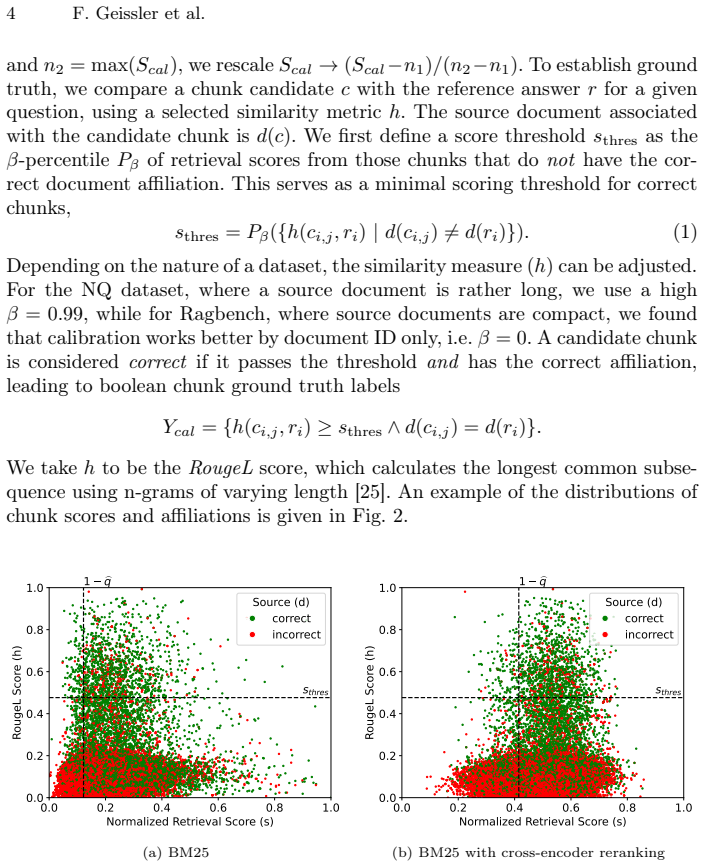
The central claim is that a two-staged pipeline—conformal selection of high-probability retrieved chunks followed by an attention-based factuality classifier—can identify inconsistent retrieval-augmented generations with up to 77 percent success while improving answer quality in suitable setups.
What carries the argument
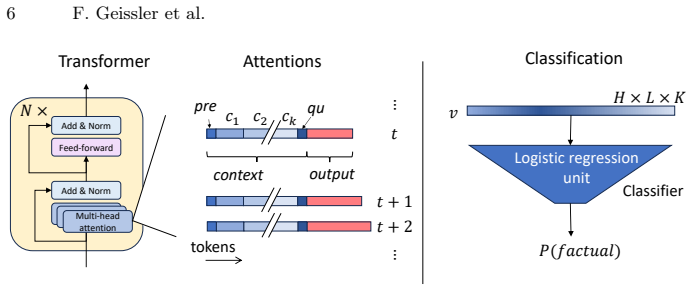
The two-stage pipeline consisting of conformal prediction for reliable chunk selection and an attention-based factuality classifier for measuring answer-context consistency.
Load-bearing premise
The statistical guarantees from conformal prediction require that the retrieved samples are exchangeable, which holds only for certain retriever setups.
What would settle it
A test on a new dataset or retriever where the conformal prediction interval fails to contain the true accuracy rate at the claimed probability would falsify the general applicability of the first stage.
Figures



read the original abstract
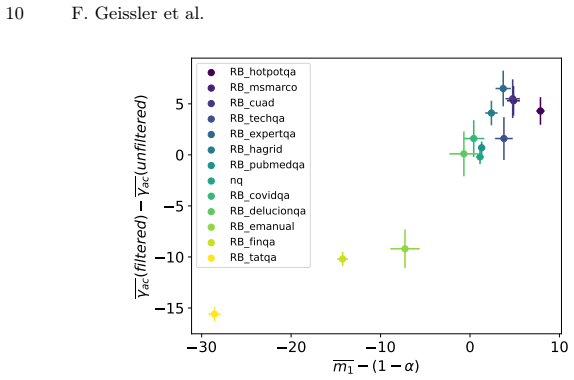
Incorporating specific knowledge into large language models via retrieval-augmented generation (RAG) is a widespread technique that fuels many of today's industry AI applications. A fundamental problem is to assess if the context retrieved by some similarity search provides indeed supporting facts, or instead misguides the generator with irrelevant information. It is critical to associate meaningful confidence measures about the factuality of the retrieval process with the generated answers. We present a new, two-staged approach to predict fact faithfulness of the output of retrieval-augmented generations. First, we employ conformal prediction to select only those retrieved chunks who have a high chance to come from the correct source. This approach in itself can improve answer quality by up to 6% in some of the studied datasets, however, the associated statistical guarantees do not hold generally, since the assumption of sample exchangeability depends on the retriever setup. We present diagnostic metrics to assess whether a setup is suitable. Second, we quantify confidence in the consistency of a generated final answer with a given retrieved context, using an attention-based factuality classifier. This approach can detect inconsistent answers with a chance of up to 77%. Our work helps to establish a novel type of certified RAG systems for a broad range of natural language industry applications.
Editorial analysis
A structured set of objections, weighed in public.
Referee Report
Summary. The paper proposes a two-stage approach for fact-faithfulness prediction in retrieval-augmented generation (RAG). Stage 1 applies conformal prediction to filter retrieved chunks for high factuality confidence, claiming up to 6% quality gains on some datasets while providing diagnostic metrics for the exchangeability assumption (which the authors note depends on the retriever setup and thus voids general statistical guarantees). Stage 2 trains an attention-based classifier to detect inconsistencies between generated answers and retrieved context, reporting detection rates up to 77%. The goal is to enable 'certified RAG' systems.
Significance. If the diagnostic metrics can be shown to reliably flag when exchangeability holds (so that conformal coverage guarantees apply), the work would offer a practical path toward more dependable RAG with quantifiable confidence. The explicit caveat on exchangeability and the two-stage separation are positive; however, without demonstrated validation of the diagnostics against known violations, the certified framing rests on an unverified precondition. No machine-checked proofs or fully reproducible code are described.
major comments (2)
- [§3] §3 (Conformal Prediction for Retrieval): The statistical guarantees are explicitly conditioned on sample exchangeability, which the authors state 'depends on the retriever setup.' The diagnostic metrics are introduced to assess suitability, yet no experiments test whether these metrics correctly predict coverage failure on deliberately non-exchangeable retrieval distributions (e.g., shifted or clustered retriever outputs). This is load-bearing for the 'certified RAG' claim.
- [Results] Results section / Table reporting 6% and 77% figures: The quality improvement and detection rates are stated without accompanying baselines, ablation studies isolating each stage, error bars, or dataset statistics. This makes it impossible to determine whether the gains exceed standard RAG filtering or simple thresholding.
minor comments (1)
- [Method] Notation for the conformal prediction score function and the attention classifier is introduced without a consolidated table of symbols, making cross-references between sections harder to follow.
Simulated Author's Rebuttal
We thank the referee for the constructive and detailed feedback on our manuscript. We agree that additional empirical validation of the diagnostic metrics and clearer, more rigorous reporting of results are necessary to strengthen the claims. We address each major comment below and will incorporate the suggested changes in a revised version of the paper.
read point-by-point responses
-
Referee: [§3] §3 (Conformal Prediction for Retrieval): The statistical guarantees are explicitly conditioned on sample exchangeability, which the authors state 'depends on the retriever setup.' The diagnostic metrics are introduced to assess suitability, yet no experiments test whether these metrics correctly predict coverage failure on deliberately non-exchangeable retrieval distributions (e.g., shifted or clustered retriever outputs). This is load-bearing for the 'certified RAG' claim.
Authors: We agree that empirical validation of the diagnostic metrics against controlled violations of exchangeability is important for substantiating the certified RAG framing. The manuscript introduces these metrics to help practitioners assess whether a given retriever setup satisfies the exchangeability assumption, but we did not perform targeted experiments on deliberately non-exchangeable distributions such as shifted or clustered outputs. In the revised manuscript, we will add experiments that deliberately violate exchangeability and evaluate whether the proposed diagnostics correctly flag the resulting coverage failures. This will provide direct evidence supporting the practical utility of the diagnostics. revision: yes
-
Referee: [Results] Results section / Table reporting 6% and 77% figures: The quality improvement and detection rates are stated without accompanying baselines, ablation studies isolating each stage, error bars, or dataset statistics. This makes it impossible to determine whether the gains exceed standard RAG filtering or simple thresholding.
Authors: We acknowledge that the current results presentation lacks sufficient context for readers to fully evaluate the reported improvements. While the 6% quality gains and 77% detection rates are measured against standard RAG baselines without our proposed filters, we agree that explicit ablations, error bars, and dataset details are needed. In the revision, we will expand the results section to include: (i) direct comparisons against additional baselines such as simple similarity thresholding, (ii) ablation studies isolating the contribution of the conformal prediction stage and the attention-based classifier, (iii) error bars from multiple random seeds, and (iv) summary statistics for each dataset. These changes will make the gains more interpretable and demonstrate that they exceed standard filtering approaches. revision: yes
Circularity Check
No significant circularity; derivation remains self-contained with explicit caveats
full rationale
The paper describes a two-stage method: conformal prediction for chunk selection (with explicit acknowledgment that exchangeability and thus guarantees depend on the retriever setup, plus diagnostic metrics offered to check suitability) followed by a separately trained attention-based factuality classifier. No equations, derivations, or self-citations are presented that reduce any claimed prediction or guarantee to a fitted parameter or input by construction. The classifier training and conformal step are treated as independent components, and the text does not smuggle an ansatz or rename a known result as a novel unification. The central claims therefore do not collapse into their own inputs.
Axiom & Free-Parameter Ledger
axioms (1)
- domain assumption Sample exchangeability holds for the retrieved chunks under the chosen retriever
Reference graph
Works this paper leans on
-
[1]
Amazon Web Services: Develop advanced generative ai chat-based assistants by using rag and react prompt- ing.https://docs.aws.amazon.com/prescriptive-guidance/ latest/patterns/develop-advanced-generative-ai-chat-based- assistants-by-using-rag-and-react-prompting.html(2023), accessed: 2023-10-01
2023
-
[2]
Angelopoulos, A.N., Bates, S.: A Gentle Introduction to Conformal Prediction and Distribution-Free Uncertainty Quantification (December 2022).https: //doi.org/10.48550/arXiv.2107.07511,http://arxiv.org/abs/2107.07511, arXiv:2107.07511 [cs]
work page internal anchor Pith review doi:10.48550/arxiv.2107.07511 2022
-
[3]
In: The Twelfth International Conference on Learning Representations (2023)
Asai, A., Wu, Z., Wang, Y., et al.: Self-rag: Learning to retrieve, generate, and cri- tique through self-reflection. In: The Twelfth International Conference on Learning Representations (2023)
2023
-
[4]
Azamfirei, R., Kudchadkar, S.R., Fackler, J.: Large language models and the perils of their hallucinations. Critical Care27(1), 120 (March 2023).https:// doi.org/10.1186/s13054-023-04393-x,https://ccforum.biomedcentral.com/ articles/10.1186/s13054-023-04393-x
-
[5]
In: Findings of the Association for Computational Linguistics: EMNLP 2023
Azaria, A., Mitchell, T.: The Internal State of an LLM Knows When It’s Lying. In: Findings of the Association for Computational Linguistics: EMNLP 2023. pp. 967–
2023
-
[6]
The internal state of an LLM knows when it ' s lying
Association for Computational Linguistics, Singapore (2023).https://doi. org/10.18653/v1/2023.findings-emnlp.68,https://aclanthology.org/2023. findings-emnlp.68 Towards Dependable Retrieval-Augmented Generation 13
-
[7]
Bates, S., Angelopoulos, A., Lei, L., et al.: Distribution-free, Risk-controlling Pre- diction Sets. Journal of the ACM68(6), 1–34 (December 2021).https://doi.org/ 10.1145/3478535,https://dl.acm.org/doi/10.1145/3478535
-
[8]
Brown, T.B., Mann, B., Ryder, N., et al.: Language Models are Few-Shot Learners (July 2020).https://doi.org/10.48550/arXiv.2005.14165,http://arxiv.org/ abs/2005.14165, arXiv:2005.14165 [cs]
work page internal anchor Pith review doi:10.48550/arxiv.2005.14165 2020
-
[9]
In: Proceedings of the 63rd Annual Meeting of the ACL (2025)
Chang, C.Y., Jiang, Z., Rakesh, V., et al.: MAIN-RAG: Multi-agent filtering retrieval-augmented generation. In: Proceedings of the 63rd Annual Meeting of the ACL (2025)
2025
-
[10]
In: Findings of the Association for Computational Linguistics: EMNLP 2024
Chen, L., Zhang, R., Guo, J., et al.: Controlling risk of retrieval-augmented gener- ation: A counterfactual prompting framework. In: Findings of the Association for Computational Linguistics: EMNLP 2024. Association for Computational Linguis- tics (Nov 2024).https://doi.org/10.18653/v1/2024.findings-emnlp.133, code & RC-RAG benchmark available
-
[11]
arXiv , url =:2407.07071 , primaryclass =
Chuang,Y.S.,Qiu,L.,Hsieh,C.Y.,etal.:LookbackLens:DetectingandMitigating Contextual Hallucinations in Large Language Models Using Only Attention Maps (October 2024).https://doi.org/10.48550/arXiv.2407.07071,http://arxiv. org/abs/2407.07071, arXiv:2407.07071 [cs]
-
[12]
com/jerryjliu/llama_index, accessed: 2023-10-03
Contributors, L.: Llamaindex: A data framework for llms (2023),https://github. com/jerryjliu/llama_index, accessed: 2023-10-03
2023
-
[13]
In: Proceedings of the 4th Workshop on Trustworthy NLP (TrustNLP@ACL)
Fang, Y., Thomas, S., Zhu, X.: HGOT: Hierarchical graph of thoughts for retrieval- augmented in-context learning in factuality evaluation. In: Proceedings of the 4th Workshop on Trustworthy NLP (TrustNLP@ACL). pp. 118–144 (2024)
2024
-
[14]
Friel, R., Belyi, M., Sanyal, A.: RAGBench: Explainable Benchmark for Retrieval-Augmented Generation Systems (January 2025).https: //doi.org/10.48550/arXiv.2407.11005,http://arxiv.org/abs/2407.11005, http://arxiv.org/abs/2407.11005
-
[15]
Retrieval-Augmented Generation for Large Language Models: A Survey
Gao, Y., Xiong, Y., Gao, X., Jia, K., Pan, J., Bi, Y., Dai, Y., Sun, J., Wang, M., Wang, H.: Retrieval-augmented generation for large language models: A survey. arXiv preprint arXiv:2312.10997 (2024),https://arxiv.org/abs/2312.10997v5
work page internal anchor Pith review arXiv 2024
-
[17]
Ge, Z., Wu, Y., Chin, D.W.K., et al.: Resolving conflicting evidence in automated fact-checking: A study on retrieval-augmented llms. Proc. of IJCAI-25 (2025)
2025
-
[18]
Grattafiori, A., Dubey, A., Jauhri, A., et al.: The Llama 3 Herd of Models (Novem- ber 2024).https://doi.org/10.48550/arXiv.2407.21783,http://arxiv.org/ abs/2407.21783, arXiv:2407.21783
work page internal anchor Pith review doi:10.48550/arxiv.2407.21783 2024
-
[19]
Huang, L., Yu, W., Ma, W., et al.: A Survey on Hallucination in Large Language Models: Principles, Taxonomy, Challenges, and Open Questions. ACM Transac- tions on Information Systems43(2), 1–55 (March 2025).https://doi.org/10. 1145/3703155,https://dl.acm.org/doi/10.1145/3703155
-
[20]
IBM Developer: Awb scenarios: Options for rag da.https://developer.ibm.com/ articles/awb-scenarios-options-for-rag-da/(2023), accessed: 2023-10-01
2023
-
[21]
Kwiatkowski, T., Palomaki, J., Redfield, O., et al.: Natural Questions: A Bench- mark for Question Answering Research
-
[22]
Lee, D., Yu, H.: REFIND at SemEval-2025 Task 3: Retrieval-Augmented Fac- tuality Hallucination Detection in Large Language Models (April 2025).https: //doi.org/10.48550/arXiv.2502.13622,http://arxiv.org/abs/2502.13622, arXiv:2502.13622 14 F. Geissler et al
-
[23]
In: Advances in Neural In- formation Processing Systems
Lewis, P., Perez, E., Piktus, A., et al.: Retrieval-Augmented Genera- tion for Knowledge-Intensive NLP Tasks. In: Advances in Neural In- formation Processing Systems. vol. 33, pp. 9459–9474. Curran Asso- ciates, Inc. (2020),https://proceedings.neurips.cc/paper/2020/hash/ 6b493230205f780e1bc26945df7481e5-Abstract.html
2020
-
[24]
Li, Z., Xiong, J., Ye, F., et al.: Uncertaintyrag: Span-level uncertainty enhanced long-context modeling for retrieval-augmented generation. In: arXiv preprint arXiv:2410.02719 (Oct 2024)
-
[25]
Liang, X., Niu, S., Li, Z., et al.: SafeRAG: Benchmarking security in retrieval- augmented generation of large language models. arXiv:2501.18636 (2025)
-
[26]
In: Text Summarization Branches Out
Lin, C.Y.: ROUGE: A Package for Automatic Evaluation of Summaries. In: Text Summarization Branches Out. pp. 74–81. Association for Computational Linguis- tics, Barcelona, Spain (July 2004),https://aclanthology.org/W04-1013/
2004
-
[27]
Manakul, P., Liusie, A., Gales, M.: SelfCheckGPT: Zero-Resource Black-Box Hal- lucination Detection for Generative Large Language Models. In: Proceedings of the 2023 Conference on Empirical Methods in Natural Language Process- ing. pp. 9004–9017. Association for Computational Linguistics, Singapore (2023). https://doi.org/10.18653/v1/2023.emnlp-main.557,h...
-
[28]
OpenAI: OpenAI Embeddings,https://platform.openai.com/docs/guides/ embeddings
-
[29]
Journal of Machine Learning Research12(85), 2825–2830 (2011),http: //jmlr.org/papers/v12/pedregosa11a.html
Pedregosa, F., Varoquaux, G., Gramfort, A., et al.: Scikit-learn: Machine Learning in Python. Journal of Machine Learning Research12(85), 2825–2830 (2011),http: //jmlr.org/papers/v12/pedregosa11a.html
2011
-
[30]
Perez-Beltrachini, L., Lapata, M.: Uncertainty quantification in retrieval aug- mented question answering (Feb 2025), code available athttps://github.com/ lauhaide/ragu
2025
-
[31]
Reimers, N., Gurevych, I.: Sentence transformers: Multilingual sentence and image embeddings (2019),https://www.sbert.net, accessed: 2023-10-03
2019
-
[32]
Journal of Ma- chine Learning Research9(12), 371–421 (2008),http://jmlr.org/papers/v9/ shafer08a.html
Shafer, G., Vovk, V.: A Tutorial on Conformal Prediction. Journal of Ma- chine Learning Research9(12), 371–421 (2008),http://jmlr.org/papers/v9/ shafer08a.html
2008
-
[33]
48550/arXiv.2404.09971,http://arxiv.org/abs/2404.09971, arXiv:2404.09971
Simhi, A., Herzig, J., Szpektor, I., et al.: Constructing Benchmarks and Interven- tions for Combating Hallucinations in LLMs (July 2024).https://doi.org/10. 48550/arXiv.2404.09971,http://arxiv.org/abs/2404.09971, arXiv:2404.09971
- [34]
-
[35]
Reliable evaluation of adversarial robustness with an ensemble of diverse parameter-free attacks
Wolf, T., Debut, L., Sanh, V., et al.: HuggingFace’s Transformers: State-of-the- art Natural Language Processing (July 2020).https://doi.org/10.48550/arXiv. 1910.03771,http://arxiv.org/abs/1910.03771, arXiv:1910.03771 [cs]
work page internal anchor Pith review doi:10.48550/arxiv 2020
-
[36]
On hallucination and predictive uncertainty in conditional language generation
Xiao, Y., Wang, W.Y.: On Hallucination and Predictive Uncertainty in Condi- tional Language Generation. In: Proceedings of the 16th Conference of the Euro- pean Chapter of the Association for Computational Linguistics: Main Volume. pp. 2734–2744. Association for Computational Linguistics, Online (2021).https:// doi.org/10.18653/v1/2021.eacl-main.236,https...
-
[37]
Zubkova, H., Park, J.H., Lee, S.W.: Sugar: Leveraging contextual confidence for smarter retrieval (Jan 2025), semantic entropy guides adaptive retrieval
2025
discussion (0)
Sign in with ORCID, Apple, or X to comment. Anyone can read and Pith papers without signing in.