Recognition: unknown
On the Origin of Mass Ejection in Failed Supernovae
Pith reviewed 2026-05-08 15:55 UTC · model grok-4.3
The pith
Failed supernovae eject material when the neutrino-driven weak shock strengthens above a critical mass-loss ratio set by the local density gradient.
A machine-rendered reading of the paper's core claim, the machinery that carries it, and where it could break.
Core claim
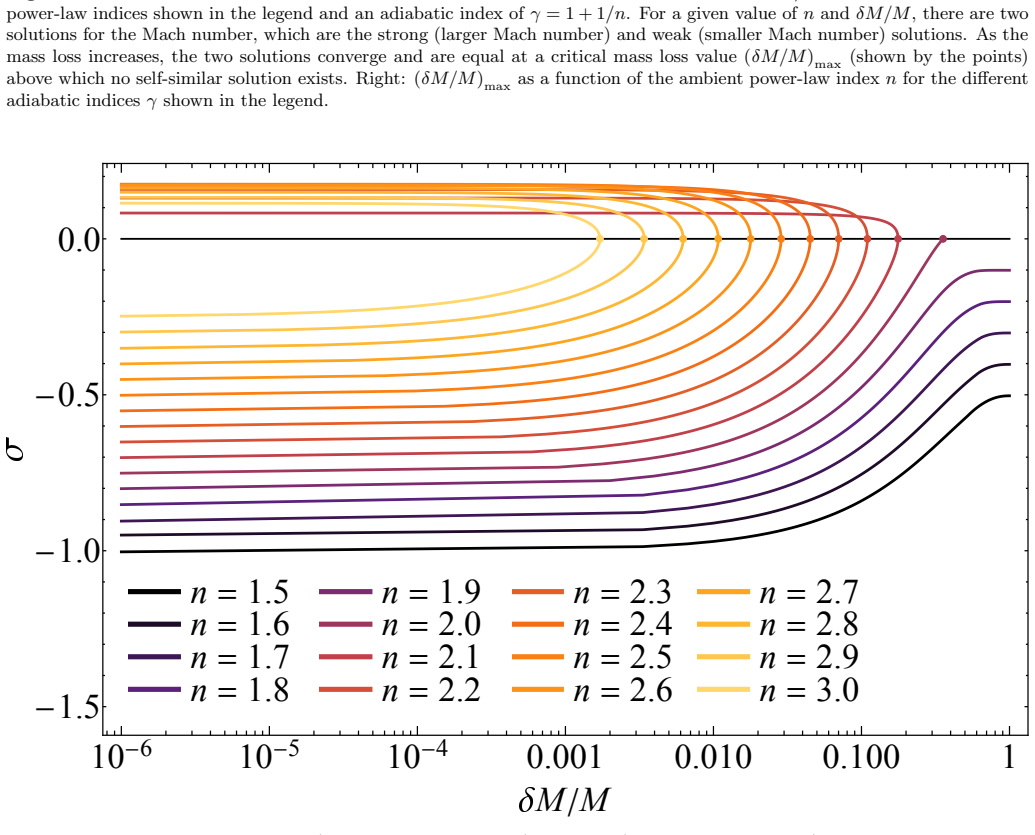
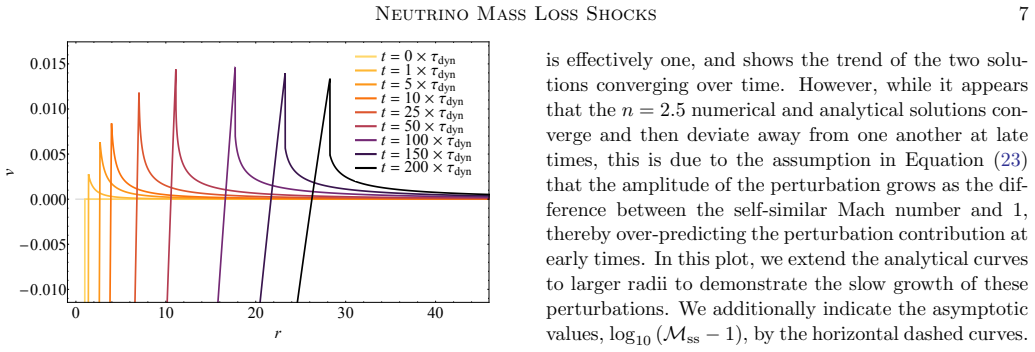
There exist two self-similar solutions for the weak shockwave generated by neutrinos in the outer layers of a star undergoing failed supernova collapse. The larger-Mach-number solutions are unstable, so the shock Mach number increases with time as proportional to t to the power alpha with alpha less than or equal to 0.1 and departs from the self-similar form. The smaller-Mach-number solutions remain stable. Above a critical neutrino mass loss that is easily reached in core-collapse events, the shock asymptotically strengthens toward the strong limit. Consequently the mass lost to neutrinos relative to the mass enclosed by the shock, together with the stellar density gradient, controls the最终
What carries the argument
The pair of self-similar weak-shock solutions in the stellar envelope, analyzed for linear stability and long-term evolution under different neutrino mass-loss ratios.
If this is right
- When neutrino mass loss exceeds the critical ratio, the shock becomes strong, ejecting more material and reducing the mass that falls back onto the newly formed black hole.
- Red supergiants satisfy the critical mass-loss condition at shock formation and therefore produce more luminous breakout transients than compact blue supergiants or Wolf-Rayet stars.
- The amount of ejected mass is set primarily by the density gradient at the radius where the shock forms rather than by global stellar properties.
- Stable, low-Mach shocks result in minimal ejection and nearly complete fallback, leaving a black hole with little surrounding material.
Where Pith is reading between the lines
- The critical mass-loss threshold offers a simple criterion for population-synthesis models to decide which progenitors produce observable transients versus silent black-hole formation.
- Time-dependent Mach-number growth could alter the early light-curve shape of failed-supernova candidates and should be included in radiative-transfer calculations.
- If the same stability behavior holds in three-dimensional simulations, the ejected mass becomes a direct probe of the neutrino emission history during the first seconds of collapse.
Load-bearing premise
The outer stellar layers can be modeled accurately by the two self-similar shock solutions without major effects from rotation, magnetic fields, or non-spherical geometry.
What would settle it
A hydrodynamical simulation that follows the shock through the envelope and shows the larger-Mach-number branch remaining constant in Mach number rather than growing as t to a power less than or equal to 0.1 would falsify the instability claim.
Figures




read the original abstract
Some high-mass stars likely end their lives in underluminous implosions that leave behind a black hole, known as failed supernovae (FSNe). However, neutrinos radiated during proto-neutron star formation generate a weak (Mach $\gtrsim 1$) shockwave in the outer layers of the star, which produces a unique transient as it breaks out of the dying star and signals its imminent disappearance. It was recently shown that there are two self-similar solutions that describe the propagation of this weak shockwave, and these solutions simultaneously contain outward-moving ejecta and fallback accretion onto the black hole. Here we show that the larger Mach number solutions are unstable, such that the Mach number of the shock grows with time $t$ and deviates from the self-similar prediction as $\propto t^{\alpha}$, with $\alpha \lesssim 0.1$, whereas the smaller Mach number solutions are stable. We also show that, above a critical mass loss that is readily achievable in core-collapse supernovae, the shock asymptotically strengthens and approaches the strong limit. Our results imply that it is the mass lost to neutrinos \textit{relative} to the mass enclosed by the shockwave, as well as the stellar density gradient where the shock forms, that primarily dictate its strength and the amount of material it ejects. These criteria explain why red supergiants, which have relative mass losses well in excess of the critical value at the time of shock formation, more readily eject material and create more luminous explosions compared to more compact progenitors.
Editorial analysis
A structured set of objections, weighed in public.
Referee Report
Summary. The paper analyzes weak neutrino-driven shocks in failed supernovae using two self-similar solutions from prior work. It performs a stability analysis showing that larger-Mach-number solutions are unstable, with the shock Mach number growing as t^α (α ≲ 0.1) and deviating from self-similarity, while smaller-Mach solutions remain stable. Above a critical neutrino mass loss relative to the enclosed mass (achievable in core-collapse events), the shock strengthens asymptotically toward the strong-shock limit. The results tie ejection outcomes to the ratio of neutrino mass loss and the local density gradient, explaining why red supergiants eject more material and produce brighter transients than compact progenitors.
Significance. If the stability results and critical-mass-loss threshold are robust, the work supplies a concrete mechanism linking progenitor structure, neutrino losses, and mass ejection in failed supernovae. It offers falsifiable predictions for the relative importance of density gradient versus mass-loss ratio and accounts for observed differences between red-supergiant and compact-star progenitors without invoking additional physics.
major comments (2)
- [Stability analysis section (likely §3–4)] The central stability claim (larger-Mach solutions unstable with α ≲ 0.1) is load-bearing for the distinction between stable and unstable regimes and for the subsequent critical-mass-loss criterion. The linear perturbation analysis and its boundary conditions at the shock and at large radius must be shown explicitly; without them it is impossible to verify that the reported growth rate does not arise from the choice of self-similar background or from neglected terms.
- [Introduction and discussion of self-similar solutions] The applicability of the two self-similar solutions to realistic envelopes is assumed throughout the derivation of both the instability and the critical mass-loss threshold. The manuscript provides no quantitative estimate of the radii or timescales at which rotation, magnetic fields, or non-spherical effects remain negligible relative to the shock dynamics; this assumption directly affects whether the reported α and critical mass-loss value survive in three-dimensional stellar models.
minor comments (2)
- [Abstract and results] The abstract states α ≲ 0.1 but does not specify the exact range or the fitting procedure used to obtain this bound; a short table or figure caption in the results section would clarify the numerical values obtained from the stability calculation.
- [Section introducing the two solutions] Notation for the two self-similar families (e.g., “larger Mach” vs. “smaller Mach”) should be defined once with reference to the prior work’s equations so that readers can map the stability results directly onto the background solutions.
Simulated Author's Rebuttal
We thank the referee for their careful reading of the manuscript and for their positive assessment of its potential significance. We address each major comment below and have revised the manuscript to improve clarity and transparency where feasible.
read point-by-point responses
-
Referee: The central stability claim (larger-Mach solutions unstable with α ≲ 0.1) is load-bearing for the distinction between stable and unstable regimes and for the subsequent critical-mass-loss criterion. The linear perturbation analysis and its boundary conditions at the shock and at large radius must be shown explicitly; without them it is impossible to verify that the reported growth rate does not arise from the choice of self-similar background or from neglected terms.
Authors: We agree that the perturbation analysis requires explicit documentation for independent verification. Sections 3 and 4 of the original manuscript derive the growth rates from the linearized hydrodynamic equations around the self-similar background, but the boundary conditions were not written out in full detail. In the revised manuscript we have added an expanded subsection (now §3.2) that presents the explicit forms of the linearized continuity, momentum, and energy equations for the perturbations δρ, δv, and δP. We also specify the boundary conditions: at the shock, the Rankine-Hugoniot conditions are linearized with no additional surface terms for the unstable mode; at large radius the perturbations are required to decay as r^{-n} with n chosen to ensure regularity. The eigenvalue problem for α is solved numerically using a shooting method, and we have included a brief description of the numerical implementation. These additions allow readers to reproduce the reported α values and confirm they are not artifacts of the background choice. revision: yes
-
Referee: The applicability of the two self-similar solutions to realistic envelopes is assumed throughout the derivation of both the instability and the critical mass-loss threshold. The manuscript provides no quantitative estimate of the radii or timescales at which rotation, magnetic fields, or non-spherical effects remain negligible relative to the shock dynamics; this assumption directly affects whether the reported α and critical mass-loss value survive in three-dimensional stellar models.
Authors: We acknowledge that the domain of validity of the spherical, non-rotating, non-magnetized self-similar solutions is an important caveat. The manuscript assumes these conditions hold in the outer envelope during the early post-bounce phase, consistent with the standard setup for self-similar shock solutions in the literature. However, the original text does not supply quantitative estimates of the radii or timescales at which rotation, magnetic fields, or non-spherical flows would invalidate the solutions. In the revised manuscript we have added a paragraph in the Discussion section that references existing 1D and 2D core-collapse simulations to indicate that, for the radii and times of interest (roughly 10^9–10^10 cm and 10^2–10^3 s after bounce), these effects remain sub-dominant in the outer layers for the progenitors considered. We note, however, that a full quantitative assessment would require coupling the analytic solutions to 3D progenitor models with rotation and MHD, which is beyond the scope of the present work. revision: partial
- Quantitative estimates of the radii and timescales at which rotation, magnetic fields, and non-spherical effects become dynamically important would require additional 3D numerical modeling of stellar progenitors that was not performed in this study.
Circularity Check
No significant circularity; derivation adds independent stability analysis
full rationale
The paper cites prior self-similar solutions for the weak shock but then performs a new linear stability analysis on those solutions to derive the time-dependent growth of the Mach number (∝ t^α with α ≲ 0.1) for the larger-Mach branch and stability for the smaller-Mach branch. The critical neutrino mass-loss threshold and its relation to enclosed mass and density gradient are obtained from this stability result rather than being presupposed or fitted. No equation reduces to its input by construction, no parameter is renamed as a prediction, and the self-citation of the base solutions is not load-bearing for the new dynamical claims. The chain is therefore self-contained against external benchmarks.
Axiom & Free-Parameter Ledger
axioms (2)
- domain assumption The outer layers of the star can be described by the two self-similar weak-shock solutions identified in prior work.
- domain assumption Spherical symmetry and neglect of rotation/magnetic fields are valid at shock-formation radii.
Reference graph
Works this paper leans on
-
[1]
Low-energy Explosions in a Gravitational Field: Implications for Sub-energetic Supernovae and Fast X-Ray Transients. , keywords =. doi:10.3847/1538-4357/ad11f4 , archivePrefix =. 2310.10713 , primaryClass =
-
[2]
Foundations of radiation hydrodynamics
-
[3]
Convective Instability of Hollow Sedov-Taylor Blast Waves. , keywords =. doi:10.1086/168977 , adsurl =
-
[4]
Delayed Neutrino-Driven Supernova Explosions Aided by the Standing Accretion-Shock Instability. , keywords =. doi:10.1088/0004-637X/694/1/664 , archivePrefix =. 0708.3372 , primaryClass =
-
[5]
Linear Stability Analysis of Spherical Accretion Flows onto Compact Objects. , keywords =. doi:10.1086/171679 , adsurl =
-
[6]
Dynamics of a Spherical Accretion Shock with Neutrino Heating and Alpha-Particle Recombination. , keywords =. doi:10.1088/0004-637X/703/2/1464 , archivePrefix =. 0812.4574 , primaryClass =
-
[7]
An Investigation into the Character of Pre-explosion Core-collapse Supernova Shock Motion. , keywords =. doi:10.1088/0004-637X/759/1/5 , archivePrefix =. 1204.3088 , primaryClass =
-
[8]
A Parametric Study of the SASI Comparing General Relativistic and Non-Relativistic Treatments. arXiv e-prints , keywords =. doi:10.48550/arXiv.2307.10904 , archivePrefix =. 2307.10904 , primaryClass =
-
[9]
The Man behind the Curtain: X-Rays Drive the UV through NIR Variability in the 2013 Active Galactic Nucleus Outburst in NGC 2617. , keywords =. doi:10.1088/0004-637X/788/1/48 , archivePrefix =. 1310.2241 , primaryClass =
-
[10]
The unblinking eye on the sky. Nature Astronomy , keywords =. doi:10.1038/s41550-017-0071 , archivePrefix =. 1705.10052 , primaryClass =
-
[11]
, archivePrefix = "arXiv", eprint =
The Cosmic Core-collapse Supernova Rate Does Not Match the Massive-star Formation Rate. , keywords =. doi:10.1088/0004-637X/738/2/154 , archivePrefix =. 1102.1977 , primaryClass =
-
[12]
Observational Constraints on the Progenitors of Core-Collapse Supernovae: The Case for Missing High-Mass Stars. , keywords =. doi:10.1017/pasa.2015.17 , archivePrefix =. 1504.02635 , primaryClass =
-
[13]
The Division between Weak and Strong Explosions from Failed Supernovae. , keywords =. doi:10.3847/1538-4357/acf313 , archivePrefix =. 2308.04486 , primaryClass =
-
[14]
Non-relativistic Radiation-mediated Shock Breakouts. I. Exact Bolometric Planar Breakout Solutions. , keywords =. doi:10.1088/0004-637X/742/1/36 , archivePrefix =. 1103.5075 , primaryClass =
-
[15]
Spherically symmetric accretion on to a compact object through a standing shock: the effects of general relativity in the Schwarzschild geometry. , keywords =. doi:10.1093/mnras/stac2494 , archivePrefix =. 2209.00023 , primaryClass =
-
[16]
Core-collapse Supernovae from 9 to 120 Solar Masses Based on Neutrino-powered Explosions. , keywords =. doi:10.3847/0004-637X/821/1/38 , archivePrefix =. 1510.04643 , primaryClass =
-
[17]
Weak Shock Propagation with Accretion. II. Stability of Self-similar Solutions to Radial Perturbations. , keywords =. doi:10.3847/1538-4357/ab09ec , archivePrefix =. 1901.04487 , primaryClass =
-
[18]
Weak Shock Propagation with Accretion. I. Self-similar Solutions and Application to Failed Supernovae. , keywords =. doi:10.3847/1538-4357/aad198 , archivePrefix =. 1805.06456 , primaryClass =
-
[19]
2000, ApJS, 131, 273, doi: 10.1086/317361
FLASH: An Adaptive Mesh Hydrodynamics Code for Modeling Astrophysical Thermonuclear Flashes. , keywords =. doi:10.1086/317361 , adsurl =
-
[20]
Journal of Applied Mathematics and Mechanics , year = 1946, month = jan, volume =
Propagation of strong shock waves. Journal of Applied Mathematics and Mechanics , year = 1946, month = jan, volume =
1946
-
[21]
The Formation of a Blast Wave by a Very Intense Explosion. I. Theoretical Discussion. Proceedings of the Royal Society of London Series A , year = 1950, month = mar, volume =. doi:10.1098/rspa.1950.0049 , adsurl =
-
[22]
Core-collapse Supernova Simulations and the Formation of Neutron Stars, Hybrid Stars, and Black Holes. , keywords =. doi:10.3847/1538-4357/ac31a8 , archivePrefix =. 2109.01508 , primaryClass =
-
[23]
The search for failed supernovae with the Large Binocular Telescope: constraints from 7 yr of data. , keywords =. doi:10.1093/mnras/stx898 , archivePrefix =. 1610.02402 , primaryClass =
-
[24]
Coughlin and Jonathan Zrake , title =
Eric R. Coughlin and Jonathan Zrake , title =. doi:10.3847/1538-4357/ac4033 , url =
-
[25]
, year = 1966, month = mar, volume =
The Hydrodynamic Behavior of Supernovae Explosions. , year = 1966, month = mar, volume =. doi:10.1086/148549 , adsurl =
-
[26]
Revival of a stalled supernova shock by neutrino heating. , keywords =. doi:10.1086/163343 , adsurl =
-
[27]
Monthly Notices of the Royal Astronomical Society , volume=
Supernova simulations from a 3D progenitor model--Impact of perturbations and evolution of explosion properties , author=. Monthly Notices of the Royal Astronomical Society , volume=. 2017 , publisher=
2017
-
[28]
2018 b , , 865, 81, 10.3847/1538-4357/aadcf7
Exploring Fundamentally Three-dimensional Phenomena in High-fidelity Simulations of Core-collapse Supernovae. , keywords =. doi:10.3847/1538-4357/aadcf7 , archivePrefix =. 1807.07579 , primaryClass =
-
[29]
Rotation-supported Neutrino-driven Supernova Explosions in Three Dimensions and the Critical Luminosity Condition. , keywords =. doi:10.3847/1538-4357/aa9ce8 , archivePrefix =. 1708.04154 , primaryClass =
-
[30]
Monthly Notices of the Royal Astronomical Society , volume=
Three-dimensional supernova explosion simulations of 9-, 10-, 11-, 12-, and 13-M⊙ stars , author=. Monthly Notices of the Royal Astronomical Society , volume=. 2019 , publisher=
2019
-
[31]
A successful 3D core-collapse supernova explosion model. , keywords =. doi:10.1093/mnras/sty2585 , archivePrefix =. 1809.05106 , primaryClass =
-
[32]
A Theory of Supernova Explosions. , keywords =. doi:10.1086/187074 , adsurl =
-
[33]
Neutrino-driven Winds from Young, Hot Neutron Stars. , keywords =. doi:10.1086/164587 , adsurl =
-
[34]
The Physics of the Neutrino Mechanism of Core-collapse Supernovae. , keywords =. doi:10.1088/0004-637X/746/1/106 , archivePrefix =. 1103.4864 , primaryClass =
-
[35]
Neutron Star Accretion in a Supernova.ApJ1989,346, 847
Neutron Star Accretion in a Supernova. , keywords =. doi:10.1086/168066 , adsurl =
-
[36]
Stability of Standing Accretion Shocks, with an Eye toward Core-Collapse Supernovae
Stability of Standing Accretion Shocks, with an Eye toward Core-Collapse Supernovae. , keywords =. doi:10.1086/345812 , archivePrefix =. astro-ph/0210634 , primaryClass =
-
[37]
LSST: From Science Drivers to Reference Design and Anticipated Data Products. , keywords =. doi:10.3847/1538-4357/ab042c , archivePrefix =. 0805.2366 , primaryClass =
-
[38]
Shock Breakout in SN 1987A. , keywords =. doi:10.1086/171542 , adsurl =
-
[39]
An extremely luminous X-ray outburst at the birth of a supernova. , keywords =. doi:10.1038/nature06997 , archivePrefix =. 0802.1712 , primaryClass =
-
[40]
Extragalactic fast X-ray transient candidates discovered by Chandra (2000-2014). , keywords =. doi:10.1051/0004-6361/202243047 , archivePrefix =. 2201.07773 , primaryClass =
-
[41]
Extragalactic fast X-ray transient candidates discovered by Chandra (2014-2022). , keywords =. doi:10.1051/0004-6361/202345912 , archivePrefix =. 2304.13795 , primaryClass =
-
[42]
Shock steepening and prompt thermal emission in supernovae. , keywords =. doi:10.1086/182810 , adsurl =
-
[43]
X-ray bursts from type II supernovae. , keywords =. doi:10.1086/182740 , adsurl =
-
[44]
Some Secondary Indications of Gravitational Collapse. , keywords =. doi:10.1007/BF00638971 , adsurl =
-
[45]
Very Low Energy Supernovae from Neutrino Mass Loss. , keywords =. doi:10.1088/0004-637X/769/2/109 , archivePrefix =. 1303.5055 , primaryClass =
-
[46]
Self-similar adiabatic strong explosion in a medium gravitationally free falling to a point mass. , keywords =. doi:10.1093/mnras/stab483 , archivePrefix =. 2008.11236 , primaryClass =
-
[47]
, year = 1957, month = aug, volume =
Automodel Motion of a Gas With Spherical Symmetry in the Field of a Gravitating Center. , year = 1957, month = aug, volume =
1957
-
[48]
Mass ejection in failed supernovae: variation with stellar progenitor. , keywords =. doi:10.1093/mnras/sty306 , archivePrefix =. 1710.01735 , primaryClass =
-
[49]
The Expulsion of Stellar Envelopes in Core-Collapse Supernovae. , keywords =. doi:10.1086/306571 , archivePrefix =. astro-ph/9807046 , primaryClass =
-
[50]
Elizabeth Lovegrove and S. E. Woosley and Weiqun Zhang , title =. The Astrophysical Journal , abstract =. 2017 , month =. doi:10.3847/1538-4357/aa7b7d , url =
-
[51]
2017b, MNRAS, 468, 4968, doi:10.1093/mnras/stx816
The search for failed supernovae with the Large Binocular Telescope: confirmation of a disappearing star. , keywords =. doi:10.1093/mnras/stx816 , adsurl =
-
[52]
How Massive Single Stars End Their Life. , keywords =. doi:10.1086/375341 , adsurl =
-
[53]
Blasts from the Past: Supernova Shock Breakouts among X-Ray Transients in the XMM-Newton Archive. , keywords =. doi:10.3847/1538-4357/ab91ba , archivePrefix =. 2004.09519 , primaryClass =
-
[54]
A force explosion condition for spherically symmetric core-collapse supernovae. , keywords =. doi:10.1093/mnras/stac1811 , archivePrefix =. 2110.10173 , primaryClass =
-
[55]
The force explosion condition is consistent with spherically symmetric CCSN explosions. , keywords =. doi:10.1093/mnras/stad2155 , archivePrefix =. 2302.04890 , primaryClass =
-
[56]
Sakurai, Akira , title =. Communications on Pure and Applied Mathematics , volume =. doi:https://doi.org/10.1002/cpa.3160130303 , url =. https://onlinelibrary.wiley.com/doi/pdf/10.1002/cpa.3160130303 , year =
-
[57]
Supernova mechanisms , author =. Rev. Mod. Phys. , volume =. 1990 , month =. doi:10.1103/RevModPhys.62.801 , url =
-
[58]
David , title =
Arnett, W. David , title =. Canadian Journal of Physics , volume =. 1966 , doi =
1966
-
[59]
Discovery of a New Kind of Explosive X-Ray Transient near M86. , keywords =. doi:10.1088/0004-637X/779/1/14 , archivePrefix =. 1310.7238 , primaryClass =
-
[60]
Handbook of Supernovae , year = 2017, editor =
Shock Breakout Theory. Handbook of Supernovae , year = 2017, editor =. doi:10.1007/978-3-319-21846-5_33 , adsurl =
-
[61]
and Treister, Ezequiel and Schawinski, Kevin and Schulze, Steve and Luo, Bin and Alexander, David M
Bauer, Franz E. and Treister, Ezequiel and Schawinski, Kevin and Schulze, Steve and Luo, Bin and Alexander, David M. and Brandt, William N. and Comastri, Andrea and Forster, Francisco and Gilli, Roberto and Kann, David Alexander and Maeda, Keiichi and Nomoto, Ken'ichi and Paolillo, Maurizio and Ranalli, Piero and Schneider, Donald P. and Shemmer, Ohad and...
-
[62]
Observability of flashes from ejecta crashes in aspherical supernovae, with application to SN 2008D. , keywords =. doi:10.1093/mnras/stad2360 , archivePrefix =. 2307.15859 , primaryClass =
-
[63]
Linear Growth of Spiral SASI Modes in Core-Collapse Supernovae. , keywords =. doi:10.1086/510614 , archivePrefix =. astro-ph/0611698 , primaryClass =
-
[64]
The Growth of Linear Perturbations of Adiabatic Shock Waves. , keywords =. doi:10.1086/165021 , adsurl =
-
[65]
Non-radial instabilities of isothermal Bondi accretion with a shock: Vortical-acoustic cycle vs. post-shock acceleration. , keywords =. doi:10.1051/0004-6361:20020912 , archivePrefix =. astro-ph/0206274 , primaryClass =
-
[66]
2016, , 833, 147, 10.3847/1538-4357/833/2/147
Three-dimensional Distribution of Ejecta in Supernova 1987A at 10,000 Days. , keywords =. doi:10.3847/1538-4357/833/2/147 , archivePrefix =. 1609.04413 , primaryClass =
-
[67]
Angular Momentum Fluctuations in the Convective Helium Shell of Massive Stars. , keywords =. doi:10.3847/0004-637X/827/1/40 , archivePrefix =. 1505.05756 , primaryClass =
-
[68]
Explaining the Most Energetic Supernovae with an Inefficient Jet-feedback Mechanism. , keywords =. doi:10.3847/0004-637X/826/2/178 , archivePrefix =. 1511.01471 , primaryClass =
-
[69]
2023 , eprint=
Supernovae in 2023 (review): breakthroughs by late observations , author=. 2023 , eprint=
2023
-
[70]
Black hole accretion discs and luminous transients in failed supernovae from non-rotating supergiants. , keywords =. doi:10.1093/mnrasl/slz031 , archivePrefix =. 1811.12427 , primaryClass =
-
[71]
Numerical simulations of the random angular momentum in convection: Implications for supergiant collapse to form black holes. , keywords =. doi:10.1093/mnras/stab3776 , archivePrefix =. 2107.09068 , primaryClass =
-
[72]
Delayed explosions of red supergiants following 'failed' supernovae
Numerical simulations of the random angular momentum in convection - II. Delayed explosions of red supergiants following 'failed' supernovae. , keywords =. doi:10.1093/mnras/stad2328 , archivePrefix =. 2301.05237 , primaryClass =
-
[73]
Kazhdan, Ya. M. and Murzina, Marina , title = ". Monthly Notices of the Royal Astronomical Society , volume =. 1994 , month =. doi:10.1093/mnras/270.2.351 , url =
-
[74]
The aspherical explosion of the Type IIP SN 2017gmr ^. , keywords =. doi:10.1093/mnrasl/slz119 , archivePrefix =. 1907.10505 , primaryClass =
-
[75]
Physical Correlations and Predictions Emerging from Modern Core-collapse Supernova Theory. , keywords =. doi:10.3847/2041-8213/ad319e , archivePrefix =. 2401.06840 , primaryClass =
-
[76]
, archivePrefix = "arXiv", eprint =
Black Hole Formation in Failing Core-Collapse Supernovae. , keywords =. doi:10.1088/0004-637X/730/2/70 , archivePrefix =. 1010.5550 , primaryClass =
-
[77]
E., Sukhbold, T., & Ugliano, M
A Two-parameter Criterion for Classifying the Explodability of Massive Stars by the Neutrino-driven Mechanism. , keywords =. doi:10.3847/0004-637X/818/2/124 , archivePrefix =. 1503.07522 , primaryClass =
-
[78]
R., Hosseinzadeh, G., Smith, N., et al
JWST Reveals a Luminous Infrared Source at the Position of the Failed Supernova Candidate N6946-BH1. , keywords =. doi:10.3847/1538-4357/ad21fa , archivePrefix =. 2309.16121 , primaryClass =
-
[79]
The Search for Failed Supernovae with the Large Binocular Telescope: The Mid-infrared Counterpart to N6946-BH1. , keywords =. doi:10.3847/1538-4357/ad18d7 , archivePrefix =. 2310.01514 , primaryClass =
-
[80]
Wang, Lifan and Wheeler, J. Craig. Spectropolarimetry of Supernovae. Annual Review of Astronomy and Astrophysics. 2008. doi:https://doi.org/10.1146/annurev.astro.46.060407.145139
discussion (0)
Sign in with ORCID, Apple, or X to comment. Anyone can read and Pith papers without signing in.