Recognition: 2 theorem links
· Lean TheoremNo measurement induced phase transition in the entanglement dynamics of monitored non-interacting one-dimensional fermions in a disordered or quasiperiodic potential
Pith reviewed 2026-05-12 04:54 UTC · model grok-4.3
The pith
Monitored non-interacting fermions in disordered or quasiperiodic potentials remain in an area-law entanglement phase for any monitoring strength.
A machine-rendered reading of the paper's core claim, the machinery that carries it, and where it could break.
Core claim
The entanglement entropy of one-dimensional non-interacting fermions with U(1) symmetry in quasi-periodic or disordered potentials, monitored by homodyne or quantum jump protocols, remains in an area-law phase for all monitoring strengths. No measurement-induced phase transition occurs. Numerical evidence from lattices up to size 18,000 shows the critical monitoring strength is consistent with zero. For the disordered case this is corroborated by an exact mapping onto a nonlinear sigma model that includes an additional mass-like term, which gaps the theory and precludes any transition. In the disordered case the correlation length is longer than in the clean limit and grows with increasing (
What carries the argument
The nonlinear sigma model mapping with an added mass-like term, which encodes the monitored dynamics for the disordered case and demonstrates that the mass term suppresses any phase transition for nonzero monitoring.
If this is right
- Entanglement entropy follows an area law for arbitrary monitoring intensity in both disordered and quasiperiodic settings.
- Any apparent volume-law regime observed at moderate system sizes is a transient finite-size effect that disappears at larger scales.
- The correlation length in the disordered case exceeds that of the clean system and lengthens as disorder increases in the weak-disorder regime.
- The absence of a transition holds equally for homodyne and quantum-jump monitoring protocols.
Where Pith is reading between the lines
- Interactions are likely required to produce a measurement-induced transition in fermionic systems that preserve U(1) symmetry.
- The mass term generated by monitoring may be tied to symmetry protection that prevents volume-law entanglement.
- Disorder could be used to tune the spatial range of entanglement in monitored non-interacting chains without triggering a transition.
Load-bearing premise
That finite-size scaling up to lattices of 18,000 sites is large enough to establish that the correlation length stays finite for every nonzero monitoring strength.
What would settle it
A simulation on substantially larger lattices (L greater than 50,000) that finds a finite critical monitoring strength at which the entanglement entropy scales with system volume would falsify the claim.
Figures


read the original abstract
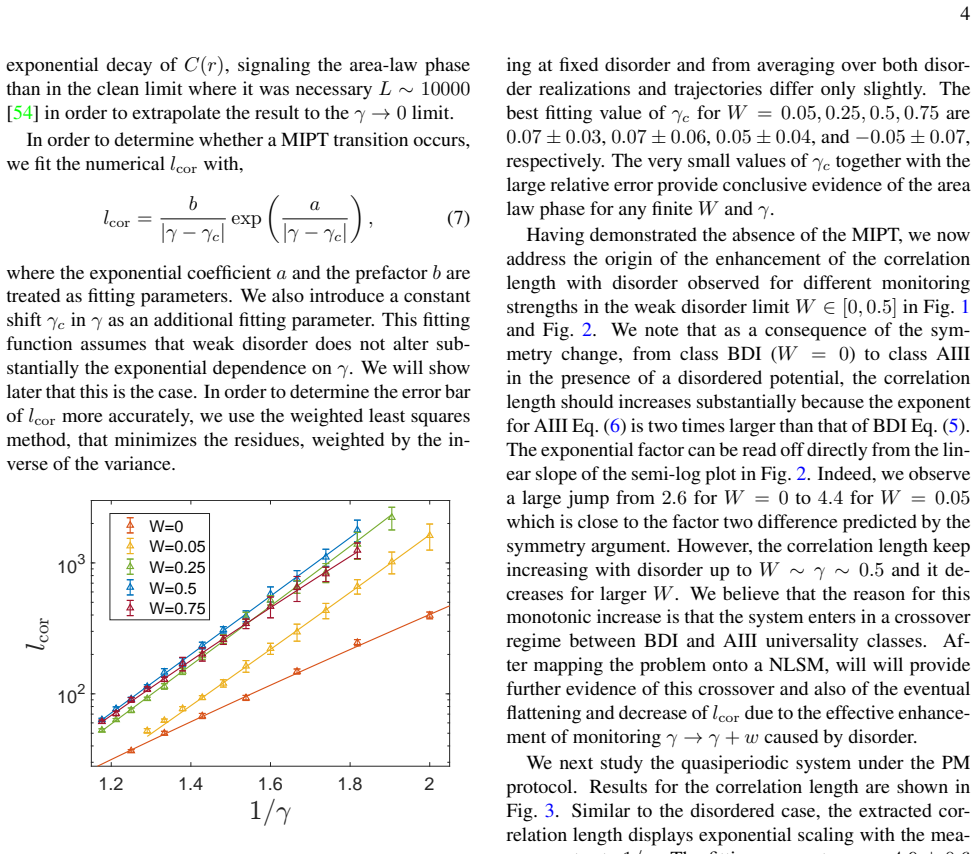
We show that the entanglement entropy (EE) of one-dimensional (1d) non-interacting fermions with $U(1)$ symmetry in the presence of a quasi-periodic or disordered potential in which the occupation number is being monitored by homodyne or quantum jump protocols is always in an area-law phase so no measurement induced phase transition (MIPT) occurs. The reason for the previously claimed MIPT in these systems was a finite size effect related to the fact that the maximum lattice size $L \sim 500$ was of the order of the correlation length. By increasing the system size up to $L \leq 18000$, employing Graphics Processing Unit (GPU), and performing a careful finite size scaling analysis, we find that the critical monitoring strength is consistent with zero so no MIPT occurs. For the disordered case, these numerical results are fully supported by an analytical calculation based on mapping the problem onto a nonlinear sigma model (NLSM) with an additional mass-like term that confirms the absence of the MIPT for any monitoring or disorder strength. Another salient feature of the disordered case, in part related to a different symmetry in the NLSM, is that the correlation length in the weak disorder limit is longer than in the clean limit and increases with the disordered strength.
Editorial analysis
A structured set of objections, weighed in public.
Referee Report
Summary. The manuscript claims that one-dimensional non-interacting fermions with U(1) symmetry, subject to monitoring (via homodyne or quantum-jump protocols) in the presence of disordered or quasiperiodic potentials, remain in an area-law entanglement phase for any nonzero monitoring strength, implying the absence of a measurement-induced phase transition (MIPT). Prior reports of an MIPT are attributed to finite-size effects, as simulations up to L=18000 (enabled by GPU acceleration) combined with finite-size scaling yield a critical monitoring rate consistent with zero. For the disordered case, this numerical conclusion is reinforced by an analytical mapping to a nonlinear sigma model (NLSM) that includes a mass-like term and confirms no transition for any monitoring or disorder strength; an additional feature is that the correlation length grows with weak disorder.
Significance. If the central claim is correct, the work would resolve apparent contradictions in the literature on monitored quantum systems by showing that disorder and quasiperiodicity eliminate the volume-law phase and the associated MIPT in these non-interacting fermionic chains. The large-scale numerics (L up to 18000) and the field-theoretic confirmation via NLSM constitute notable strengths, offering both computational and analytical support. The reported increase of correlation length with disorder strength in the weak-disorder regime is a nontrivial byproduct that may inform related studies of localization and monitoring.
major comments (2)
- [Numerical results and finite-size scaling] Numerical finite-size scaling analysis (described in the abstract and the results section on GPU-enabled simulations): The conclusion that the critical monitoring strength γ_c is consistent with zero, and thus that no MIPT occurs for any γ>0, rests on data collapse and correlation-length extraction up to L=18000. The manuscript must explicitly test whether the observed area-law scaling is robust against the possibility that ξ(γ) diverges faster than any power of 1/γ (e.g., via an essential singularity) as γ→0; if the scaling ansatz implicitly assumes the γ_c=0 form, a small but nonzero γ_c could still produce apparent area-law behavior within the accessible sizes. This point is load-bearing for the headline claim.
- [Analytical NLSM derivation] Analytical NLSM mapping for the disordered case (abstract and the corresponding analytical section): The mapping of the monitored dynamics onto a nonlinear sigma model with an added mass-like term is asserted to confirm the absence of an MIPT for any monitoring or disorder strength. The derivation must detail how the monitoring protocol generates the mass term, confirm that the altered symmetry of the NLSM (relative to the clean case) precludes relevant operators capable of restoring a transition, and verify that no other operators are missed. Without these steps, the analytical support for γ_c=0 remains incomplete.
minor comments (2)
- [Figures] Figure clarity: The finite-size scaling plots and data-collapse figures should include explicit error bars on the extracted correlation lengths and a clear statement of the fitting window and exclusion criteria for small-L data.
- [Throughout] Notation: The monitoring strength parameter should be denoted uniformly (e.g., always as γ) across text, equations, and figure labels to avoid minor confusion.
Simulated Author's Rebuttal
We thank the referee for the careful reading of our manuscript and the constructive comments, which help clarify the robustness of our claims regarding the absence of an MIPT. We respond point by point to the major comments below.
read point-by-point responses
-
Referee: [Numerical results and finite-size scaling] Numerical finite-size scaling analysis (described in the abstract and the results section on GPU-enabled simulations): The conclusion that the critical monitoring strength γ_c is consistent with zero, and thus that no MIPT occurs for any γ>0, rests on data collapse and correlation-length extraction up to L=18000. The manuscript must explicitly test whether the observed area-law scaling is robust against the possibility that ξ(γ) diverges faster than any power of 1/γ (e.g., via an essential singularity) as γ→0; if the scaling ansatz implicitly assumes the γ_c=0 form, a small but nonzero γ_c could still produce apparent area-law behavior within the accessible sizes. This point is load-bearing for the headline claim.
Authors: We agree that a more explicit test against possible essential singularities (or other divergences faster than any power law) is necessary to fully substantiate the claim that γ_c=0. Our existing data collapse up to L=18000 is optimized under the γ_c=0 ansatz, yielding a correlation length ξ(γ) that grows as γ decreases but remains finite and consistent with power-law scaling in the accessible range. To address this concern directly, we have performed additional analysis by inspecting the form of ln(ξ) versus 1/γ, which shows no evidence of the linear behavior expected for an essential singularity exp(c/γ) within our parameter window. While no finite-size study can exhaustively exclude all exotic functional forms, the numerical results are independently corroborated by the NLSM analysis, which analytically predicts a finite ξ for any γ>0. In the revised manuscript we will add these supplementary scaling plots together with an expanded discussion of the ansatz assumptions and their limitations. We therefore make a revision on this point. revision: yes
-
Referee: [Analytical NLSM derivation] Analytical NLSM mapping for the disordered case (abstract and the corresponding analytical section): The mapping of the monitored dynamics onto a nonlinear sigma model with an added mass-like term is asserted to confirm the absence of an MIPT for any monitoring or disorder strength. The derivation must detail how the monitoring protocol generates the mass term, confirm that the altered symmetry of the NLSM (relative to the clean case) precludes relevant operators capable of restoring a transition, and verify that no other operators are missed. Without these steps, the analytical support for γ_c=0 remains incomplete.
Authors: We thank the referee for highlighting the need for greater explicitness in the NLSM section. The monitoring (via either protocol) enters the effective field theory through the disorder-averaged measurement back-action, which generates a mass-like term proportional to γ that gaps the would-be Goldstone modes. The random potential further modifies the target manifold symmetry relative to the clean case, removing the possibility of relevant operators that could restore a critical point. In the revised manuscript we will expand the analytical section to include: (i) a step-by-step derivation showing how the homodyne/quantum-jump averaging produces the mass term, (ii) a symmetry comparison (with explicit group structure) between the clean and disordered NLSMs, and (iii) a brief replica-trick argument confirming that the operator content is complete and contains no additional relevant perturbations capable of driving a transition. These additions will make the analytical support self-contained. revision: yes
Circularity Check
No circularity: central claims rest on direct numerics and standard field theory mapping
full rationale
The paper's derivation consists of GPU-enabled direct simulation of monitored fermion dynamics up to L=18000 followed by finite-size scaling to extract a critical monitoring strength consistent with zero, plus an analytical mapping of the disordered case onto an NLSM with an added mass term. Neither step reduces a result to a fitted input by construction, nor invokes a self-citation whose content is the sole justification for the load-bearing step. The scaling analysis operates on raw entanglement data without presupposing the functional form of the correlation length; the NLSM mapping is presented as an independent analytical confirmation rather than an ansatz imported from the authors' prior work. The derivation is therefore self-contained against external benchmarks.
Axiom & Free-Parameter Ledger
axioms (1)
- domain assumption The monitored non-interacting fermion problem with disorder can be mapped onto a nonlinear sigma model with an additional mass-like term
Lean theorems connected to this paper
-
IndisputableMonolith/Foundation/RealityFromDistinction.leanreality_from_one_distinction unclear?
unclearRelation between the paper passage and the cited Recognition theorem.
mapping the problem onto a nonlinear sigma model (NLSM) with an additional mass-like term that confirms the absence of the MIPT for any monitoring or disorder strength
-
IndisputableMonolith/Cost/FunctionalEquation.leanwashburn_uniqueness_aczel unclear?
unclearRelation between the paper passage and the cited Recognition theorem.
the one loop RG equation is given by ∂D/∂log l =−1/(4π(1+μ̃(l))²)
What do these tags mean?
- matches
- The paper's claim is directly supported by a theorem in the formal canon.
- supports
- The theorem supports part of the paper's argument, but the paper may add assumptions or extra steps.
- extends
- The paper goes beyond the formal theorem; the theorem is a base layer rather than the whole result.
- uses
- The paper appears to rely on the theorem as machinery.
- contradicts
- The paper's claim conflicts with a theorem or certificate in the canon.
- unclear
- Pith found a possible connection, but the passage is too broad, indirect, or ambiguous to say the theorem truly supports the claim.
Reference graph
Works this paper leans on
-
[1]
The filling rate isN/L= 1/2, withNthe number of fermions, and the initial state is|ψ⟩ 0 =|010101· · · ⟩ with0,1the site occupation numbers. We consider two potentialsV i: (1) Disordered potential:V i is the random potential ex- tracted from a box distribution between[−W, W]. We im- pose periodic boundary conditionsc i =c i+L, c† i =c † i+L. (2) Quasiperio...
-
[2]
P. W. Anderson, Absence of diffusion in certain random lat- tices, Phys. Rev.109, 1492 (1958)
work page 1958
-
[3]
E. Abrahams, P. W. Anderson, D. C. Licciardello, and T. V . Ramakrishnan, Scaling theory of localization: Absence of quantum diffusion in two dimensions, Phys. Rev. Lett.42, 673 (1979)
work page 1979
-
[4]
M. Schreiber and H. Grussbach, Multifractal wave functions at the anderson transition, Phys. Rev. Lett.67, 607 (1991)
work page 1991
-
[6]
A. M. Garc ´ıa-Garc´ıa and E. Cuevas, Dimensional depen- dence of the metal-insulator transition, Phys. Rev. B75, 174203 (2007)
work page 2007
-
[7]
A. Rodriguez, L. J. Vasquez, K. Slevin, and R. A. R ¨omer, Multifractal finite-size scaling and universality at the ander- son transition, Phys. Rev. B84, 134209 (2011)
work page 2011
-
[8]
A. M. Garc ´ıa-Garc´ıa, Semiclassical theory of the anderson transition, Phys. Rev. Lett.100, 076404 (2008)
work page 2008
-
[9]
P. G. Harper, Single band motion of conduction electrons in a uniform magnetic field, Proceedings of the Physical Soci- ety. Section A68, 874 (1955)
work page 1955
-
[10]
S. Aubry and G. Andr ´e, Analyticity breaking and anderson localization in incommensurate lattices, Ann. Israel Phys. Soc3, 18 (1980)
work page 1980
-
[11]
M. Kohmoto, L. P. Kadanoff, and C. Tang, Localization problem in one dimension: Mapping and escape, Phys. Rev. Lett.50, 1870 (1983)
work page 1983
-
[12]
I. Burmistrov, K. Tikhonov, I. Gornyi, and A. Mirlin, En- tanglement entropy and particle number cumulants of dis- ordered fermions, Annals of Physics (NY)383, 140 (2017)
work page 2017
-
[13]
D. Gioev and I. Klich, Entanglement entropy of fermions in any dimension and the widom conjecture, Phys. Rev. Lett. 96, 100503 (2006)
work page 2006
-
[14]
W. Nagourney, J. Sandberg, and H. Dehmelt, Shelved op- tical electron amplifier: Observation of quantum jumps, Phys. Rev. Lett.56, 2797 (1986)
work page 1986
- [15]
-
[16]
S. Gleyzes, S. Kuhr, C. Guerlin, J. Bernu, S. Del ´eglise, U. Busk Hoff, M. Brune, J.-M. Raimond, and S. Haroche, Quantum jumps of light recording the birth and death of a photon in a cavity, Nature446, 297–300 (2007)
work page 2007
- [17]
-
[18]
M. B. Plenio and P. L. Knight, The quantum-jump approach to dissipative dynamics in quantum optics, Rev. Mod. Phys. 70, 101 (1998)
work page 1998
-
[19]
H. M. Wiseman and G. J. Milburn, Quantum theory of op- tical feedback via homodyne detection, Phys. Rev. Lett.70, 548 (1993)
work page 1993
-
[20]
M. Collett, R. Loudon, and C. G. and, Quantum theory of optical homodyne and heterodyne detection, Journal of Modern Optics34, 881 (1987)
work page 1987
-
[21]
H. M. Wiseman and G. J. Milburn,Quantum Measurement and Control(Cambridge University Press, 2014)
work page 2014
-
[22]
M. Fuwa, S. Takeda, M. Zwierz, H. M. Wiseman, and A. Fu- rusawa, Experimental proof of nonlocal wavefunction col- lapse for a single particle using homodyne measurements, Nature Communications6, 10.1038/ncomms7665 (2015)
-
[23]
Y . Li, X. Chen, and M. P. A. Fisher, Quantum Zeno effect and the many-body entanglement transition, Phys. Rev. B 98, 205136 (2018)
work page 2018
-
[24]
B. Skinner, J. Ruhman, and A. Nahum, Measurement- induced phase transitions in the dynamics of entanglement, Phys. Rev. X9, 031009 (2019)
work page 2019
- [25]
-
[26]
M. Ippoliti, M. J. Gullans, S. Gopalakrishnan, D. A. Huse, and V . Khemani, Entanglement phase transitions in measurement-only dynamics, Phys. Rev. X11, 011030 (2021)
work page 2021
-
[27]
Y . Li, X. Chen, and M. P. A. Fisher, Measurement-driven entanglement transition in hybrid quantum circuits, Phys. Rev. B100, 134306 (2019)
work page 2019
-
[28]
C. Carisch, A. Romito, and O. Zilberberg, Quantifying measurement-induced quantum-to-classical crossover using an open-system entanglement measure, Phys. Rev. Res.5, L042031 (2023)
work page 2023
-
[29]
M. Szyniszewski, A. Romito, and H. Schomerus, Entangle- ment transition from variable-strength weak measurements, Phys. Rev. B100, 064204 (2019)
work page 2019
-
[30]
M. Szyniszewski, A. Romito, and H. Schomerus, Universal- ity of entanglement transitions from stroboscopic to contin- uous measurements, Phys. Rev. Lett.125, 210602 (2020)
work page 2020
-
[31]
X. Turkeshi, R. Fazio, and M. Dalmonte, Measurement- induced criticality in(2 + 1)-dimensional hybrid quantum circuits, Phys. Rev. B102, 014315 (2020)
work page 2020
-
[32]
X. Turkeshi, A. Biella, R. Fazio, M. Dalmonte, and M. Schir `o, Measurement-induced entanglement transitions in the quantum Ising chain: From infinite to zero clicks, Phys. Rev. B103, 224210 (2021)
work page 2021
-
[33]
X. Turkeshi, M. Dalmonte, R. Fazio, and M. Schir `o, En- tanglement transitions from stochastic resetting of non- Hermitian quasiparticles, Phys. Rev. B105, L241114 (2022)
work page 2022
-
[34]
Y . L. Gal, X. Turkeshi, and M. Schir`o, V olume-to-area law entanglement transition in a non-Hermitian free fermionic chain, SciPost Phys.14, 138 (2023)
work page 2023
- [35]
-
[36]
C. Noel, P. Niroula, D. Zhu, A. Risinger, L. Egan, D. Biswas, M. Cetina, A. V . Gorshkov, M. J. Gullans, D. A. Huse, and C. Monroe, Measurement-induced quan- tum phases realized in a trapped-ion quantum computer, Nat. Phys.18, 760 (2022)
work page 2022
-
[37]
J. M. Koh, S.-N. Sun, M. Motta, and A. J. Minnich, Measurement-induced entanglement phase transition on a superconducting quantum processor with mid-circuit read- 8 out, Nat. Phys.19, 1314 (2023)
work page 2023
-
[38]
Y . Li, X. Chen, A. W. W. Ludwig, and M. P. A. Fisher, Con- formal invariance and quantum nonlocality in critical hybrid circuits, Phys. Rev. B104, 104305 (2021)
work page 2021
-
[39]
C.-M. Jian, Y .-Z. You, R. Vasseur, and A. W. W. Ludwig, Measurement-induced criticality in random quantum cir- cuits, Phys. Rev. B101, 104302 (2020)
work page 2020
-
[40]
C.-M. Jian, B. Bauer, A. Keselman, and A. W. W. Ludwig, Criticality and entanglement in nonunitary quantum circuits and tensor networks of noninteracting fermions, Phys. Rev. B106, 134206 (2022)
work page 2022
- [41]
-
[42]
I. Poboiko, P. P ¨opperl, I. V . Gornyi, and A. D. Mirlin, Theory of free fermions under random projective measure- ments, Phys. Rev. X13, 041046 (2023)
work page 2023
-
[43]
I. Poboiko, I. V . Gornyi, and A. D. Mirlin, Measurement- induced phase transition for free fermions above one dimen- sion, Phys. Rev. Lett.132, 110403 (2024)
work page 2024
-
[44]
M. Buchhold, Y . Minoguchi, A. Altland, and S. Diehl, Ef- fective theory for the measurement-induced phase transition of Dirac fermions, Phys. Rev. X11, 041004 (2021)
work page 2021
-
[45]
M. Buchhold, T. M ¨uller, and S. Diehl, Revealing measurement-induced phase transitions by pre-selection (2022), arXiv:2208.10506 [cond-mat.dis-nn]
-
[46]
M. Fava, L. Piroli, T. Swann, D. Bernard, and A. Nahum, Nonlinear sigma models for monitored dynamics of free fermions, Phys. Rev. X13, 041045 (2023)
work page 2023
-
[47]
M. Fava, L. Piroli, D. Bernard, and A. Nahum, Monitored fermions with conservedu(1)charge, Phys. Rev. Res.6, 043246 (2024)
work page 2024
-
[48]
X. Cao, A. Tilloy, and A. De Luca, Entanglement in a fermion chain under continuous monitoring, SciPost Phys. 7, 024 (2019)
work page 2019
-
[49]
I. Poboiko and A. D. Mirlin, Quantum dynamics of moni- tored free fermions: Evolution of quantum correlations and scaling at measurement-induced phase transitions, Phys. Rev. B113, 144311 (2026)
work page 2026
-
[50]
I. Poboiko, M. Szyniszewski, C. J. Turner, I. V . Gornyi, A. D. Mirlin, and A. Pal, Measurement-induced l´evy flights of quantum information, Phys. Rev. Lett.135, 170403 (2025)
work page 2025
-
[51]
F. Wegner, The mobility edge problem: continuous symme- try and a conjecture, Zeitschrift f¨ur Physik B35, 207 (1979)
work page 1979
-
[52]
Wegner, Anomalous dimesions for the nonlinear sigma- model in 2 +ϵdimensions (I), Nucl
F. Wegner, Anomalous dimesions for the nonlinear sigma- model in 2 +ϵdimensions (I), Nucl. Phys. B280, 193 (1987)
work page 1987
-
[53]
Efetov, Supersymmetry and theory of disordered metals, Advances in Physics32, 53 (1983)
K. Efetov, Supersymmetry and theory of disordered metals, Advances in Physics32, 53 (1983)
work page 1983
-
[55]
K. Chahine and M. Buchhold, Entanglement phases, local- ization, and multifractality of monitored free fermions in two dimensions, Phys. Rev. B110, 054313 (2024)
work page 2024
- [56]
-
[57]
Entanglement entropy and the fermi surface,
T. Muller, S. Diehl, and M. Buchhold, Measurement- induced dark state phase transitions in long-ranged fermion systems, Physical Review Letters128, 10.1103/phys- revlett.128.010605 (2022)
-
[58]
Y . Fuji and Y . Ashida, Measurement-induced quantum criti- cality under continuous monitoring, Physical Review B102, 054302 (2020)
work page 2020
-
[59]
I. Poboiko, P. P ¨opperl, I. V . Gornyi, and A. D. Mirlin, Measurement-induced transitions for interacting fermions, Phys. Rev. B111, 024204 (2025)
work page 2025
-
[60]
M. Szyniszewski, O. Lunt, and A. Pal, Disordered moni- tored free fermions, Phys. Rev. B108, 165126 (2023)
work page 2023
-
[61]
T. Matsubara, K. Yamamoto, and A. Koga, Measurement- induced phase transitions for free fermions in a quasiperi- odic potential, Phys. Rev. B112, 054309 (2025)
work page 2025
-
[62]
I. Klich and L. Levitov, Quantum noise as an entanglement meter, Phys. Rev. Lett.102, 100502 (2009)
work page 2009
-
[63]
A. MacKinnon and B. Kramer, The scaling theory of elec- trons in disordered solids: Additional numerical results, Zeitschrift fur Physik B Condensed Matter53, 1 (1983)
work page 1983
- [64]
-
[65]
B. Fan, C. Yin, and A. M. Garc´ıa-Garc´ıa, Entanglement dy- namics of monitored noninteracting fermions on graphics processing units, Phys. Rev. B113, 094317 (2026)
work page 2026
-
[66]
Y . Liao, M. Matheussen, and X. Zhang, Measurement- induced phase transitions in disordered fermions (2026), arXiv:2605.05306 [cond-mat.stat-mech]
work page internal anchor Pith review Pith/arXiv arXiv 2026
-
[67]
F. Evers and A. D. Mirlin, Anderson transitions, Rev. Mod. Phys.80, 1355 (2008). 9 Supplemental Materials These Supplemental Materials provides technical details and additional numerical results supporting the analysis pre- sented in the main text. We present the numerical implementation of the projective measurement (PM) and quantum state diffusion (QSD)...
work page 2008
-
[68]
project onto both on-diagonalTr(G)and off-diagonal channelsG − Tr(G) 2R I2R, since Tr ( ¯ΨΨ)2 = 1 2( ¯ΨΨ)ab( ¯ΨΨ)ba − 1 2( ¯ΨΨ)aa( ¯ΨΨ)bb =− 1 2 Tr(G2)−(Tr(G)) 2 , and choose the saddle point at the replica symmetric sectorR= 1. We believe in the current monitoring problem, the replica symmetricTr(G)andTr(σ zG)contribution can only generate diffusive dyna...
-
[69]
=−(∂ µU0)U † 0 ,(∂ µU † f)Uf =−U † f(∂µUf), the last two fast-slow correlated term merge into 2DP µ Tr h (∂µU0)U † 0 U † f(∂µUf) i . Then we try to integrate out the fastΦ f field, we first perform the expansion of Wµ ≡ −iU † f(∂µUf): Wµ =∂ µΦf − i 2 [Φf , ∂µΦf]− 1 6 [Φf ,[Φ f , ∂µΦf]] +O(Φ 4 f). and we expand the non-zero interaction vertex inS 0 of thre...
discussion (0)
Sign in with ORCID, Apple, or X to comment. Anyone can read and Pith papers without signing in.