Recognition: unknown
Stellar rotation and binaries in open clusters with Gaia DR3
Pith reviewed 2026-05-08 16:14 UTC · model grok-4.3
The pith
Most clusters more massive than 1000 solar masses display an extended main sequence turnoff.
A machine-rendered reading of the paper's core claim, the machinery that carries it, and where it could break.
Core claim
The authors conduct the first large-scale statistical exploration of stellar rotation in open clusters by combining Gaia DR3 rotational broadening and periods with literature membership lists. They manually select exotic stellar populations from the color-magnitude diagrams of individual clusters and discover that most clusters more massive than 10^3 M_⊙ display an eMSTO. They present a new parametrization of the number of blue stragglers as a function of cluster mass and age and find that the percentage of binary stars in the equal-mass binary sequence and in the main sequence are similar.
What carries the argument
Manual selection of exotic populations from color-magnitude diagrams of open clusters combined with Gaia DR3 rotation data to characterize populations like blue stragglers and extended main sequence turnoffs.
Load-bearing premise
Literature lists of almost a million cluster member stars are accurate and complete, and manual selection of exotic populations from color-magnitude diagrams introduces no significant subjectivity or contamination biases.
What would settle it
An independent photometric survey of a large sample of massive open clusters that identifies extended main sequence turnoffs in significantly fewer than most of them would challenge the reported discovery.
Figures


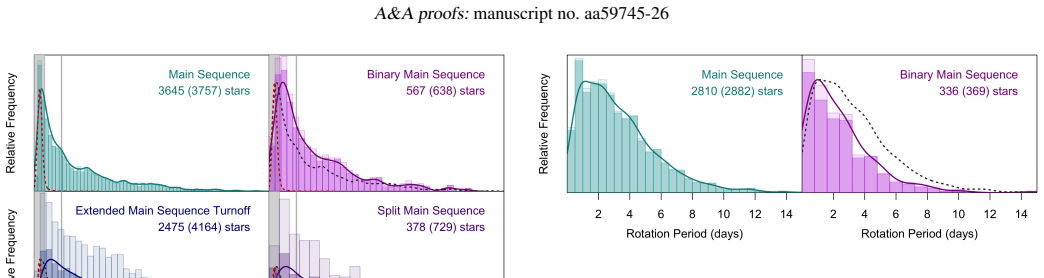
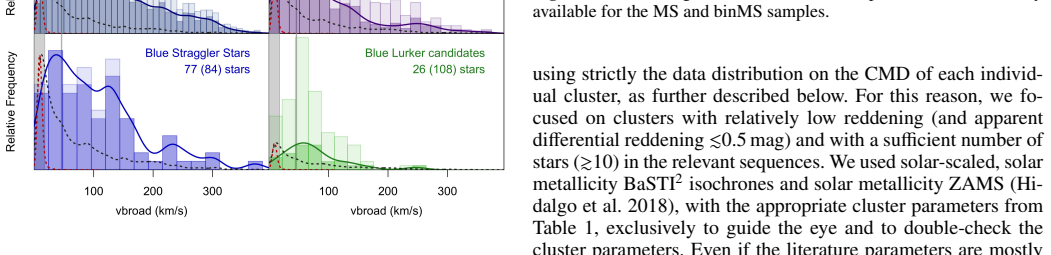

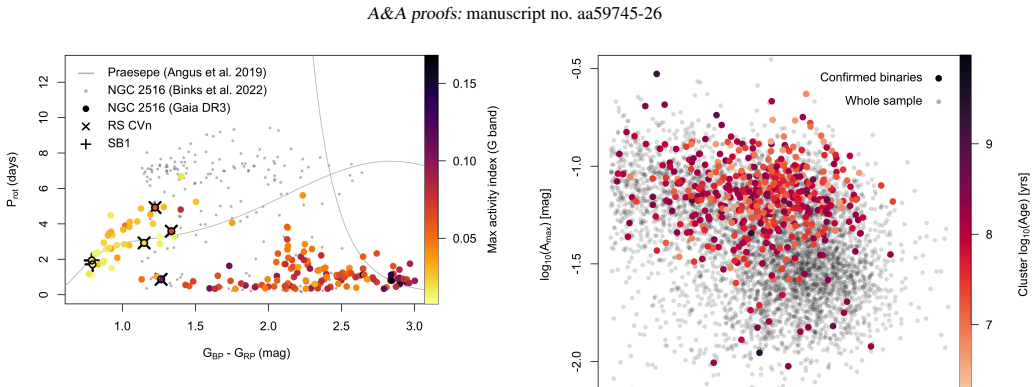
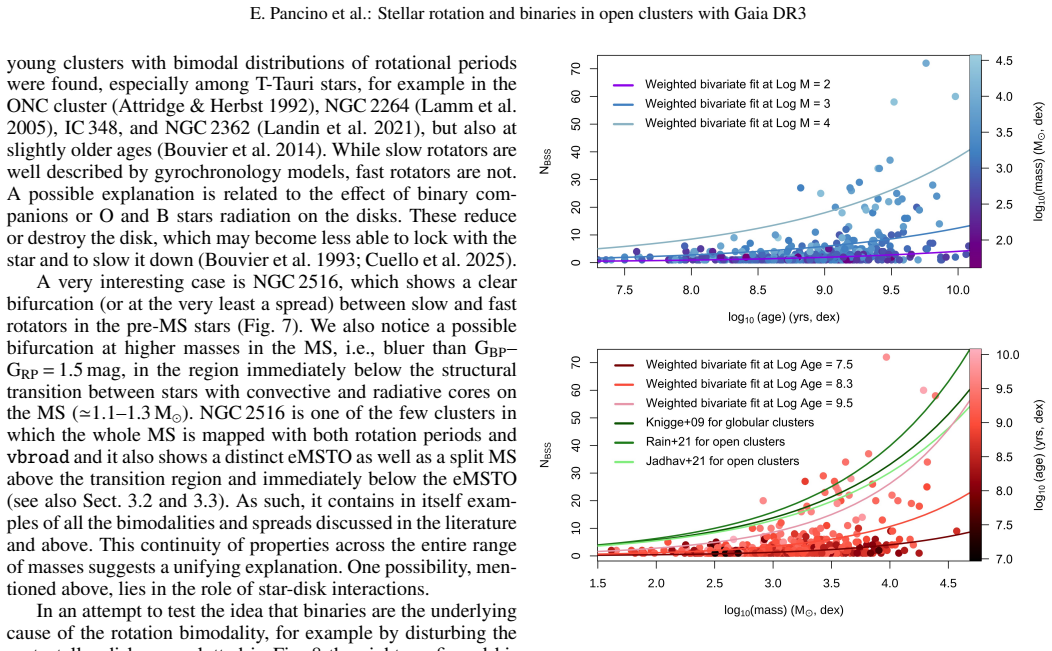

read the original abstract
Stellar rotation is a fundamental ingredient in shaping the evolution of stars and it can also be used to trace past stellar interactions. Yet, systematic studies of stellar rotation in large samples of stars belonging to different populations have only recently been made possible, thanks to spectroscopic surveys. We profit from the catalogue of rotational broadening and rotation periods released with Gaia DR3. We focus on open clusters to study the rotational behaviour of several interesting populations including, among others, blue stragglers and extended main sequence turnoffs (eMSTO). We use literature lists of almost a million member stars in several thousand open clusters in the Milky Way. We collect properties of stars and clusters from large surveys, including Gaia, and from various literature sources. We include a comprehensive collection of known variables and binary stars from various databases. We manually select (exotic) stellar populations from the color-magnitude diagrams of individual clusters and study their rotational properties. Our catalogue contains more than 44 000 rotationally characterised stars, almost 57 000 variables (excluding binaries) and more than 22 000 binary stars. We find several interesting results, including a few hundred new blue stragglers, several fast rotating red giants, and we increase the number of clusters with an eMSTO to 96. We discover that most clusters more massive than $10^3$ $M_{\odot}$ display an eMSTO. We present a new parametrization of the number of blue stragglers as a function of cluster mass and age. We find that the percentage of binary stars in the equal-mass binary sequence and in the main sequence are similar. We present the first large-scale statistical exploration of stellar rotation in open clusters, which already yielded new interesting results and which can be used as the basis for several detailed follow-up studies.
Editorial analysis
A structured set of objections, weighed in public.
Referee Report
Summary. The paper compiles a catalog of >44,000 rotationally characterized stars, ~57,000 variables, and >22,000 binaries in open clusters using Gaia DR3 rotational broadening/periods combined with literature membership lists of nearly one million stars. It manually identifies exotic populations (blue stragglers, eMSTO) from individual cluster CMDs, reports increasing the number of eMSTO clusters to 96, finds that most clusters above 10^3 M_⊙ show an eMSTO, presents a new parametrization of blue-straggler numbers versus cluster mass and age, and finds similar binary fractions in the equal-mass binary sequence and main sequence. The work positions itself as the first large-scale statistical study of stellar rotation in open clusters.
Significance. If the manual population selections prove robust, the catalog and statistical results would provide a valuable resource for follow-up studies of rotation, binary interactions, and cluster evolution. The increase in known eMSTO clusters and the proposed BS parametrization could inform models of stellar interactions, while the rotation measurements in specific populations (BS, red giants) add new observational constraints.
major comments (3)
- [Abstract] Abstract and results on eMSTO: The claim that 'most clusters more massive than 10^3 M_⊙ display an eMSTO' and the increase to 96 such clusters rests on manual selection of populations from CMDs. No quantitative threshold (e.g., minimum color spread at fixed magnitude, or comparison to isochrone width) is provided to define eMSTO, making the mass-dependent fraction sensitive to observer choices and catalog completeness.
- [Abstract] Abstract and BS results: The new parametrization of the number of blue stragglers as a function of cluster mass and age is presented without details on how BS candidates were counted (contamination correction, magnitude limits, or comparison to field contamination), which is load-bearing for the functional form and any downstream use of the relation.
- [Abstract] Binary fractions: The statement that 'the percentage of binary stars in the equal-mass binary sequence and in the main sequence are similar' requires explicit definition of the equal-mass binary sequence (e.g., color/magnitude offset from single-star locus) and a statistical test; without these, the similarity cannot be evaluated for significance or selection bias.
minor comments (2)
- [Abstract] The abstract states 'we manually select (exotic) stellar populations' but does not indicate whether the selection criteria or the resulting lists will be released with the catalog; providing the lists or a reproducible selection script would strengthen the work.
- [Abstract] The total sample sizes (>44 000 rotationally characterised stars) are given without breakdown by population or cluster, which would help readers assess the statistical power for the reported trends.
Simulated Author's Rebuttal
We thank the referee for their thorough and constructive report. We address each of the three major comments point by point below. In each case we agree that additional methodological detail is warranted and have revised the manuscript accordingly while preserving the core scientific claims, which rest on the large sample size and the manual but systematic inspection of individual cluster CMDs.
read point-by-point responses
-
Referee: [Abstract] Abstract and results on eMSTO: The claim that 'most clusters more massive than 10^3 M_⊙ display an eMSTO' and the increase to 96 such clusters rests on manual selection of populations from CMDs. No quantitative threshold (e.g., minimum color spread at fixed magnitude, or comparison to isochrone width) is provided to define eMSTO, making the mass-dependent fraction sensitive to observer choices and catalog completeness.
Authors: We acknowledge that our identification of eMSTO clusters relies on visual inspection of the CMDs, a practice that is standard in the literature but indeed benefits from explicit criteria. In the revised manuscript we have added a new subsection (Section 3.2) that specifies the quantitative thresholds applied: an eMSTO is flagged when the observed color spread at the turn-off exceeds 3 times the median photometric uncertainty and the width of the best-fit isochrone at that magnitude. We also report the fraction of clusters above 10^3 M_⊙ that satisfy this criterion (approximately 70 percent in our sample) and discuss possible completeness biases for lower-mass clusters. The increase to 96 clusters is a direct count from our new catalog and remains unchanged. revision: partial
-
Referee: [Abstract] Abstract and BS results: The new parametrization of the number of blue stragglers as a function of cluster mass and age is presented without details on how BS candidates were counted (contamination correction, magnitude limits, or comparison to field contamination), which is load-bearing for the functional form and any downstream use of the relation.
Authors: We agree that the counting procedure must be fully documented. Blue-straggler candidates were selected as stars lying more than 0.5 mag above the main-sequence turn-off in the cluster CMD, after removing known variables and spectroscopic binaries. A statistical field-contamination correction was applied by scaling the number of stars in an equal-area annulus outside the cluster radius. In the revised version we have inserted a dedicated paragraph (Section 4.1) that lists the exact magnitude and color cuts, the contamination subtraction method, and the resulting functional fit (N_BS ∝ M^0.8 * exp(-age/τ) with τ ≈ 1.2 Gyr). We also note the limitations of the empirical relation for future users. revision: yes
-
Referee: [Abstract] Binary fractions: The statement that 'the percentage of binary stars in the equal-mass binary sequence and in the main sequence are similar' requires explicit definition of the equal-mass binary sequence (e.g., color/magnitude offset from single-star locus) and a statistical test; without these, the similarity cannot be evaluated for significance or selection bias.
Authors: We thank the referee for highlighting this ambiguity. The equal-mass binary sequence is defined as the region 0.6–0.9 mag brighter than the single-star main sequence at the same color, corresponding to mass ratios q ≈ 0.9–1.0. Binary fractions were computed separately for this strip and for the single-star locus using the >22 000 binaries in our catalog. In the revised manuscript we now state the precise magnitude offset, provide the number of stars in each region, and include a two-proportion z-test (p = 0.42) demonstrating that the fractions are statistically indistinguishable within the sample. These details appear in the new Section 5.3. revision: yes
Circularity Check
No circularity: purely observational catalog statistics with no derivations or self-referential fits
full rationale
The paper reports direct counts and statistics from external Gaia DR3 rotation data, literature membership catalogs, and manual CMD selections of populations such as eMSTO and blue stragglers. No equations, model derivations, or 'predictions' are presented that reduce to fitted inputs or self-citations by construction. The new BS parametrization is an empirical fit to observed counts versus mass and age, not a self-defined loop. Manual selection introduces potential subjectivity (as noted by the skeptic), but this is a methodological limitation, not a circular reduction of any claimed result to its own inputs. All findings remain independent of the paper's own outputs.
Axiom & Free-Parameter Ledger
axioms (2)
- domain assumption Gaia DR3 rotational broadening and period measurements are reliable for the selected stars
- domain assumption Literature lists of cluster member stars are accurate and complete
Reference graph
Works this paper leans on
-
[1]
2022, ApJS, 259, 35 Ahumada, J
Abdurro’uf, Accetta, K., Aerts, C., et al. 2022, ApJS, 259, 35 Ahumada, J. A. & Lapasset, E. 2007, A&A, 463, 789 Ahumada, R., Prieto, C. A., Almeida, A., et al. 2020, ApJS, 249, 3 Alexander, J. S. & Albrow, M. D. 2025, MNRAS, 536, 471 Andrae, R., Rix, H.-W., & Chandra, V . 2023, ApJS, 267, 8 Andrew, S., Penoyre, Z., Belokurov, V ., Evans, N. W., & Oh, S. ...
-
[2]
We identified more than 200 000 member stars in our literature col- lection that were missing from the Hunt & Reffert (2024) list
and used the best matches as ourbona fideidentifications. We identified more than 200 000 member stars in our literature col- lection that were missing from the Hunt & Reffert (2024) list. As mentioned in Sect. 2.2, in most cases the CMDs obtained with the Hunt & Reffert (2024) list appear cleaner and better de- fined, therefore we did not want to blindly...
2024
-
[3]
and is stored in the parametervbroad in thegaia_sourceTable. While there are still some limitations in these measurements, the large sample size and full sky cover- age render the catalogue unique and improvements are expected in the nextGaiadata releases. Briefly,vbroadwas estimated by cross-correlation of the RVS spectra with broadened syn- thetic spect...
2014
-
[4]
13; and Gaia-ESO DR3 (Gilmore et al. 2012)14. No trends are apparent in the DR3 RVs with any of the parameters considered by Tsantaki et al. (2022), while the G magnitude trend previously reported for the DR2 RVs by Katz 10 https://www.sdss.org/dr16/ 11 https://www.rave-survey.org/ 12 https://www.galah-survey.org/ 13 http://www.lamost.org/public/ 14 https...
2012
-
[5]
We noted that the median differences (i.e
Appendix C.2: Stellar parameters We used several literature source catalogues, prioritised by their precision, which were estimated with the three-cornered hat method, using the stars in common between pairs of cata- logues. We noted that the median differences (i.e. zeropoints) among the quoted catalogues are typically below 100 K in Teff, 0.2 dex in log...
2025
-
[6]
C.1.Similar to Figure B.5, but for the case of mass (top panels) and radius (bottom panels) estimates
Fig. C.1.Similar to Figure B.5, but for the case of mass (top panels) and radius (bottom panels) estimates. The left panels show the compar- ison with the PLATO Input Catalogue (PIC, Montalto et al. 2021), and the right ones with the Gaia-Kepler catalogue (Berger et al. 2020). The symbols, annotations, and color-scale are the same as in Figure B.5. For st...
2021
-
[7]
2020), as illustrated in Fig
and the Gaia-Kepler catalogue (Berger et al. 2020), as illustrated in Fig. C.1. However, for masses lower than about 2.5 M ⊙ the different datasets agree with each other more than satisfacto- rily, as well as for radii. We found only mild indications that the GaiaFLAME parameters are worse for stars with largervbroad (Fig. C.1, top-right panel). Appendix ...
2020
-
[8]
2022), but also from spectroscopic surveys
and the SoS (Tsantaki et al. 2022), but also from spectroscopic surveys. This way, we can count on more stars with RV estimated than the ones considered by Hunt & Reffert (2024). We computed cluster median RVs and their spread using the median and the MAD of the members stars in each cluster, after removing all the confirmed binary and variable stars. Our...
2022
-
[9]
We thus collected literature re- sults by Dias et al
catalogue. We thus collected literature re- sults by Dias et al. (2021), Netopil et al. (2016, 2022), Fu et al. (2022), Zhang et al. (2024) for 1571 clusters. We also computed new cluster metallicities from our collection of [Fe/H] estimates, by selecting stars with –1<[Fe/H]<0.5 dex, T eff<8000 K, and with metallicity errors below 1 dex. When comparing t...
2021
-
[10]
(2024) when available
For this reason, we preferred the ages by Cavallo et al. (2024) when available. Otherwise, we used Cantat-Gaudin et al. (2020) be- cause of the good agreeement with Cavallo et al. (2024), and in case those were missing, we used Hunt & Reffert (2023). Appendix D: Variable and binary stars Appendix D.1: Variable stars Variability information was obtained ma...
2024
-
[11]
2020), the ASAS- SN catalogue of variable stars (Jayasinghe et al
We complemented it with the most up- dated versions of the ZTF survey (Chen et al. 2020), the ASAS- SN catalogue of variable stars (Jayasinghe et al. 2021), the lat- est TESS variables classification by Gao et al. (2025). We also checked the updated versions of the main OGLE catalogues 15 (Pawlak et al. 2016; Soszy ´nski et al. 2016; Pietrukowicz et al. 2...
2020
-
[12]
of the literature information, but we reported some of the basic literature information in Table D.1
is plotted in the background as small grey points in both panels. of the literature information, but we reported some of the basic literature information in Table D.1. Based on the available litera- ture information, we set a specific flag in the catalogue of cluster members (Table 2), namedflag_var, which can take the value VARfor confirmed and character...
2023
-
[13]
2016), as well as the latest version of the SB9 catalogue (Pourbaix et al
and Kepler (Kirk et al. 2016), as well as the latest version of the SB9 catalogue (Pourbaix et al. 2004, March 2021 update). We also included binaries from large spec- troscopic surveys and other survey data from a variety of cata- logues (e.g. Merle et al. 2017; El-Badry et al. 2018; Birko et al. 2019; Qian et al. 2019; Merle et al. 2020; Mazzola et al. ...
2016
-
[14]
identifier MER_TYP Merle et al. (2017,
2017
-
[15]
(2024) identifier KOV_PER (d) Kovalev et al
binary type KOV_ID Kovalev et al. (2024) identifier KOV_PER (d) Kovalev et al. (2024) period KOV_ECC Kovalev et al. (2024) eccentricity KOV_TYP Kovalev et al. (2024) binary type GRO_ID Grondin et al. (2024) identifier GRO_TYP Grondin et al. (2024) binary type JAC_ID Jackim et al. (2024) identifier JAC_TYP Jackim et al. (2024) binary type ment, complemente...
2024
-
[16]
The first is that, below a certain q, bi- naries land on the MS itself and it is difficult to disentangle them Article number, page 18 of 20 E
presents two problems. The first is that, below a certain q, bi- naries land on the MS itself and it is difficult to disentangle them Article number, page 18 of 20 E. Pancino et al.: Stellar rotation and binaries in open clusters with Gaia DR3 Fig. E.1.Examples of MS and binMS selections. The clusters are plotted in order of increasing interstellar absorp...
2010
-
[17]
or by a lower starting mass of the accretor. In this work, we define BL candidates as stars belonging to the MS or binMS sample of each cluster, with rotation higher than 3 MAD with respect to other stars at a similar magnitude. Our main goal is in fact to decontaminate the MS sample from abnormally fast rotating stars, even if they could be other kinds o...
1967
-
[18]
They are mostly classified as SB1, with one SB2 and a few astrometric binaries
of the candidate BL are flagged as bi- naries or suspected binaries, which is about twice the percent- age of the MS sample (or the binMS one). They are mostly classified as SB1, with one SB2 and a few astrometric binaries. When the periods are available, they are mostly above 200 days. Eight candidates are classified as RS CVn inGaiaDR3 (but not parametr...
2023
discussion (0)
Sign in with ORCID, Apple, or X to comment. Anyone can read and Pith papers without signing in.