Recognition: unknown
Frustrated Fields: Statistical Field Theory for Frustrated Brownian Particles on 2D Manifolds
Pith reviewed 2026-05-08 15:54 UTC · model grok-4.3
The pith
Frustrated Brownian particles on a sphere reduce their low-energy dynamics to the nonlinear sigma model on RP².
A machine-rendered reading of the paper's core claim, the machinery that carries it, and where it could break.
Core claim
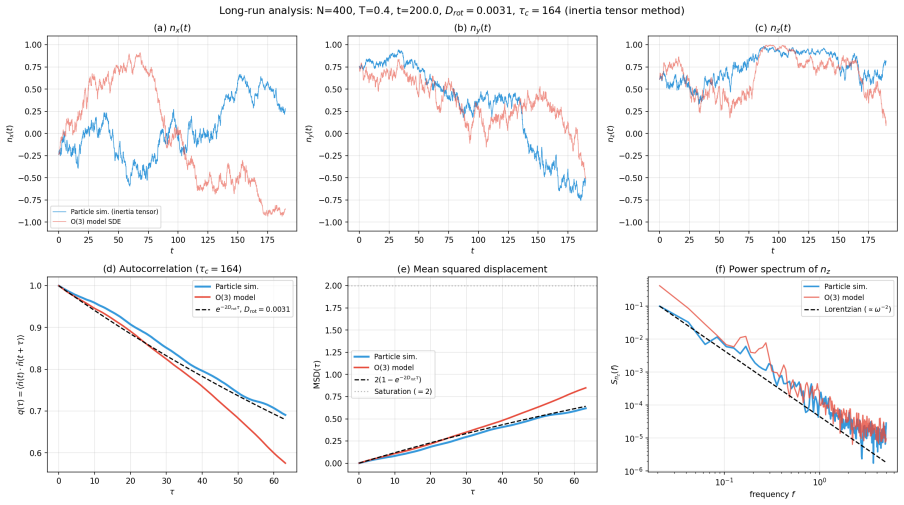
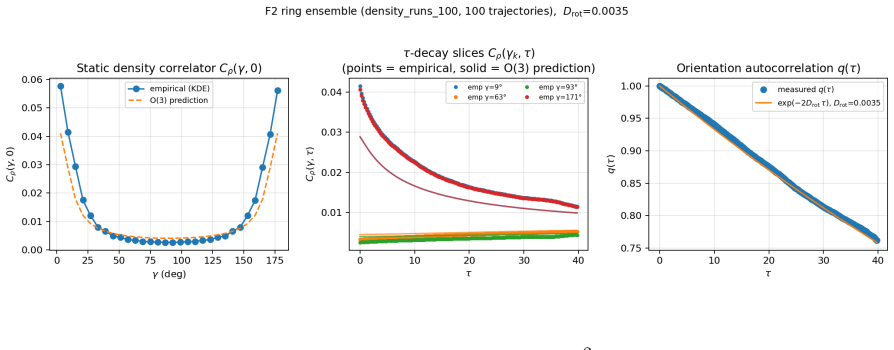
Conditioned on the ring saddle observed in particle simulations and a Born-Oppenheimer separation of timescales, the low-energy dynamics of the director orientation is fixed by symmetry to the nonlinear sigma model on RP² in (0+1) dimensions. This effective theory, governed solely by the rotational diffusion coefficient D_rot, reproduces multiple independent diagnostics in the orientation and density sectors once D_rot and the static ring profile f0 are taken from simulations.
What carries the argument
The nonlinear sigma model on the real projective plane RP², which encodes the slow director dynamics of the precessing density ring.
If this is right
- Orientation correlation functions are predicted by diffusion on RP² using only the measured D_rot.
- Density fluctuations stay gapped and track the static ring profile f0.
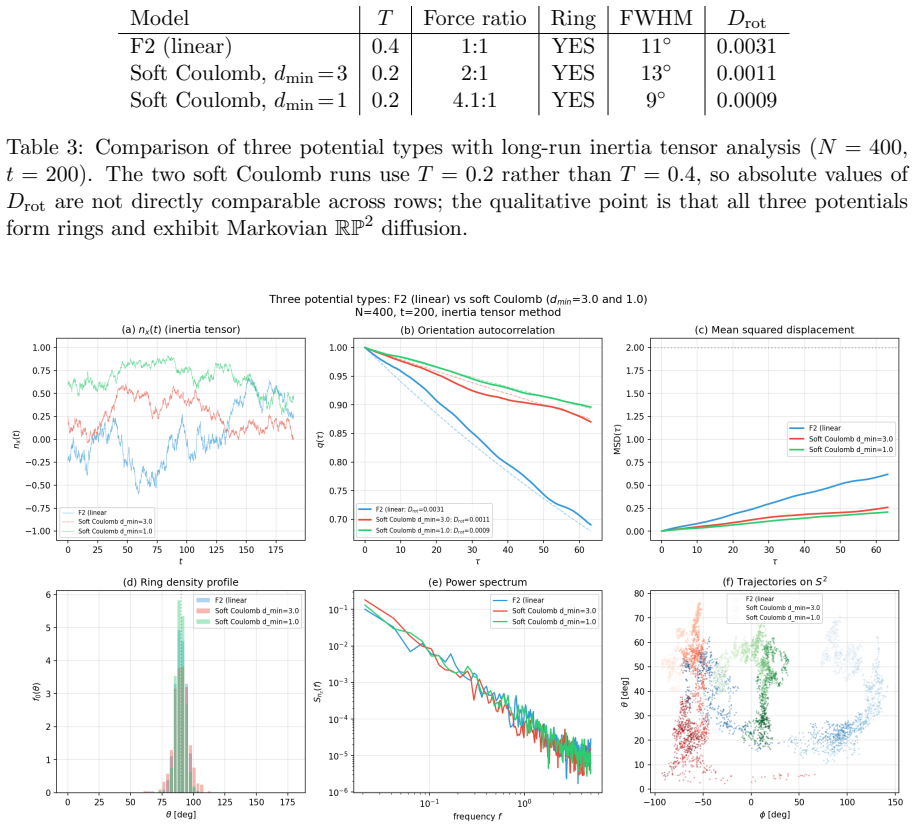
- The same reduction applies to other compact 2D Riemannian manifolds that support an analogous ring saddle.
- All reported orientation-sector and density-sector diagnostics match simulations with no additional free parameters.
Where Pith is reading between the lines
- The same adiabatic reduction might appear in other frustrated particle systems on curved surfaces, yielding projective-space effective models.
- Varying manifold curvature or interaction range could provide a direct test of how the RP² description breaks down.
- The approach offers a route to derive effective rotor models from microscopic spin-glass-like interactions in higher-dimensional or driven settings.
Load-bearing premise
The particle density remains concentrated on a stable ring saddle with a clear separation between slow orientation changes and fast gapped density fluctuations.
What would settle it
A long-time simulation in which the density ring dissolves or in which the orientation autocorrelation requires more than one fitted parameter would falsify the reduction to the single-constant RP² NLSM.
Figures



read the original abstract
We develop a statistical field theory that describes the large-N limit of a system of Brownian particles with quenched random pairwise interactions on a compact two-dimensional Riemannian manifold. The resulting Frustrated Fields (F2) model is a non-linear field theory for a smooth self-interacting density field $\rho$ on the manifold, with local and non-local (in space and time) self-interactions characteristic of spin-glass dynamics. Particle simulations show \emph{adiabatic dimension reduction}: on $S^2$, the density concentrates on a slowly precessing great-circle ring whose orientation is a director ($\hat{\mathbf{n}} \sim -\hat{\mathbf{n}}$, even profile). Conditioned on this simulation-supported ring saddle and on a Born-Oppenheimer separation between the slow orientation and the gapped density fluctuations, symmetry fixes the low-energy dynamics to be the nonlinear sigma model (NLSM) on the real projective plane $S^2/\mathbb{Z}_2 = \mathbb{RP}^2$ (the $\mathbb{RP}^2$ NLSM on the projective rotor space) in $(0+1)$ dimensions, governed by a single low-energy constant, the rotational diffusion coefficient $D_{\text{rot}}$. With $D_{\text{rot}}$ and the static ring profile $f_0$ measured from particle simulations, the resulting effective theory reproduces multiple independent orientation- and density-sector diagnostics with no further adjustable parameters.
Editorial analysis
A structured set of objections, weighed in public.
Referee Report
Summary. The paper develops the Frustrated Fields (F2) statistical field theory for large-N Brownian particles with quenched random pairwise interactions on compact 2D Riemannian manifolds. Particle simulations on S^2 reveal adiabatic dimension reduction in which the density concentrates on a slowly precessing great-circle ring whose orientation behaves as a director (n̂ ∼ −n̂). Conditioned on this ring saddle and a Born-Oppenheimer separation between slow orientational dynamics and gapped density fluctuations, symmetry reduces the low-energy theory to the (0+1)D nonlinear sigma model on RP^2, controlled by a single constant D_rot. With D_rot and the static ring profile f0 extracted from the same simulations, the effective theory reproduces multiple independent orientation- and density-sector diagnostics without further adjustable parameters.
Significance. If the timescale separation is quantitatively validated, the work supplies a symmetry-protected effective description that converts microscopic frustration into a parameter-light rotor model on the projective plane, with direct predictive power for both orientational diffusion and density correlations once two quantities are measured from simulation. The explicit construction of the ring saddle and the reproduction of multiple diagnostics from measured D_rot and f0 constitute a concrete strength.
major comments (2)
- [Abstract] Abstract and the derivation of the low-energy theory: the Born-Oppenheimer separation between slow orientation and gapped density modes is invoked to eliminate all additional operators and fix the dynamics to the pure RP^2 NLSM, yet no numerical estimate of the gap (e.g., ratio of density-mode frequencies or decay rates to D_rot/R^2) is supplied. This separation is load-bearing for the central claim that the effective theory contains no further parameters or couplings.
- [Abstract] The reproduction of diagnostics: D_rot is extracted from the identical particle trajectories that later serve as the benchmark for the effective theory. While the paper correctly states that no further adjustable parameters are introduced after this measurement, the circular dependence means the match constitutes a consistency check rather than an independent test of the reduction; an external benchmark or parameter-free prediction would strengthen the claim.
minor comments (1)
- Notation for the ring profile f0 and the director n̂ should be introduced with an explicit equation reference when first used in the main text.
Simulated Author's Rebuttal
We thank the referee for the careful reading and constructive feedback on our manuscript. We appreciate the positive assessment of the significance of the Frustrated Fields (F2) model and the explicit ring-saddle construction. We address each major comment below, indicating the revisions we will make.
read point-by-point responses
-
Referee: [Abstract] Abstract and the derivation of the low-energy theory: the Born-Oppenheimer separation between slow orientation and gapped density modes is invoked to eliminate all additional operators and fix the dynamics to the pure RP^2 NLSM, yet no numerical estimate of the gap (e.g., ratio of density-mode frequencies or decay rates to D_rot/R^2) is supplied. This separation is load-bearing for the central claim that the effective theory contains no further parameters or couplings.
Authors: We agree that an explicit numerical estimate of the gap would strengthen the justification for the Born-Oppenheimer separation and the resulting claim of a parameter-free effective theory. The current manuscript relies on the observed adiabatic dimension reduction in simulations but does not report a quantitative ratio of density-mode relaxation rates to D_rot/R^2. In the revised manuscript we will add a quantitative analysis (in the main text or an appendix) that extracts the relevant density-fluctuation decay rates from the particle trajectories and computes the gap ratio. This addition will directly address the concern while leaving the central claims unchanged. revision: yes
-
Referee: [Abstract] The reproduction of diagnostics: D_rot is extracted from the identical particle trajectories that later serve as the benchmark for the effective theory. While the paper correctly states that no further adjustable parameters are introduced after this measurement, the circular dependence means the match constitutes a consistency check rather than an independent test of the reduction; an external benchmark or parameter-free prediction would strengthen the claim.
Authors: We acknowledge that measuring D_rot from the same trajectories used for subsequent benchmarking renders the agreement a consistency check rather than a fully independent test. The manuscript correctly notes that no additional parameters are introduced after extracting D_rot and f0, and that the RP^2 NLSM then accounts for multiple independent diagnostics. In revision we will explicitly rephrase the relevant passages to describe the agreement as a non-trivial consistency check of the symmetry-based reduction. While an external benchmark on a different manifold or parameter set would further strengthen the result, such an extension lies beyond the scope of the present work focused on S^2; we will note this limitation in the revised text. revision: partial
Circularity Check
D_rot and f0 measured from simulations are inserted into the effective theory to reproduce diagnostics from the same simulations
specific steps
-
fitted input called prediction
[Abstract]
"With D_rot and the static ring profile f0 measured from particle simulations, the resulting effective theory reproduces multiple independent orientation- and density-sector diagnostics with no further adjustable parameters."
D_rot is extracted from the same particle simulations that later serve as the benchmark for the effective theory; the reproduction therefore depends on a quantity defined from the input data rather than a parameter-free derivation against external benchmarks.
full rationale
The derivation proceeds by running particle simulations to identify the ring saddle and to extract D_rot and f0, then conditioning the low-energy theory on those simulation outputs plus an assumed Born-Oppenheimer separation, and finally claiming that the resulting RP^2 NLSM reproduces multiple diagnostics from the identical simulations with no further parameters. This matches the fitted-input-called-prediction pattern: the quantitative match is achieved by construction once the measured constants are inserted. The symmetry argument fixing the form of the NLSM is independent of the data, but the load-bearing reproduction step reduces to the fitted inputs. No self-citation chains, ansatz smuggling, or self-definitional equations are exhibited in the supplied text. The separation assumption is an unverified premise rather than a circular reduction.
Axiom & Free-Parameter Ledger
free parameters (2)
- D_rot
- f0
axioms (1)
- domain assumption Born-Oppenheimer separation between slow orientation dynamics and gapped density fluctuations
invented entities (1)
-
ring saddle
independent evidence
Reference graph
Works this paper leans on
- [1]
-
[2]
M´ ezard, G
M. M´ ezard, G. Parisi, and M. A. Virasoro.Spin Glass Theory and Beyond. World Scientific, 1987
1987
-
[3]
T. Castellani and A. Cavagna. Spin-glass theory for pedestrians.Journal of Statistical Mechanics: Theory and Experiment, 2005(05):P05012, 2005. arXiv:cond-mat/0505032
-
[4]
L. F. Cugliandolo and J. Kurchan, Analytical solution of the off-equilibrium dynamics of a long-range spin-glass model,Phys. Rev. Lett.71, 173–176 (1993)
1993
-
[5]
D. Facoetti, G. Biroli, J. Kurchan, and D. R. Reichman. Classical glasses, black holes, and strange quantum liquids.Physical Review E, 100(1):010102(R), 2019. arXiv:1906.09228
-
[6]
P. C. Hohenberg and B. I. Halperin, Theory of dynamic critical phenomena, Rev. Mod. Phys.49, 435 (1977)
1977
-
[7]
Zinn-Justin,Quantum Field Theory and Critical Phenomena, Oxford University Press, 4th edition, 2002
J. Zinn-Justin,Quantum Field Theory and Critical Phenomena, Oxford University Press, 4th edition, 2002
2002
-
[8]
Itˆ o, The Brownian motion and tensor fields on Riemannian manifold, inProceedings of the International Congress of Mathematicians, Stockholm, 1962, pp
K. Itˆ o, The Brownian motion and tensor fields on Riemannian manifold, inProceedings of the International Congress of Mathematicians, Stockholm, 1962, pp. 536–539. Institut Mittag-Leffler, Djursholm, 1963
1962
-
[9]
Castro-Villarreal, A
P. Castro-Villarreal, A. Villada-Balbuena, J. M. M´ endez-Alcaraz, R. Casta˜ neda-Priego, and S. Ram´ ırez-Hinestrosa, Colloid dynamics on curved surfaces,J. Chem. Phys.158, 214906 (2023)
2023
-
[10]
D. S. Dean. Langevin equation for the density of a system of interacting Langevin processes. Journal of Physics A, 29(24):L613, 1996
1996
-
[11]
Illien, The Dean-Kawasaki equation and stochastic density functional theory, Rep
P. Illien, The Dean-Kawasaki equation and stochastic density functional theory, Rep. Prog. Phys.(2025)
2025
- [12]
- [13]
- [14]
-
[15]
P. C. Martin, E. D. Siggia, and H. A. Rose. Statistical dynamics of classical systems. Physical Review A, 8(1):423, 1973
1973
-
[16]
H. K. Janssen. On a Lagrangean for classical field dynamics and renormalization group calculations of dynamical critical properties.Zeitschrift f¨ ur Physik B, 23(4):377–380, 1976
1976
-
[17]
De Dominicis
C. De Dominicis. Techniques de renormalisation de la th´ eorie des champs et dynamique des ph´ enom` enes critiques.Journal de Physique Colloques, 37(C1):C1-247, 1976
1976
-
[18]
K. L. C. Hunt and J. Ross, Path integral solutions of stochastic equations for nonlinear irre- versible processes: The uniqueness of the thermodynamic Lagrangian,J. Chem. Phys.75, 976 (1981). 71
1981
-
[19]
De Dominicis
C. De Dominicis. Dynamics as a substitute for replicas in systems with quenched random impurities.Physical Review B, 18(9):4913–4919, 1978
1978
-
[20]
A. Velenich, C. Chamon, L. F. Cugliandolo, and D. Kreimer, On the Brownian gas: a field theory with a Poissonian ground state,J. Phys. A: Math. Theor.41, 235002 (2008). arXiv:0802.3212
-
[21]
Gervais, J.-L., Jevicki, A., and Sakita, B. (1975). Perturbation expansion around extended- particle states in quantum field theory.Phys. Rev. D12, 1038
1975
-
[22]
(1982).Solitons and Instantons
Rajaraman, R. (1982).Solitons and Instantons. North-Holland, Amsterdam
1982
-
[23]
(1985).Aspects of Symmetry
Coleman, S. (1985).Aspects of Symmetry. Cambridge University Press
1985
-
[24]
P., and Safko, J
Goldstein, H., Poole, C. P., and Safko, J. L. (2001).Classical Mechanics(3rd ed.). Addison- Wesley
2001
-
[25]
D., and Lifshitz, E
Landau, L. D., and Lifshitz, E. M. (1976).Mechanics(Vol. 1, 3rd ed.). Butterworth- Heinemann
1976
-
[26]
F. D. M. Haldane. Nonlinear field theory of large-spin Heisenberg antiferromagnets: semi- classically quantized solitons of the one-dimensional easy-axis N´ eel state.Physical Review Letters, 50(15):1153, 1983
1983
-
[27]
F. D. M. Haldane. Continuum dynamics of the 1-D Heisenberg antiferromagnet: identifi- cation with theRP 2 NLSM.Physics Letters A, 93(9):464–468, 1983
1983
-
[28]
Berry, M. V. (1984). Quantal phase factors accompanying adiabatic changes.Proceedings of the Royal Society of London A, 392(1802):45–57
1984
-
[29]
and Mottelson, B
Bohr, A. and Mottelson, B. R. (1975).Nuclear Structure, Vol. II: Nuclear Deformations. W. A. Benjamin
1975
-
[30]
and Oppenheimer, R
Born, M. and Oppenheimer, R. (1927). Zur Quantentheorie der Molekeln,Ann. Phys.389, 457–484
1927
-
[31]
Landau, L. D. and Lifshitz, E. M. (1977).Quantum Mechanics: Non-Relativistic Theory (3rd ed.). Pergamon Press
1977
-
[32]
Skyrme, T. H. R. (1961). A non-linear field theory,Proc. Roy. Soc. A260, 127–138
1961
-
[33]
S., Nappi, C
Adkins, G. S., Nappi, C. R., and Witten, E. (1983). Static properties of nucleons in the Skyrme model,Nucl. Phys. B228, 552–566
1983
-
[34]
and Panagopoulos, C
Psaroudaki, C. and Panagopoulos, C. (2021). Skyrmion qubits: a new class of quantum logic elements based on nanoscale magnetization.Phys. Rev. Lett.127, 067201
2021
-
[35]
Chaikin, P. M. and Lubensky, T. C. (1995).Principles of Condensed Matter Physics. Cam- bridge University Press
1995
-
[36]
Kubo, The fluctuation-dissipation theorem,Rep
R. Kubo, The fluctuation-dissipation theorem,Rep. Prog. Phys.29, 255–284 (1966)
1966
-
[37]
B., Weber, H
Arfken, G. B., Weber, H. J., and Harris, F. E. (2013).Mathematical Methods for Physicists. Academic Press, 7th edition
2013
-
[38]
Sompolinsky and A
H. Sompolinsky and A. Zippelius. Dynamic theory of the spin-glass phase.Physical Review Letters, 47(5):359–362, 1981. 72
1981
-
[39]
Bouchaud and A
J.-P. Bouchaud and A. Georges. Anomalous diffusion in disordered media: statistical mech- anisms, models and physical applications.Physics Reports, 195(4-5):127–293, 1990
1990
-
[40]
L. F. Cugliandolo, J. Kurchan, and L. Peliti, Energy flow, partial equilibration, and effective temperatures in systems with slow dynamics,Phys. Rev. E55, 3898–3914 (1997)
1997
-
[41]
J. M. Caillol, Exact results for a two-dimensional one-component plasma on a sphere,J. Physique – Lettres42, L-245 (1981)
1981
-
[42]
P. J. Forrester, B. Jancovici, and J. Madore, The two-dimensional Coulomb gas on a sphere: exact results,J. Stat. Phys.69, 179 (1992)
1992
-
[43]
P., and de Falco, D
Pennestri, E., Valentini, P. P., and de Falco, D. (2016). Dual Cayley-Klein parameters and M¨ obius transform: Theory and applications.Mechanism and Machine Theory106, 50–67
2016
-
[44]
W. N. Cottingham and D. D. Doyle, The rotational dynamics of rigid bodies implemented with the Cayley Klein parametrization,Molecular Physics99(22), 1839–1843 (2001)
2001
-
[45]
P. E. Lammert, D. S. Rokhsar, and J. Toner, Topology and nematic ordering. I. A gauge theory,Physical Review E52(2), 1778–1800 (1995)
1995
-
[46]
P. G. de Gennes and J. Prost,The Physics of Liquid Crystals, 2nd ed., International Series of Monographs on Physics, Vol. 83 (Oxford University Press, Oxford, 1993)
1993
-
[47]
(2003).Geometry, Topology and Physics
Nakahara, M. (2003).Geometry, Topology and Physics. Taylor & Francis, 2nd edition
2003
-
[48]
N. D. Mermin, The topological theory of defects in ordered media,Reviews of Modern Physics51(3), 591–648 (1979)
1979
-
[49]
Halperin
I. Halperin. Frustrated dynamics of distance matrices.In preparation, 2026
2026
-
[50]
Kawasaki, Stochastic model of slow dynamics in supercooled liquids and dense colloidal suspensions,Physica A208, 35 (1994)
K. Kawasaki, Stochastic model of slow dynamics in supercooled liquids and dense colloidal suspensions,Physica A208, 35 (1994)
1994
-
[51]
A. J. Archer and M. Rauscher, Dynamical density functional theory for interacting Brow- nian particles: stochastic or deterministic?,J. Phys. A37, 9325 (2004)
2004
- [52]
- [53]
-
[54]
Konarovskyi, T
V. Konarovskyi, T. Lehmann, and M. K. von Renesse, Dean–Kawasaki dynamics: ill- posedness vs. triviality,Electron. Commun. Probab.24, 1 (2019)
2019
-
[55]
Sompolinsky and A
H. Sompolinsky and A. Zippelius. Relaxational dynamics of the Edwards-Anderson model and the mean-field theory of spin-glasses.Physical Review B, 25(11):6860–6875, 1982
1982
-
[56]
J. A. Hertz, Y. Roudi, and P. Sollich. Path integral methods for the dynamics of stochastic and disordered systems.Journal of Physics A: Mathematical and Theoretical, 50(3):033001,
-
[57]
Parisi and N
G. Parisi and N. Sourlas. Random magnetic fields, supersymmetry, and negative dimen- sions.Physical Review Letters, 43(11):744, 1979
1979
-
[58]
Parisi and N
G. Parisi and N. Sourlas. Supersymmetric field theories and stochastic differential equa- tions.Nuclear Physics B, 206(2):321–332, 1982. 73
1982
-
[59]
M. V. Feigel’man and A. M. Tsvelik. Hidden supersymmetry of stochastic dissipative dy- namics.Soviet Physics JETP, 56(4):823–827, 1982
1982
-
[60]
Gozzi, Onsager principle of microscopic reversibility and supersymmetry,Phys
E. Gozzi, Onsager principle of microscopic reversibility and supersymmetry,Phys. Rev. D 30, 1218 (1984)
1984
-
[61]
J. Kurchan. Supersymmetry in spin glass dynamics.Journal de Physique I, 2(7):1333–1352, 1992
1992
-
[62]
E. Witten. Dynamical breaking of supersymmetry.Nuclear Physics B, 188(3):513–554, 1981
1981
-
[63]
E. Witten. Supersymmetry and Morse theory.Journal of Differential Geometry, 17(4):661– 692, 1982
1982
-
[64]
B. Kim, K. Kawasaki, H. Jacquin, and F. van Wijland, Equilibrium dynamics of the Dean- Kawasaki equation: Mode-coupling theory and its extension,Phys. Rev. E89, 012150 (2014). 74
2014
discussion (0)
Sign in with ORCID, Apple, or X to comment. Anyone can read and Pith papers without signing in.