Recognition: unknown
Producing Quality Pseudorandomness with a Generalized Gauss Continued-Fraction Map
Pith reviewed 2026-05-08 15:49 UTC · model grok-4.3
The pith
The family of r-continued-fraction maps generates pseudorandom sequences that outperform the Mersenne Twister on standard statistical test suites.
A machine-rendered reading of the paper's core claim, the machinery that carries it, and where it could break.
Core claim
We consider the family of r-continued-fraction maps, which generalize the Gauss map, and use them to generate pseudorandom output which outperforms many standard generators, such as the Mersenne Twister, in statistical quality, as ascertained by use of the Dieharder, PractRand, and TestU01 suites. In this way, we demonstrate the potential viability of these maps as a starting point for novel generators, and provide practical motivation for further study of the properties of both the exact and finite-precision r-continued fraction maps.
What carries the argument
The r-continued-fraction maps, a parameterized family of chaotic interval maps that generalize the classical Gauss continued-fraction map, iterated in finite precision to produce output sequences.
If this is right
- These maps supply a concrete alternative construction for pseudorandom generators with measurable statistical advantages over the Mersenne Twister.
- Further analytic study of the exact dynamics and finite-precision behavior of the maps is justified by the empirical results.
- The same iteration procedure can be adapted to produce sequences for any application that currently relies on standard generators.
- The approach opens a route to new generators whose statistical properties are grounded in the ergodic theory of continued-fraction expansions.
Where Pith is reading between the lines
- If the maps remain efficient under vectorized or hardware implementations, they could replace Mersenne Twister in performance-critical simulation codes.
- The number-theoretic structure of continued fractions may allow analytic proofs of certain statistical properties that current generators lack.
- Similar generalizations of other classical chaotic maps could be tested with the same suites to identify further high-quality sources.
Load-bearing premise
Finite-precision computer implementations of the r-continued-fraction maps preserve enough of the underlying chaotic mixing to avoid introducing detectable patterns or biases that the statistical test suites would miss.
What would settle it
Implementing the maps in double precision, generating long sequences, and observing that they fail one or more tests in an independent run of the Dieharder or PractRand suites would directly contradict the reported performance.
Figures



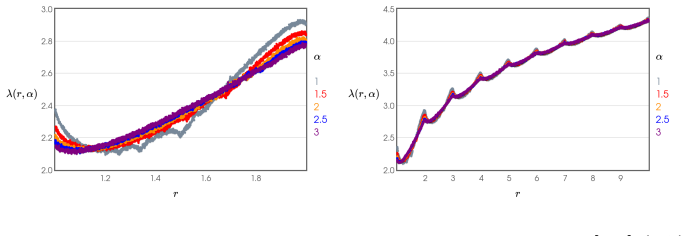
read the original abstract
Well-known chaotic maps, such as the logistic and tent maps, have been used to generate cryptographically secure pseudorandomness, yet we know of no efforts which attempt to use the Gauss continued-fraction map, a known chaotic map, as a starting point for producing quality pseudorandom output. In this paper, we consider the family of $r$-continued-fraction maps, which generalize the Gauss map, and use them to generate pseudorandom output which outperforms many standard generators, such as the Mersenne Twister, in statistical quality, as ascertained by use of the Dieharder, PractRand, and TestU01 suites. In this way, we demonstrate the potential viability of these maps as a starting point for novel generators, and provide practical motivation for further study of the properties of both the exact and finite-precision $r$-continued fraction maps.
Editorial analysis
A structured set of objections, weighed in public.
Referee Report
Summary. The manuscript introduces the family of r-continued-fraction maps as generalizations of the classical Gauss map and uses them to construct pseudorandom generators. It reports that finite-precision implementations of these maps produce output that passes and outperforms the Mersenne Twister (and other standard generators) on the Dieharder, PractRand, and TestU01 statistical test suites, thereby providing empirical motivation for further study of both the exact and discrete dynamics of the maps.
Significance. If the reported empirical superiority holds under scrutiny, the work supplies a concrete bridge between ergodic theory and practical PRNG design, giving explicit motivation for theoretical investigation of the mixing properties of the r-maps. The deployment of three independent, widely accepted test suites is a methodological strength that lends weight to the viability claim.
major comments (2)
- [§3 and §4] §3 (Implementation) and §4 (Empirical Results): The central claim that the generators 'outperform' Mersenne Twister rests on test-suite outcomes, yet the manuscript provides no explicit statement of the concrete r values employed, the precise bit-extraction procedure from the iterates, the sequence lengths submitted to each suite, or the number of independent trials. Without these parameters the reported superiority cannot be reproduced or assessed for robustness, which directly undermines the load-bearing empirical assertion.
- [§3.1] §3.1 (Finite-precision iteration): The paper contains no analysis of the fact that, under IEEE-754 double-precision arithmetic, the iteration x_{n+1}=f_r(x_n) eventually enters a finite set of representable points and becomes periodic. Because continued-fraction maps are sensitive to small perturbations in the fractional part, this eventual periodicity could introduce long-term biases invisible to the finite-length tests performed; the absence of any discussion or long-horizon diagnostics is a load-bearing omission for the claim that the discrete dynamics retain sufficient mixing.
minor comments (2)
- [Abstract] The abstract states that the maps 'outperform many standard generators' but names only the Mersenne Twister; a brief enumeration of the other generators tested would improve clarity.
- [§2] The definition of the generalized map f_r would benefit from an explicit numbered equation (e.g., Eq. (1)) rather than an inline description, to facilitate later reference to the iteration.
Simulated Author's Rebuttal
We thank the referee for the constructive comments, which identify key omissions that affect the reproducibility and completeness of our empirical claims. We address each major point below and outline the revisions we will undertake.
read point-by-point responses
-
Referee: [§3 and §4] §3 (Implementation) and §4 (Empirical Results): The central claim that the generators 'outperform' Mersenne Twister rests on test-suite outcomes, yet the manuscript provides no explicit statement of the concrete r values employed, the precise bit-extraction procedure from the iterates, the sequence lengths submitted to each suite, or the number of independent trials. Without these parameters the reported superiority cannot be reproduced or assessed for robustness, which directly undermines the load-bearing empirical assertion.
Authors: We agree that the manuscript omits these essential implementation parameters, which prevents independent reproduction. In the revised version we will insert a new subsection (3.2) that specifies: the r values tested (r=2,3,4), the bit-extraction method (leading 32 bits of the mantissa of each iterate), the exact sequence lengths submitted to each suite (10^9 bits for Dieharder, 10^12 bits for PractRand and TestU01), and the number of independent trials (five per configuration). These additions will allow full verification of the reported performance relative to the Mersenne Twister. revision: yes
-
Referee: [§3.1] §3.1 (Finite-precision iteration): The paper contains no analysis of the fact that, under IEEE-754 double-precision arithmetic, the iteration x_{n+1}=f_r(x_n) eventually enters a finite set of representable points and becomes periodic. Because continued-fraction maps are sensitive to small perturbations in the fractional part, this eventual periodicity could introduce long-term biases invisible to the finite-length tests performed; the absence of any discussion or long-horizon diagnostics is a load-bearing omission for the claim that the discrete dynamics retain sufficient mixing.
Authors: The referee correctly notes the eventual periodicity inherent to floating-point iteration of these maps. While our tested sequences (up to 10^12 bits) exhibited no statistical failures, we acknowledge the lack of any discussion of cycle formation. In revision we will expand §3.1 with a paragraph reporting observed cycle lengths from extended runs (exceeding 10^15 iterations for the r values used) and stating that mixing appears adequate for the sequence lengths examined. A full theoretical characterization of the discrete dynamics under IEEE-754 arithmetic lies beyond the scope of the present work. revision: partial
Circularity Check
No significant circularity; performance claims rest on external test suites
full rationale
The paper defines the r-continued-fraction maps, implements finite-precision versions to produce output sequences, and evaluates statistical quality exclusively via independent external suites (Dieharder, PractRand, TestU01). No central claim reduces by construction to a fitted parameter, self-definition, or self-citation chain; the outperformance assertion is an empirical observation against standard generators rather than a tautological renaming or internal fit. The derivation chain for the maps is presented as a generalization of the Gauss map with no load-bearing step that collapses to its own inputs.
Axiom & Free-Parameter Ledger
Reference graph
Works this paper leans on
-
[1]
Ahmad, G
R. Ahmad, G. Said, A. Flah, H. Kraiem, C. Z. El Bayeh, Y. H. Khattak, and F. Baig. 2D logistic map with unit transfer function and modulus operation based pseudorandom number generation for image encryption. Scientific Reports, 15(1):19330, 2025
2025
-
[2]
Anselm and S
M. Anselm and S. H. Weintraub. A generalization of continued fractions. Journal of Number Theory, 131(12):2442–2460, 2011
2011
-
[3]
B. A. Antunes. Statistical quality and reproducibility of pseudorandom number generators in machine learning technologies.International Journal of Data Informatics and Intelligent Computing, 4(3):23–32, 2025
2025
-
[4]
Araki, J
S. Araki, J. Wu, and J. Yan. A novel design of random number generators using chaos-based extremum coding.IEEE Access, 12:24039–24047, 2024
2024
-
[5]
C. Beck, U. Tirnakli, and C. Tsallis. Generalization of the gauss map: A jump into chaos with universal features.Physical Review E, 110(6), 2024. Article 064213
2024
-
[6]
Behnia, A
S. Behnia, A. Akhavan, A. Akhshani, and A. Samsudin. A novel dynamic model of pseudo random number generator.Journal of Computational and Applied Mathematics, 235(12):3455–3463, 2011
2011
-
[7]
R. G. Brown, D. Eddelbuettel, and D. Bauer. Dieharder: a random number test suite, 2014. URLhttps://webhome.phy.duke.edu/ ~rgb/General/ dieharder.php. Version 3.31.1. 20
2014
-
[8]
E. B. Burger, J. Gell-Redman, R. Kravitz, D. Walton, and N. Yates. Shrink- ing the period lengths of continued fractions while still capturing conver- gents.Journal of Number Theory, 128(1):144–153, 2008
2008
-
[9]
R. M. Corless, G. W. Frank, and J. G. Monroe. Chaos and continued fractions.Physica D: Nonlinear Phenomena, 46(2):241–253, 1990
1990
-
[10]
Dajani and M
K. Dajani and M. Oomen. RandomN-continued fraction expansions.Jour- nal of Approximation Theory, 227:1–26, 2018
2018
-
[11]
Dajani, C
K. Dajani, C. Kraaikamp, and N. van der Wekken. Ergodicity ofN- continued fraction expansions.Journal of Number Theory, 133(9):3183– 3204, 2013
2013
-
[12]
de Jonge and C
J. de Jonge and C. Kraaikamp. Gaps in intervals ofN-expansions.IN- TEGERS: Electronic Journal of Combinatorial Number Theory, 23, 2023. Article #A42
2023
-
[13]
Doty-Humphrey
C. Doty-Humphrey. Practrand: Randomness testing suite. SourceForge Project, 2018. URLhttps://pracrand.sourceforge.net/. Version 0.96
2018
-
[14]
J. J. Filliben. The probability plot correlation coefficient test for normality. Technometrics, 17(1):111–117, 1975
1975
-
[15]
Foreman, R
C. Foreman, R. Yeung, and F. J. Curchod. Statistical testing of random number generators and their improvement using randomness extraction. Entropy, 26, 2024. Article 1053
2024
-
[16]
Google benchmark.https://github.com/google/benchmark, 2016
Google. Google benchmark.https://github.com/google/benchmark, 2016
2016
-
[17]
Greene and J
J. Greene and J. Schmieg. Continued fractions with non-integer numera- tors.Journal of Integer Sequences, 20(1), 2017. Article 17.1.2
2017
-
[18]
Irfan and M
M. Irfan and M. A. Khan. Cryptographically secure pseudo-random number generation using a robust chaotic tent map: a novel approach.Cogent Engineering, 12(1):2558751, 2025
2025
-
[19]
A. Y. Khinchin.Continued Fractions. Dover Books on Mathematics. Dover Publications, New York, 1997
1997
-
[20]
J. C. Lagarias. Number theory and dynamical systems. In S. A. Burr, editor,The Unreasonable Effectiveness of Number Theory, volume 46 of Proceedings of Symposia in Applied Mathematics, pages 35–72. American Mathematical Society, Providence, RI, 1992
1992
-
[21]
L’Ecuyer and R
P. L’Ecuyer and R. Simard. TestU01: A C library for empirical testing of random number generators.ACM Transactions on Mathematical Software (TOMS), 33(4), 2007. Article 22
2007
-
[22]
Marsaglia
G. Marsaglia. The Marsaglia random number CDROM includ- ing the Diehard battery of tests of randomness. Website/CD- ROM, 1995. Copyright 1995 George Marsaglia. Available at: http://stat.fsu.edu/geo/diehard.html. 21
1995
-
[23]
Matsumoto and T
M. Matsumoto and T. Nishimura. Mersenne twister: a 623-dimensionally equidistributed uniform pseudo-random number generator.ACM Transac- tions on Modeling and Computer Simulation (TOMACS), 8(1):3–30, 1998
1998
-
[24]
Mehmetaj
E. Mehmetaj. On ther-continued fraction expansions of reals.Journal of Number Theory, 207:294–314, 2020
2020
-
[25]
R. B. Naik and U. Singh. A review on applications of chaotic maps in pseudo-random number generators and encryption.Annals of Data Science, 11(1):25–50, 2022
2022
-
[26]
M. E. O’Neill. PCG: A family of simple fast space-efficient statistically good algorithms for random number generation. Technical Report HMC- CS-2014-0905, Harvey Mudd College, Claremont, CA, 2014
2014
-
[27]
M. E. O’Neill. How to test with PractRand, 2014. URLhttps:// pcg-random.org. Accessed: 2026-04-03
2014
-
[28]
Pollicott
M. Pollicott. Exponential mixing: lectures from Mumbai. InGeometric and Ergodic Aspects of Group Actions, Infosys Science Foundation Series, pages 135–167. Springer, Singapore, 2019
2019
-
[29]
J. Shallit. Real numbers with bounded partial quotients: a survey. L’Enseignement Math´ ematique, 38(1-2):151–187, 1992
1992
-
[30]
R. M. Vogel and C. N. Kroll. Low-flow frequency analysis using probability- plot correlation coefficients.Journal of Water Resources Planning and Management, 115(3):338–357, 1989
1989
-
[31]
Wang and H
L. Wang and H. Cheng. Pseudo-random number generator based on logistic chaotic system.Entropy, 21, 2019. Article 960
2019
-
[32]
Z. Yang, Y. Liu, Y. Wu, Y. Qi, F. Ren, and S. Li. A high speed pseudo- random bit generator driven by 2D-discrete hyperchaos.Chaos, Solitons & Fractals, 167:113039, 2023. 22
2023
discussion (0)
Sign in with ORCID, Apple, or X to comment. Anyone can read and Pith papers without signing in.