Recognition: unknown
Generating Query-Focused Summarization Datasets from Query-Free Summarization Datasets
Pith reviewed 2026-05-08 16:18 UTC · model grok-4.3
The pith
An evidence-based model can generate queries from query-free summarization datasets that enable competitive query-focused summarization performance.
A machine-rendered reading of the paper's core claim, the machinery that carries it, and where it could break.
Core claim
The central discovery is a model for generating queries from query-free data by focusing on evidence present in the documents and summaries. Intrinsic tests measure similarity to human-provided queries in two datasets. Extrinsic tests run summarization with various models including a state-of-the-art QFS system and find that evidence-based queries yield competitive ROUGE scores to the originals.
What carries the argument
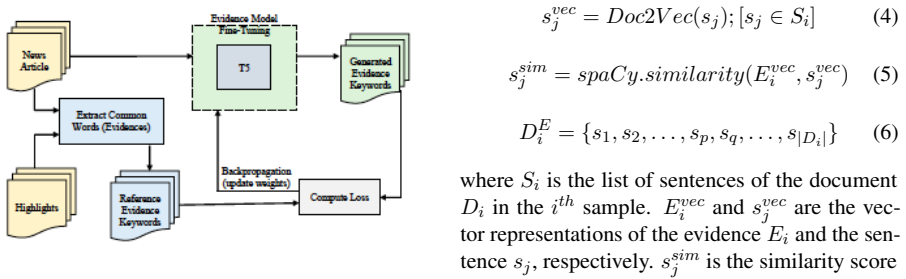
Evidence-based query generation model that extracts keywords supported by the input document and reference summary.
If this is right
- Generated queries produce summaries with ROUGE scores close to those from original queries.
- The method works across different pre-trained summarization models and a SOTA QFS model.
- Query-free datasets can be converted into resources suitable for query-focused summarization.
- Intrinsic similarity checks confirm the generated queries align with original ones on tested data.
Where Pith is reading between the lines
- This could greatly increase the amount of training data available for QFS models by repurposing general summarization corpora.
- The approach might be extended to generate queries for other tasks like question answering from existing datasets.
- Testing on more diverse or real-world queries could reveal if the evidence-based property holds beyond ROUGE metrics.
Load-bearing premise
That achieving competitive ROUGE scores with generated queries on the evaluated datasets and models indicates they are generally effective for query-focused summarization.
What would settle it
A follow-up experiment where summaries using the generated queries show clearly inferior ROUGE scores compared to original queries on a new dataset or model.
Figures
read the original abstract
Large-scale datasets are widely used to perform summarization tasks, but they may not include queries alongside documents and summaries. In the search for suitable datasets for Query-Focused Summarization (QFS), we identify two research questions: Is it possible to automatically generate evidence-based query keywords from query-free datasets? Does evidence-based query generation support the QFS task? This paper proposes an evidence-based model to generate queries from query-free datasets. To evaluate our model intrinsically, we compare the similarity between the original queries and the system-generated queries of two QFS datasets. We also perform summarization tasks using different pre-trained models, as well as a state-of-the-art (SOTA) QFS model, to measure the extrinsic performance of our query generation approach. Experimental results indicate that summaries generated using evidence-based queries achieve competitive ROUGE scores compared to those generated from the original queries.
Editorial analysis
A structured set of objections, weighed in public.
Referee Report
Summary. The paper proposes an evidence-based model to generate queries from query-free document-summary pairs and evaluates it on two QFS datasets. Intrinsically, it measures similarity between generated and gold queries; extrinsically, it feeds the generated queries into various summarization models (including a SOTA QFS model) and reports that the resulting ROUGE scores are competitive with those obtained using the original gold queries.
Significance. If the evaluation holds under more rigorous testing, the work would be significant for QFS research by providing a way to convert abundant query-free summarization corpora into query-focused ones, mitigating data scarcity without requiring new human annotations.
major comments (1)
- [Evaluation] Evaluation section: The extrinsic evaluation (ROUGE comparisons) and intrinsic similarity checks are performed exclusively on existing QFS datasets that already contain human-annotated queries. The generator is never applied to a genuinely query-free corpus (where no gold query exists for reference), so the competitive ROUGE scores do not demonstrate that the generated queries would be effective for downstream QFS on new, query-free documents.
minor comments (2)
- [Abstract] Abstract and Methods: The manuscript provides no details on the query generator's architecture, training data sources, hyperparameters, or exact QFS datasets used, which hinders assessment of reproducibility and potential confounds.
- [Results] Results: No statistical significance tests or variance estimates are reported for the ROUGE score differences, making it unclear whether the 'competitive' performance is reliably equivalent to the gold-query baseline.
Simulated Author's Rebuttal
We thank the referee for the thoughtful review and for highlighting an important aspect of our evaluation design. We address the major comment below.
read point-by-point responses
-
Referee: [Evaluation] Evaluation section: The extrinsic evaluation (ROUGE comparisons) and intrinsic similarity checks are performed exclusively on existing QFS datasets that already contain human-annotated queries. The generator is never applied to a genuinely query-free corpus (where no gold query exists for reference), so the competitive ROUGE scores do not demonstrate that the generated queries would be effective for downstream QFS on new, query-free documents.
Authors: We agree that direct application to a corpus lacking any gold queries would provide stronger evidence for generalization to truly query-free settings. Our evaluation deliberately uses existing QFS datasets to enable controlled intrinsic (query similarity) and extrinsic (ROUGE) comparisons against human-annotated references, which serves as a rigorous proxy for the utility of the generated queries. To address the concern, we will revise the manuscript to add an experiment on a query-free summarization corpus (such as CNN/DailyMail). We will generate queries from document-summary pairs, feed them into the same summarization models, and report ROUGE scores of the resulting summaries against the human reference summaries, thereby demonstrating effectiveness without relying on gold queries. revision: yes
Circularity Check
No significant circularity; derivation chain is self-contained with independent benchmarks
full rationale
The paper trains an evidence-based query generator exclusively on query-free document-summary pairs, then applies it to separate QFS datasets solely for evaluation. Intrinsic similarity to human queries and extrinsic ROUGE comparisons on those held-out QFS datasets do not reduce any claimed prediction to the training inputs by construction, nor rely on self-citations or fitted parameters from the evaluation set. The two research questions are addressed via standard transfer evaluation without tautological redefinition of results.
Axiom & Free-Parameter Ledger
Reference graph
Works this paper leans on
-
[1]
Aho and Jeffrey D
Alfred V. Aho and Jeffrey D. Ullman , title =. 1972
1972
-
[2]
Publications Manual , year = "1983", publisher =
1983
-
[3]
Ashok K. Chandra and Dexter C. Kozen and Larry J. Stockmeyer , year = "1981", title =. doi:10.1145/322234.322243
-
[4]
Scalable training of
Andrew, Galen and Gao, Jianfeng , booktitle=. Scalable training of
-
[5]
Dan Gusfield , title =. 1997
1997
-
[6]
Tetreault , title =
Mohammad Sadegh Rasooli and Joel R. Tetreault , title =. Computing Research Repository , volume =. 2015 , url =
2015
-
[7]
A Framework for Learning Predictive Structures from Multiple Tasks and Unlabeled Data , Volume =
Ando, Rie Kubota and Zhang, Tong , Issn =. A Framework for Learning Predictive Structures from Multiple Tasks and Unlabeled Data , Volume =. Journal of Machine Learning Research , Month = dec, Numpages =
-
[8]
ROUGE : A Package for Automatic Evaluation of Summaries
Lin, Chin-Yew. ROUGE : A Package for Automatic Evaluation of Summaries. Text Summarization Branches Out. 2004
2004
-
[9]
Measuring Importance and Query Relevance in Topic-focused Multi-document Summarization
Gupta, Surabhi and Nenkova, Ani and Jurafsky, Dan. Measuring Importance and Query Relevance in Topic-focused Multi-document Summarization. Proceedings of the 45th Annual Meeting of the Association for Computational Linguistics Companion Volume Proceedings of the Demo and Poster Sessions. 2007
2007
-
[10]
Proceedings of the 20th International Joint Conference on Artifical Intelligence , pages =
Wan, Xiaojun and Yang, Jianwu and Xiao, Jianguo , title =. Proceedings of the 20th International Joint Conference on Artifical Intelligence , pages =. 2007 , publisher =
2007
-
[11]
Applying regression models to query-focused multi-document summarization , journal =
You Ouyang and Wenjie Li and Sujian Li and Qin Lu , keywords =. Applying regression models to query-focused multi-document summarization , journal =. 2011 , issn =. doi:https://doi.org/10.1016/j.ipm.2010.03.005 , url =
-
[12]
Feigenblat, Guy and Roitman, Haggai and Boni, Odellia and Konopnicki, David , title =. Proceedings of the 40th International ACM SIGIR Conference on Research and Development in Information Retrieval , pages =. 2017 , isbn =. doi:10.1145/3077136.3080690 , abstract =
-
[13]
and Laha, Anirban and Ravindran, Balaraman
Nema, Preksha and Khapra, Mitesh M. and Laha, Anirban and Ravindran, Balaraman. Diversity driven attention model for query-based abstractive summarization. Proceedings of the 55th Annual Meeting of the Association for Computational Linguistics (Volume 1: Long Papers). 2017. doi:10.18653/v1/P17-1098
-
[14]
2017 , eprint=
Query-Based Abstractive Summarization Using Neural Networks , author=. 2017 , eprint=
2017
-
[15]
2018 , eprint=
Query Focused Abstractive Summarization: Incorporating Query Relevance, Multi-Document Coverage, and Summary Length Constraints into seq2seq Models , author=. 2018 , eprint=
2018
-
[16]
Towards Generating Query to Perform Query Focused Abstractive Summarization using Pre-trained Model
Abdullah, Deen Mohammad and Chali, Yllias. Towards Generating Query to Perform Query Focused Abstractive Summarization using Pre-trained Model. Proceedings of the 13th International Conference on Natural Language Generation. 2020
2020
-
[17]
Coarse-to-Fine Query Focused Multi-Document Summarization
Xu, Yumo and Lapata, Mirella. Coarse-to-Fine Query Focused Multi-Document Summarization. Proceedings of the 2020 Conference on Empirical Methods in Natural Language Processing (EMNLP). 2020. doi:10.18653/v1/2020.emnlp-main.296
-
[18]
Query Focused Abstractive Summarization via Incorporating Query Relevance and Transfer Learning with Transformer Models
Laskar, Md Tahmid Rahman and Hoque, Enamul and Huang, Jimmy. Query Focused Abstractive Summarization via Incorporating Query Relevance and Transfer Learning with Transformer Models. Advances in Artificial Intelligence. 2020
2020
-
[19]
2021 , eprint=
Improve Query Focused Abstractive Summarization by Incorporating Answer Relevance , author=. 2021 , eprint=
2021
-
[20]
Proceedings of the Document Understanding Conference, DUC-2006, New York, USA , year=
Query-focused summarization by supervised sentence ranking and skewed word distributions , author=. Proceedings of the Document Understanding Conference, DUC-2006, New York, USA , year=
2006
-
[21]
2017 , eprint=
Get To The Point: Summarization with Pointer-Generator Networks , author=. 2017 , eprint=
2017
-
[22]
Text Summarization with Pretrained Encoders
Liu, Yang and Lapata, Mirella. Text Summarization with Pretrained Encoders. Proceedings of the 2019 Conference on Empirical Methods in Natural Language Processing and the 9th International Joint Conference on Natural Language Processing (EMNLP-IJCNLP). 2019. doi:10.18653/v1/D19-1387
-
[23]
BERT: Pre-training of deep bidi- rectional transformers for language understanding
Devlin, Jacob and Chang, Ming-Wei and Lee, Kenton and Toutanova, Kristina. BERT : Pre-training of Deep Bidirectional Transformers for Language Understanding. Proceedings of the 2019 Conference of the North A merican Chapter of the Association for Computational Linguistics: Human Language Technologies, Volume 1 (Long and Short Papers). 2019. doi:10.18653/v...
-
[24]
OpenAI blog , volume=
Language models are unsupervised multitask learners , author=. OpenAI blog , volume=
-
[25]
2019 , eprint=
RoBERTa: A Robustly Optimized BERT Pretraining Approach , author=. 2019 , eprint=
2019
-
[26]
2020 , eprint=
Exploring the Limits of Transfer Learning with a Unified Text-to-Text Transformer , author=. 2020 , eprint=
2020
-
[27]
2020 , eprint=
Longformer: The Long-Document Transformer , author=. 2020 , eprint=
2020
-
[28]
Lewis, Mike and Liu, Yinhan and Goyal, Naman and Ghazvininejad, Marjan and Mohamed, Abdelrahman and Levy, Omer and Stoyanov, Veselin and Zettlemoyer, Luke. BART : Denoising Sequence-to-Sequence Pre-training for Natural Language Generation, Translation, and Comprehension. Proceedings of the 58th Annual Meeting of the Association for Computational Linguisti...
-
[29]
2020 , editor =
Zhang, Jingqing and Zhao, Yao and Saleh, Mohammad and Liu, Peter , booktitle =. 2020 , editor =
2020
-
[30]
Uniform and Effective Tagging of a Heterogeneous Giga-word Corpus
Ma, Wei-Yun and Huang, Chu-Ren. Uniform and Effective Tagging of a Heterogeneous Giga-word Corpus. Proceedings of the Fifth International Conference on Language Resources and Evaluation ( LREC ' 06). 2006
2006
-
[31]
Advances in neural information processing systems , volume=
Teaching machines to read and comprehend , author=. Advances in neural information processing systems , volume=
-
[32]
Rajpurkar, Pranav and Zhang, Jian and Lopyrev, Konstantin and Liang, Percy. SQ u AD : 100,000+ Questions for Machine Comprehension of Text. Proceedings of the 2016 Conference on Empirical Methods in Natural Language Processing. 2016. doi:10.18653/v1/D16-1264
-
[33]
Proceedings of the AAAI Conference on Artificial Intelligence , author=
Topic Concentration in Query Focused Summarization Datasets , volume=. Proceedings of the AAAI Conference on Artificial Intelligence , author=. 2016 , month=. doi:10.1609/aaai.v30i1.10323 , abstractNote=
-
[34]
URL http://dx.doi.org/10.18653/v1/ D15-1044
Rush, Alexander M. and Chopra, Sumit and Weston, Jason. A Neural Attention Model for Abstractive Sentence Summarization. Proceedings of the 2015 Conference on Empirical Methods in Natural Language Processing. 2015. doi:10.18653/v1/D15-1044
-
[35]
Abstractive Text Summarization using Sequence-to-sequence RNNs and Beyond , url=
Nallapati, Ramesh and Zhou, Bowen and dos Santos, Cicero and G?l c ehre, C a g lar and Xiang, Bing. Abstractive Text Summarization using Sequence-to-sequence RNN s and Beyond. Proceedings of the 20th SIGNLL Conference on Computational Natural Language Learning. 2016. doi:10.18653/v1/K16-1028
-
[36]
Learning-Based Single-Document Summarization with Compression and Anaphoricity Constraints
Durrett, Greg and Berg-Kirkpatrick, Taylor and Klein, Dan. Learning-Based Single-Document Summarization with Compression and Anaphoricity Constraints. Proceedings of the 54th Annual Meeting of the Association for Computational Linguistics (Volume 1: Long Papers). 2016. doi:10.18653/v1/P16-1188
discussion (0)
Sign in with ORCID, Apple, or X to comment. Anyone can read and Pith papers without signing in.