Recognition: unknown
A Dual-Band Centimetre Continuum Monitoring Survey of Young Stellar Objects in the Coronet Cluster
Pith reviewed 2026-05-08 15:46 UTC · model grok-4.3
The pith
Dual-band radio monitoring shows younger YSOs have broader spectral indices than evolved Class II objects.
A machine-rendered reading of the paper's core claim, the machinery that carries it, and where it could break.
Core claim
The paper establishes that peak spectral indices distinguish evolutionary classes: Class 0 and I YSOs range from -0.4 to 1.7 while Class II YSOs remain flatter between 0 and 0.8, consistent with free-free emission plus minor non-thermal contributions, and that variability is ubiquitous across stages.
What carries the argument
Spectral index α_pk computed from peak intensities at 9 GHz and 14 GHz, combined with multi-epoch monitoring to track intensity changes over years.
If this is right
- Spectral index ranges can serve as an evolutionary diagnostic for embedded YSOs when infrared data are ambiguous.
- Free-free emission dominates in Class II objects while younger stages allow additional non-thermal contributions.
- Ubiquitous variability without preferred timescales implies ongoing activity in winds or outflows at all stages.
- Some extended components around sources like IRS 7B show negative indices, indicating localized non-thermal processes.
Where Pith is reading between the lines
- Similar dual-band monitoring in other nearby clusters could test whether the same index separation holds beyond the Coronet.
- Higher-resolution follow-up might resolve whether the wider index range in young sources arises from multiple unresolved components.
- The lack of timescale preference in variability suggests that single-epoch radio surveys may miss or misclassify sources.
Load-bearing premise
That prior infrared data correctly assign evolutionary classes to each radio source and that the measured indices reflect the dominant emission mechanism without major unresolved blends or calibration offsets.
What would settle it
Detection of a securely classified Class II YSO with α_pk outside 0-0.8 across multiple epochs, or a Class 0/I source with α_pk locked between 0 and 0.8 without detectable non-thermal signatures.
Figures





read the original abstract
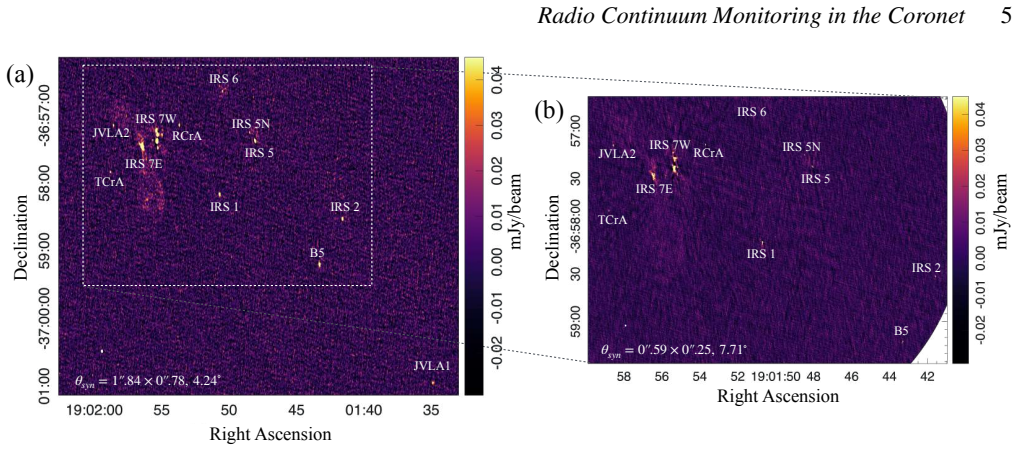
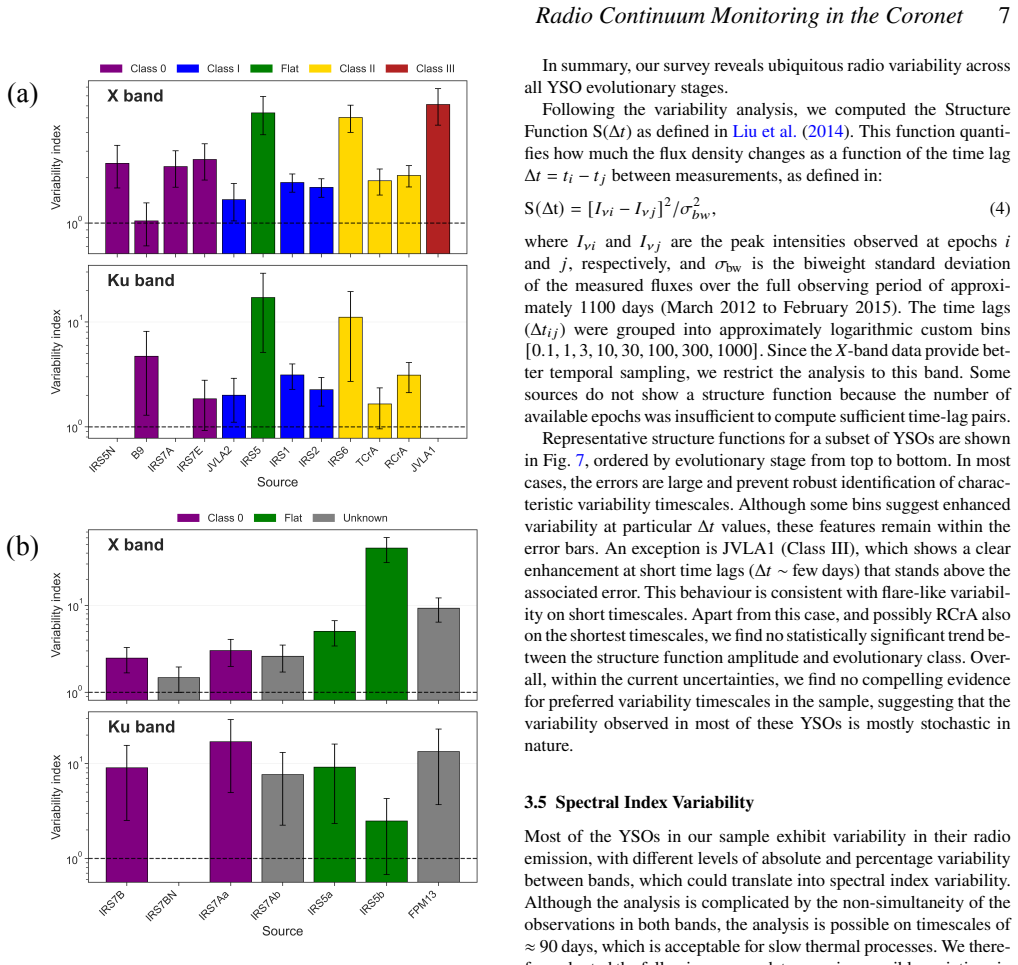
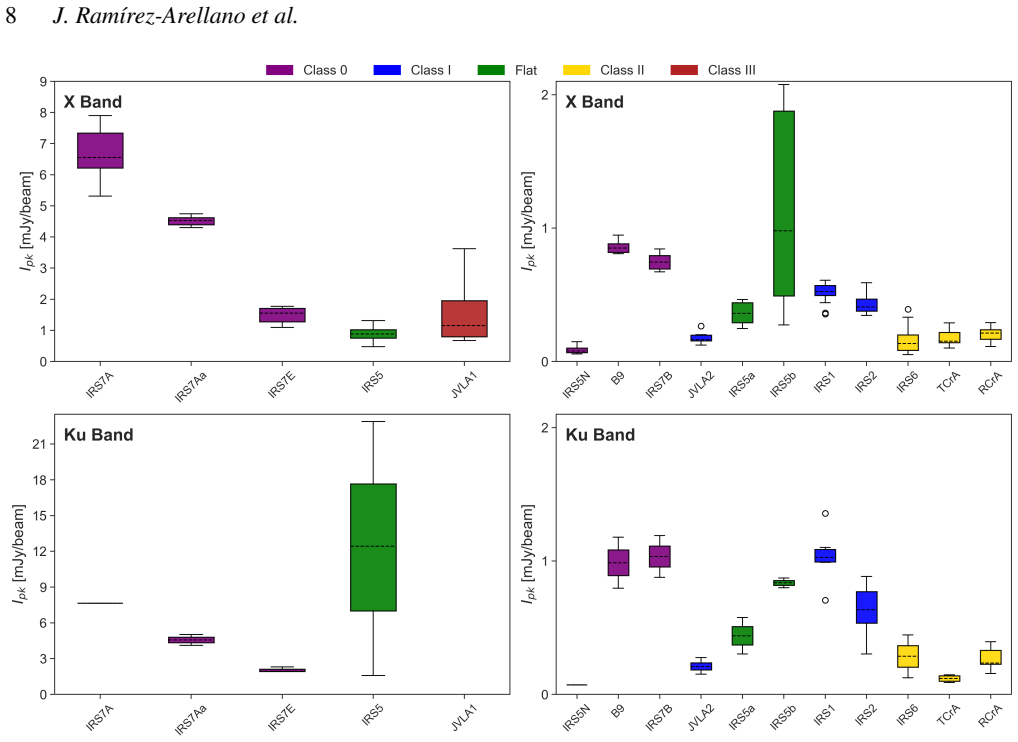
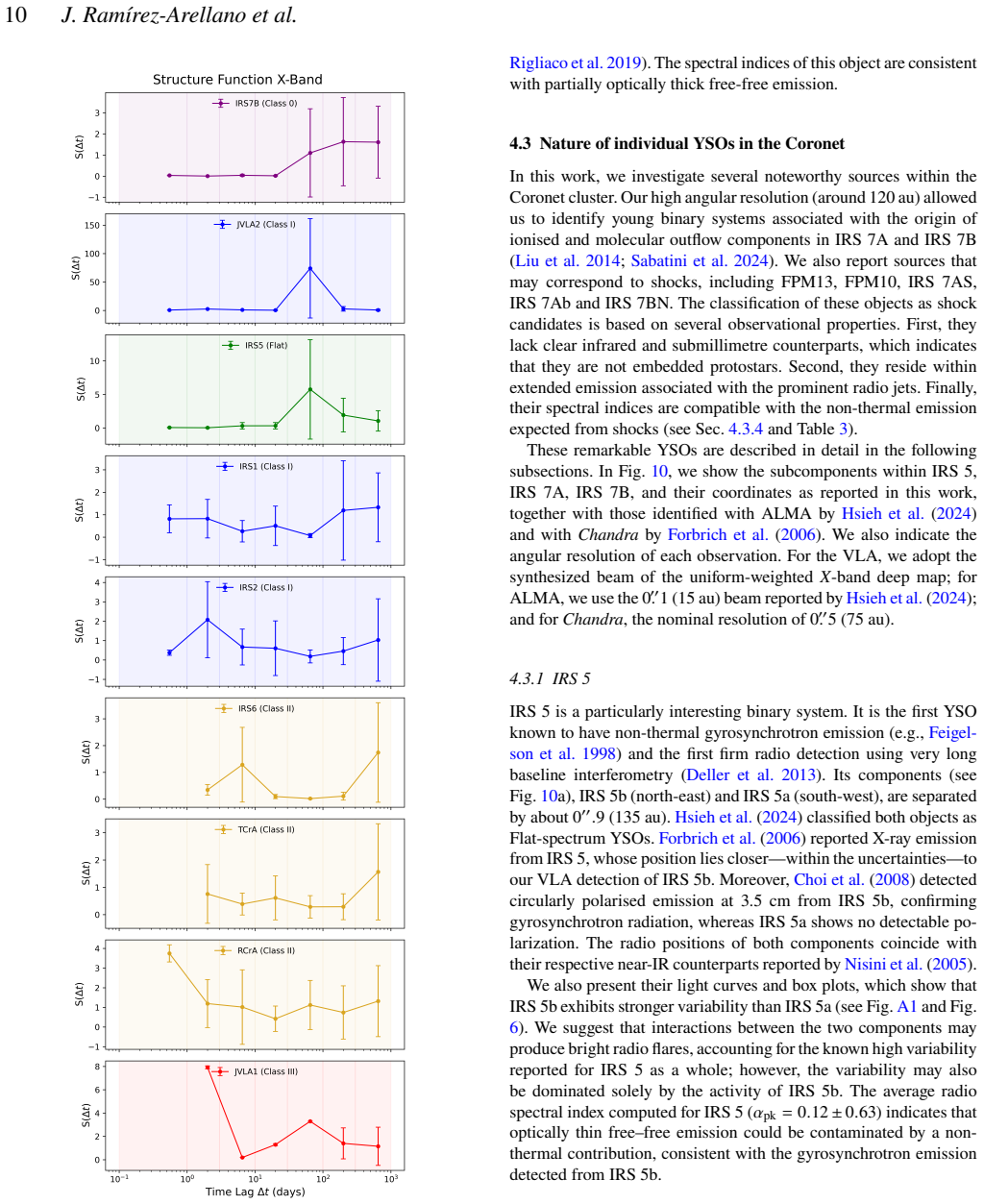
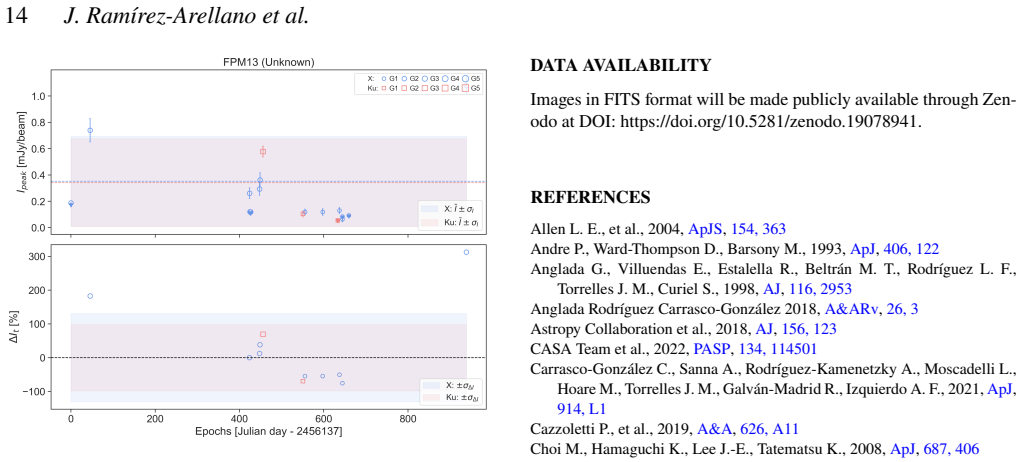
We present sensitive ($\sim$9 $\mu$Jy), sub-arcsecond resolution radio continuum observations at 9.0 GHz (3.3 cm) and 14.0 GHz (2.1 cm) obtained with the Karl G. Jansky Very Large Array (VLA) toward the nearby Coronet Cluster in Corona Australis (d $\approx$ 150 pc). We monitored the region from March 2012 to February 2015 using all available VLA configurations, allowing us to construct deep X- and Ku-band maps at multiple angular resolutions. We detected 20 radio sources, including 14 previously known Young Stellar Objects (YSOs), five sources possibly associated with shock emission, and one background galaxy. We resolved IRS 5, previously known to be a binary system, and identified IRS 7A and IRS 7B as multiple systems at centimetre wavelengths. The younger Class 0 and I YSOs exhibit spectral indices $\alpha_{pk}$ ranging from -0.4 to 1.7, while the more evolved Class II YSOs show flatter values between 0 and 0.8, consistent with free-free emission, with minor contributions from non-thermal emission. The Class III source is only constrained by an upper limit. Radio variability, measured as a fraction of the mean intensity peak, is found to be ubiquitous and independent of evolutionary stage. Variability structure functions computed for nine sources indicate no preferred timescales for most of them. We also investigate spectral index variability for six sources and find significant variations in only one object. Finally, we analyse the extended radio emission toward IRS 7B, where some subcomponents exhibit negative spectral indices suggestive of non-thermal processes.
Editorial analysis
A structured set of objections, weighed in public.
Referee Report
Summary. This paper reports sensitive dual-band VLA monitoring observations at 9 GHz and 14 GHz of the Coronet Cluster, detecting 20 radio sources (14 associated with YSOs). It finds that younger Class 0/I YSOs exhibit peak spectral indices α_pk from -0.4 to 1.7 while more evolved Class II sources show flatter values (0 to 0.8) consistent with free-free emission, with radio variability ubiquitous and independent of evolutionary stage, structure functions indicating no preferred timescales for most sources, and some subcomponents of IRS 7B showing negative indices suggestive of non-thermal emission.
Significance. If the spectral-index differences prove robust, the work supplies useful empirical constraints on how radio emission mechanisms evolve with YSO stage in a nearby cluster, complementing infrared classifications. The multi-configuration monitoring strategy is a clear strength, enabling both deep sensitivity and time-domain analysis.
major comments (1)
- [Results section describing spectral-index computation] The central claim that α_pk ranges distinguish Class 0/I from Class II sources rests on peak-flux ratios. The abstract notes that all VLA configurations were used to build multi-resolution maps, yet the text does not specify whether images were convolved to identical resolution or restricted to common uv-coverage before extracting peaks. For resolved or extended sources such as IRS 7B and its subcomponents, this omission could systematically offset the reported indices and undermine the evolutionary-stage interpretation.
minor comments (2)
- The criteria used to associate the five shock-emission candidates and to confirm the 14 YSOs with prior infrared classifications should be stated explicitly, including positional matching tolerances and any deblending procedures.
- The variability structure functions are computed for nine sources; a brief description of the exact definition, binning, and handling of non-detections would improve reproducibility.
Simulated Author's Rebuttal
We thank the referee for their careful reading of the manuscript and for the positive assessment of its significance. We address the major comment below and will revise the manuscript to incorporate the requested clarification.
read point-by-point responses
-
Referee: [Results section describing spectral-index computation] The central claim that α_pk ranges distinguish Class 0/I from Class II sources rests on peak-flux ratios. The abstract notes that all VLA configurations were used to build multi-resolution maps, yet the text does not specify whether images were convolved to identical resolution or restricted to common uv-coverage before extracting peaks. For resolved or extended sources such as IRS 7B and its subcomponents, this omission could systematically offset the reported indices and undermine the evolutionary-stage interpretation.
Authors: We agree that the description of the spectral-index computation is incomplete and could lead to questions about possible resolution-induced biases. In the revised manuscript we will add an explicit statement in the Results section that peak fluxes for α_pk were measured on maps constructed from the subset of VLA configurations that provide overlapping uv-coverage at both frequencies and that were convolved to a common synthesized beam (∼1″) before peak extraction. For the extended source IRS 7B we already analysed its subcomponents separately in the highest-resolution data; we will expand that discussion to note that the negative indices reported for some subcomponents are measured at the native resolution of the A-array data and are therefore not subject to the same convolution. The compact sources that dominate the Class 0/I versus Class II comparison remain unaffected by these choices, so the reported range differences are robust. revision: yes
Circularity Check
No circularity: purely observational survey with direct measurements only
full rationale
This paper presents VLA radio continuum observations at two frequencies, reports direct detections of 20 sources, computes spectral indices α_pk from measured peak fluxes, and tabulates variability metrics. No derivations, fitted parameters, model predictions, or equations appear in the abstract or described content. Evolutionary classifications are taken from prior external infrared catalogs, and the reported α_pk ranges are empirical observations rather than outputs of any internal chain. No self-citations are invoked to justify uniqueness theorems or ansatzes that would reduce the central claims to the paper's own inputs. The work is self-contained as a data report against standard radio-astronomy benchmarks.
Axiom & Free-Parameter Ledger
Reference graph
Works this paper leans on
-
[1]
Allen L. E., et al., 2004, @doi [ ] 10.1086/422715 , https://ui.adsabs.harvard.edu/abs/2004ApJS..154..363A 154, 363
-
[2]
Andre P., Ward-Thompson D., Barsony M., 1993, @doi [ ] 10.1086/172425 , https://ui.adsabs.harvard.edu/abs/1993ApJ...406..122A 406, 122
-
[3]
Anglada G., Villuendas E., Estalella R., Beltr \'a n M. T., Rodr \' guez L. F., Torrelles J. M., Curiel S., 1998, @doi [ ] 10.1086/300637 , https://ui.adsabs.harvard.edu/abs/1998AJ....116.2953A 116, 2953
-
[4]
Anglada Rodr \' guez Carrasco-Gonz \'a lez 2018, @doi [ ] 10.1007/s00159-018-0107-z , https://ui.adsabs.harvard.edu/abs/2018A&ARv..26....3A 26, 3
-
[5]
Astropy Collaboration et al., 2018, @doi [ ] 10.3847/1538-3881/aabc4f , https://ui.adsabs.harvard.edu/abs/2018AJ....156..123A 156, 123
-
[6]
CASA Team et al., 2022, @doi [ ] 10.1088/1538-3873/ac9642 , https://ui.adsabs.harvard.edu/abs/2022PASP..134k4501C 134, 114501
-
[7]
arXiv , author =:2106.01235 , journal =
Carrasco-Gonz \'a lez C., Sanna A., Rodr \' guez-Kamenetzky A., Moscadelli L., Hoare M., Torrelles J. M., Galv \'a n-Madrid R., Izquierdo A. F., 2021, @doi [ ] 10.3847/2041-8213/abf735 , https://ui.adsabs.harvard.edu/abs/2021ApJ...914L...1C 914, L1
-
[8]
Cazzoletti P., et al., 2019, @doi [ ] 10.1051/0004-6361/201935273 , https://ui.adsabs.harvard.edu/abs/2019A&A...626A..11C 626, A11
-
[9]
Choi M., Hamaguchi K., Lee J.-E., Tatematsu K., 2008, @doi [ ] 10.1086/591540 , https://ui.adsabs.harvard.edu/abs/2008ApJ...687..406C 687, 406
-
[10]
Comrie A., et al., 2026, CARTA: The Cube Analysis and Rendering Tool for Astronomy, @doi 10.5281/zenodo.18477253 , https://doi.org/10.5281/zenodo.18477253
-
[11]
Deller A. T., Forbrich J., Loinard L., 2013, @doi [ ] 10.1051/0004-6361/201321085 , https://ui.adsabs.harvard.edu/abs/2013A&A...552A..51D 552, A51
-
[12]
D \' az-M \'a rquez E., et al., 2024, @doi [ ] 10.1051/0004-6361/202348085 , https://ui.adsabs.harvard.edu/abs/2024A&A...682A.180D 682, A180
-
[13]
Dunham M. M., et al., 2015, @doi [ ] 10.1088/0067-0049/220/1/11 , https://ui.adsabs.harvard.edu/abs/2015ApJS..220...11D 220, 11
-
[14]
Dzib S. A., et al., 2013, @doi [ ] 10.1088/0004-637X/775/1/63 , https://ui.adsabs.harvard.edu/abs/2013ApJ...775...63D 775, 63
-
[15]
Esplin T., Luhman K., 2022, @doi [ ] 10.3847/1538-3881/ac3e64 , https://ui.adsabs.harvard.edu/abs/2022AJ....163...64E 163, 64
-
[16]
doi:10.1088/0067-0049/181/2/321 , eprint =
Evans Neal J. I., et al., 2009, @doi [ ] 10.1088/0067-0049/181/2/321 , https://ui.adsabs.harvard.edu/abs/2009ApJS..181..321E 181, 321
-
[17]
Fazio G. G., et al., 2004, @doi [ ] 10.1086/422843 , https://ui.adsabs.harvard.edu/abs/2004ApJS..154...10F 154, 10
-
[18]
Feigelson E. D., Carkner L., Wilking B. A., 1998, @doi [ ] 10.1086/311190 , https://ui.adsabs.harvard.edu/abs/1998ApJ...494L.215F 494, L215
-
[19]
Forbrich J., Preibisch T., 2007, @doi [ ] 10.1051/0004-6361:20066342 , https://ui.adsabs.harvard.edu/abs/2007A&A...475..959F 475, 959
-
[20]
Forbrich J., Preibisch T., Menten K. M., 2006, @doi [ ] 10.1051/0004-6361:20052871 , https://ui.adsabs.harvard.edu/abs/2006A&A...446..155F 446, 155
-
[21]
Forbrich J., et al., 2007a, @doi [ Astronomy & Astrophysics - A&A ] 10.1051/0004-6361:20066158 , 464, 1003
-
[22]
Forbrich J., Massi M., Ros E., Brunthaler A., Menten K. M., 2007b, @doi [ ] 10.1051/0004-6361:20077113 , https://ui.adsabs.harvard.edu/abs/2007A&A...469..985F 469, 985
-
[23]
Protostars and Planets VI , year = 2014, editor =
Frank A., et al., 2014, in Beuther H., Klessen R. S., Dullemond C. P., Henning T., eds, Protostars and Planets VI. pp 451--474 ( @eprint arXiv 1402.3553 ), @doi 10.2458/azu_uapress_9780816531240-ch020
-
[24]
Galli P. A. B., Bouy H., Olivares J., Miret-Roig N., Sarro L. M., Barrado D., Berihuete A., Brandner W., 2020, @doi [ ] 10.1051/0004-6361/201936708 , https://ui.adsabs.harvard.edu/abs/2020A&A...634A..98G 634, A98
-
[25]
Galv \'a n-Madrid R., et al., 2014, @doi [ ] 10.1051/0004-6361/201424630 , https://ui.adsabs.harvard.edu/abs/2014A&A...570L...9G 570, L9
-
[26]
Garufi A., et al., 2025, @doi [ ] 10.1051/0004-6361/202452496 , https://ui.adsabs.harvard.edu/abs/2025A&A...694A.290G 694, A290
-
[27]
Ghosh A., et al., 2026, @doi [ ] 10.1093/mnras/stag154 , https://ui.adsabs.harvard.edu/abs/2026MNRAS.tmp..156G
-
[28]
E., Kulesa C., Walker C., Martin C
Groppi C. E., Kulesa C., Walker C., Martin C. L., 2004, @doi [ ] 10.1086/422168 , https://ui.adsabs.harvard.edu/abs/2004ApJ...612..946G 612, 946
-
[29]
G \"u del M., 2002, @doi [ ] 10.1146/annurev.astro.40.060401.093806 , https://ui.adsabs.harvard.edu/abs/2002ARA&A..40..217G 40, 217
-
[30]
Hamaguchi K., Corcoran M. F., Petre R., White N. E., Stelzer B., Nedachi K., Kobayashi N., Tokunaga A. T., 2005, @doi [ ] 10.1086/428434 , https://ui.adsabs.harvard.edu/abs/2005ApJ...623..291H 623, 291
-
[31]
Hartmann L., Herczeg G., Calvet N., 2016, @doi [ ] 10.1146/annurev-astro-081915-023347 , https://ui.adsabs.harvard.edu/abs/2016ARA&A..54..135H 54, 135
-
[32]
Hern \'a ndez J., et al., 2007, @doi [ ] 10.1086/522882 , https://ui.adsabs.harvard.edu/abs/2007ApJ...671.1784H 671, 1784
-
[33]
Hsieh C.-H., Arce H. G., Maureira M. J., Pineda J. E., Segura-Cox D., Mardones D., Dunham M. M., Arun A., 2024, @doi [ ] 10.3847/1538-4357/ad6152 , https://ui.adsabs.harvard.edu/abs/2024ApJ...973..138H 973, 138
-
[34]
J., 1987, in Peimbert M., Jugaku J., eds, IAU Symposium Vol
Lada C. J., 1987, in Peimbert M., Jugaku J., eds, IAU Symposium Vol. 115, Star Forming Regions. p. 1
1987
-
[35]
Liu H. B., et al., 2014, @doi [ ] 10.1088/0004-637X/780/2/155 , https://ui.adsabs.harvard.edu/abs/2014ApJ...780..155L 780, 155
-
[36]
Mac \' as E., et al., 2016, @doi [ ] 10.3847/0004-637X/829/1/1 , https://ui.adsabs.harvard.edu/abs/2016ApJ...829....1M 829, 1
-
[37]
Manara C. F., Ansdell M., Rosotti G. P., Hughes A. M., Armitage P. J., Lodato G., Williams J. P., 2023, in Inutsuka S., Aikawa Y., Muto T., Tomida K., Tamura M., eds, Astronomical Society of the Pacific Conference Series Vol. 534, Protostars and Planets VII. p. 539 ( @eprint arXiv 2203.09930 ), @doi 10.48550/arXiv.2203.09930
-
[38]
Maureira M. J., et al., 2026, @doi [ ] 10.1051/0004-6361/202556063 , https://ui.adsabs.harvard.edu/abs/2026A&A...705A..96M 705, A96
-
[39]
Miettinen O., Kontinen S., Harju J., Higdon J. L., 2008, @doi [ ] 10.1051/0004-6361:200809348 , https://ui.adsabs.harvard.edu/abs/2008A&A...486..799M 486, 799
-
[40]
Moscadelli L., et al., 2016, @doi [ ] 10.1051/0004-6361/201526238 , https://ui.adsabs.harvard.edu/abs/2016A&A...585A..71M 585, A71
-
[41]
Myers P. C., Ladd E. F., 1993, @doi [ ] 10.1086/186956 , https://ui.adsabs.harvard.edu/abs/1993ApJ...413L..47M 413, L47
-
[42]
5, Handbook of Star Forming Regions, Volume II
Neuh \"a user R., Forbrich J., 2008, in Reipurth B., ed., , Vol. 5, Handbook of Star Forming Regions, Volume II. p. 735, @doi 10.48550/arXiv.0808.3374
-
[43]
Nisini B., Antoniucci S., Giannini T., Lorenzetti D., 2005, @doi [ ] 10.1051/0004-6361:20041409 , https://ui.adsabs.harvard.edu/abs/2005A&A...429..543N 429, 543
-
[44]
Ortiz-Le \'o n G. N., et al., 2015, @doi [ ] 10.1088/0004-637X/805/1/9 , https://ui.adsabs.harvard.edu/abs/2015ApJ...805....9O 805, 9
-
[45]
Pascucci I., Gorti U., Hollenbach D., 2012, @doi [ ] 10.1088/2041-8205/751/2/L42 , https://ui.adsabs.harvard.edu/abs/2012ApJ...751L..42P 751, L42
-
[46]
Pascucci I., Ricci L., Gorti U., Hollenbach D., Hendler N. P., Brooks K. J., Contreras Y., 2014, @doi [ ] 10.1088/0004-637X/795/1/1 , https://ui.adsabs.harvard.edu/abs/2014ApJ...795....1P 795, 1
-
[47]
Pattle K., et al., 2025, @doi [ ] 10.1093/mnras/staf009 , https://ui.adsabs.harvard.edu/abs/2025MNRAS.537.2127P 537, 2127
-
[48]
Peterson D. E., et al., 2011, @doi [ ] 10.1088/0067-0049/194/2/43 , https://ui.adsabs.harvard.edu/abs/2011ApJS..194...43P 194, 43
-
[49]
Phillips R. B., Lonsdale C. J., Feigelson E. D., 1993, @doi [ ] 10.1086/186717 , https://ui.adsabs.harvard.edu/abs/1993ApJ...403L..43P 403, L43
-
[50]
Ray T. P., Muxlow T. W. B., Axon D. J., Brown A., Corcoran D., Dyson J., Mundt R., 1997, @doi [ ] 10.1038/385415a0 , https://ui.adsabs.harvard.edu/abs/1997Natur.385..415R 385, 415
-
[51]
Ray T., Dougados C., Bacciotti F., Eisl \"o ffel J., Chrysostomou A., 2007, in Reipurth B., Jewitt D., Keil K., eds, Protostars and Planets V. p. 231 ( @eprint arXiv astro-ph/0605597 ), @doi 10.48550/arXiv.astro-ph/0605597
-
[52]
Rigliaco E., et al., 2019, @doi [ ] 10.1051/0004-6361/201936707 , https://ui.adsabs.harvard.edu/abs/2019A&A...632A..18R 632, A18
-
[53]
M., Anglada G., Mart \' J., Rodr \' guez L
Rodr \' guez-Kamenetzky A., Carrasco-Gonz \'a lez C., Araudo A., Torrelles J. M., Anglada G., Mart \' J., Rodr \' guez L. F., Valotto C., 2016, @doi [ ] 10.3847/0004-637X/818/1/27 , https://ui.adsabs.harvard.edu/abs/2016ApJ...818...27R 818, 27
-
[54]
Rodr \' guez-Kamenetzky A. R., et al., 2022, @doi [ ] 10.3847/2041-8213/ac6fd1 , https://ui.adsabs.harvard.edu/abs/2022ApJ...931L..26R 931, L26
-
[55]
Rodr \' guez L. F., Zapata L. A., Dzib S. A., Ortiz-Le \'o n G. N., Loinard L., Mac \' as E., Anglada G., 2014, @doi [ ] 10.1088/2041-8205/793/1/L21 , https://ui.adsabs.harvard.edu/abs/2014ApJ...793L..21R 793, L21
-
[56]
Rota A. A., Meijerhof J. D., van der Marel N., Francis L., van der Tak F. F. S., Sellek A. D., 2024, @doi [ ] 10.1051/0004-6361/202348387 , https://ui.adsabs.harvard.edu/abs/2024A&A...684A.134R 684, A134
-
[57]
Rota A. A., et al., 2025, @doi [ ] 10.1051/0004-6361/202554259 , https://ui.adsabs.harvard.edu/abs/2025A&A...700A..32R 700, A32
-
[58]
Sabatini G., et al., 2024, @doi [ ] 10.1051/0004-6361/202449616 , https://ui.adsabs.harvard.edu/abs/2024A&A...684L..12S 684, L12
-
[59]
Sandell G., Reipurth B., Vacca W. D., Bajaj N. S., 2021, @doi [ ] 10.3847/1538-4357/ac133d , https://ui.adsabs.harvard.edu/abs/2021ApJ...920....7S 920, 7
-
[60]
Sicilia-Aguilar A., Henning T., Linz H., Andr \'e P., Stutz A., Eiroa C., White G. J., 2013, @doi [ ] 10.1051/0004-6361/201220170 , https://ui.adsabs.harvard.edu/abs/2013A&A...551A..34S 551, A34
-
[61]
Skrutskie M. F., et al., 2006, @doi [ ] 10.1086/498708 , https://ui.adsabs.harvard.edu/abs/2006AJ....131.1163S 131, 1163
-
[62]
Teixeira P. S., Lada C. J., Marengo M., Lada E. A., 2012, @doi [ ] 10.1051/0004-6361/201015326 , https://ui.adsabs.harvard.edu/abs/2012A&A...540A..83T 540, A83
-
[63]
Tobin J. J., Sheehan P. D., 2024, @doi [ ] 10.1146/annurev-astro-052920-103752 , https://ui.adsabs.harvard.edu/abs/2024ARA&A..62..203T 62, 203
discussion (0)
Sign in with ORCID, Apple, or X to comment. Anyone can read and Pith papers without signing in.