Recognition: unknown
Multiwavelength Analysis of PSR J0437-4715 with Pulse Profile Modeling
Pith reviewed 2026-05-08 15:33 UTC · model grok-4.3
The pith
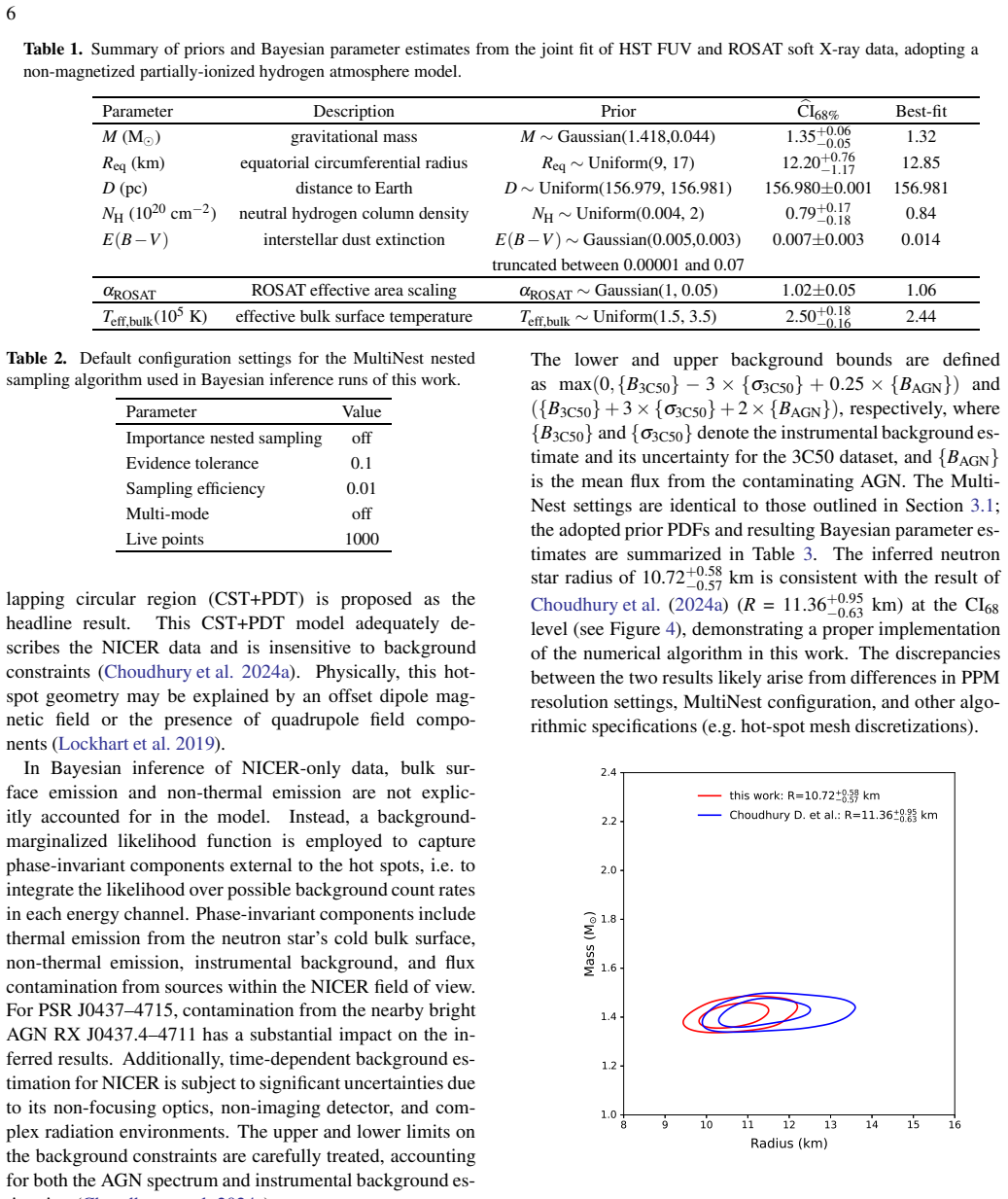
Multi-wavelength analysis constrains the mass of PSR J0437-4715 to 1.38 solar masses and its radius to 13.25 km.
A machine-rendered reading of the paper's core claim, the machinery that carries it, and where it could break.
Core claim
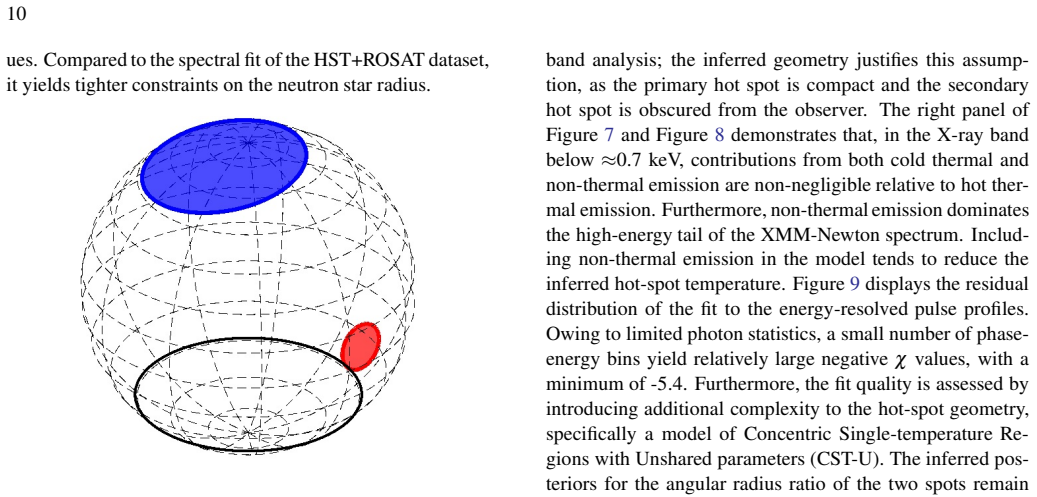
The joint multi-instrument analysis yields a statistically viable and radio-consistent solution with a gravitational mass of 1.38 ± 0.03 solar masses and an equatorial circumferential radius of 13.25 with +0.34 and -0.35 km uncertainties at 68 percent confidence. The hot-spot geometry consists of two spherical caps with uniform temperatures: primary at colatitude approximately 130 degrees and secondary at approximately 9 degrees near the north pole.
What carries the argument
Bayesian inference combining multi-wavelength pulse profiles with non-magnetized hydrogen atmosphere models for cold and hot thermal emission and an informative prior on hot-spot geometry from radio data.
If this is right
- The radius constraints are tighter than those from HST and ROSAT data alone.
- The radius posterior distribution shifts toward larger values compared to NICER-only analyses.
- The derived hot-spot positions align with expectations from radio polarization measurements.
- Multi-wavelength observations help break geometric degeneracies that affect single-band modeling.
Where Pith is reading between the lines
- This mass-radius pair can be used to test specific models of the dense matter equation of state inside neutron stars.
- Applying the same multi-instrument approach to other nearby pulsars could yield a sample of precise radius measurements.
- Additional data from future X-ray or UV telescopes would likely narrow the uncertainties further.
Load-bearing premise
The non-magnetized hydrogen atmosphere models for the cold surface and hot spots accurately capture the thermal emission, and the radio polarization prior correctly describes the hot-spot geometry.
What would settle it
An independent, high-precision measurement of the pulsar's gravitational mass or equatorial radius falling outside the quoted 68 percent confidence intervals would indicate that the modeled solution does not hold.
Figures






read the original abstract
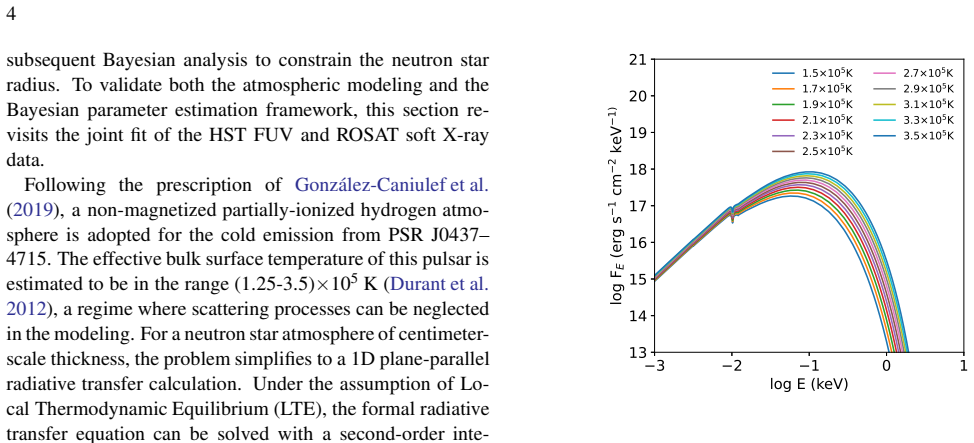
We present a multi-wavelength analysis of the nearby millisecond pulsar PSR J0437--4715, combining Hubble Space Telescope (HST) far-ultraviolet, ROSAT soft X-ray, and XMM-Newton X-ray data, to model its broadband emission and energy-resolved pulse profiles, and infer key stellar parameters via Bayesian inference. The broadband emission includes cold thermal, hot thermal, and non-thermal components: cold bulk surface emission is modeled with a non-magnetized partially-ionized hydrogen atmosphere; hot-spot emission adopts the pulse profile modeling technique with a non-magnetized fully-ionized hydrogen atmosphere model; and non-thermal emission is included as a phase-invariant power-law component. By adopting an informative prior on the hot-spot geometry informed by radio polarization position angle measurements, the joint multi-instrument analysis yields a statistically viable and radio-consistent solution with a gravitational mass of 1.38$\pm$0.03~M$_\odot$ and an equatorial circumferential radius of 13.25$_{-0.35}^{+0.34}$~km (68\% confidence intervals). The hot-spot geometry consists of two spherical caps with uniform temperature distributions: the primary hot spot is situated at a colatitude of $\approx$130$^{\circ}$, and the secondary hot spot lies at a colatitude of $\approx$9$^{\circ}$, close to the north pole. It yields tighter radius constraints than HST+ROSAT fits and shifts the radius posterior distribution to larger values relative to NICER-only fits. This work demonstrates the importance of multi-wavelength data in refining neutron star mass-radius measurements and resolving geometric degeneracies.
Editorial analysis
A structured set of objections, weighed in public.
Referee Report
Summary. The manuscript presents a multiwavelength Bayesian analysis of PSR J0437-4715 combining HST far-UV, ROSAT, and XMM-Newton X-ray data. Emission is modeled as cold thermal (non-magnetized partially-ionized hydrogen atmosphere), hot thermal (non-magnetized fully-ionized hydrogen atmosphere with pulse-profile modeling of two uniform-temperature spherical caps), and non-thermal (phase-invariant power-law) components. An informative prior on hot-spot geometry is taken from radio polarization measurements. The joint fit yields a gravitational mass of 1.38 ± 0.03 M⊙ and equatorial circumferential radius 13.25_{-0.35}^{+0.34} km (68% CI), with primary and secondary hot spots at colatitudes ≈130° and ≈9°. The result is claimed to tighten the radius constraint relative to HST+ROSAT data alone and to shift it to larger values than NICER-only analyses.
Significance. If the modeling assumptions are validated, the work supplies a useful multi-instrument cross-check on the neutron-star mass-radius relation for a well-studied pulsar. The incorporation of UV data together with an external radio geometric prior addresses degeneracies that affect single-instrument pulse-profile fits and demonstrates consistency between X-ray/UV and radio observables.
major comments (2)
- [§3.2] §3.2 (Atmosphere modeling): The non-magnetized partially-ionized and fully-ionized hydrogen atmosphere grids are adopted for the cold bulk and hot-spot components without any reported sensitivity tests against magnetized atmosphere models at B ≈ 10^8 G or against grids that include trace metals. Because the spectral shape, beaming, and energy dependence enter directly into the likelihood for the radius posterior, this assumption is load-bearing for the quoted 13.25 km result.
- [§5.1] §5.1 (Posterior reporting): The mass and radius are quoted at 68% confidence, yet the manuscript does not present the full posterior corner plots, Gelman-Rubin statistics, or effective sample sizes for the MCMC chains. Without these diagnostics it is not possible to confirm that the reported uncertainties are not underestimated by sampling issues or hidden multimodalities in the geometry parameters.
minor comments (2)
- [Abstract] Abstract: The hot-spot colatitudes are stated only approximately (≈130° and ≈9°); reporting the posterior medians and 68% intervals would allow readers to assess the precision of the radio-informed prior.
- [§4.1] §4.1: The power-law component is described as phase-invariant; a short test showing that allowing phase dependence does not improve the fit would strengthen the modeling choice.
Simulated Author's Rebuttal
We thank the referee for their detailed and constructive report. We address each major comment below and have revised the manuscript accordingly where the concerns can be directly incorporated.
read point-by-point responses
-
Referee: [§3.2] §3.2 (Atmosphere modeling): The non-magnetized partially-ionized and fully-ionized hydrogen atmosphere grids are adopted for the cold bulk and hot-spot components without any reported sensitivity tests against magnetized atmosphere models at B ≈ 10^8 G or against grids that include trace metals. Because the spectral shape, beaming, and energy dependence enter directly into the likelihood for the radius posterior, this assumption is load-bearing for the quoted 13.25 km result.
Authors: We agree that atmosphere model assumptions are important for the radius inference. For PSR J0437-4715 the surface field is ~3×10^8 G; at this strength and for the observed energies, prior literature indicates that magnetic effects on the emergent spectrum and beaming are modest, justifying the non-magnetized grids as a first-order approximation. Nevertheless, to strengthen the result we will add a dedicated sensitivity subsection in the revised manuscript that compares the baseline posteriors against (i) magnetized hydrogen atmosphere models at the relevant field strength and (ii) a brief exploration of trace-metal contamination. These tests will be reported with quantitative shifts in the mass-radius credible intervals. revision: partial
-
Referee: [§5.1] §5.1 (Posterior reporting): The mass and radius are quoted at 68% confidence, yet the manuscript does not present the full posterior corner plots, Gelman-Rubin statistics, or effective sample sizes for the MCMC chains. Without these diagnostics it is not possible to confirm that the reported uncertainties are not underestimated by sampling issues or hidden multimodalities in the geometry parameters.
Authors: We accept this point. The MCMC runs were performed with 32 walkers, 50 000 steps after burn-in, and convergence was verified with Gelman-Rubin R-hat values <1.01 and effective sample sizes >2000 for all parameters of interest. Full corner plots and the diagnostic table were omitted from the original submission for brevity. In the revision we will move the complete corner plots to an appendix and explicitly quote the Gelman-Rubin statistics and minimum ESS values in §5.1 so that readers can independently assess chain quality and the absence of hidden modes. revision: yes
Circularity Check
No circularity: posterior inference from external data and models
full rationale
The paper's central result (M = 1.38 ± 0.03 M⊙, R = 13.25+0.34−0.35 km) is obtained via Bayesian inference combining HST/ROSAT/XMM data, non-magnetized H atmosphere models, and an external radio polarization prior on hot-spot geometry. No step reduces by the paper's own equations to a fitted input renamed as prediction, nor to a self-citation chain, nor to a self-definitional ansatz. The derivation is self-contained against the multi-instrument likelihood and prior; the reported values are not forced by construction.
Axiom & Free-Parameter Ledger
free parameters (3)
- hot-spot colatitudes and sizes
- cold and hot component temperatures
- power-law normalization and index
axioms (2)
- domain assumption Non-magnetized hydrogen atmosphere models (partially ionized for cold, fully ionized for hot) correctly predict the emitted spectrum and beaming
- standard math General-relativistic light bending and Doppler effects for a rotating neutron star are accurately captured by the pulse-profile code
Reference graph
Works this paper leans on
-
[1]
A., Ackermann, M., Ajello, M., et al
Abdo, A. A., Ackermann, M., Ajello, M., et al. 2010, The Astrophysical Journal Supplement Series, 187, 460, doi: 10.1088/0067-0049/187/2/460
-
[2]
AlGendy, M., & Morsink, S. M. 2014, The Astrophysical Journa l, 791, 78 13
2014
-
[3]
1999, XSPEC: An X-ray spectral fitting package, Astrophysics Source Code Library , record ascl:9910.005
Arnaud, K., Dorman, B., & Gordon, C. 1999, XSPEC: An X-ray spectral fitting package, Astrophysics Source Code Library , record ascl:9910.005. http://ascl.net/9910.005
1999
-
[4]
Bhat, N. D. R., Ord, S. M., Tremblay, S. E., et al. 2014, The Astrophysical Journal Letters, 791, L32, doi: 10.1088/2041-8205/791/2/L32
-
[5]
V ., Watts, A
Bilous, A. V ., Watts, A. L., Harding, A. K., et al. 2019, The Astrophysical Journal Letters, 887, L23
2019
-
[6]
The Astrophysical Journal , author =
Bogdanov, S. 2012, The Astrophysical Journal, 762, 96, doi: 10.1088/0004-637X/762/2/96
-
[7]
K., Mahmoodifar, S., et al
Bogdanov, S., Lamb, F. K., Mahmoodifar, S., et al. 2019, The Astrophysical Journal Letters, 887, L26
2019
-
[8]
M., Leahy, D., & Campbell, S
Cadeau, C., Morsink, S. M., Leahy, D., & Campbell, S. S. 2007, The Astrophysical Journal, 654, 458
2007
-
[9]
2023, Monthly Notices of the Royal Astronomical Society, 52 0, 3151
Carrasco, F., Pelle, J., Reula, O., Vigan` o, D., & Palenzuela, C. 2023, Monthly Notices of the Royal Astronomical Society, 52 0, 3151
2023
-
[10]
Y ., Y uan, Y ., & V asilopoulos, G
Chen, A. Y ., Y uan, Y ., & V asilopoulos, G. 2020, The Astrophysical Journal Letters, 893, L38
2020
-
[11]
Choudhury, D., Salmi, T., Serena, V ., et al. 2024b, Reproduction package for: ’A NICER View of the Nearest and Brightest Millisecond Pulsar: PSR J0437–4715’, Zenodo, doi: 10.5281/ZENODO.10886504
-
[12]
Clayton, G. C., Wolff, M. J., Sofia, U. J., Gordon, K. D., & Miss elt, K. A. 2003, The Astrophysical Journal, 588, 871, doi: 10.1086/374316
-
[13]
J., Miller, M
Dittmann, A. J., Miller, M. C., Lamb, F. K., et al. 2024, The Astrophysical Journal, 974, 295
2024
-
[14]
Durant, M., Kargaltsev, O., Pavlov, G. G., et al. 2012, The Astrophysical Journal, 746, 6, doi: 10.1088/0004-637X/746/1/6
-
[15]
2009, Monthly Notices of the Royal Astronomical Society, 398, 1601
Feroz, F., Hobson, M., & Bridges, M. 2009, Monthly Notices of the Royal Astronomical Society, 398, 1601
2009
-
[16]
Fitzpatrick, E. L., & Massa, D. 1990, ApJS, 72, 163, doi: 10.1086/191413
-
[17]
C., Arzoumanian, Z., Adkins, P
Gendreau, K. C., Arzoumanian, Z., Adkins, P . W., et al. 2016, in Space telescopes and instrumentation 2016: Ultraviolet to gamma ray, V ol. 9905, SPIE, 420–435 Gonz´ alez-Caniulef, D., Guillot, S., & Reisenegger, A. 2019, Monthly Notices of the Royal Astronomical Society, 490, 584 8, doi: 10.1093/mnras/stz2941
-
[18]
Guillot, S., Kaspi, V . M., Archibald, R. F., et al. 2016, Mont hly Notices of the Royal Astronomical Society, 463, 2612, doi: 10.1093/mnras/stw2194
-
[19]
2001, Astronomy & Astrophysics, 365, L1
Jansen, F., Lumb, D., Altieri, B., et al. 2001, Astronomy & Astrophysics, 365, L1
2001
-
[20]
2024, MNRAS, 530, 4839, doi: 10.1093/mnras/stae1175
Karastergiou, A. 2024, Monthly Notices of the Royal Astronomical Society, 530, 4839, doi: 10.1093/mnras/stae1175
-
[21]
K., & Kazan as, D
Kalapotharakos, C., Wadiasingh, Z., Harding, A. K., & Kazan as, D. 2021, The Astrophysical Journal, 907, 63
2021
-
[22]
2018, A& A, 616, A132, doi: 10.1051/0004-6361/201832832
Lallement, R., Capitanio, L., Ruiz-Dern, L., et al. 2018, A& A, 616, A132, doi: 10.1051/0004-6361/201832832
-
[23]
2001, The Astrophysical Journal , 550, 426
Lattimer, J., & Prakash, M. 2001, The Astrophysical Journal , 550, 426
2001
-
[24]
Li, A., Watts, A. L., Zhang, G., et al. 2025, Science China Phy sics, Mechanics & Astronomy, 68, 119503, doi: 10.1007/s11433-025-2761-4
-
[25]
Lockhart, W., Gralla, S. E., ¨Ozel, F., & Psaltis, D. 2019, Monthly Notices of the Royal Astronomical Society, 490, 1774, doi: 10.1093/mnras/stz2524
-
[26]
Manchester, R. N., & Johnston, S. 1995, ApJL, 441, L65, doi: 10.1086/187791
-
[27]
2025, The Astrop hysical Journal, 995, 60
Mauviard, L., Guillot, S., Salmi, T., et al. 2025, The Astrop hysical Journal, 995, 60
2025
-
[28]
2024, Physical Review D, 109, 123005
Miao, Z., Qi, L., Zhang, J., Li, A., & Ge, M. 2024, Physical Review D, 109, 123005
2024
-
[29]
1978, Stellar atmospheres
Mihalas, D. 1978, Stellar atmospheres
1978
-
[30]
K., Dittmann, A., et al
Miller, M., Lamb, F. K., Dittmann, A., et al. 2019, The Astrophysical Journal Letters, 887, L24
2019
-
[31]
C., Lamb, F., Dittmann, A., et al
Miller, M. C., Lamb, F., Dittmann, A., et al. 2021, The Astrophysical Journal Letters, 918, L28
2021
-
[32]
M., Leahy, D
Morsink, S. M., Leahy, D. A., Cadeau, C., & Braga, J. 2007, The Astrophysical Journal, 663, 1244 N¨ attil¨ a, J., & Pihajoki, P . 2018, Astronomy & Astrophysics, 615, A50
2007
-
[33]
Olson, G. L., & Kunasz, P . 1987, Journal of Quantitative Spectroscopy and Radiative Transfer, 38, 325, doi: https://doi.org/10.1016/0022-4073(87)90027-6
-
[34]
Perera, B. B. P ., DeCesar, M. E., Demorest, P . B., et al. 2019, MNRAS, 490, 4666, doi: 10.1093/mnras/stz2857 P´ etri, J., Stammler, P ., Guillemot, L., et al. 2026, arXiv preprint arXiv:2603.10536
work page internal anchor Pith review Pith/arXiv arXiv doi:10.1093/mnras/stz2857 2019
-
[35]
Poutanen, J., & Beloborodov, A. M. 2006, Monthly Notices of t he Royal Astronomical Society, 373, 836
2006
-
[36]
2003, Monthly Notices of the Royal Astronomical Society, 343, 1301
Poutanen, J., & Gierli´ nski, M. 2003, Monthly Notices of the Royal Astronomical Society, 343, 1301
2003
-
[37]
2025, The Astrophysical J ournal, 981, 99, doi: 10.3847/1538-4357/adb42f
Qi, L., Zheng, S., Zhang, J., et al. 2025, The Astrophysical J ournal, 981, 99, doi: 10.3847/1538-4357/adb42f
-
[38]
2021, The Astrophysical Journal Letters, 918, L29
Raaijmakers, G., Greif, S., Hebeler, K., et al. 2021, The Astrophysical Journal Letters, 918, L29
2021
-
[39]
Reardon, D. J., Bailes, M., Shannon, R. M., et al. 2024, The Astrophysical Journal Letters, 971, L18, doi: 10.3847/2041-8213/ad614a
-
[40]
E., Watts, A
Riley, T. E., Watts, A. L., Bogdanov, S., et al. 2019, The Astrophysical Journal Letters, 887, L21
2019
-
[41]
E., Watts, A
Riley, T. E., Watts, A. L., Ray, P . S., et al. 2021, The Astrophysical Journal Letters, 918, L27 14
2021
-
[42]
E., Choudhury, D., Salmi, T., et al
Riley, T. E., Choudhury, D., Salmi, T., et al. 2023, Journal o f Open Source Software, 8
2023
-
[43]
2022, The Astrophysical Journal, 941, 150 —
Salmi, T., Vinciguerra, S., Choudhury, D., et al. 2022, The Astrophysical Journal, 941, 150 —. 2023, The Astrophysical Journal, 956, 138
2022
-
[44]
Salmi, T., Choudhury, D., Kini, Y ., et al. 2024a, arXiv preprint arXiv:2406.14466
-
[45]
1982, AdSR, 2, 241, doi: 10.1016/0273-1177(82)90070-9
Salmi, T., Deneva, J. S., Ray, P . S., et al. 2024b, The Astrophysical Journal, 976, 58 Str¨ uder, L., Briel, U., Dennerl, K., et al. 2001, Astronomy & Astrophysics, 365, L18 Tr¨ umper, J. 1982, Advances in Space Research, 2, 241, doi: https://doi.org/10.1016/0273-1177(82)90070-9 V ergely, J. L., Lallement, R., & Cox, N. L. J. 2022, A&A, 664, A174, doi: 1...
-
[46]
L., et al
Vinciguerra, S., Salmi, T., Watts, A. L., et al. 2024, The Astrophysical Journal, 961, 62
2024
-
[47]
L., Andersson, N., Chakrabarty, D., et al
Watts, A. L., Andersson, N., Chakrabarty, D., et al. 2016, Re views of Modern Physics, 88, 021001
2016
-
[48]
L., Salmi, T., Choudhury, D., et al
Watts, A. L., Salmi, T., Choudhury, D., et al. 2022, Auxiliar y files for X-PSI tutorials, Zenodo, doi: 10.5281/ZENODO.7094144
-
[49]
2000, The Astrophysical Journal, 542, 914
Wilms, J., Allen, A., & McCray, R. 2000, The Astrophysical Journal, 542, 914
2000
-
[50]
2025, Science Ch ina
Zhang, S.-N., Santangelo, A., Xu, Y ., et al. 2025, Science Ch ina
2025
-
[51]
Physics, Mechanics & Astronomy, 68, 119502, doi: 10.1007/s11433-025-2786-6
-
[52]
2024, Universe, 10, 174, doi: 10.3390/universe10040174
Zheng, S., Han, D., Xu, H., et al. 2024, Universe, 10, 174, doi: 10.3390/universe10040174
discussion (0)
Sign in with ORCID, Apple, or X to comment. Anyone can read and Pith papers without signing in.