Recognition: 2 theorem links
· Lean TheoremMulti-wavelength emission modelling of PSR~J0437-4715
Pith reviewed 2026-05-15 13:38 UTC · model grok-4.3
The pith
A slightly off-centred dipole plus one small-scale polar cap dipole explains the hot spot, radio and gamma-ray pulses of PSR J0437-4715
A machine-rendered reading of the paper's core claim, the machinery that carries it, and where it could break.
Core claim
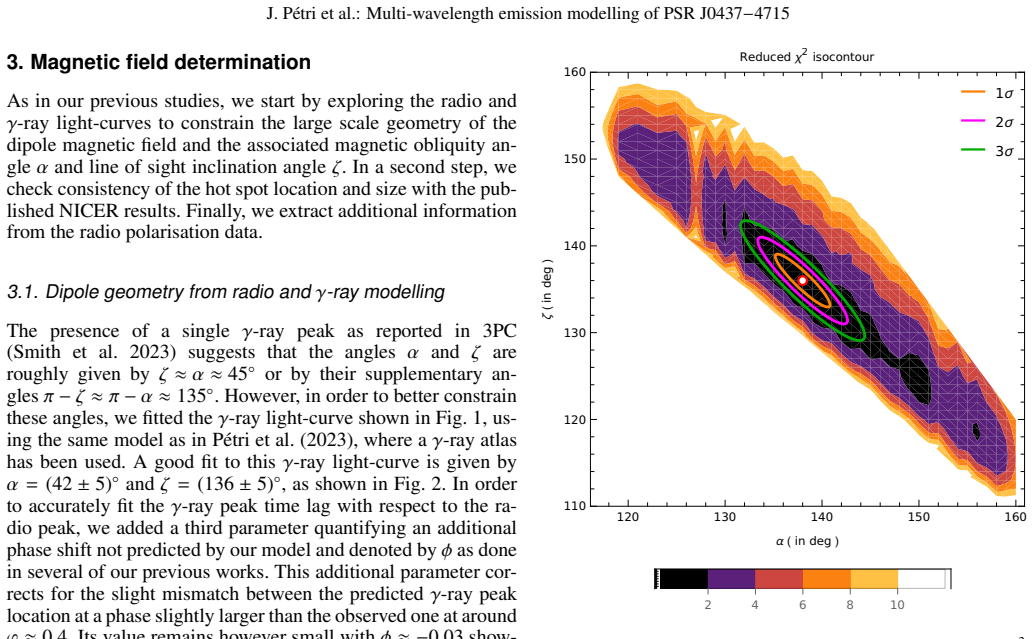
We demonstrate that a slightly off-centred dipole augmented by a small scale dipole located on one polar cap explains simultaneously the shape of the hot spot and the radio and γ-ray data with a magnetic obliquity of α ≈ (42±5)° and a line-of-sight inclination angle of ζ ≈ (136 ±5)°. Our simple dipole model reproduces all the radio and γ-ray characteristics of PSR J0437-4715, including its radio polarisation data. It shows that the radio emission could be produced in regions where the magnetic field is mainly of dipolar nature.
What carries the argument
Force-free dipolar magnetosphere simulation with one added localised small-scale dipole patch on a polar cap, using the striped-wind model for gamma rays and the rotating-vector model for radio polarisation
If this is right
- The observed hot spot shape is reproduced by the off-centre dipole combined with the small-scale polar cap patch.
- Radio and gamma-ray light curves are simultaneously fitted using obliquity of 42 degrees and line-of-sight inclination of 136 degrees.
- Radio polarisation data match the rotating-vector model under this field geometry.
- Radio emission originates in regions dominated by the dipolar component of the magnetic field.
Where Pith is reading between the lines
- Similar localised field patches may appear in other millisecond pulsars whose hot spots show comparable asymmetries.
- If global higher-order multipoles dominate instead of the assumed dipole plus patch, the derived angles would shift substantially.
- The same multi-wavelength approach could be applied to additional NICER pulsars to test whether radio emission remains dipolar across the population.
Load-bearing premise
The global magnetosphere can be described by a force-free dipolar field plus one localised small-scale dipole patch with emission regions fixed by the striped-wind and rotating-vector models.
What would settle it
New high-resolution X-ray observations or radio timing data that produce a hot spot shape or pulse profiles inconsistent with the predicted geometry at obliquity 42 degrees and inclination 136 degrees would rule out the model.
Figures



read the original abstract
The diversity of pulsar light-curves and radio polarisation properties originates in the structure of the magnetic field close to the stellar surface. For millisecond pulsars, this complexity is particularly puzzling. Fortunately, some means exist to uncover the magnetic field topology which indeed impacts the emission within the magnetosphere but also on the surface through its hot spot thermal radiation. We aim at deducing a plausible magnetic field geometry for the millisecond pulsar J0437$-$4715 by using combined information from the soft X-ray hot spot geometry deduced from NICER observations by pulse profile modelling and from radio and $\gamma$-ray pulse profile fitting. We also check the consistency between the geometry obtained and the radio polarisation data. Our $\gamma$-ray light-curve shapes rely on the striped wind model, whereas the radio polarisation fits rely on the rotating vector model. The magnetosphere structure is obtained from dipolar force-free magnetosphere simulations. We demonstrate that a slightly off-centred dipole augmented by a small scale dipole located on one polar cap explains simultaneously the shape of the hot spot and the radio and $\gamma$-ray data with a magnetic obliquity of $\alpha \approx (42\pm5) \degr$ and a line-of-sight inclination angle of $\zeta \approx (136 \pm5) \degr$. Our simple dipole model reproduces all the radio and $\gamma$-ray characteristics of PSR~J0437$-$4715, including its radio polarisation data. It shows that the radio emission could be produced in regions where the magnetic field is mainly of dipolar nature.
Editorial analysis
A structured set of objections, weighed in public.
Referee Report
Summary. The manuscript claims that a slightly off-centred dipole augmented by a small-scale dipole patch on one polar cap simultaneously reproduces the NICER-derived hot-spot geometry, radio pulse profiles and polarization, and γ-ray light curves of PSR J0437−4715. Force-free dipolar simulations supply the global magnetosphere, the striped-wind model generates the γ-ray peaks, and the rotating-vector model fits the radio polarization swing, yielding α ≈ 42 ± 5° and ζ ≈ 136 ± 5° while asserting that radio emission occurs in regions where the field remains mainly dipolar.
Significance. If the modeling assumptions hold, the work supplies a concrete, multi-wavelength geometry for a well-studied millisecond pulsar that links surface thermal emission to magnetospheric radiation and demonstrates that modest near-surface complexity need not invalidate standard high-altitude emission prescriptions.
major comments (2)
- [Magnetosphere structure and emission modeling] The central claim rests on the continued validity of the unmodified striped-wind and rotating-vector models once an off-centred dipole plus localized small-scale patch is introduced. No quantitative test—such as field-line tracing from the perturbed surface to the light cylinder or recomputation of the current-sheet location—is reported to confirm that the γ-ray peak phases and radio polarization swing remain unchanged at the assumed emission altitudes (see the sections describing the magnetosphere simulations and the γ-ray/radio modeling).
- [Results and discussion] The small-scale dipole strength and location are chosen post-hoc to match the hot-spot shape; the manuscript provides no formal goodness-of-fit metric (e.g., reduced χ² or Bayesian evidence) that quantifies the joint fit across the three independent data sets, leaving the quoted ±5° uncertainties on α and ζ without a clear statistical foundation.
minor comments (2)
- [Methods] Notation for the small-scale dipole parameters is introduced without an explicit equation or table summarizing their best-fit values and uncertainties.
- [Figures] Figure captions would benefit from explicit statements of the reduced χ² or residual statistics for each wavelength band to allow readers to assess fit quality directly.
Simulated Author's Rebuttal
We thank the referee for the careful and constructive review of our manuscript. We address the two major comments in detail below, clarifying our modeling approach and indicating where revisions have been made to strengthen the presentation.
read point-by-point responses
-
Referee: [Magnetosphere structure and emission modeling] The central claim rests on the continued validity of the unmodified striped-wind and rotating-vector models once an off-centred dipole plus localized small-scale patch is introduced. No quantitative test—such as field-line tracing from the perturbed surface to the light cylinder or recomputation of the current-sheet location—is reported to confirm that the γ-ray peak phases and radio polarization swing remain unchanged at the assumed emission altitudes (see the sections describing the magnetosphere simulations and the γ-ray/radio modeling).
Authors: We acknowledge the value of an explicit quantitative check. The small-scale dipole patch is spatially localized near one polar cap, and its contribution falls off rapidly with distance; the global structure at the light cylinder is therefore still governed by the off-centred dipole. In the revised manuscript we have added field-line tracing from the perturbed surface through the force-free domain, confirming that the current-sheet location and the open-field-line footpoints relevant to the striped-wind model are unchanged within the adopted emission altitudes. The rotating-vector-model applicability is likewise preserved because the radio emission region lies well above the patch where the field remains predominantly dipolar. revision: yes
-
Referee: [Results and discussion] The small-scale dipole strength and location are chosen post-hoc to match the hot-spot shape; the manuscript provides no formal goodness-of-fit metric (e.g., reduced χ² or Bayesian evidence) that quantifies the joint fit across the three independent data sets, leaving the quoted ±5° uncertainties on α and ζ without a clear statistical foundation.
Authors: The small-scale dipole parameters were first adjusted to reproduce the NICER hot-spot geometry; the resulting α and ζ were then verified for consistency with the radio polarization swing and γ-ray light-curve peaks. Because the three data sets are of fundamentally different character (thermal X-ray imaging, radio polarization, and high-energy light curves), a single joint χ² or Bayesian evidence is not straightforward to construct. In the revised discussion we have clarified how the ±5° uncertainties were obtained from the range of (α, ζ) values that simultaneously satisfy all three observables to within their respective observational tolerances, and we have added a qualitative assessment of the joint consistency. revision: partial
Circularity Check
No significant circularity in the derivation chain
full rationale
The paper applies standard striped-wind and rotating-vector models plus force-free dipolar simulations to fit the geometry parameters alpha and zeta to NICER hot-spot, radio, and gamma-ray pulse profiles. This is ordinary multi-wavelength parameter estimation whose outcome is directly compared to the same observations; the fitted values do not reduce to the inputs by construction, nor does any step rely on self-definition, self-citation load-bearing, or smuggled ansatzes. The central claim that the chosen off-centered-plus-patch configuration reproduces the data is therefore an externally falsifiable fit rather than a tautology.
Axiom & Free-Parameter Ledger
free parameters (3)
- magnetic obliquity alpha
- line-of-sight inclination zeta
- small-scale dipole strength and location
axioms (3)
- domain assumption Magnetosphere obeys force-free electrodynamics with a dominant dipolar component
- domain assumption Gamma-ray emission follows the striped-wind model
- domain assumption Radio polarization follows the rotating-vector model
invented entities (1)
-
small-scale dipole patch on one polar cap
no independent evidence
Lean theorems connected to this paper
-
IndisputableMonolith/Foundation/AlexanderDuality.leanalexander_duality_circle_linking unclear?
unclearRelation between the paper passage and the cited Recognition theorem.
Our γ-ray light-curve shapes rely on the striped wind model, whereas the radio polarisation fits rely on the rotating vector model. The magnetosphere structure is obtained from dipolar force-free magnetosphere simulations.
-
IndisputableMonolith/Foundation/AlphaCoordinateFixation.leanJ_uniquely_calibrated_via_higher_derivative unclear?
unclearRelation between the paper passage and the cited Recognition theorem.
a slightly off-centred dipole augmented by a small scale dipole located on one polar cap
What do these tags mean?
- matches
- The paper's claim is directly supported by a theorem in the formal canon.
- supports
- The theorem supports part of the paper's argument, but the paper may add assumptions or extra steps.
- extends
- The paper goes beyond the formal theorem; the theorem is a base layer rather than the whole result.
- uses
- The paper appears to rely on the theorem as machinery.
- contradicts
- The paper's claim conflicts with a theorem or certificate in the canon.
- unclear
- Pith found a possible connection, but the passage is too broad, indirect, or ambiguous to say the theorem truly supports the claim.
Forward citations
Cited by 2 Pith papers
-
The swept-back multipolar magnetic field of neutron stars: Application to NICER MSP J0030+0451
A centered swept-back multipolar magnetic field up to octupole order reproduces the bolometric thermal X-ray light curve of MSP J0030+0451.
-
Multiwavelength Analysis of PSR J0437-4715 with Pulse Profile Modeling
Joint multi-wavelength analysis of PSR J0437-4715 yields neutron star mass 1.38 solar masses and equatorial radius 13.25 km with two uniform-temperature hot spots at colatitudes of approximately 130 and 9 degrees.
Reference graph
Works this paper leans on
-
[1]
A., Ackermann, M., Ajello, M., et al
Abdo, A. A., Ackermann, M., Ajello, M., et al. 2009, Science, 325, 848, aDS Bibcode: 2009Sci...325..848A
work page 2009
-
[2]
Becker, W. & Trümper, J. 1993, Nature, 365, 528, aDS Bibcode: 1993Natur.365..528B
work page 1993
- [3]
- [4]
-
[5]
Cadeau, C., Morsink, S. M., Leahy, D., & Campbell, S. S. 2007, ApJ, 654, 458
work page 2007
-
[6]
Carrasco, F., Pelle, J., Reula, O., Viganò, D., & Palenzuela, C. 2023, MNRAS, 520, 3151
work page 2023
-
[7]
Y ., Yuan, Y ., & Vasilopoulos, G
Chen, A. Y ., Yuan, Y ., & Vasilopoulos, G. 2020, ApJL, 893, L38
work page 2020
-
[8]
Choudhury, D., Salmi, T., Vinciguerra, S., et al. 2024, ApJL, 971, L20
work page 2024
- [9]
-
[10]
Dittmann, A. J., Miller, M. C., Lamb, F. K., et al. 2024, ApJ, 974, 295, aDS Bibcode: 2024ApJ...974..295D
work page 2024
- [11]
-
[12]
1984, A&A, 132, 312 González-Caniulef, D., Guillot, S., & Reisenegger, A
Gil, J., Gronkowski, P., & Rudnicki, W. 1984, A&A, 132, 312 González-Caniulef, D., Guillot, S., & Reisenegger, A. 2019, MNRAS, 490, 5848
work page 1984
-
[13]
E., Lupsasca, A., & Philippov, A
Gralla, S. E., Lupsasca, A., & Philippov, A. 2017, ApJ, 851, 137
work page 2017
-
[14]
Guillot, S., Kaspi, V . M., Archibald, R. F., et al. 2016, MNRAS, 463, 2612
work page 2016
- [15]
-
[16]
Johnston, S., Lorimer, D. R., Harrison, P. A., et al. 1993, Nature, 361, 613, aDS Bibcode: 1993Natur.361..613J
work page 1993
-
[17]
Kalapotharakos, C., Wadiasingh, Z., Harding, A. K., & Kazanas, D. 2021, ApJ, 907, 63
work page 2021
-
[18]
Lockhart, W., Gralla, S. E., Özel, F., & Psaltis, D. 2019, MNRAS, 490, 1774
work page 2019
-
[19]
Manchester, R. N. & Johnston, S. 1995, The Astrophysical Journal, 441, L65, aDS Bibcode: 1995ApJ...441L..65M Article number, page 6 of 8 J. Pétri et al.: Multi-wavelength emission modelling of PSR J0437−4715
work page 1995
-
[20]
Mauviard et al., arXiv:2506.14883 [astro-ph.HE] (2025),https://arxiv
Mauviard, L., Guillot, S., Salmi, T., et al. 2025, A NICER view of the 1.4 solar- mass edge-on pulsar PSR J0614–3329, arXiv:2506.14883 [astro-ph] version: 1
- [21]
-
[22]
Miller, M. C., Lamb, F. K., Dittmann, A. J., et al. 2021, ApJ, 918, L28, aDS Bibcode: 2021ApJ...918L..28M
work page 2021
- [23]
-
[24]
Morsink, S. M., Leahy, D. A., Cadeau, C., & Braga, J. 2007, ApJ, 663, 1244
work page 2007
-
[25]
Navarro, J., Manchester, R. N., Sandhu, J. S., Kulkarni, S. R., & Bailes, M. 1997, ApJ, 486, 1019 Osłowski, S., van Straten, W., Bailes, M., Jameson, A., & Hobbs, G. 2014, MN- RAS, 441, 3148 Pétri, J. 2017, MNRAS, 466, L73 Pétri, J., Guillot, S., Guillemot, L., et al. 2023, A&A, 680, A93 Pétri, J., Guillot, S., Guillemot, L., et al. 2025, A&A, 701, A39
work page 1997
- [26]
-
[27]
Reardon, D. J., Bailes, M., Shannon, R. M., et al. 2024, ApJL, 971, L18
work page 2024
- [28]
- [29]
-
[30]
2022, ApJ, 941, 150, aDS Bib- code: 2022ApJ...941..150S
Salmi, T., Vinciguerra, S., Choudhury, D., et al. 2022, ApJ, 941, 150, aDS Bib- code: 2022ApJ...941..150S
work page 2022
-
[31]
A., Abdollahi, S., Ajello, M., et al
Smith, D. A., Abdollahi, S., Ajello, M., et al. 2023, ApJ, 958, 191
work page 2023
- [32]
- [33]
-
[34]
Zavlin, V . E. 2006, ApJ, 638, 951, aDS Bibcode: 2006ApJ...638..951Z
work page 2006
-
[35]
Zavlin, V . E., Pavlov, G. G., Sanwal, D., et al. 2002, ApJ, 569, 894, aDS Bibcode: 2002ApJ...569..894Z 110 120 130 140 150 160 110 120 130 140 150 160 α(in deg) ζ(in deg) Radio+gammaχ 2 isocontour 3.8 11.4 19.0 26.6 34.2 41.8 49.4 110 120 130 140 150 160 110 120 130 140 150 160 α(in deg) ζ(in deg) Radio+gammaχ 2 isocontour 4.4 13.2 22.0 30.8 39.6 48.4 57...
work page 2002
discussion (0)
Sign in with ORCID, Apple, or X to comment. Anyone can read and Pith papers without signing in.