Recognition: unknown
Wick Renormalized Parabolic Stochastic Quantization Equations on Rough Metric Measure Spaces
Pith reviewed 2026-05-08 15:35 UTC · model grok-4.3
The pith
Metric measure spaces with sub-Gaussian heat kernels admit local and global solutions to Wick-renormalized stochastic quantization equations when their Hausdorff dimension, walk dimension, and heat kernel Hölder regularity satisfy explicit
A machine-rendered reading of the paper's core claim, the machinery that carries it, and where it could break.
Core claim
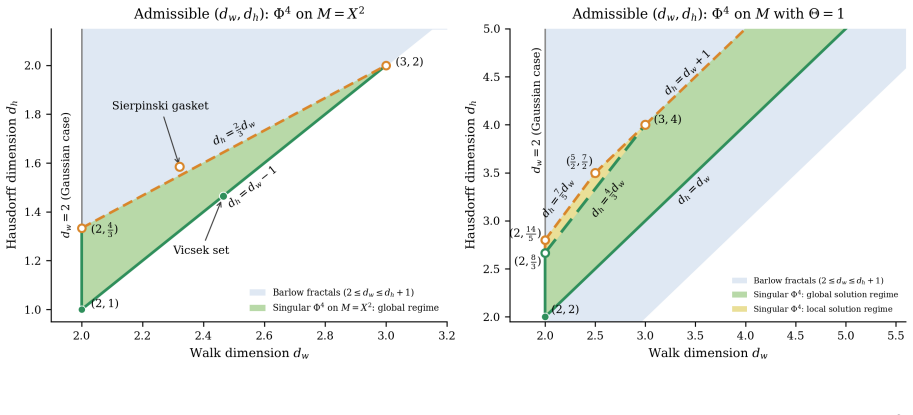
On metric measure spaces with sub-Gaussian heat kernel behavior in small time, Wick-renormalized stochastic quantization equations with polynomial interaction admit local solutions provided the power of the nonlinearity obeys a condition depending on the Hausdorff dimension d_h, the walk dimension d_w, and the maximal spatial Hölder regularity Θ of the heat kernel. Global solutions exist under a slightly stricter condition on the same three parameters, and every such global solution generates a Markov process that possesses an invariant measure. The construction proceeds by building the required analytic framework entirely from the short-time heat semigroup, which accommodates the roughness
What carries the argument
The short-time heat semigroup on the metric measure space, from which the authors construct the full analytic framework needed to control renormalization and the effects of rough local geometry.
If this is right
- Local solutions exist whenever the power of the polynomial satisfies the inequality involving d_h, d_w and Θ.
- Global solutions exist under the stricter version of the same inequality.
- Every global solution carries an invariant measure for its Markov process.
- The theory applies to Barlow-Kigami fractals and their Cartesian products.
- Quantum-field-theoretic structures become rigorous on a range of non-integer-dimensional spaces.
Where Pith is reading between the lines
- The same heat-semigroup construction could be tested numerically on explicit fractals by approximating the semigroup and checking convergence of the renormalized equation.
- Invariant measures open the possibility of studying long-time statistical behavior directly on these rough spaces.
- The framework may extend to other parabolic SPDEs whose linear part is generated by the same heat semigroup.
- Connections to deterministic analysis on fractals become available once the stochastic objects are constructed.
Load-bearing premise
The metric measure spaces admit sub-Gaussian heat kernel estimates in small time and the nonlinearity is a polynomial interaction that can be Wick-renormalized.
What would settle it
On a concrete space such as the Sierpinski gasket, where d_h, d_w and Θ are known explicitly, exhibit a sequence of approximate solutions that fail to converge in the expected Hölder space when the stated inequality on d_h, d_w and Θ holds.
Figures

read the original abstract
On metric measure spaces with sub-Gaussian heat kernel behavior in small time, we obtain a sufficient condition to solve Wick renormalized stochastic quantization equations with polynomial interaction. Given the power of the nonlinearity, the local solution condition depends on the Hausdorff dimension $d_h$, the walk dimension $d_w$, and the maximal spatial H\"older regularity of the heat kernel $\Theta$. A slightly more restrictive condition based on the same parameters is required for a global solution. For all global solutions, we construct an invariant measure for the Markov process defined by the solution. Our results apply to many rough spaces such as Barlow--Kigami type fractals as well as their Cartesian products and open up the possibility of making rigorous various structures in quantum field theory and statistical mechanics in non-integer dimensions. In the process, we build entirely from the short-time heat semigroup the necessary analytic framework that accommodates the issues which come with allowing rough local geometry.
Editorial analysis
A structured set of objections, weighed in public.
Referee Report
Summary. The paper develops a framework for Wick-renormalized parabolic stochastic quantization equations on metric measure spaces with sub-Gaussian small-time heat kernel estimates. It provides sufficient conditions in terms of the Hausdorff dimension d_h, walk dimension d_w, and the maximal spatial Hölder regularity Θ of the heat kernel for the existence of local solutions to the equation with polynomial nonlinearity. A stricter version of these conditions allows for global solutions, for which an invariant measure is constructed for the associated Markov process. The results are applicable to various rough spaces including Barlow-Kigami fractals and their products, with the analytic framework built entirely from the short-time heat semigroup.
Significance. Should the central claims hold, this would be a substantial contribution to SPDE theory by extending stochastic quantization to non-smooth metric measure spaces. The explicit geometric conditions depending on d_h, d_w, and Θ, together with the construction of invariant measures, would enable rigorous analysis of models from quantum field theory and statistical mechanics on fractals and other spaces with non-integer dimensions. The self-contained construction from short-time semigroup properties is a notable technical strength.
major comments (2)
- The abstract asserts that a slightly more restrictive condition on d_h, d_w, and Θ suffices for global solutions and that an invariant measure exists for all such solutions. However, since the entire analytic framework is constructed from short-time sub-Gaussian heat kernel estimates, it is unclear how these conditions alone yield the a priori bounds, tightness, or long-time control required for global existence over arbitrary intervals and for the invariant measure, particularly on spaces of infinite measure lacking uniform large-time decay. This point is load-bearing for the global claims.
- The local solution condition is stated to depend on the power of the nonlinearity together with d_h, d_w, and Θ. The precise form of this condition and the manner in which Wick renormalization interacts with the maximal spatial Hölder regularity Θ of the heat kernel should be exhibited explicitly (e.g., in the main existence theorem) to confirm that the derivation closes without hidden restrictions on the parameters.
minor comments (2)
- The abstract introduces Θ as 'the maximal spatial Hölder regularity of the heat kernel' without a brief inline definition or forward reference; adding this would improve immediate readability.
- Notation for d_h and d_w should be accompanied by a short reminder of their standard definitions in the metric-measure-space literature at first use.
Simulated Author's Rebuttal
We thank the referee for the careful reading and constructive comments on our manuscript. The points raised concern the justification for global existence and invariant measures from short-time estimates, as well as the need for explicit conditions in the main theorem. We address each below and plan revisions to improve clarity.
read point-by-point responses
-
Referee: The abstract asserts that a slightly more restrictive condition on d_h, d_w, and Θ suffices for global solutions and that an invariant measure exists for all such solutions. However, since the entire analytic framework is constructed from short-time sub-Gaussian heat kernel estimates, it is unclear how these conditions alone yield the a priori bounds, tightness, or long-time control required for global existence over arbitrary intervals and for the invariant measure, particularly on spaces of infinite measure lacking uniform large-time decay. This point is load-bearing for the global claims.
Authors: We appreciate the referee highlighting this as load-bearing. The conditions on d_h, d_w, and Θ are chosen so that the Wick-renormalized nonlinearity maps into spaces where the local solution theory yields uniform-in-time a priori bounds via energy estimates and maximal regularity from the sub-Gaussian kernel; these bounds prevent blow-up and permit global extension. For the invariant measure, tightness of the family of time-marginal measures follows from moment bounds controlled by the same dimension parameters, combined with the Markov property of the solution process. On infinite-measure spaces the argument uses only local heat-kernel control and does not require uniform large-time decay. To address the lack of clarity, we will insert a new subsection (after the statement of the global-existence theorem) that derives the a priori bounds and tightness explicitly from the short-time estimates and the given conditions on d_h, d_w, Θ. revision: yes
-
Referee: The local solution condition is stated to depend on the power of the nonlinearity together with d_h, d_w, and Θ. The precise form of this condition and the manner in which Wick renormalization interacts with the maximal spatial Hölder regularity Θ of the heat kernel should be exhibited explicitly (e.g., in the main existence theorem) to confirm that the derivation closes without hidden restrictions on the parameters.
Authors: We agree that the precise condition should appear in the main theorem. The interaction of Wick renormalization with Θ arises because Θ governs the spatial Hölder regularity of the heat kernel, which in turn determines the admissible regularity of the solution process; this regularity must be sufficient to make the Wick product well-defined as a distribution for the given polynomial degree. The resulting restriction is an explicit inequality relating d_h, d_w, Θ, and the power p. We will revise the statement of the principal local-existence theorem to display this inequality verbatim, together with a short paragraph immediately following the theorem that recalls how the Wick term is controlled by Θ. revision: yes
Circularity Check
No circularity: framework constructed directly from short-time heat kernel assumptions
full rationale
The paper assumes sub-Gaussian small-time heat kernel estimates on metric measure spaces and states that it builds the analytic framework, solution conditions (depending on d_h, d_w, Θ), global existence under stricter parameter bounds, and invariant measure construction entirely from the short-time semigroup and the Wick-renormalizable polynomial nonlinearity. No quoted steps reduce any claimed result to a self-definition, a fitted parameter renamed as prediction, or a load-bearing self-citation chain; the derivation remains self-contained against the external assumptions on the heat kernel and space geometry.
Axiom & Free-Parameter Ledger
axioms (1)
- domain assumption Metric measure spaces admit sub-Gaussian heat kernel behavior in small time
Reference graph
Works this paper leans on
-
[1]
[ADC21] M. Aizenman and H. Duminil-Copin,Marginal triviality of the scaling limits of critical 4d ising andλϕ 4 4 models, Annals of Mathematics194(2021), no. 1, 163–235. [ADT10] E. Akkermans, G. V Dunne, and A. Teplyaev,Thermodynamics of photons on fractals, Physical review letters 105(2010), no. 23, 230407. [AK14] S. Andres and N. Kajino,Continuity and e...
-
[2]
Alonso-Ruiz, F
[ARBC+23] P. Alonso-Ruiz, F. Baudoin, L. Chen, L. G. Rogers, N. Shanmugalingam, and A. Teplyaev,Bv functions and fractional laplacians on dirichlet spaces, Asian Journal of Mathematics (2023). [Bar03] M. T Barlow,Heat kernels and sets with fractal structure, Contemporary Mathematics338(2003), 11–40. [Bar06] M. T Barlow,Diffusions on fractals, Lectures on ...
2023
-
[3]
Bailleul and F
[BB16] I. Bailleul and F. Bernicot,Heat semigroup and singular pdes, Journal of Functional Analysis270(2016), no. 9, 3344–3452. [BBD23] R. Bauerschmidt, T. Bodineau, and B. Dagallier,Stochastic dynamics and the polchinski equation: An intro- duction, Probability Surveys (2023). [BBST99] O. Ben-Bassat, R. S Strichartz, and A. Teplyaev,What is not in the do...
2016
-
[4]
Baudoin and L
[BC24a] F. Baudoin and L. Chen,Heat kernel gradient estimates for the vicsek set, Mathematische Nachrichten (2024). [BC24b] B. Bringmann and S. Cao,Global well-posedness of the stochastic abelian-higgs equations in two dimensions,
2024
-
[5]
Bruned, A
[BCCH20] Y. Bruned, A. Chandra, I. Chevyrev, and M. Hairer,Renormalising spdes in regularity structures, Journal of the European Mathematical Society23(2020), no. 3, 869–947. [BCD11] H. Bahouri, J.-Y. Chemin, and R. Danchin,Fourier analysis and nonlinear partial differential equations, Springer,
2020
-
[6]
[BCH+25a] F. Baudoin, L. Chen, C.-H. Huang, C. Ouyang, S. Tindel, and J. Wang,Parabolic anderson model in bounded domains of recurrent metric measure spaces, Transactions of the American Mathematical Society (2025). [BCH+25b] F. Baudoin, L. Chen, C.-H. Huang, C. Ouyang, S. Tindel, and J. Wang,Weighted besov spaces on heisenberg groups and applications to ...
-
[7]
Cerrai and M
[CF17] S. Cerrai and M. Freidlin,Spdes on narrow domains and on graphs: An asymptotic approach, Annales de l’institut henri poincar´ e-probabilit´ es et statistiques, 2017, pp. 865–899. [CF19] S. Cerrai and M. Freidlin,Fast flow asymptotics for stochastic incompressible viscous fluids inR 2 and spdes on graphs, Probability Theory and Related Fields173(201...
2017
-
[8]
[CH24] S. Cerrai and W.-T. Hsu,Spdes on narrow channels and graphs: convergence and large deviations in case of non smooth noise, arXiv preprint arXiv:2403.13493 (2024). [Cro06] D. A. Croydon,Volume growth and heat kernel estimates for the continuum random tree, Probability Theory and Related Fields140(2006), 207–238. [CS86] L. Crane and L. Smolin,Renorma...
-
[9]
B Davies,Non-gaussian aspects of heat kernel behaviour, Journal of the London Mathematical Society55 (1997), no
[Dav97] E. B Davies,Non-gaussian aspects of heat kernel behaviour, Journal of the London Mathematical Society55 (1997), no. 1, 105–125. [DDD19] A. Dahlqvist, J. Diehl, and B. K Driver,The parabolic anderson model ßon riemann surfaces, Probability Theory and Related Fields174(2019), no. 1, 369–444. [DGR25] P. Duch, M. Gubinelli, and P. Rinaldi,Parabolic st...
1997
-
[10]
Da Prato and A
[DPD03] G. Da Prato and A. Debussche,Strong solutions to the stochastic quantization equations, The Annals of Probability31(2003), no. 4, 1900–1916. [DPZ14] G. Da Prato and J. Zabczyk,Stochastic equations in infinite dimensions, Vol. 152, Cambridge university press,
2003
-
[11]
Delporte and V
[DR19] N. Delporte and V. Rivasseau,Perturbative quantum field theory on random trees, Communications in Math- ematical Physics381(2019), 857 –887. [Duc25] P. Duch,Flow equation approach to singular stochastic pdes, Probability and Mathematical Physics6(2025), no. 2, 327–437. [DZZ18] J. Ding, O. Zeitouni, and F. Zhang,Heat kernel for liouville brownian mo...
2019
-
[12]
Fritz and B
[FR95] J. Fritz and B. R¨ udiger,Time dependent critical fluctuations of a one dimensional local mean field model, Probability theory and related fields103(1995), no. 3, 381–407. [GH19] M. Gubinelli and M. Hofmanov´ a,Global solutions to elliptic and parabolicϕ 4 models in euclidean space, Communications in Mathematical Physics368(2019), no. 3, 1201–1266....
1995
-
[13]
Grazieschi, K
[GMW24] P. Grazieschi, K. Matetski, and H. Weber,The dynamical ising-kac model in 3 d converges toϕ 4 3, Probability Theory and Related Fields (2024), 1–108. [Hai14] M. Hairer,A theory of regularity structures, Inventiones mathematicae198(2014), no. 2, 269–504. [HM22] M. Hinz and M. Meinert,Approximation of partial differential equations on compact resist...
2024
-
[14]
[HR23] M. Hairer and T. C. Rosati,Global existence for perturbations of the 2d stochastic navier–stokes equations with space-time white noise, Annals of PDE (2023). [HRT13] M. Hinz, M. R¨ ockner, and A. Teplyaev,Vector analysis for dirichlet forms and quasilinear pde and spde on metric measure spaces, Stochastic Processes and their Applications123(2013), ...
-
[15]
[HØUZ96] H. Holden, B. Øksendal, J. Ubøe, and T. Zhang,Stochastic partial differential equations, Stochastic partial differential equations: A modeling, white noise functional approach, 1996, pp. 141–191. [HY17] B. Hambly and W. Yang,Continuous random field solutions to parabolic spdes on pcf fractals, arXiv preprint arXiv:1709.00916 (2017). [HY18] B. Ham...
-
[16]
Kajino and M
[KM20] N. Kajino and M. Murugan,On singularity of energy measures for symmetric diffusions with full off-diagonal heat kernel estimates, The Annals of Probability48(2020), no. 6, 2920–2951. [KSS25] T. Kumagai, N. Shanmugalingam, and R. Shimizu,Finite dimensionality of besov spaces and potential- theoretic decomposition of metric spaces, Annales Fennici Ma...
2020
-
[17]
Kr¨ atschmer and M
[KU23] V. Kr¨ atschmer and M. Urusov,A kolmogorov–chentsov type theorem on general metric spaces with appli- cations to limit theorems for banach-valued processes, Journal of Theoretical Probability36(2023), no. 3, 1454–1486. [Laa00] T. J Laakso,Ahlfors q-regular spaces with arbitrary q¿ 1 admitting weak poincar´ e inequality, Geometric & Functional Analy...
2023
-
[18]
[LYY16] L. Liu, D. Yang, and W. Yuan,Besov-type and triebel–lizorkin-type spaces associated with heat kernels, Collectanea mathematica67(2016), no. 2, 247–310. [MR12] Z.-M. Ma and M. R¨ ockner,Introduction to the theory of (non-symmetric) dirichlet forms, Springer Science & Business Media,
2016
-
[19]
[MRVZ16] P. Maillard, R. Rhodes, V. Vargas, and O. Zeitouni,Liouville heat kernel: Regularity and bounds, Annales de l’Institut Henri Poincar´ e, Probabilit´ es et Statistiques52(2016), no. 3, 1281 –1320. [MS23] A. Mayorcas and H. Singh,Singular spdes on homogeneous lie groups, Proceedings of the Royal Society of Edinburgh: Section A Mathematics (2023). 6...
-
[20]
Perreau,Ising model in planar lacunary and fractal lattices: A path counting approach, Phys
[Per17] M. Perreau,Ising model in planar lacunary and fractal lattices: A path counting approach, Phys. Rev. B96 (2017Nov), 174407. [PW81] G. Parisi and Y.-s. Wu,Perturbation Theory Without Gauge Fixing, Sci. Sin.24(1981),
1981
-
[21]
Singh,Canonical solutions to non-translation invariant singular spdes, Electronic Journal of Probability 30(2025), 1–24
[Sin25] H. Singh,Canonical solutions to non-translation invariant singular spdes, Electronic Journal of Probability 30(2025), 1–24. [SS25] K. Seong and P. Sosoe,Central limit theorem for the focusingϕ 4-measure in the infinite volume limit,
2025
-
[22]
[SWW25] C. Song, H. Weber, and R. Wulkenhaar,Stochastic quantization ofλϕ 4 2−theory in2−dmoyal space, arXiv preprint arXiv:2502.02355 (2025). [SZZ23] H. Shen, R. Zhu, and X. Zhu,An spde approach to perturbation theory ofϕ 4 2: Asymptoticity and short distance behavior, The Annals of Applied Probability (2023). [SZZ24] H. Shen, R. Zhu, and X. Zhu,Global w...
-
[23]
Tsatsoulis and H
[TW18] P. Tsatsoulis and H. Weber,Spectral gap for the stochastic quantization equation on the 2-dimensional torus, Annales de l’Institut Henri Poincar´ e, Probabilit´ es et Statistiques (2018). [Var85] N. T. Varopoulos,Hardy-littlewood theory for semigroups, Journal of Functional Analysis63(1985), no. 2, 240–260. [Wal86] J. B. Walsh,An introduction to st...
2018
-
[24]
[Wil73] K. G. Wilson,Quantum field-theory models in less than 4 dimensions, Physical Review D7(1973), 2911–
1973
discussion (0)
Sign in with ORCID, Apple, or X to comment. Anyone can read and Pith papers without signing in.