Recognition: unknown
Bayesian Rain Field Reconstruction using Commercial Microwave Links and Diffusion Model Priors
Pith reviewed 2026-05-08 16:20 UTC · model grok-4.3
The pith
Diffusion models as priors in a Bayesian inverse problem improve rainfall field reconstruction from commercial microwave link measurements.
A machine-rendered reading of the paper's core claim, the machinery that carries it, and where it could break.
Core claim
Viewing rain field reconstruction as a Bayesian inverse problem with diffusion models as spatial priors enables training-free posterior sampling. Diffusion models better preserve key rainfall statistics than censored Gaussian processes. This framework leads to consistent improvements in reconstruction accuracy on both synthetic and real-world datasets compared to established CML-based baselines.
What carries the argument
Bayesian inverse problem formulation with diffusion model priors for path-integrated attenuation measurements from commercial microwave links.
If this is right
- Better reconstruction under heterogeneous precipitation conditions.
- Training-free application of advanced priors without domain-specific fine-tuning.
- Potential for integration with various sampling methods including Plug-and-Play, Sequential Monte Carlo, and Replica Exchange.
- Improved ground-level rainfall estimates from dense but line-integrated sensor networks.
Where Pith is reading between the lines
- This could extend to real-time nowcasting systems if sampling is efficient enough.
- Connecting to other inverse problems in environmental sensing where diffusion priors might apply.
- If validated more broadly, it suggests pre-trained generative models can substitute for hand-crafted priors in geophysical inverse problems.
Load-bearing premise
Pre-trained diffusion models without adaptation accurately capture the spatial statistics of rainfall, and the forward model of line-integrated attenuation holds for heterogeneous precipitation.
What would settle it
A direct comparison on real-world data where ground truth from rain gauges shows no improvement in metrics like RMSE or correlation over baselines would falsify the claim of consistent improvements.
Figures




read the original abstract
Commercial Microwave Links (CMLs) offer dense spatial coverage for rainfall sensing but produce path-integrated measurements that make accurate ground-level reconstruction challenging. Existing methods typically oversimplify CMLs as point sensors and neglect line integration relating rainfall to signal attenuation, resulting in degraded performance under heterogeneous precipitation. In this work, we view rain field reconstruction as a Bayesian inverse problem with Diffusion Models (DMs) as high-fidelity spatial priors. We show that diffusion models better preserve key rainfall statistics compared to censored Gaussian processes. Framing rainfall estimation as a Bayesian inverse problem with a DM prior enables training-free posterior sampling using a broad family of methods, including Plug-and-Play, Sequential Monte Carlo, and Replica Exchange methods. Experiments on synthetic and real-world datasets demonstrate consistent improvements over established CML-based reconstruction baselines.
Editorial analysis
A structured set of objections, weighed in public.
Referee Report
Summary. The manuscript frames rainfall field reconstruction from commercial microwave link (CML) path-integrated attenuation measurements as a Bayesian inverse problem. It uses pre-trained diffusion models as spatial priors and applies training-free posterior sampling via Plug-and-Play, Sequential Monte Carlo, and Replica Exchange methods. The central claims are that diffusion model priors better preserve key rainfall statistics (e.g., intermittency and heavy tails) than censored Gaussian processes and that the approach yields consistent improvements over established CML-based baselines on both synthetic and real-world datasets.
Significance. If the claims hold, the work would be significant for demonstrating the utility of off-the-shelf diffusion model priors in Bayesian inverse problems involving non-Gaussian spatial fields, particularly for environmental sensing applications. A notable strength is the reliance on standard sampling techniques applied to a new modality without introducing free parameters or circular derivations. The emphasis on statistic preservation addresses a known shortcoming of Gaussian process methods in precipitation modeling.
major comments (2)
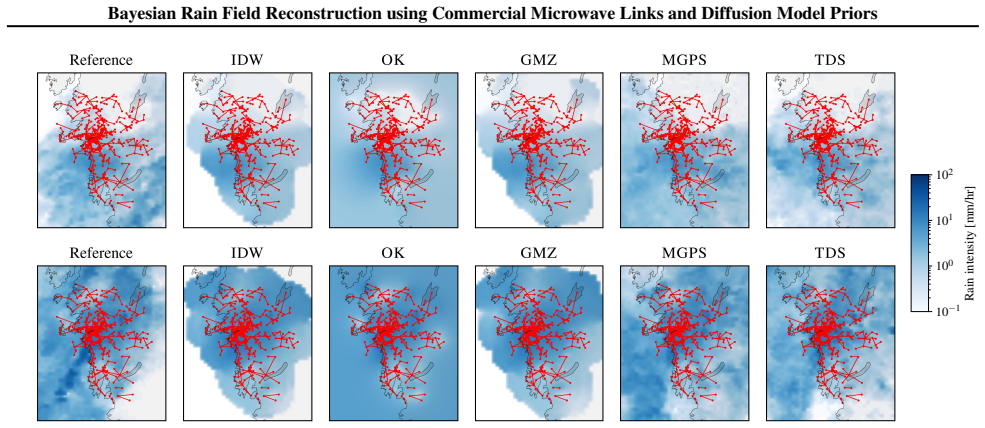
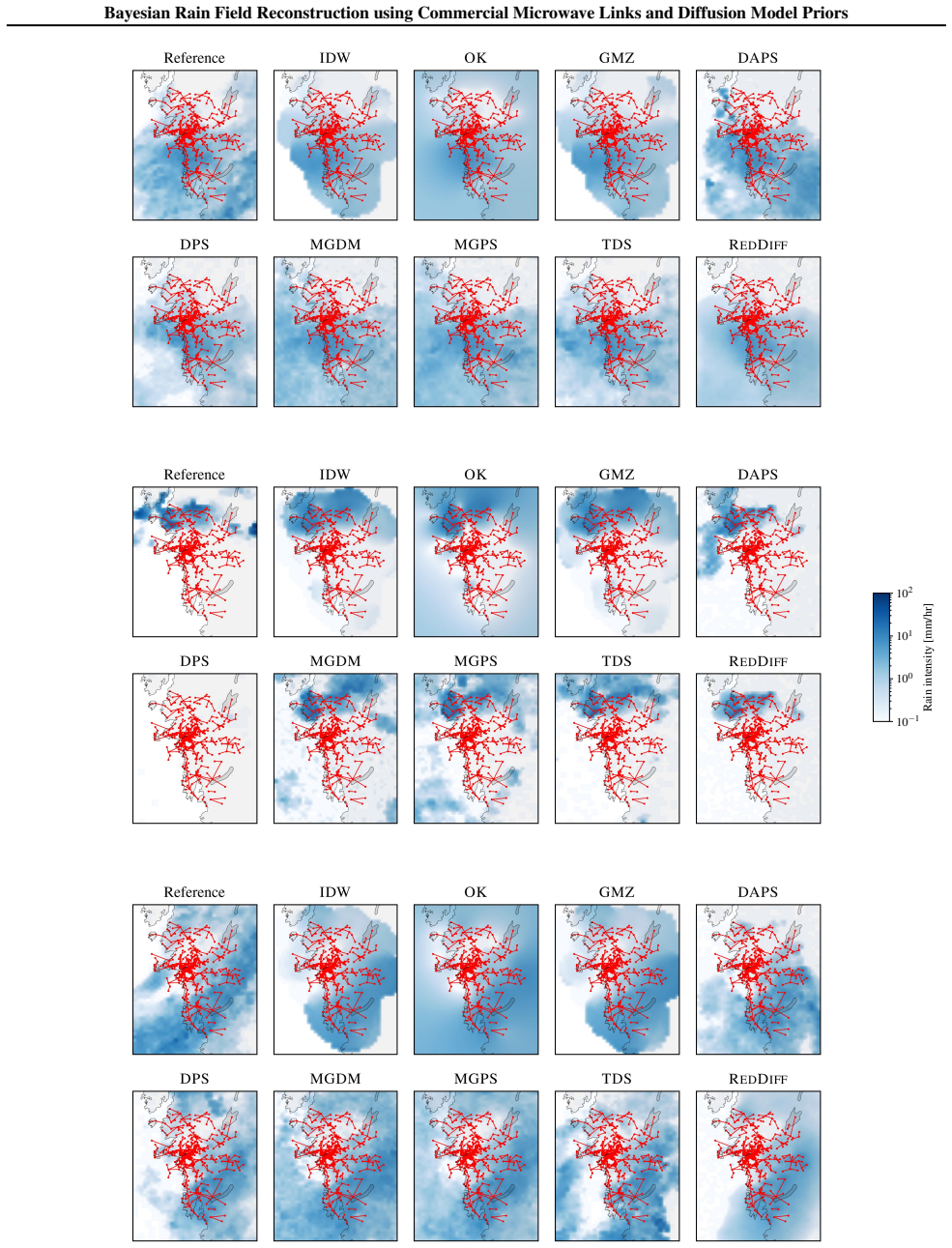
- [§4 (Experiments)] §4 (Experiments): The abstract and results section claim consistent improvements over baselines and better preservation of rainfall statistics than censored GPs, but provide no quantitative details on exact error metrics (e.g., RMSE, MAE), specific baseline implementations, or ablation studies on sampling methods. This leaves the magnitude and robustness of the reported gains difficult to assess and undermines evaluation of the central claim.
- [§3 (Method)] §3 (Method) and real-world dataset results: The load-bearing assumption that pre-trained (training-free) diffusion models faithfully capture rainfall intermittency, heavy-tailed statistics, and spatial structure is not supported by direct quantitative checks. No comparisons of DM prior samples against observed variograms, exceedance probabilities, or wet/dry area fractions from the real dataset are reported, which directly risks the validity of the superiority claim over censored GPs.
minor comments (2)
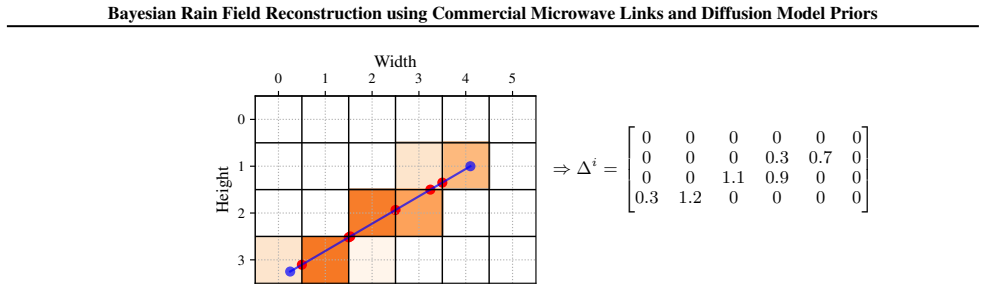
- [§2] The forward model of line-integrated attenuation is described at a high level; adding an explicit equation or pseudocode in §2 would improve clarity for readers unfamiliar with CML physics.
- [Figures] Figure captions and axis labels in the results section could more explicitly indicate which sampling method (PnP, SMC, or Replica Exchange) is shown in each panel to aid reproducibility.
Simulated Author's Rebuttal
We thank the referee for the constructive feedback on our manuscript. We address each major comment point by point below and have revised the manuscript to incorporate additional quantitative details and validations where the original presentation was insufficient.
read point-by-point responses
-
Referee: [§4 (Experiments)] The abstract and results section claim consistent improvements over baselines and better preservation of rainfall statistics than censored GPs, but provide no quantitative details on exact error metrics (e.g., RMSE, MAE), specific baseline implementations, or ablation studies on sampling methods. This leaves the magnitude and robustness of the reported gains difficult to assess and undermines evaluation of the central claim.
Authors: We agree that the original manuscript would benefit from more explicit numerical reporting. While Section 4 includes visual comparisons and aggregate performance indicators, tabulated error metrics, precise baseline specifications, and sampling ablations were not provided. In the revised version we have added a summary table reporting RMSE, MAE, and Pearson correlation for all methods on both synthetic and real datasets, along with a detailed description of baseline implementations (including the censored GP setup) and an ablation comparing Plug-and-Play, SMC, and Replica Exchange sampling. revision: yes
-
Referee: [§3 (Method)] and real-world dataset results: The load-bearing assumption that pre-trained (training-free) diffusion models faithfully capture rainfall intermittency, heavy-tailed statistics, and spatial structure is not supported by direct quantitative checks. No comparisons of DM prior samples against observed variograms, exceedance probabilities, or wet/dry area fractions from the real dataset are reported, which directly risks the validity of the superiority claim over censored GPs.
Authors: We acknowledge that direct quantitative validation of the diffusion prior against real-data statistics is important for supporting the central claims. The manuscript demonstrates advantages through improved posterior reconstructions, but does not include standalone prior-sample diagnostics. In the revised manuscript we have added a new subsection with explicit comparisons of diffusion-model samples to the real dataset (and to the censored GP) using variograms, exceedance probabilities, and wet/dry area fractions; these confirm that the DM prior better reproduces the observed non-Gaussian spatial structure. revision: yes
Circularity Check
No significant circularity; derivation applies standard Bayesian methods to new modality
full rationale
The paper frames rain field reconstruction as a Bayesian inverse problem, adopts pre-trained diffusion models as spatial priors (without domain-specific fine-tuning or fitting in this work), and invokes established training-free posterior sampling algorithms (Plug-and-Play, SMC, Replica Exchange). All central claims rest on experimental validation against baselines on synthetic and real CML datasets rather than any self-referential definitions, fitted parameters renamed as predictions, or load-bearing self-citations. No equation or step reduces a claimed result to its own inputs by construction; the approach is self-contained against external benchmarks.
Axiom & Free-Parameter Ledger
axioms (2)
- domain assumption Diffusion models trained on general spatial data serve as suitable high-fidelity priors for rainfall fields
- domain assumption The line integration relating rainfall to signal attenuation can be accurately modeled in the forward operator
Reference graph
Works this paper leans on
-
[1]
AMC , volume=
Bayesian bounds for parameter estimation and nonlinear filtering/tracking , author=. AMC , volume=
-
[2]
2014 , publisher=
Understanding machine learning: From theory to algorithms , author=. 2014 , publisher=
2014
-
[3]
IEEE Transactions on Acoustics, Speech, and Signal Processing , volume=
Array shape calibration using sources in unknown locations--Part I: Far-field sources , author=. IEEE Transactions on Acoustics, Speech, and Signal Processing , volume=. 1987 , publisher=
1987
-
[4]
1993 , publisher=
Fundamentals of statistical signal processing , author=. 1993 , publisher=
1993
-
[5]
Advances in Neural Information Processing Systems , pages=
Masked autoregressive flow for density estimation , author=. Advances in Neural Information Processing Systems , pages=
-
[6]
Applications of the van Trees inequality: a Bayesian Cram
Gill, Richard D and Levit, Boris Y and others , journal=. Applications of the van Trees inequality: a Bayesian Cram. 1995 , publisher=
1995
-
[7]
Advances in neural information processing systems , pages=
Generative adversarial nets , author=. Advances in neural information processing systems , pages=
-
[8]
The Gaussian data assumption leads to the largest Cram
Stoica, Petre and Babu, Prabhu , journal=. The Gaussian data assumption leads to the largest Cram. 2011 , publisher=
2011
-
[9]
Proceedings of the IEEE/CVF International Conference on Computer Vision , pages=
Noise flow: Noise modeling with conditional normalizing flows , author=. Proceedings of the IEEE/CVF International Conference on Computer Vision , pages=
-
[10]
Proceedings of the International Conference on Learning Representations (ICLR) , volume=
Auto-encoding variational bayes , author=. Proceedings of the International Conference on Learning Representations (ICLR) , volume=
-
[11]
Conditional Generative Adversarial Nets
Conditional generative adversarial nets , author=. arXiv preprint arXiv:1411.1784 , year=
work page internal anchor Pith review arXiv
-
[12]
Proceedings of the 31st International Conference on Machine Learning , pages =
Stochastic Backpropagation and Approximate Inference in Deep Generative Models , author =. Proceedings of the 31st International Conference on Machine Learning , pages =. 2014 , editor =
2014
-
[13]
Kingma and Jimmy Ba , editor =
Diederik P. Kingma and Jimmy Ba , editor =. Adam:. 3rd International Conference on Learning Representations,. 2015 , url =
2015
-
[14]
2017 IEEE International Conference on Computer Vision (ICCV) , title=
X. 2017 IEEE International Conference on Computer Vision (ICCV) , title=. 2017 , volume=
2017
-
[15]
Rectifier nonlinearities improve neural network acoustic models , author=
-
[16]
Proceedings of the IEEE conference on computer vision and pattern recognition , pages=
Deep residual learning for image recognition , author=. Proceedings of the IEEE conference on computer vision and pattern recognition , pages=
-
[17]
2017 , publisher=
Deep learning , author=. 2017 , publisher=
2017
-
[18]
Proceedings of the European conference on computer vision (ECCV) , pages=
Cbam: Convolutional block attention module , author=. Proceedings of the European conference on computer vision (ECCV) , pages=
-
[19]
International conference on machine learning , pages=
Autoencoding beyond pixels using a learned similarity metric , author=. International conference on machine learning , pages=. 2016 , organization=
2016
-
[20]
arXiv preprint arXiv:2011.08848 , year=
Deep Networks for Direction-of-Arrival Estimation in Low SNR , author=. arXiv preprint arXiv:2011.08848 , year=
-
[21]
1992 , publisher=
Array signal processing: concepts and techniques , author=. 1992 , publisher=
1992
-
[22]
2004 , publisher=
Optimum array processing: Part IV of detection, estimation, and modulation theory , author=. 2004 , publisher=
2004
-
[23]
, journal=
Liu, Zhang-Meng and Zhang, Chenwei and Yu, Philip S. , journal=. Direction-of-Arrival Estimation Based on Deep Neural Networks With Robustness to Array Imperfections , year=
-
[24]
Scientific Reports , volume=
Super resolution DOA estimation based on deep neural network , author=. Scientific Reports , volume=. 2020 , publisher=
2020
-
[25]
Generative-Adversarial-Network-Based Wireless Channel Modeling: Challenges and Opportunities , year=
Yang, Yang and Li, Yang and Zhang, Wuxiong and Qin, Fei and Zhu, Pengcheng and Wang, Cheng-Xiang , journal=. Generative-Adversarial-Network-Based Wireless Channel Modeling: Challenges and Opportunities , year=
-
[26]
2019 IEEE International Symposium on Information Theory (ISIT) , pages=
Solving linear inverse problems using generative models , author=. 2019 IEEE International Symposium on Information Theory (ISIT) , pages=. 2019 , organization=
2019
-
[27]
Proceedings of the IEEE conference on computer vision and pattern recognition , pages=
Photo-realistic single image super-resolution using a generative adversarial network , author=. Proceedings of the IEEE conference on computer vision and pattern recognition , pages=
-
[28]
European Conference on Computer Vision , pages=
Srflow: Learning the super-resolution space with normalizing flow , author=. European Conference on Computer Vision , pages=. 2020 , organization=
2020
-
[29]
Glow: Generative Flow with Invertible 1x1 Convolutions , url =
Kingma, Durk P and Dhariwal, Prafulla , booktitle =. Glow: Generative Flow with Invertible 1x1 Convolutions , url =
-
[30]
IEEE Transactions on Pattern Analysis and Machine Intelligence , year=
Normalizing flows: An introduction and review of current methods , author=. IEEE Transactions on Pattern Analysis and Machine Intelligence , year=
-
[31]
Advances in Neural Information Processing Systems , volume=
Neural spline flows , author=. Advances in Neural Information Processing Systems , volume=
-
[32]
Adam: A Method for Stochastic Optimization
Adam: A method for stochastic optimization , author=. arXiv preprint arXiv:1412.6980 , year=
work page internal anchor Pith review arXiv
-
[33]
Journal of Machine Learning Research , volume=
Normalizing flows for probabilistic modeling and inference , author=. Journal of Machine Learning Research , volume=
-
[34]
International conference on machine learning , pages=
Parallel wavenet: Fast high-fidelity speech synthesis , author=. International conference on machine learning , pages=. 2018 , organization=
2018
-
[35]
International Conference on Machine Learning , pages=
Neural autoregressive flows , author=. International Conference on Machine Learning , pages=. 2018 , organization=
2018
-
[36]
3rd International Conference on Learning Representations,
Laurent Dinh and David Krueger and Yoshua Bengio , editor =. 3rd International Conference on Learning Representations,. 2015 , url =
2015
-
[37]
Electronic Journal of Statistics , volume=
Estimating covariance and precision matrices along subspaces , author=. Electronic Journal of Statistics , volume=. 2021 , publisher=
2021
-
[38]
Proceedings of the IEEE Conference on Computer Vision and Pattern Recognition , pages=
A high-quality denoising dataset for smartphone cameras , author=. Proceedings of the IEEE Conference on Computer Vision and Pattern Recognition , pages=
-
[39]
Proceedings of the IEEE Conference on Computer Vision and Pattern Recognition , pages=
Image blind denoising with generative adversarial network based noise modeling , author=. Proceedings of the IEEE Conference on Computer Vision and Pattern Recognition , pages=
-
[40]
IEEE Transactions on Image Processing , volume=
Practical Poissonian-Gaussian noise modeling and fitting for single-image raw-data , author=. IEEE Transactions on Image Processing , volume=. 2008 , publisher=
2008
-
[41]
IEEE Transactions on Image Processing , volume=
Improved denoising via Poisson mixture modeling of image sensor noise , author=. IEEE Transactions on Image Processing , volume=. 2017 , publisher=
2017
-
[42]
Advances in neural information processing systems , volume=
Pytorch: An imperative style, high-performance deep learning library , author=. Advances in neural information processing systems , volume=
-
[43]
IEEE Communications Letters , volume=
The Cramer-Rao bounds of hybrid TOA/RSS and TDOA/RSS location estimation schemes , author=. IEEE Communications Letters , volume=. 2004 , publisher=
2004
-
[44]
2004 , publisher=
Detection, estimation, and modulation theory, part I: detection, estimation, and linear modulation theory , author=. 2004 , publisher=
2004
-
[45]
Information and the accuracy attainable in the estimation of statistical parameters , author=. Reson. J. Sci. Educ , volume=
-
[46]
IEEE Communications Magazine , volume=
Generative-adversarial-network-based wireless channel modeling: Challenges and opportunities , author=. IEEE Communications Magazine , volume=. 2019 , publisher=
2019
-
[47]
2021 IEEE 12th Annual Ubiquitous Computing, Electronics & Mobile Communication Conference (UEMCON) , pages=
Neural Network Generative Models for Radio Frequency Data , author=. 2021 IEEE 12th Annual Ubiquitous Computing, Electronics & Mobile Communication Conference (UEMCON) , pages=. 2021 , organization=
2021
-
[48]
International Conference on Artificial Intelligence and Statistics , pages=
The expressive power of a class of normalizing flow models , author=. International Conference on Artificial Intelligence and Statistics , pages=. 2020 , organization=
2020
-
[49]
GitHub repository , howpublished =
Hai Victor Habi , title =. GitHub repository , howpublished =. 2022 , publisher =
2022
-
[50]
Technical University of Denmark , volume=
The matrix cookbook , author=. Technical University of Denmark , volume=
-
[51]
Density estimation using Real NVP
Density estimation using real nvp , author=. arXiv preprint arXiv:1605.08803 , year=
work page internal anchor Pith review arXiv
-
[52]
2006 , publisher=
Theory of point estimation , author=. 2006 , publisher=
2006
-
[53]
Advances in Neural Information Processing Systems , volume=
Universal Approximation Using Well-Conditioned Normalizing Flows , author=. Advances in Neural Information Processing Systems , volume=
-
[54]
Gaussian Error Linear Units (GELUs)
Gaussian error linear units (gelus) , author=. arXiv preprint arXiv:1606.08415 , year=
work page internal anchor Pith review arXiv
-
[55]
The Annals of Statistics , volume=
Robust multivariate mean estimation: the optimality of trimmed mean , author=. The Annals of Statistics , volume=. 2021 , publisher=
2021
-
[56]
Electronic Journal of Statistics , volume=
A general family of trimmed estimators for robust high-dimensional data analysis , author=. Electronic Journal of Statistics , volume=. 2018 , publisher=
2018
-
[57]
and Poor, H.V
Kassam, S.A. and Poor, H.V. , journal=. Robust techniques for signal processing: A survey , year=
-
[58]
arXiv preprint arXiv:2107.07232 , year=
On the expressivity of bi-Lipschitz normalizing flows , author=. arXiv preprint arXiv:2107.07232 , year=
-
[59]
Economic Geology , volume =
Principles of geostatistics , author =. Economic Geology , volume =. 1963 , doi =
1963
-
[60]
2005 , month = mar, url =
2005
-
[61]
ICML Workshop on Invertible Neural Networks, Normalizing Flows, and Explicit Likelihood Models , year=
Universal Approximation of Residual Flows in Maximum Mean Discrepancy , author=. ICML Workshop on Invertible Neural Networks, Normalizing Flows, and Explicit Likelihood Models , year=
-
[62]
IEEE Transactions on information theory , volume=
Single tone parameter estimation from discrete-time observations , author=. IEEE Transactions on information theory , volume=. 1974 , publisher=
1974
-
[63]
IEEE Transactions on Signal Processing , volume=
Effects of sampling and quantization on single-tone frequency estimation , author=. IEEE Transactions on Signal Processing , volume=. 2000 , publisher=
2000
-
[64]
IEEE transactions on wireless communications , volume=
On the Cramer-Rao bound for carrier frequency estimation in the presence of phase noise , author=. IEEE transactions on wireless communications , volume=. 2007 , publisher=
2007
-
[65]
IEEE Transactions on Signal Processing , volume=
Joint ML/MAP Estimation of the Frequency and Phase of a Single Sinusoid With Wiener Carrier Phase Noise , author=. IEEE Transactions on Signal Processing , volume=. 2021 , publisher=
2021
-
[66]
Advances in Neural Information Processing Systems , volume=
Data-driven estimation of sinusoid frequencies , author=. Advances in Neural Information Processing Systems , volume=
-
[67]
Energies , volume=
Estimation of modal parameters for inter-area oscillations analysis by a machine learning approach with offline training , author=. Energies , volume=. 2020 , publisher=
2020
-
[68]
arXiv preprint arXiv:2203.03695 , year=
Learning to Bound: A Generative Cram 'er-Rao Bound , author=. arXiv preprint arXiv:2203.03695 , year=
-
[69]
International Conference on Machine Learning , pages=
Flow++: Improving flow-based generative models with variational dequantization and architecture design , author=. International Conference on Machine Learning , pages=. 2019 , organization=
2019
-
[70]
A note on the evaluation of generative models
A note on the evaluation of generative models , author=. arXiv preprint arXiv:1511.01844 , year=
-
[71]
Conference on Learning Theory , pages=
Non-convex learning via stochastic gradient langevin dynamics: a nonasymptotic analysis , author=. Conference on Learning Theory , pages=. 2017 , organization=
2017
-
[72]
Advances in Neural Information Processing Systems , volume=
Global convergence of Langevin dynamics based algorithms for nonconvex optimization , author=. Advances in Neural Information Processing Systems , volume=
-
[73]
Estimation of Non-Normalized Statistical Models by Score Matching , year =
Hyv\". Estimation of Non-Normalized Statistical Models by Score Matching , year =. J. Mach. Learn. Res. , month = dec, pages =
-
[74]
arXiv preprint arXiv:2304.04740 , year=
Reflected Diffusion Models , author=. arXiv preprint arXiv:2304.04740 , year=
-
[75]
arXiv preprint arXiv:2203.10215 , year=
Convergence error analysis of reflected gradient langevin dynamics for globally optimizing non-convex constrained problems , author=. arXiv preprint arXiv:2203.10215 , year=
-
[76]
Journal of Machine Learning Research , volume=
Estimating density models with truncation boundaries using score matching , author=. Journal of Machine Learning Research , volume=
-
[77]
Journal of statistical computation and simulation , volume=
Stochastic gradient Langevin dynamics with adaptive drifts , author=. Journal of statistical computation and simulation , volume=. 2022 , publisher=
2022
-
[78]
Computational statistics & data analysis , volume=
Some extensions of score matching , author=. Computational statistics & data analysis , volume=. 2007 , publisher=
2007
-
[79]
The Journal of Machine Learning Research , volume=
Generalized score matching for non-negative data , author=. The Journal of Machine Learning Research , volume=. 2019 , publisher=
2019
-
[80]
Information and Inference: A Journal of the IMA , volume=
Generalized score matching for general domains , author=. Information and Inference: A Journal of the IMA , volume=. 2022 , publisher=
2022
discussion (0)
Sign in with ORCID, Apple, or X to comment. Anyone can read and Pith papers without signing in.