Recognition: unknown
A Multiwavelength Assessment Disfavoring the X-ray Binary Origin of He III Regions in Metal-Poor Star-Forming Dwarf Galaxies
Pith reviewed 2026-05-08 06:33 UTC · model grok-4.3
The pith
Accreting X-ray sources fall short of the extreme-UV output needed to explain He II emission in metal-poor dwarf galaxies.
A machine-rendered reading of the paper's core claim, the machinery that carries it, and where it could break.
Core claim
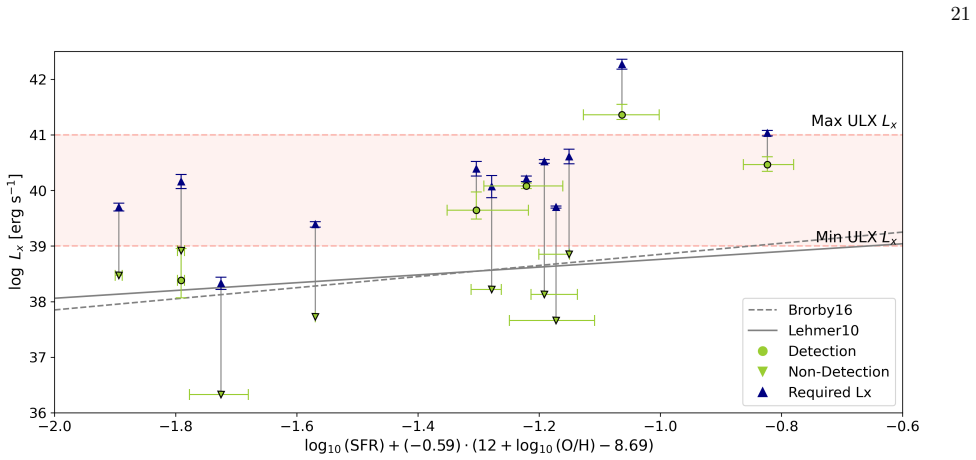
In a sample of 21 galaxies, the EUV photon output inferred from observed X-ray luminosities via standard spectral models falls below the level required to produce the measured He II 4686 emission, while the X-ray properties remain consistent with established empirical relations; therefore accreting X-ray sources cannot supply the observed He II-ionizing photon budget.
What carries the argument
Comparison of the EUV ionizing continuum required by observed He II 4686 line strengths against the continuum inferred from Chandra X-ray luminosities using standard spectral models, supplemented by stellar population synthesis.
If this is right
- Accreting X-ray sources alone cannot power the observed He III regions.
- Metal-poor star-forming galaxies require additional hard EUV radiation sources.
- Ionization models for low-metallicity environments must incorporate non-X-ray-binary contributors.
Where Pith is reading between the lines
- Models of reionization in the early universe may need to reduce the assumed contribution from X-ray binaries in dwarf-galaxy analogs.
- Targeted searches for hot stellar populations or other exotic EUV emitters in these galaxies could resolve the photon-budget shortfall.
- Repeated X-ray monitoring could test whether transient or variable sources were underrepresented in the existing observations.
Load-bearing premise
Standard spectral models accurately convert observed X-ray luminosities into EUV photon output and that the Chandra observations plus synthesis models capture all relevant ionizing sources without missing variable or undetected contributions.
What would settle it
Deeper X-ray observations or revised spectral models that yield an EUV photon production rate matching or exceeding the rate required by the observed He II 4686 emission strengths.
Figures





read the original abstract
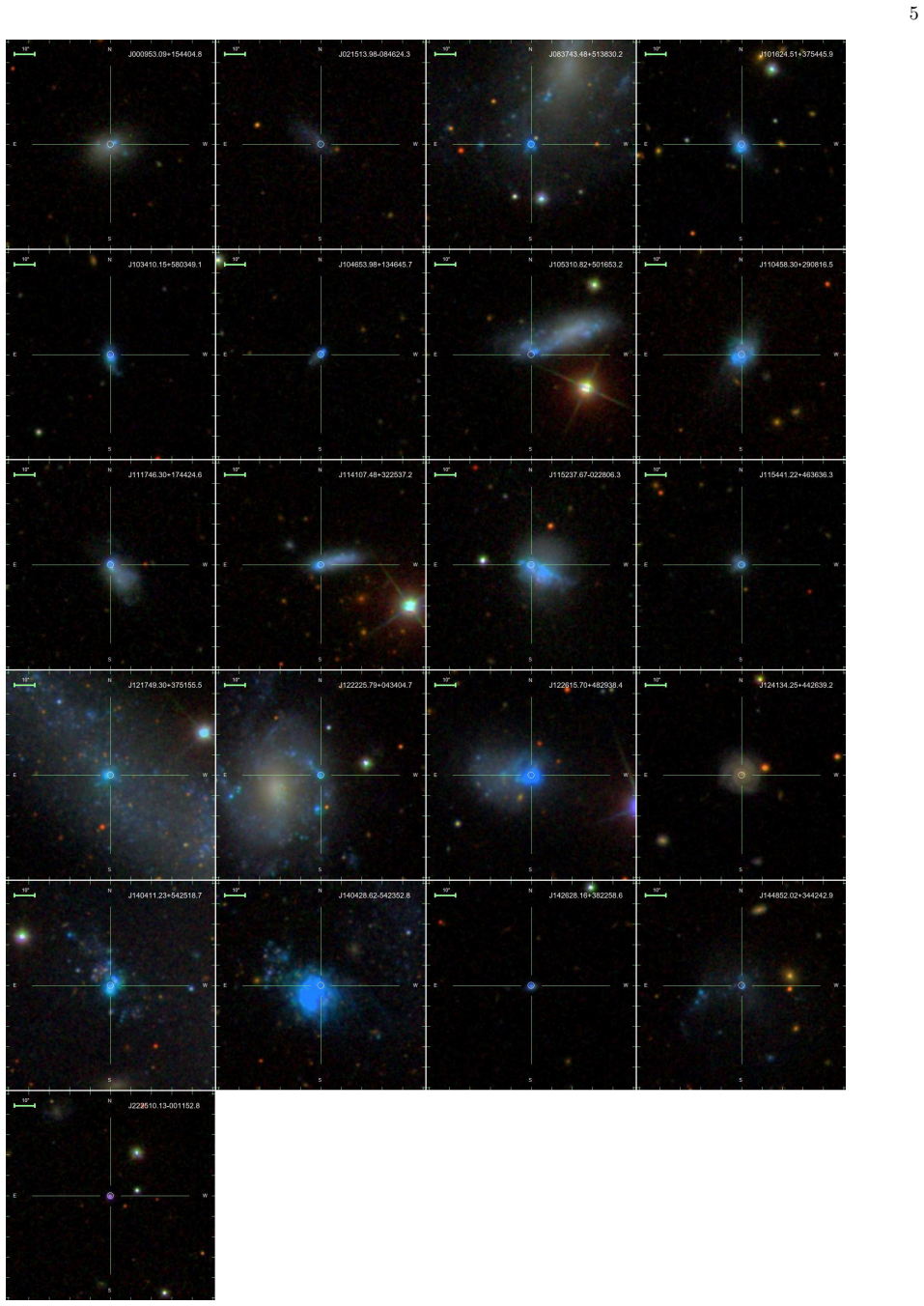
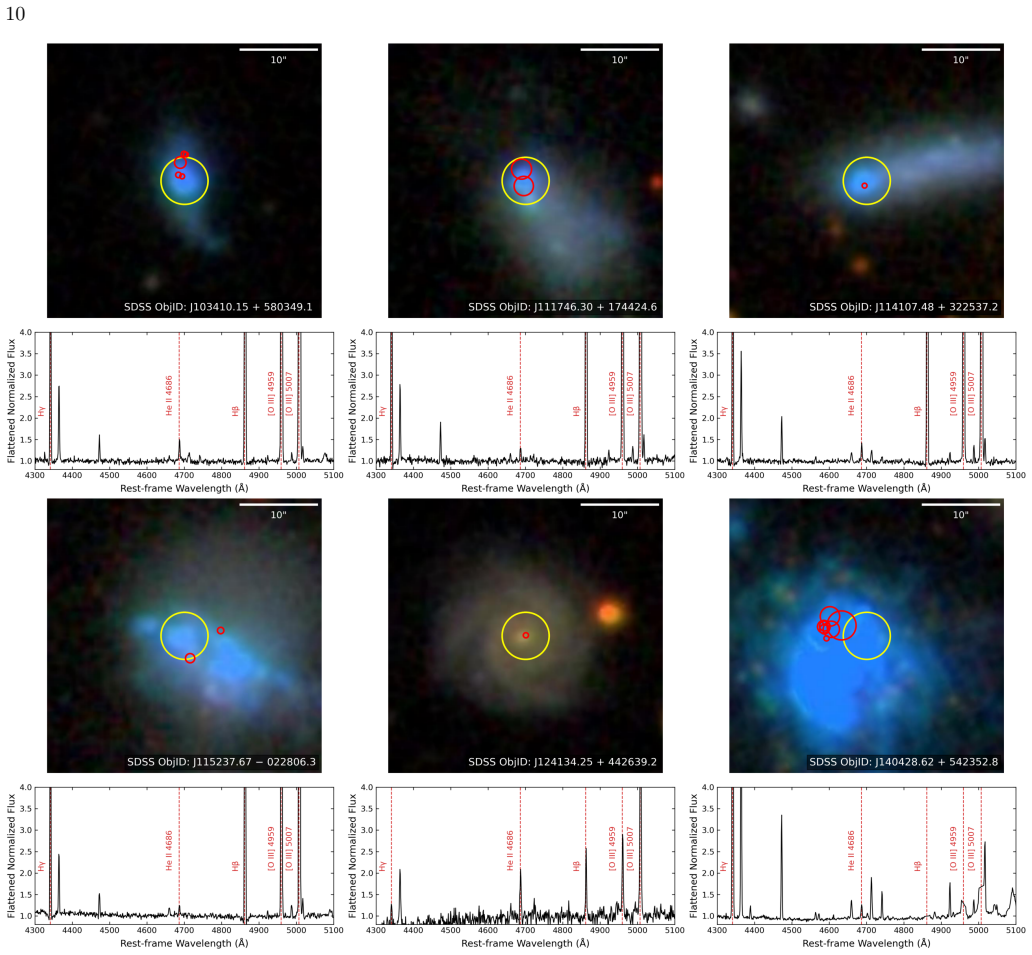
Recent observations of metal-poor, star-forming dwarf galaxies reveal He III regions, traced by nebular He II 4686 emission that require a strong source of extreme-ultraviolet (EUV) radiation. The origin of this hard ionizing radiation remains poorly understood, as standard stellar populations fail to account for it, posing key implications for the understanding of early galaxy formation. We present a systematic Chandra X-ray study of 21 nearby star-forming galaxies with He II emission but lacking Wolf-Rayet spectral signatures. Using 7 new and 36 archival Chandra X-ray observations combined with optical stellar population synthesis modelling, we constrain the ionizing continuum required to sustain the observed He II line, the ionizing continuum available from X-ray objects, and the properties of the host H II regions. We find that the inferred EUV output from accreting X-ray sources in our sample is systematically lower than what is required to produce the observed He II emission. Our sample is consistent with established empirical scaling relations for X-ray luminosity, indicating that this discrepancy cannot be attributed to an anomalously low number or luminosity of X-ray sources. These results indicate that accreting X-ray sources alone cannot account for the observed He II-ionizing photon budget, pointing to additional or alternative sources of hard EUV radiation in metal-poor star-forming environments. Potential alternative or additional contributors are discussed.
Editorial analysis
A structured set of objections, weighed in public.
Referee Report
Summary. The paper presents a Chandra X-ray study of 21 nearby metal-poor star-forming dwarf galaxies that exhibit nebular He II 4686 emission without Wolf-Rayet signatures. Combining 7 new and 36 archival Chandra observations with optical stellar population synthesis modeling, the authors compare the EUV photon budget required to sustain the observed He II line (derived from H II region parameters) against the EUV output inferred from the detected X-ray sources. They report that the X-ray sources fall systematically short of the required He II-ionizing photons, that the sample follows standard X-ray luminosity scaling relations, and therefore conclude that accreting X-ray binaries alone cannot account for the observed emission, pointing instead to alternative hard-EUV sources.
Significance. If the quantitative discrepancy holds after validation of the spectral extrapolations, the result would be significant for high-energy astrophysics and reionization studies: it would disfavor XRBs as the dominant source of He II-ionizing radiation in metal-poor environments and strengthen the case for alternative mechanisms (e.g., stripped stars or other exotic sources). The multi-object sample and direct comparison to empirical scaling relations are positive features that move the field beyond single-object case studies.
major comments (2)
- [§4] §4 (X-ray to EUV conversion): The central claim that inferred EUV output from XRBs is systematically lower than required rests on extrapolation of observed 0.5–8 keV luminosities to E > 54 eV photons using fixed spectral templates (absorbed power-law or disk-blackbody). No sensitivity analysis is presented on the spectral parameters (photon index, column density, or possible supersoft components) that are unconstrained by Chandra data; any systematic shift in the EUV tail would remove the reported discrepancy.
- [§5.1] §5.1 (Comparison to required photon budget): The quantitative shortfall is presented without propagated uncertainties from the X-ray spectral model assumptions or from the stellar synthesis models used for the non-XRB continuum; the error budget on the ratio of available to required Q(He II) is therefore incomplete and load-bearing for the conclusion.
minor comments (3)
- [Abstract] Abstract and §2: The total number of unique galaxies versus total pointings (7 new + 36 archival) should be clarified to avoid double-counting.
- [Figure 3] Figure 3 (or equivalent comparison plot): Error bars on the model-predicted EUV rates and on the required photon rates are missing or unclear, making it difficult to assess the statistical significance of the systematic offset.
- [§6] §6 (Discussion): The text mentions consistency with empirical X-ray scaling relations but does not cite the specific relations or show the comparison data in a figure or table.
Simulated Author's Rebuttal
We thank the referee for their positive evaluation of the manuscript's significance and for the constructive major comments, which help improve the robustness of our analysis. We address each point below and will revise the manuscript accordingly to incorporate additional sensitivity tests and error propagation.
read point-by-point responses
-
Referee: [§4] §4 (X-ray to EUV conversion): The central claim that inferred EUV output from XRBs is systematically lower than required rests on extrapolation of observed 0.5–8 keV luminosities to E > 54 eV photons using fixed spectral templates (absorbed power-law or disk-blackbody). No sensitivity analysis is presented on the spectral parameters (photon index, column density, or possible supersoft components) that are unconstrained by Chandra data; any systematic shift in the EUV tail would remove the reported discrepancy.
Authors: We acknowledge that the EUV extrapolation relies on standard spectral templates (absorbed power-law with Γ ≈ 1.7 and typical N_H for these low-metallicity systems, or disk-blackbody for softer sources) because Chandra data provide limited constraints on the soft tail. We agree a sensitivity analysis is valuable. In the revised manuscript we will add an appendix or expanded §4 subsection that systematically varies Γ between 1.4–2.2, N_H by factors of 2–5, and includes a possible supersoft blackbody component (kT = 0.1–0.3 keV) normalized to the observed hard-band flux. We will demonstrate that even under these excursions the inferred Q(He II) from XRBs remains at least an order of magnitude below the required budget for the majority of the sample, preserving the central conclusion while quantifying the robustness of the result. revision: yes
-
Referee: [§5.1] §5.1 (Comparison to required photon budget): The quantitative shortfall is presented without propagated uncertainties from the X-ray spectral model assumptions or from the stellar synthesis models used for the non-XRB continuum; the error budget on the ratio of available to required Q(He II) is therefore incomplete and load-bearing for the conclusion.
Authors: We agree that a complete error budget is necessary. The current presentation reports measurement uncertainties on X-ray luminosities and on the observed He II fluxes but does not fully propagate the systematic uncertainties arising from the choice of spectral template or from the stellar-population synthesis parameters (age, metallicity, IMF). In the revision we will add Monte Carlo error propagation in §5.1: we will draw spectral parameters from plausible priors, re-compute the EUV extrapolation for each realization, and similarly vary the synthesis-model outputs within their observational priors. The resulting distribution on the ratio of available to required Q(He II) will be reported, allowing us to state the significance of the shortfall with quantified uncertainties. This addition will not change the main result but will make the quantitative claim more rigorous. revision: yes
Circularity Check
No significant circularity; direct comparison of X-ray data to He II requirements via external models.
full rationale
The paper measures Chandra 0.5-8 keV luminosities, applies standard XRB spectral templates to extrapolate EUV output, and compares the result to the Q(He II) needed to match observed 4686 luminosities plus H II region parameters. These templates and scaling relations are cited as established and independent of the current sample; the paper reports consistency with prior empirical L_X-SFR relations rather than deriving them from its own data. No equations reduce a fitted parameter to a prediction of itself, no self-citation is invoked as a uniqueness theorem, and the central discrepancy is presented as an observational result rather than a definitional identity. Minor self-citation risk exists only in the use of standard models, but this does not load-bear the claim.
Axiom & Free-Parameter Ledger
free parameters (1)
- X-ray to EUV conversion efficiency
axioms (2)
- standard math He II 4686 emission traces a photon flux above the 54 eV ionization edge of He+
- domain assumption Chandra observations detect the complete relevant X-ray source population
Reference graph
Works this paper leans on
-
[1]
Abazajian, K. N., Adelman-McCarthy, J. K., Ag¨ ueros, M. A., et al. 2009, ApJS, 182, 543, doi: 10.1088/0067-0049/182/2/543
-
[2]
, archivePrefix = "arXiv", eprint =
Alam, S., Albareti, F. D., Allende Prieto, C., et al. 2015, ApJS, 219, 12, doi: 10.1088/0067-0049/219/1/12 Astropy Collaboration, Robitaille, T. P., Tollerud, E. J., et al. 2013, A&A, 558, A33, doi: 10.1051/0004-6361/201322068 Astropy Collaboration, Price-Whelan, A. M., Sip˝ ocz, B. M., et al. 2018, AJ, 156, 123, doi: 10.3847/1538-3881/aabc4f Astropy Coll...
-
[3]
Baldwin, J. A., Phillips, M. M., & Terlevich, R. 1981, PASP, 93, 5, doi: 10.1086/130766
-
[4]
Basu-Zych, A. R., Lehmer, B. D., Hornschemeier, A. E., et al. 2013, ApJ, 774, 152, doi: 10.1088/0004-637X/774/2/152
-
[5]
Brammer, G. B. 2018, ApJ, 859, 164, doi: 10.3847/1538-4357/aab7fa
-
[6]
Bray, J. C., Stanway, E. R., & Eldridge, J. J. 2025, MNRAS, 542, 2087, doi: 10.1093/mnras/staf1348 19 http://www.astropy.org
-
[7]
Brinchmann, J., Charlot, S., White, S. D. M., et al. 2004, MNRAS, 351, 1151, doi: 10.1111/j.1365-2966.2004.07881.x
-
[8]
Brinkman, A. C., Kaastra, J. S., van der Meer, R. L. J., et al. 2002, A&A, 396, 761, doi: 10.1051/0004-6361:20020918
-
[9]
2014, MNRAS, 441, 2346, doi: 10.1093/mnras/stu736
Brorby, M., Kaaret, P., & Prestwich, A. 2014, MNRAS, 441, 2346, doi: 10.1093/mnras/stu736
-
[10]
Brorby, M., Kaaret, P., Prestwich, A., & Mirabel, I. F. 2016, MNRAS, 457, 4081, doi: 10.1093/mnras/stw284
-
[11]
Byler, N., Dalcanton, J. J., Conroy, C., & Johnson, B. D. 2017, ApJ, 840, 44, doi: 10.3847/1538-4357/aa6c66
-
[12]
Byrne, C. M., Eldridge, J. J., & Stanway, E. R. 2025, MNRAS, 537, 2433, doi: 10.1093/mnras/staf178
-
[13]
2025, ApJL, 989, L35, doi: 10.3847/2041-8213/adf5bc
Cai, S., Cai, Z., Lyu, J., et al. 2025, ApJL, 989, L35, doi: 10.3847/2041-8213/adf5bc
-
[14]
2013, Cambridge University Press
Calzetii, D. 2013, Cambridge University Press
2013
-
[15]
Calzetti, D., Armus, L., Bohlin, R. C., et al. 2000, ApJ, 533, 682, doi: 10.1086/308692
-
[16]
1979, Astrophysical Journal, 228, 939
Cash, W. 1979, Astrophysical Journal, 228, 939
1979
-
[17]
2024, ApJ, 972, 143, doi: 10.3847/1538-4357/ad5f88
Castellano, M., Napolitano, L., Fontana, A., et al. 2024, ApJ, 972, 143, doi: 10.3847/1538-4357/ad5f88
-
[18]
Charlot, S., & Fall, S. M. 2000a, ApJ, 539, 718, doi: 10.1086/309250 —. 2000b, ApJ, 539, 718, doi: 10.1086/309250 28
-
[19]
Charlot, S., & Longhetti, M. 2001, MNRAS, 323, 887, doi: 10.1046/j.1365-8711.2001.04260.x
-
[20]
Modeling the Panchromatic Spectral Energy Distributions of Galaxies
Conroy, C. 2013, ARA&A, 51, 393, doi: 10.1146/annurev-astro-082812-141017
work page Pith review doi:10.1146/annurev-astro-082812-141017 2013
-
[21]
Conroy, C., & Gunn, J. E. 2010, ApJ, 712, 833, doi: 10.1088/0004-637X/712/2/833
-
[22]
Conroy, C., Gunn, J. E., & White, M. 2009, ApJ, 699, 486, doi: 10.1088/0004-637X/699/1/486
work page internal anchor Pith review doi:10.1088/0004-637x/699/1/486 2009
-
[23]
Crowther, P. A. 2007, ARA&A, 45, 177, doi: 10.1146/annurev.astro.45.051806.110615 de Mello, D. F., Schaerer, D., Heldmann, J., & Leitherer, C. 1998, ApJ, 507, 199, doi: 10.1086/306317
-
[24]
Dopita, M. A., & Sutherland, R. S. 1996, ApJS, 102, 161, doi: 10.1086/192255
-
[25]
A., Fischera, J., Sutherland, R
Dopita, M. A., Fischera, J., Sutherland, R. S., et al. 2006, ApJS, 167, 177, doi: 10.1086/508261
-
[26]
2016, ApJS, 222, 8, doi: 10.3847/0067-0049/222/1/8 Ekstr¨ om, S., Georgy, C., Eggenberger, P., et al
Dotter, A. 2016, The Astrophysical Journal Supplement Series, 222, doi: 10.3847/0067-0049/222/1/8
-
[27]
Dougherty, S. M., Williams, P. M., & Pollacco, D. L. 2000, MNRAS, 316, 143, doi: 10.1046/j.1365-8711.2000.03504.x
-
[28]
Douna, V. M., Pellizza, L. J., Mirabel, I. F., & Pedrosa, S. E. 2015, A&A, 579, A44, doi: 10.1051/0004-6361/201525617
-
[29]
Draine, B. T., & Li, A. 2007, ApJ, 657, 810, doi: 10.1086/511055
-
[30]
Drout, M. R., G¨ otberg, Y., Ludwig, B. A., et al. 2023, Science, 382, 1287, doi: 10.1126/science.ade4970
-
[31]
Eldridge, J. J., & Stanway, E. R. 2022, ARA&A, 60, 455, doi: 10.1146/annurev-astro-052920-100646
-
[32]
Eldridge, J. J., Stanway, E. R., Xiao, L., et al. 2017, PASA, 34, e058, doi: 10.1017/pasa.2017.51
-
[33]
Elmegreen, D. M., Elmegreen, B. G., S´ anchez Almeida, J., et al. 2016, ApJ, 825, 145, doi: 10.3847/0004-637X/825/2/145
-
[34]
Emami, N., Siana, B., Weisz, D. R., et al. 2019, ApJ, 881, 71, doi: 10.3847/1538-4357/ab211a
-
[35]
2020, ApJ, 898, 171, doi: 10.3847/1538-4357/aba004
Estrada-Carpenter, V., Papovich, C., Momcheva, I., et al. 2020, ApJ, 898, 171, doi: 10.3847/1538-4357/aba004
-
[36]
Fabian, A. C. 2012, ARA&A, 50, 455, doi: 10.1146/annurev-astro-081811-125521 Falc´ on-Barroso, J., S´ anchez-Bl´ azquez, P., Vazdekis, A., et al. 2011, A&A, 532, A95, doi: 10.1051/0004-6361/201116842
work page Pith review doi:10.1146/annurev-astro-081811-125521 2012
-
[37]
Fisher, D. B., Bolatto, A. D., Herrera-Camus, R., et al. 2014, Nature, 505, 186, doi: 10.1038/nature12765
-
[38]
2013, ApJ, 764, 41, doi: 10.1088/0004-637X/764/1/41
Fragos, T., Lehmer, B., Tremmel, M., et al. 2013, ApJ, 764, 41, doi: 10.1088/0004-637X/764/1/41
-
[39]
Fruscione, A., McDowell, J. C., Allen, G. E., et al. 2006, in Society of Photo-Optical Instrumentation Engineers (SPIE) Conference Series, Vol. 6270, Society of Photo-Optical Instrumentation Engineers (SPIE) Conference Series, ed. D. R. Silva & R. E. Doxsey, 62701V, doi: 10.1117/12.671760
-
[40]
Garmire, G. P., Bautz, M. W., Ford, P. G., Nousek, J. A., & Jr., G. R. R. 2003, in X-Ray and Gamma-Ray Telescopes and Instruments for Astronomy, ed. J. E. Truemper & H. D. Tananbaum, Vol. 4851, International Society for Optics and Photonics (SPIE), 28 – 44, doi: 10.1117/12.461599
-
[41]
Skillman, E. D. 1991, ApJ, 373, 458, doi: 10.1086/170065
-
[42]
Garofali, K., Basu-Zych, A. R., Johnson, B. D., et al. 2024, The Astrophysical Journal, 960, doi: 10.3847/1538-4357/ad0a6a
-
[43]
Gelbord, J. M., Mullaney, J. R., & Ward, M. J. 2009, MNRAS, 397, 172, doi: 10.1111/j.1365-2966.2009.14961.x G¨ otberg, Y., Drout, M. R., Ji, A. P., et al. 2023, ApJ, 959, 125, doi: 10.3847/1538-4357/ace5a3
-
[44]
Greene, J. E., Strader, J., & Ho, L. C. 2020, Annual Review of Astronomy and Astrophysics, 58, 257, doi: 10.1146/annurev-astro-032620-021835
-
[45]
Guseva, N. G., Izotov, Y. I., & Thuan, T. X. 2000, ApJ, 531, 776, doi: 10.1086/308489 G¨ uver, T., &¨Ozel, F. 2009, MNRAS, 400, 2050, doi: 10.1111/j.1365-2966.2009.15598.x
-
[46]
C., & DeNicola, L
Houck, J. C., & DeNicola, L. A. 2000, Astronomical Data Analysis Software and Systems IX, ASP Conference Proceedings, 216
2000
-
[47]
Izotov, Y. I., Guseva, N. G., Fricke, K. J., & Henkel, C. 2019, Astronomy and Astrophysics, 623, doi: 10.1051/0004-6361/201834768
-
[48]
D., Leja, J., Conroy, C., & Speagle, J
Johnson, B. D., Leja, J., Conroy, C., & Speagle, J. S. 2021, The Astrophysical Journal Supplement Series, 254, doi: 10.3847/1538-4365/abef67
work page internal anchor Pith review doi:10.3847/1538-4365/abef67 2021
-
[49]
Kaaret, P., Ward, M. J., & Zezas, A. 2004, MNRAS, 351, L83, doi: 10.1111/j.1365-2966.2004.08020.x
-
[50]
P., Telford, G., & Senchyna, P
Katz, H., Ji, A. P., Telford, G., & Senchyna, P. 2024, The Open Journal of Astrophysics, 7, 106, doi: 10.33232/001c.126253
-
[51]
M., Tremonti, C., et al
Kauffmann, G., Heckman, T. M., Tremonti, C., et al. 2003, Monthly Notices of the Royal Astronomical Society, 346
2003
-
[52]
Kehrig, C., V´ ılchez, J. M., Guerrero, M. A., et al. 2018, MNRAS, 480, 1081, doi: 10.1093/mnras/sty1920
-
[53]
M., P´ erez-Montero, E., et al
Kehrig, C., V´ ılchez, J. M., P´ erez-Montero, E., et al. 2015, ApJL, 801, L28, doi: 10.1088/2041-8205/801/2/L28
-
[54]
Kennicutt, Jr., R. C. 1998, ARA&A, 36, 189, doi: 10.1146/annurev.astro.36.1.189 29
work page Pith review doi:10.1146/annurev.astro.36.1.189 1998
-
[55]
Kewley, L. J., Dopita, M. A., Sutherland, R. S., Heisler, C. A., & Trevena, J. 2001, The Astrophysical Journal, 556, doi: 10.1086/321545
-
[56]
Kobulnicky, H. A., Kennicutt, Jr., R. C., & Pizagno, J. L. 1999, ApJ, 514, 544, doi: 10.1086/306987
-
[57]
F., Blanc, G
Kollmeier, J., Anderson, S. F., Blanc, G. A., et al. 2019, in Bulletin of the American Astronomical Society, Vol. 51, 274
2019
-
[58]
Kroupa, P. 2001, MNRAS, 322, 231, doi: 10.1046/j.1365-8711.2001.04022.x Lan¸ con, A., & Wood, P. R. 2000, A&AS, 146, 217, doi: 10.1051/aas:2000269
-
[59]
2024, MNRAS, 527, 9480, doi: 10.1093/mnras/stad3838
Lecroq, M., Charlot, S., Bressan, A., et al. 2024, MNRAS, 527, 9480, doi: 10.1093/mnras/stad3838
-
[60]
Lehmer, B. D., Alexander, D. M., Bauer, F. E., et al. 2010, ApJ, 724, 559, doi: 10.1088/0004-637X/724/1/559
-
[61]
Lehmer, B. D., Tyler, J. B., Hornschemeier, A. E., et al. 2015, ApJ, 806, 126, doi: 10.1088/0004-637X/806/1/126
-
[62]
Lehmer, B. D., Eufrasio, R. T., Basu-Zych, A., et al. 2021, The Astrophysical Journal, 907, 17, doi: 10.3847/1538-4357/abcec1
-
[63]
Speagle, J. S. 2019a, ApJ, 876, 3, doi: 10.3847/1538-4357/ab133c
-
[64]
Byler, N. 2017, The Astrophysical Journal, 837, doi: 10.3847/1538-4357/aa5ffe
-
[65]
Leja, J., Johnson, B. D., Conroy, C., et al. 2019b, ApJ, 877, 140, doi: 10.3847/1538-4357/ab1d5a
-
[66]
2011, ApJS, 192, 10, doi: 10.1088/0067-0049/192/1/10
Liu, J. 2011, ApJS, 192, 10, doi: 10.1088/0067-0049/192/1/10
-
[67]
Lower, S., Narayanan, D., Leja, J., et al. 2020, ApJ, 904, 33, doi: 10.3847/1538-4357/abbfa7
-
[68]
2002, RMxAA, 38, 97, doi: 10.48550/arXiv.astro-ph/0205021
Luridiana, V., Esteban, C., Peimbert, M., & Peimbert, A. 2002, RMxAA, 38, 97, doi: 10.48550/arXiv.astro-ph/0205021
work page internal anchor Pith review doi:10.48550/arxiv.astro-ph/0205021 2002
-
[69]
Manzano-King, C. M., Canalizo, G., & Sales, L. V. 2019, ApJ, 884, 54, doi: 10.3847/1538-4357/ab4197
-
[70]
2019, Nature Astronomy, 3, 6, doi: 10.1038/s41550-018-0662-2
Mezcua, M. 2019, Nature Astronomy, 3, 6, doi: 10.1038/s41550-018-0662-2
-
[71]
2025, ApJ, 988, 171, doi: 10.3847/1538-4357/ade2cd
Mondal, C., Saha, K., Borgohain, A., et al. 2025, ApJ, 988, 171, doi: 10.3847/1538-4357/ade2cd
-
[72]
Moon, D.-S., Harrison, F. A., Cenko, S. B., & Shariff, J. A. 2011, The Astrophysical Journal Letters, 731, L32, doi: 10.1088/2041-8205/731/2/L32
-
[73]
The Astrophysical Journal Supplement Series , author =
Morrissey, P., Conrow, T., Barlow, T. A., et al. 2007, ApJS, 173, 682, doi: 10.1086/520512 NASA/IPAC Extragalactic Database (NED). 2019, NASA/IPAC Extragalactic Database (NED), IPAC, doi: 10.26132/NED1
-
[74]
2024, A&A, 681, A94, doi: 10.1051/0004-6361/202346769
Nersesian, A., van der Wel, A., Gallazzi, A., et al. 2024, A&A, 681, A94, doi: 10.1051/0004-6361/202346769
-
[75]
Nersesian, A., van der Wel, A., Gallazzi, A. R., et al. 2025, A&A, 695, A86, doi: 10.1051/0004-6361/202452662
-
[76]
Analysis of galaxy SEDs from far-UV to far-IR with CIGALE: Studying a SINGS test sample
Noll, S., Burgarella, D., Giovannoli, E., et al. 2009, A&A, 507, 1793, doi: 10.1051/0004-6361/200912497
-
[77]
Oskinova, L. M., & Schaerer, D. 2022, A&A, 661, A67, doi: 10.1051/0004-6361/202142520
-
[78]
Pacifici, C., Iyer, K. G., Mobasher, B., et al. 2023, ApJ, 944, 141, doi: 10.3847/1538-4357/acacff
-
[79]
Pakull, M. W., & Angebault, L. P. 1986, Nature, 322, 511, doi: 10.1038/322511a0
-
[80]
Optical Counterparts of Ultraluminous X-Ray Sources
Pakull, M. W., & Mirioni, L. 2002, arXiv e-prints, astro, doi: 10.48550/arXiv.astro-ph/0202488
work page internal anchor Pith review doi:10.48550/arxiv.astro-ph/0202488 2002
discussion (0)
Sign in with ORCID, Apple, or X to comment. Anyone can read and Pith papers without signing in.