Recognition: unknown
Nonsense Helps: Prompt Space Perturbation Broadens Reasoning Exploration
Pith reviewed 2026-05-08 12:04 UTC · model grok-4.3
The pith
Adding random nonsense text to prompts helps large language models find new reasoning paths during training.
A machine-rendered reading of the paper's core claim, the machinery that carries it, and where it could break.
Core claim
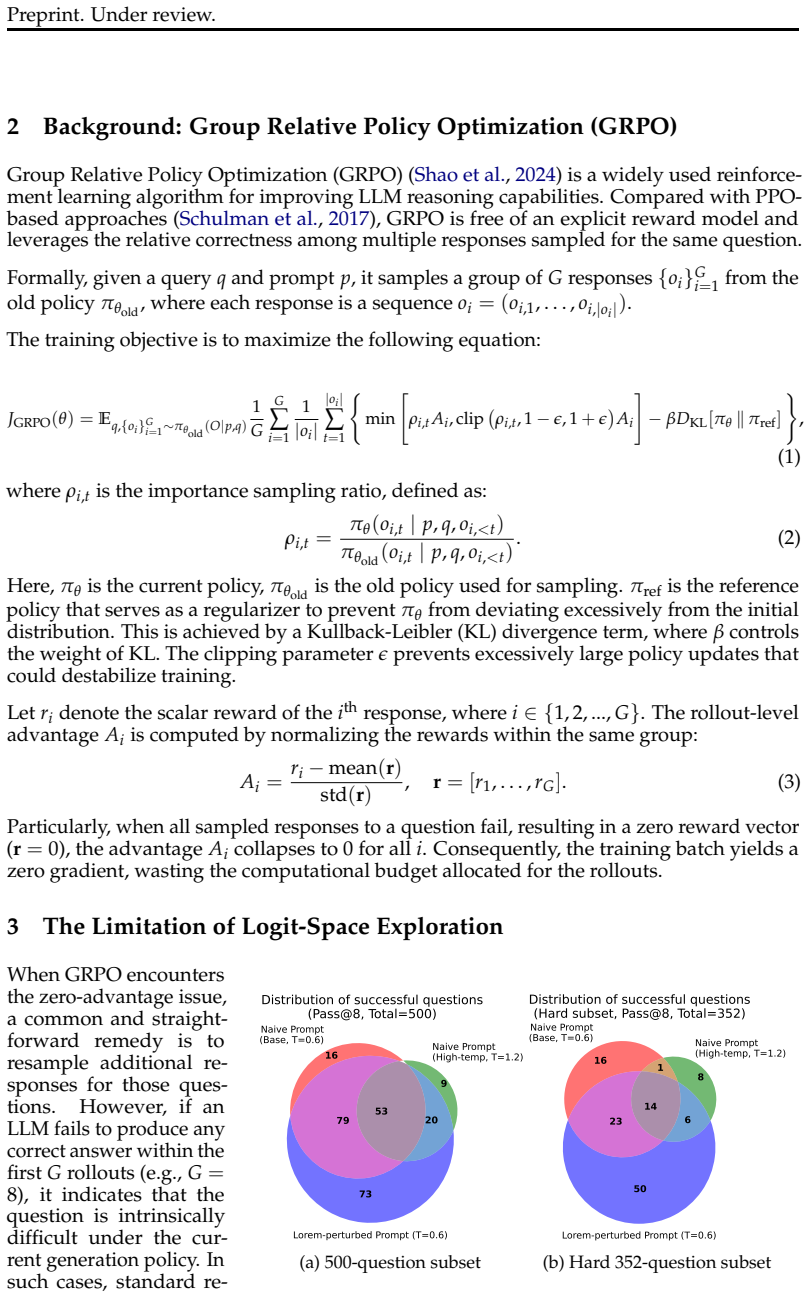
Task-irrelevant prompt-space perturbations assembled from Lorem Ipsum vocabulary can shift an LLM's output distribution during resampling in GRPO, unlocking previously inaccessible reasoning pathways and providing effective training signals for questions that would otherwise yield zero advantage.
What carries the argument
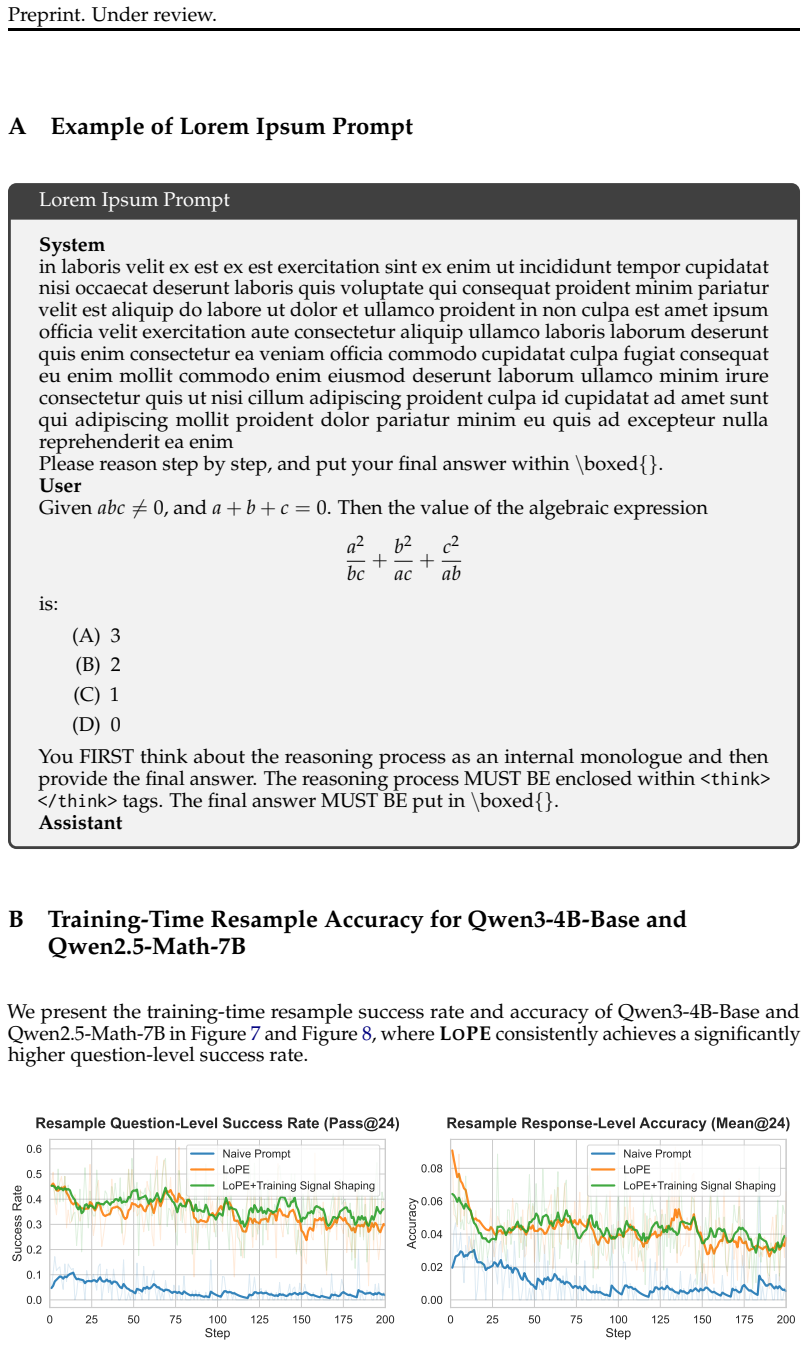
LoPE, or Lorem Perturbation for Exploration: stochastically prepending sequences from a pseudo-Latin placeholder text to the original prompt before generating new rollouts.
If this is right
- LoPE increases the success rate on hard questions compared to resampling with original prompts.
- Similar perturbations using other low-perplexity Latin-based sequences also work.
- The approach scales to models between 1.7 billion and 7 billion parameters.
- It reduces wasted computation on questions with no successful rollouts.
Where Pith is reading between the lines
- Simple input noise can serve as an exploration mechanism in RL fine-tuning without modifying the policy or reward function.
- The finding may extend to other sampling-based training methods where exploration is limited by deterministic policies.
- Further work could test whether the same perturbations help in non-reasoning tasks or larger models.
Load-bearing premise
That the performance gains come specifically from unlocking new reasoning pathways rather than from incidental effects of the added text such as changing sequence lengths or introducing noise.
What would settle it
An experiment that shows no increase in the fraction of previously failing questions that now receive at least one correct rollout when using the perturbed prompts versus the original prompts.
Figures





read the original abstract
Reinforcement learning with verifiable rewards, particularly Group Relative Policy Optimization (GRPO), has significantly advanced the reasoning capabilities of Large Language Models (LLMs). However, in complex tasks, GRPO frequently suffers from the ``zero-advantage problem'': when all sampled rollouts for a query fail, the relative advantage collapses to zero. Consequently, the model loses effective training signals for these questions, wasting the training data and computational budget. While simply increasing the sampling budget for these questions is a common remedy, the static sampling policy inherently constrains reasoning exploration, limiting the success rate. In this paper, we propose Lorem Perturbation for Exploration (LoPE), a simple yet effective training framework to break this exploration bottleneck. We posit that task-irrelevant prompt-space perturbations can shift the model's output distribution enough to unlock orthogonal reasoning pathways for hard questions. Specifically, LoPE prepends sequences stochastically assembled from Lorem Ipsum vocabulary (a pseudo-Latin placeholder text) to the prompts before resampling. Experiments across 1.7B, 4B, and 7B models demonstrate that LoPE significantly outperforms resampling with the original prompts. Further analysis reveals that other Latin-based random sequences with low perplexity are also effective perturbations. Our results establish LoPE as a strong baseline for broadening exploration in LLM reinforcement learning.
Editorial analysis
A structured set of objections, weighed in public.
Referee Report
Summary. The paper proposes Lorem Perturbation for Exploration (LoPE), a training framework for GRPO in LLMs that prepends stochastically assembled Lorem Ipsum sequences to prompts. It claims this task-irrelevant perturbation shifts the output distribution to unlock orthogonal reasoning pathways, mitigating the zero-advantage problem where all rollouts fail and yielding higher success rates than standard resampling on 1.7B–7B models.
Significance. If the empirical gains prove robust and the mechanism is shown to involve broadened path diversity rather than incidental effects, LoPE would supply a simple, low-overhead baseline for improving exploration in RL-based LLM reasoning, particularly on zero-advantage queries.
major comments (3)
- [Experiments] Experiments section: reported success-rate improvements are presented without details on tasks, baselines beyond plain resampling, number of runs, statistical tests, or ablations on perturbation parameters (length, sampling probability).
- [Analysis] Analysis section: no inspection of reasoning traces (CoT steps, intermediate states, or solution trees) is described to confirm that LoPE rollouts follow distinct orthogonal pathways; gains could equally arise from non-specific changes in token probabilities or sampling entropy.
- [Abstract] Abstract and §1: the central claim that perturbations 'unlock orthogonal reasoning pathways' is load-bearing yet rests solely on final accuracy deltas; without path-diversity metrics the interpretation remains unverified.
minor comments (2)
- [Abstract] Abstract: the 'zero-advantage problem' is introduced without a brief formal statement or reference to the GRPO advantage formula.
- Ensure reproducibility by specifying exact procedure for stochastic Lorem Ipsum assembly and any filtering for low perplexity.
Simulated Author's Rebuttal
We thank the referee for the constructive feedback on our manuscript. We address each major comment below and have revised the paper to incorporate additional details, examples, and metrics where the concerns are valid. Our responses focus on substance and aim to strengthen the presentation of LoPE without overstating the original evidence.
read point-by-point responses
-
Referee: [Experiments] Experiments section: reported success-rate improvements are presented without details on tasks, baselines beyond plain resampling, number of runs, statistical tests, or ablations on perturbation parameters (length, sampling probability).
Authors: We agree that the original Experiments section was concise and omitted several implementation details. In the revised manuscript we have expanded this section to list the exact tasks (GSM8K, MATH, and two additional reasoning benchmarks), the full set of baselines (including temperature scaling and random token insertion controls), the number of independent runs (five per configuration), the statistical tests performed (paired t-tests with p-values reported), and systematic ablations varying perturbation length (10–100 tokens) and sampling probability (0.1–0.5). These additions make the reported gains reproducible and demonstrate that the improvements are stable across the tested parameter ranges. revision: yes
-
Referee: [Analysis] Analysis section: no inspection of reasoning traces (CoT steps, intermediate states, or solution trees) is described to confirm that LoPE rollouts follow distinct orthogonal pathways; gains could equally arise from non-specific changes in token probabilities or sampling entropy.
Authors: The referee correctly notes that the original Analysis section did not include direct examination of reasoning traces. While we did show that other low-perplexity Latin-based sequences produce similar gains, this alone does not rule out entropy-driven effects. In the revision we have added a new subsection containing (i) qualitative examples of divergent CoT steps and intermediate states between LoPE and standard rollouts on the same queries, and (ii) quantitative diversity metrics (average pairwise edit distance on CoT sequences and number of unique solution paths). We also include a control experiment that matches sampling entropy between conditions to isolate the contribution of the prompt-space perturbation. These additions support the claim that LoPE encourages distinct pathways beyond generic entropy increases. revision: yes
-
Referee: [Abstract] Abstract and §1: the central claim that perturbations 'unlock orthogonal reasoning pathways' is load-bearing yet rests solely on final accuracy deltas; without path-diversity metrics the interpretation remains unverified.
Authors: We acknowledge that the original abstract and introduction presented the orthogonal-pathways interpretation primarily on the basis of accuracy improvements and the selectivity of low-perplexity perturbations. This leaves the mechanistic claim under-supported. In the revised version we have introduced explicit path-diversity metrics (reasoning-embedding cosine distances and unique-path counts) into the Analysis section and updated the abstract and §1 to describe the mechanism as a well-supported hypothesis rather than a definitive conclusion. The language is tempered accordingly while retaining the core empirical finding that LoPE broadens exploration relative to standard resampling. revision: partial
Circularity Check
No circularity: purely empirical proposal validated by direct comparison
full rationale
The paper introduces LoPE as a heuristic training intervention (stochastic Lorem Ipsum prepending) and evaluates it solely through success-rate experiments on 1.7B–7B models against a resampling baseline. No equations, derivations, fitted parameters presented as predictions, or self-citations are used to justify the central claim. The hypothesis that perturbations unlock orthogonal paths is stated as a posit and tested empirically; it does not reduce to any input by construction. This is the standard case of an empirical methods paper whose validity rests on external benchmarks rather than internal definitional closure.
Axiom & Free-Parameter Ledger
axioms (2)
- domain assumption GRPO suffers from the zero-advantage problem when all sampled rollouts for a query fail
- ad hoc to paper Task-irrelevant prompt-space perturbations shift output distribution to unlock orthogonal reasoning pathways
Reference graph
Works this paper leans on
-
[1]
Attention is All you Need , url =
Vaswani, Ashish and Shazeer, Noam and Parmar, Niki and Uszkoreit, Jakob and Jones, Llion and Gomez, Aidan N and Kaiser, ukasz and Polosukhin, Illia , booktitle =. Attention is All you Need , url =
-
[2]
2026 , eprint=
Group Pattern Selection Optimization: Let LRMs Pick the Right Pattern for Reasoning , author=. 2026 , eprint=
2026
-
[3]
2026 , eprint=
Train Less, Learn More: Adaptive Efficient Rollout Optimization for Group-Based Reinforcement Learning , author=. 2026 , eprint=
2026
-
[4]
2026 , eprint=
No Prompt Left Behind: Exploiting Zero-Variance Prompts in LLM Reinforcement Learning via Entropy-Guided Advantage Shaping , author=. 2026 , eprint=
2026
-
[5]
2025 , eprint=
XRPO: Pushing the limits of GRPO with Targeted Exploration and Exploitation , author=. 2025 , eprint=
2025
-
[6]
2026 , eprint=
WS-GRPO: Weakly-Supervised Group-Relative Policy Optimization for Rollout-Efficient Reasoning , author=. 2026 , eprint=
2026
-
[7]
2024 , eprint=
DeepSeekMath: Pushing the Limits of Mathematical Reasoning in Open Language Models , author=. 2024 , eprint=
2024
-
[8]
2026 , eprint=
Prompt Augmentation Scales up GRPO Training on Mathematical Reasoning , author=. 2026 , eprint=
2026
-
[9]
2026 , eprint=
Scaf-GRPO: Scaffolded Group Relative Policy Optimization for Enhancing LLM Reasoning , author=. 2026 , eprint=
2026
-
[10]
2025 , eprint=
Learning to Reason under Off-Policy Guidance , author=. 2025 , eprint=
2025
-
[11]
2026 , eprint=
Self-Distilled Reasoner: On-Policy Self-Distillation for Large Language Models , author=. 2026 , eprint=
2026
-
[12]
2024 , eprint=
Qwen2.5-Math Technical Report: Toward Mathematical Expert Model via Self-Improvement , author=. 2024 , eprint=
2024
-
[13]
Guo, Daya and Yang, Dejian and Zhang, Haowei and Song, Junxiao and Wang, Peiyi and Zhu, Qihao and Xu, Runxin and Zhang, Ruoyu and Ma, Shirong and Bi, Xiao and Zhang, Xiaokang and Yu, Xingkai and Wu, Yu and Wu, Z. F. and Gou, Zhibin and Shao, Zhihong and Li, Zhuoshu and Gao, Ziyi and Liu, Aixin and Xue, Bing and Wang, Bingxuan and Wu, Bochao and Feng, Bei ...
-
[14]
2025 , eprint=
Equivalence of Context and Parameter Updates in Modern Transformer Blocks , author=. 2025 , eprint=
2025
-
[15]
2023 , eprint=
Why Can GPT Learn In-Context? Language Models Implicitly Perform Gradient Descent as Meta-Optimizers , author=. 2023 , eprint=
2023
-
[16]
2022 , eprint=
An Explanation of In-context Learning as Implicit Bayesian Inference , author=. 2022 , eprint=
2022
-
[17]
2025 , eprint=
Knapsack RL: Unlocking Exploration of LLMs via Optimizing Budget Allocation , author=. 2025 , eprint=
2025
-
[18]
2025 , eprint=
Reinforce-Ada: An Adaptive Sampling Framework under Non-linear RL Objectives , author=. 2025 , eprint=
2025
-
[19]
2025 , eprint=
Enhancing Efficiency and Exploration in Reinforcement Learning for LLMs , author=. 2025 , eprint=
2025
-
[20]
2025 , eprint=
Meaningless Tokens, Meaningful Gains: How Activation Shifts Enhance LLM Reasoning , author=. 2025 , eprint=
2025
-
[21]
2026 , eprint=
Neural Thickets: Diverse Task Experts Are Dense Around Pretrained Weights , author=. 2026 , eprint=
2026
-
[22]
Open R1: A fully open reproduction of DeepSeek-R1 , url =
-
[23]
2025 , eprint=
Qwen3 Technical Report , author=. 2025 , eprint=
2025
-
[24]
2025 , journal=
OctoThinker: Mid-training Incentivizes Reinforcement Learning Scaling , author=. 2025 , journal=
2025
-
[25]
EasyR1: An Efficient, Scalable, Multi-Modality RL Training Framework , author =
-
[26]
ModelScope Team , year=
-
[27]
2021 , eprint=
Measuring Mathematical Problem Solving With the MATH Dataset , author=. 2021 , eprint=
2021
-
[28]
2021 , eprint=
Training Verifiers to Solve Math Word Problems , author=. 2021 , eprint=
2021
-
[29]
Lorem ipsum generator , url =
-
[30]
arXiv preprint arXiv:2503.12734 , year=
In-context linear regression demystified: Training dynamics and mechanistic interpretability of multi-head softmax attention , author=. arXiv preprint arXiv:2503.12734 , year=
-
[31]
2017 , eprint=
Proximal Policy Optimization Algorithms , author=. 2017 , eprint=
2017
-
[32]
2025 , eprint=
DAPO: An Open-Source LLM Reinforcement Learning System at Scale , author=. 2025 , eprint=
2025
-
[33]
2023 , eprint=
Transformers learn in-context by gradient descent , author=. 2023 , eprint=
2023
-
[34]
2023 , eprint=
Chain-of-Thought Prompting Elicits Reasoning in Large Language Models , author=. 2023 , eprint=
2023
-
[35]
2023 , eprint=
Self-Consistency Improves Chain of Thought Reasoning in Language Models , author=. 2023 , eprint=
2023
-
[36]
2023 , eprint=
Least-to-Most Prompting Enables Complex Reasoning in Large Language Models , author=. 2023 , eprint=
2023
-
[37]
Liu , title =
Colin Raffel and Noam Shazeer and Adam Roberts and Katherine Lee and Sharan Narang and Michael Matena and Yanqi Zhou and Wei Li and Peter J. Liu , title =. Journal of Machine Learning Research , year =
-
[38]
FastText.zip: Compressing text classification models
FastText.zip: Compressing text classification models , author=. arXiv preprint arXiv:1612.03651 , year=
-
[39]
2025 , eprint=
ASPO: Asymmetric Importance Sampling Policy Optimization , author=. 2025 , eprint=
2025
-
[40]
Journal of Social Computing , volume=
GPT models can perform thematic analysis in public health studies, akin to qualitative researchers , author=. Journal of Social Computing , volume=. 2024 , publisher=
2024
-
[41]
Efficient test-time scaling via self-calibration
Efficient test-time scaling via self-calibration , author=. arXiv preprint arXiv:2503.00031 , year=
-
[42]
Chengsong Huang and Langlin Huang and Jixuan Leng and Jiacheng Liu and Jiaxin Huang , booktitle=. Ca. 2026 , url=
2026
-
[43]
Divide, Reweight, and Conquer: A Logit Arithmetic Approach for In-Context Learning
Huang, Chengsong and Huang, Langlin and Huang, Jiaxin. Divide, Reweight, and Conquer: A Logit Arithmetic Approach for In-Context Learning. Proceedings of the 19th Conference of the E uropean Chapter of the A ssociation for C omputational L inguistics (Volume 1: Long Papers). 2026. doi:10.18653/v1/2026.eacl-long.11
discussion (0)
Sign in with ORCID, Apple, or X to comment. Anyone can read and Pith papers without signing in.