Recognition: no theorem link
Self-organized photonic time quasicrystal from a single imposed clock
Pith reviewed 2026-05-11 00:53 UTC · model grok-4.3
The pith
A single pump frequency self-organizes a discrete photonic time quasicrystal in a nonlinear dipole lattice.
A machine-rendered reading of the paper's core claim, the machinery that carries it, and where it could break.
Core claim
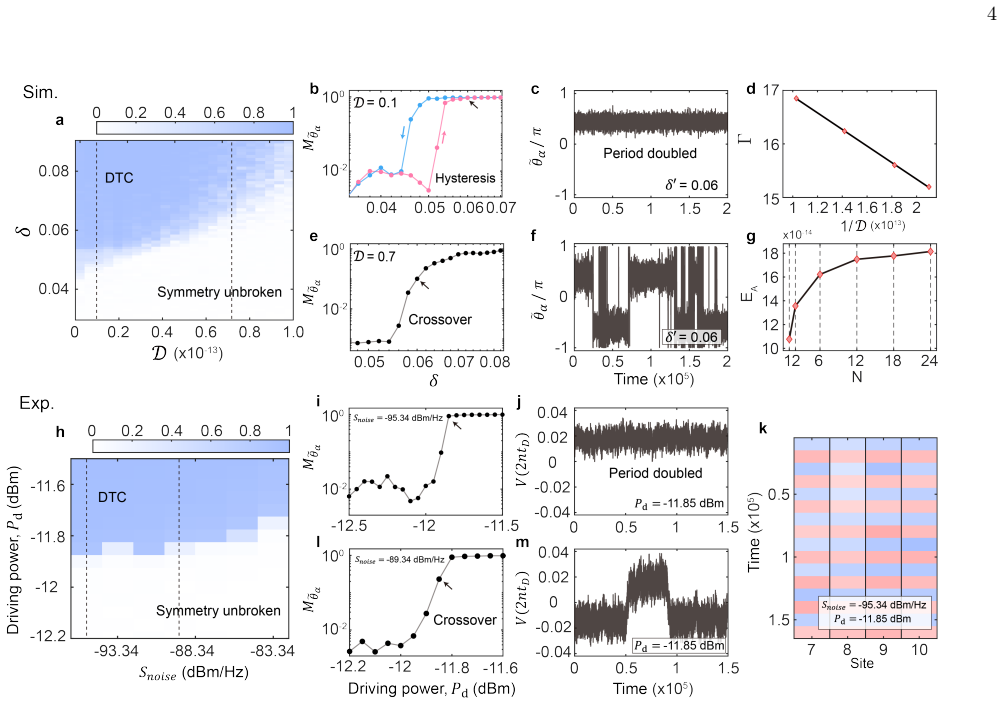
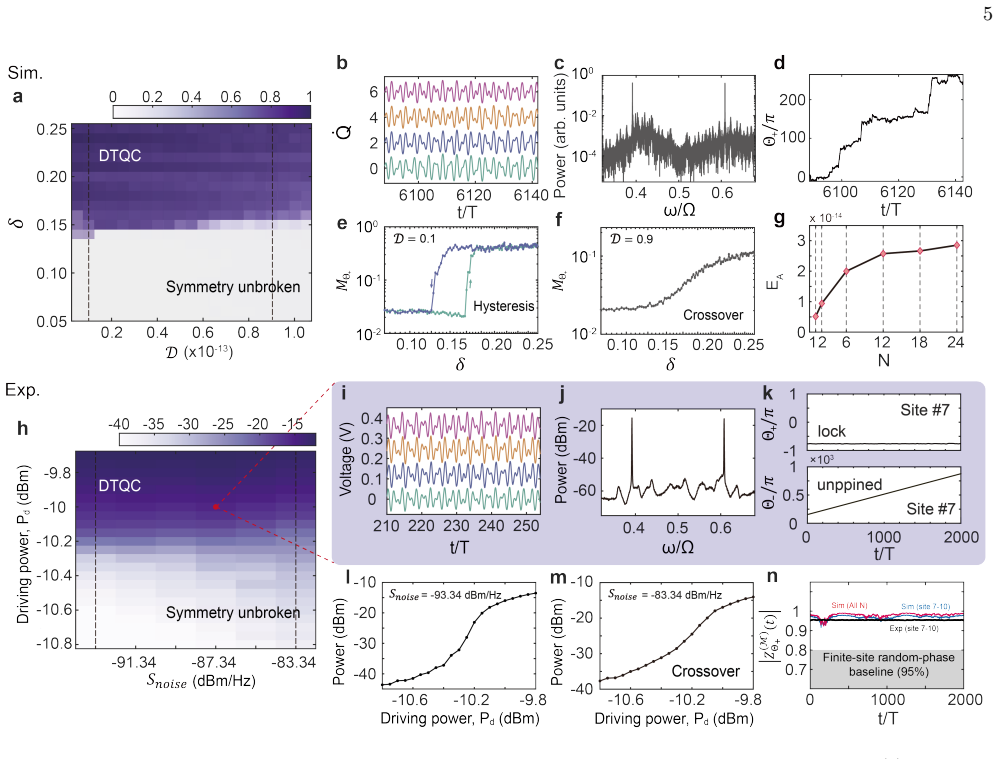
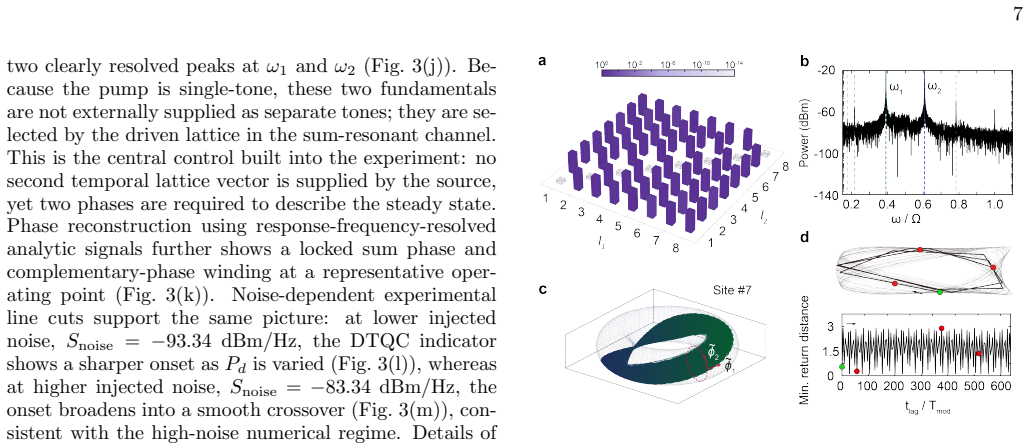
In a guided-wave lattice of nonlinear dipoles, a single-tone pump modulates the polarization sector while Maxwell-polarization back-action selects two response frequencies whose only resolved low-order relation is the pump-locked sum condition. Their sum phase locks to the pump and the complementary phase winds, producing a photonic discrete time quasicrystal with torus-like phase dynamics and a discrete combination spectrum. Site-resolved measurements show locked-phase coherence across the measured lattice sites over a finite control-parameter window.
What carries the argument
Maxwell-polarization back-action that selects two response frequencies satisfying only the pump-locked sum condition and generates torus-like phase dynamics.
If this is right
- Phase coherence persists across multiple lattice sites without additional external frequency drives.
- The output spectrum consists of discrete combinations generated from the two self-selected frequencies.
- The quasicrystal state appears within a bounded window of system parameters.
- Self-selection replaces the requirement for externally programmed multi-frequency modulation.
Where Pith is reading between the lines
- The same back-action selection could operate in other nonlinear wave systems where minimal frequency relations are enforced by field-medium coupling.
- Single-source optical setups might generate tunable quasiperiodic signals by exploiting this minimal-drive route.
- Changing lattice size or dipole density could map how the coherence window scales with system extent.
- The torus dynamics supply a minimal platform for exploring nonequilibrium time quasicrystals under reduced external control.
Load-bearing premise
Maxwell-polarization back-action autonomously selects exactly two response frequencies whose only low-order relation is the pump-locked sum condition.
What would settle it
Observation of additional dominant frequencies beyond the two selected ones or loss of sum-phase locking to the pump in the measured response spectrum under single-tone driving.
Figures

read the original abstract
A photonic time crystal usually writes a clock into a medium. Here one clock does more than program the medium: it seeds a quasiperiodic temporal order that the nonlinear medium selects for itself. In a guided-wave lattice of nonlinear dipoles, a single-tone pump modulates the polarization sector, while Maxwell--polarization back-action selects two response frequencies whose only resolved low-order relation is the pump-locked sum condition. Their sum phase locks to the pump and the complementary phase winds, producing a photonic discrete time quasicrystal with torus-like phase dynamics and a discrete combination spectrum. Site-resolved measurements show locked-phase coherence across the measured lattice sites over a finite control-parameter window. These results establish a route from externally programmed time-varying media to self-organized temporal order in nonlinear photonic systems.
Editorial analysis
A structured set of objections, weighed in public.
Referee Report
Summary. The paper claims that in a guided-wave lattice of nonlinear dipoles, a single-tone pump modulates the polarization sector while Maxwell-polarization back-action autonomously selects two response frequencies satisfying only a pump-locked sum condition. The sum phase locks to the pump and the complementary phase winds, yielding a photonic discrete time quasicrystal with torus-like phase dynamics and a discrete combination spectrum. Site-resolved measurements are reported to show locked-phase coherence across lattice sites over a finite control-parameter window, establishing a route from externally programmed time-varying media to self-organized temporal order.
Significance. If the central mechanism holds, the work demonstrates self-organization of temporal quasicrystalline order in a nonlinear photonic system driven by only one external clock. This reduces reliance on multiple imposed drives and could inform design of robust time-varying photonic media. The reported site-resolved coherence and discrete spectrum provide concrete observables that could be tested in related platforms.
major comments (1)
- Abstract and main text: the claim that Maxwell-polarization back-action 'selects two response frequencies whose only resolved low-order relation is the pump-locked sum condition' is load-bearing for the self-organized quasicrystal result, yet the manuscript provides no explicit stability analysis, derivation, or simulation showing suppression of higher-order mixing terms, lattice dispersion effects, or other commensurate solutions. Without this, it remains unclear whether the two-frequency attractor is generic or requires implicit tuning or post-selection.
minor comments (2)
- The abstract is dense; several technical terms (e.g., 'torus-like phase dynamics', 'discrete combination spectrum') would benefit from a brief parenthetical definition or reference to a specific figure or equation in the main text.
- Site-resolved measurements are mentioned but no details on error bars, number of sites, or control-parameter window boundaries are given in the abstract; these should be summarized with quantitative bounds in the results section.
Simulated Author's Rebuttal
We thank the referee for the careful reading and constructive feedback. The major comment identifies a key point about the robustness of the two-frequency attractor, which we address directly below. We agree that additional analysis will strengthen the manuscript and have outlined revisions accordingly.
read point-by-point responses
-
Referee: Abstract and main text: the claim that Maxwell-polarization back-action 'selects two response frequencies whose only resolved low-order relation is the pump-locked sum condition' is load-bearing for the self-organized quasicrystal result, yet the manuscript provides no explicit stability analysis, derivation, or simulation showing suppression of higher-order mixing terms, lattice dispersion effects, or other commensurate solutions. Without this, it remains unclear whether the two-frequency attractor is generic or requires implicit tuning or post-selection.
Authors: We agree that an explicit demonstration of the attractor's robustness is important. The manuscript presents direct numerical integration of the coupled Maxwell-polarization equations across the lattice, which incorporates dispersion and all orders of nonlinear mixing; these simulations show the two-frequency state emerging spontaneously and remaining stable over a finite window of pump parameters, with the observed torus dynamics and discrete spectrum. No post-selection is applied. However, we acknowledge the lack of a dedicated analytical stability analysis or targeted simulations isolating higher-order terms. In the revised manuscript we will add a supplementary section deriving a reduced envelope model and performing linear stability analysis around the sum-locked solution to show that perturbations from other commensurate frequencies are unstable under the back-action. We will also include additional parameter scans confirming the basin of attraction. revision: yes
Circularity Check
No circularity: derivation grounded in standard Maxwell-polarization dynamics
full rationale
The paper claims that Maxwell-polarization back-action in a nonlinear dipole lattice autonomously selects two response frequencies satisfying only the pump-locked sum condition, yielding a discrete time quasicrystal. No equations, fitted parameters, or self-citations are shown that reduce this selection to a definition of the target state or to a prior result by the same authors. The mechanism is presented as emerging from the coupled Maxwell and polarization equations without post-selection or implicit tuning that would make the outcome tautological. The abstract and description contain no self-definitional steps, fitted-input predictions, or load-bearing self-citations; the central claim therefore remains independent of its own inputs.
Axiom & Free-Parameter Ledger
axioms (1)
- domain assumption Maxwell-polarization back-action in a lattice of nonlinear dipoles selects response frequencies satisfying a pump-locked sum condition
Reference graph
Works this paper leans on
-
[1]
Reyes-Ayona and P
J. Reyes-Ayona and P. Halevi, Observation of genuine wave vector (k orβ) gap in a dynamic transmission line and temporal photonic crystals, Applied Physics Letters 107, 074101 (2015)
2015
-
[2]
J. S. Mart´ ınez-Romero, O. M. Becerra-Fuentes, and P. Halevi, Temporal photonic crystals with modulations of both permittivity and permeability, Physical Review A93, 063813 (2016)
2016
-
[3]
M. M. Asgari, P. Garg, X. Wang, M. S. Mirmoosa, C. Rockstuhl, and V. Asadchy, Theory and applications of photonic time crystals: a tutorial, Advances in Optics and Photonics16, 958 (2024)
2024
-
[4]
X. Wang, P. Garg, M. Mirmoosa, A. Lamprianidis, C. Rockstuhl, and V. Asadchy, Expanding momentum bandgaps in photonic time crystals through resonances, Nature Photonics19, 149 (2025)
2025
-
[5]
Wang, Z.-Q
N. Wang, Z.-Q. Zhang, and C. T. Chan, Photonic flo- quet media with a complex time-periodic permittivity, Physical Review B98, 085142 (2018)
2018
-
[6]
Galiffi, R
E. Galiffi, R. Tirole, S. Yin, H. Li, S. Vezzoli, P. A. Huidobro, M. G. Silveirinha, R. Sapienza, A. Al` u, and J. Pendry, Photonics of time-varying media, Advanced Photonics4, 014002 (2022)
2022
-
[7]
J. Park, K. Lee, R.-Y. Zhang, H.-C. Park, J.-W. Ryu, G. Y. Cho, M. Y. Lee, Z. Zhang, N. Park, W. Jeon, et al., Spontaneous emission decay and excitation in pho- tonic time crystals, Physical Review Letters135, 133801 (2025)
2025
-
[8]
K. Lee, M. Kyung, Y. Kim, J. Park, H. Lee, J. Choi, C. Chan, J. Shin, K. W. Kim, and B. Min, Analogs of spontaneous emission and lasing in photonic time crys- tals, Physical Review Letters136, 093802 (2026)
2026
-
[9]
J. E. Sustaeta-Osuna, F. J. Garc´ ıa-Vidal, and P. Huido- bro, Quantum theory of photon pair creation in photonic time crystals, ACS Photonics12, 1873 (2025)
2025
-
[10]
J. Bae, K. Lee, B. Min, and K. W. Kim, Quantum elec- trodynamics of photonic time crystals, Nature Commu- nications17, 858 (2026)
2026
-
[11]
Z. Dong, X. Chen, and L. Yuan, Extremely narrow band in moir´ e photonic time crystal, Physical Review Letters 135, 033803 (2025)
2025
-
[12]
Feinberg, D
J. Feinberg, D. E. Fernandes, B. Shapiro, and M. G. Sil- veirinha, Plasmonic time crystals, Physical Review Let- ters134, 183801 (2025)
2025
-
[13]
T. F. Allard, J. E. Sustaeta-Osuna, F. J. Garc´ ıa-Vidal, and P. A. Huidobro, Broadband dipole absorption in dis- persive photonic time crystals, Physical Review Letters 136, 106903 (2026)
2026
-
[14]
J. Park, H. Cho, S. Lee, K. Lee, K. Lee, H. C. Park, J.-W. Ryu, N. Park, S. Jeon, and B. Min, Revealing non-hermitian band structure of photonic floquet media, Science Advances8, eabo6220 (2022)
2022
-
[15]
Lyubarov, Y
M. Lyubarov, Y. Lumer, A. Dikopoltsev, E. Lustig, Y. Sharabi, and M. Segev, Amplified emission and las- ing in photonic time crystals, Science377, 425 (2022)
2022
-
[16]
X. Wang, M. S. Mirmoosa, V. S. Asadchy, C. Rock- stuhl, S. Fan, and S. A. Tretyakov, Metasurface-based realization of photonic time crystals, Science Advances 9, eadg7541 (2023)
2023
-
[17]
J. S. Mart´ ınez-Romero and P. Halevi, Parametric reso- nances in a temporal photonic crystal slab, Physical Re- view A98, 053852 (2018)
2018
-
[18]
Wilczek, Quantum time crystals, Physical Review Let- ters109, 160401 (2012)
F. Wilczek, Quantum time crystals, Physical Review Let- ters109, 160401 (2012)
2012
-
[19]
Shapere and F
A. Shapere and F. Wilczek, Classical time crystals, Phys- ical Review Letters109, 160402 (2012)
2012
-
[20]
D. V. Else, B. Bauer, and C. Nayak, Floquet time crys- tals, Physical Review Letters117, 090402 (2016)
2016
-
[21]
N. Y. Yao, A. C. Potter, I.-D. Potirniche, and A. Vish- wanath, Discrete time crystals: Rigidity, criticality, and realizations, Physical Review Letters118, 030401 (2017)
2017
-
[22]
D. V. Else, C. Monroe, C. Nayak, and N. Y. Yao, Dis- crete time crystals, Annual Review of Condensed Matter Physics11, 467 (2020)
2020
-
[23]
Yi-Thomas and J
S. Yi-Thomas and J. D. Sau, Theory for dissipative time crystals in coupled parametric oscillators, Physical Re- view Letters133, 266601 (2024)
2024
-
[24]
S. Choi, J. Choi, R. Landig, G. Kucsko, H. Zhou, J. Isoya, F. Jelezko, S. Onoda, H. Sumiya, V. Khemani, et al., Ob- servation of discrete time-crystalline order in a disordered dipolar many-body system, Nature543, 221 (2017)
2017
-
[25]
Zhang, P
J. Zhang, P. W. Hess, A. Kyprianidis, P. Becker, A. Lee, J. Smith, G. Pagano, I.-D. Potirniche, A. C. Potter, 9 A. Vishwanath, et al., Observation of a discrete time crystal, Nature543, 217 (2017)
2017
-
[26]
Kyprianidis, F
A. Kyprianidis, F. Machado, W. Morong, P. Becker, K. S. Collins, D. V. Else, L. Feng, P. W. Hess, C. Nayak, G. Pagano, et al., Observation of a prethermal discrete time crystal, Science372, 1192 (2021)
2021
-
[27]
Taheri, A
H. Taheri, A. B. Matsko, L. Maleki, and K. Sacha, All- optical dissipative discrete time crystals, Nature Com- munications13, 848 (2022)
2022
-
[28]
N. Y. Yao, C. Nayak, L. Balents, and M. P. Zaletel, Classical discrete time crystals, Nature Physics16, 438 (2020)
2020
-
[29]
T. L. Heugel, M. Oscity, A. Eichler, O. Zilberberg, and R. Chitra, Classical many-body time crystals, Physical Review Letters123, 124301 (2019)
2019
-
[30]
M. P. Zaletel, M. Lukin, C. Monroe, C. Nayak, F. Wilczek, and N. Y. Yao, Colloquium: Quantum and classical discrete time crystals, Reviews of Modern Physics95, 031001 (2023)
2023
-
[31]
Liu, J.-Y
T. Liu, J.-Y. Ou, K. F. MacDonald, and N. I. Zheludev, Photonic metamaterial analogue of a continuous time crystal, Nature Physics19, 986 (2023)
2023
-
[32]
Raskatla, T
V. Raskatla, T. Liu, J. Li, K. F. MacDonald, and N. I. Zheludev, Continuous space-time crystal state driven by nonreciprocal optical forces, Physical Review Letters 133, 136202 (2024)
2024
-
[33]
Shechtman, I
D. Shechtman, I. Blech, D. Gratias, and J. W. Cahn, Metallic phase with long-range orientational order and no translational symmetry, Physical Review Letters53, 1951 (1984)
1951
-
[34]
Levine and P
D. Levine and P. J. Steinhardt, Quasicrystals: A new class of ordered structures, Physical Review Letters53, 2477 (1984)
1984
-
[35]
Autti, V
S. Autti, V. Eltsov, and G. Volovik, Observation of a time quasicrystal and its transition to a superfluid time crystal, Physical Review Letters120, 215301 (2018)
2018
-
[36]
Pizzi, J
A. Pizzi, J. Knolle, and A. Nunnenkamp, Period-n discrete time crystals and quasicrystals with ultracold bosons, Physical Review Letters123, 150601 (2019)
2019
-
[37]
H. Zhao, F. Mintert, and J. Knolle, Floquet time spi- rals and stable discrete-time quasicrystals in quasiperi- odically driven quantum many-body systems, Physical Review B100, 134302 (2019)
2019
-
[38]
D. V. Else, W. W. Ho, and P. T. Dumitrescu, Long- lived interacting phases of matter protected by multiple time-translation symmetries in quasiperiodically driven systems, Physical Review X10, 021032 (2020)
2020
-
[39]
Z. G. Nicolaou and A. E. Motter, Anharmonic classical time crystals: A coresonance pattern formation mecha- nism, Physical Review Research3, 023106 (2021)
2021
-
[40]
G. He, B. Ye, R. Gong, C. Yao, Z. Liu, K. W. Murch, N. Y. Yao, and C. Zu, Experimental realization of dis- crete time quasicrystals, Physical Review X15, 011055 (2025)
2025
- [41]
-
[42]
M. R. Shcherbakov, K. Werner, Z. Fan, N. Talisa, E. Chowdhury, and G. Shvets, Photon acceleration and tunable broadband harmonics generation in nonlinear time-dependent metasurfaces, Nature Communications 10, 1345 (2019)
2019
-
[43]
R. S. Maier and D. L. Stein, Noise-activated escape from a sloshing potential well, Physical Review Letters86, 3942 (2001)
2001
-
[44]
H. B. Chan and C. Stambaugh, Activation barrier scal- ing and crossover for noise-induced switching in microme- chanical parametric oscillators, Physical Review Letters 99, 060601 (2007). 10 Supplementary Information: Self-organized photonic time quasicrystal from a single imposed clock Minwook Kyung1,∗, Kyungmin Lee 1,∗, Yung Kim1, Eun-Gook Moon 1, Joonh...
2007
discussion (0)
Sign in with ORCID, Apple, or X to comment. Anyone can read and Pith papers without signing in.