Recognition: unknown
Retrieval-Conditioned Topology Selection with Provable Budget Conservation for Multi-Agent Code Generation
Pith reviewed 2026-05-08 11:53 UTC · model grok-4.3
The pith
Retrieval from a hierarchical code index lets multi-agent systems select orchestration topologies while provably conserving budgets.
A machine-rendered reading of the paper's core claim, the machinery that carries it, and where it could break.
Core claim
The composition of complexity-conditioned LLM routing and formal resource algebras yields provable budget conservation under retrieval-conditioned dynamic topology selection. The system extracts a structural complexity vector from a hierarchical code index, routes to an appropriate orchestration topology, and executes under contracts that carry six-dimensional budget vectors; a structural-induction theorem in the budget algebra ensures total resource consumption stays within the allocated bounds regardless of the topology chosen.
What carries the argument
The budget algebra with its structural-induction conservation theorem, which tracks six-dimensional resource vectors across sub-agents and guarantees that the sum of expenditures remains inside the original budget envelope when topology selection is conditioned on the retrieved complexity vector.
If this is right
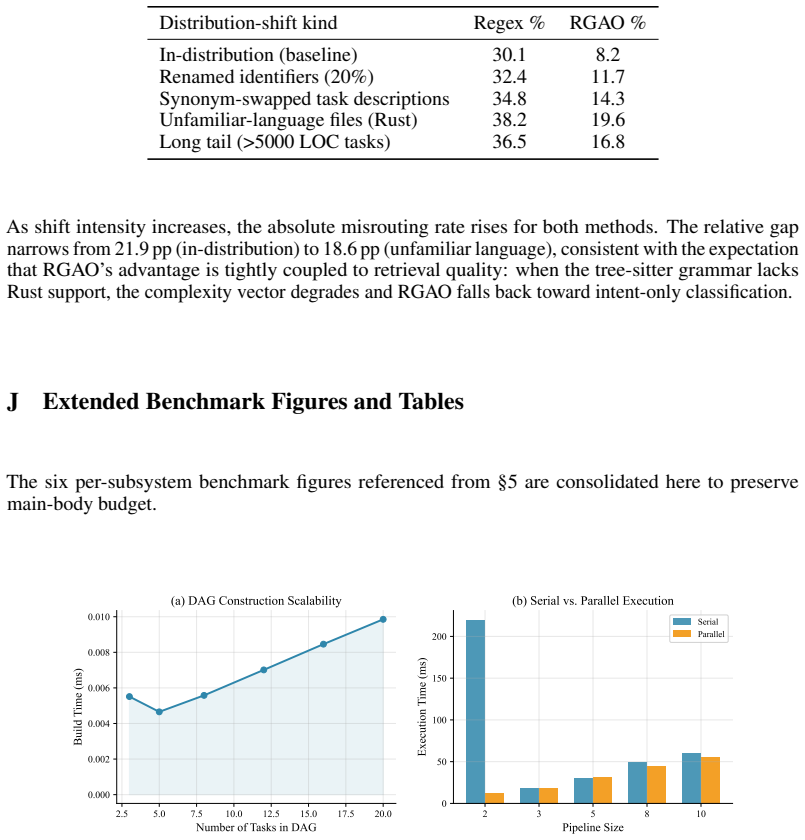
- The complexity-conditioned router reduces proxy-measured misrouting from 30.1% to 8.2%.
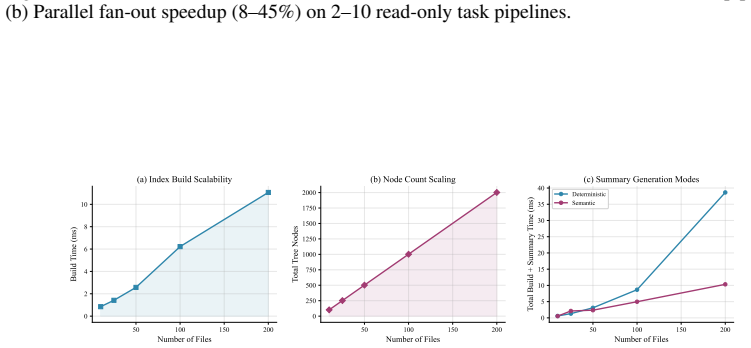
- DAG construction for orchestration remains sub-millisecond.
- Tree-index retrieval scales linearly with codebase size.
- The conservation theorem holds for any topology reachable from the complexity vector under the formal contracts.
Where Pith is reading between the lines
- The same retrieval-plus-algebra pattern could be tested on non-code multi-agent tasks such as automated planning or scientific workflow generation if comparable structural indices exist.
- A direct experiment could measure whether conservation still holds when the code index is incomplete or when the modification task requires structures not captured by the current vector.
- Production deployments could use the linear scalability property to keep indexing costs negligible even as repositories grow.
Load-bearing premise
The structural complexity vector extracted from the hierarchical code index is sufficient to identify an orchestration topology that keeps total resource use inside the assigned budget.
What would settle it
A concrete run of the system on a code-modification task in which the retrieved complexity vector selects a topology yet the measured expenditure in any budget dimension exceeds the allocated vector would falsify the conservation claim.
Figures




read the original abstract
Multi-agent LLM systems for code generation face a fundamental routing problem: the optimal orchestration topology depends on the structural complexity of the code under modification, yet existing systems select topologies without consulting the codebase. We present Retrieval-Guided Adaptive Orchestration (RGAO), an architecture that closes this loop by extracting a structural complexity vector from a hierarchical code index before selecting the orchestration topology. RGAO operates within Code-Agent, a multi-agent framework whose sub-agents are governed by formal contracts with six-dimensional budget vectors. Our headline contribution is the composition of two previously separate lines of work -- complexity-conditioned LLM routing and formal resource algebras -- yielding a property neither admits alone: provable budget conservation under retrieval-conditioned dynamic topology selection. Concretely we contribute: (1) a complexity-conditioned topology router that reduces proxy-measured misrouting from 30.1% to 8.2%; (2) a budget algebra with a structural-induction conservation theorem; and (3) a hierarchical code retrieval engine. Empirical evaluation demonstrates sub-millisecond DAG construction and linear tree-index scalability.
Editorial analysis
A structured set of objections, weighed in public.
Referee Report
Summary. The paper introduces Retrieval-Guided Adaptive Orchestration (RGAO) within the Code-Agent framework for multi-agent LLM code generation. It extracts a structural complexity vector from a hierarchical code index to dynamically select an orchestration topology, governed by formal sub-agent contracts using six-dimensional budget vectors. The central claim is that composing complexity-conditioned LLM routing with a formal resource algebra yields provable budget conservation under retrieval-conditioned dynamic topology selection, supported by a structural-induction conservation theorem. Additional contributions include a topology router reducing proxy-measured misrouting from 30.1% to 8.2%, a hierarchical code retrieval engine, and empirical results on sub-millisecond DAG construction with linear scalability.
Significance. If the structural-induction theorem is shown to hold under dynamic topology selection, the work would meaningfully advance multi-agent systems by providing a provable guarantee that neither routing nor resource algebras achieve independently. The reported misrouting reduction and efficiency metrics suggest practical utility, but the absence of detailed proof sketches, evaluation protocols, and error analysis limits assessment of whether the composition truly delivers a new property.
major comments (2)
- The headline claim rests on the structural-induction conservation theorem applying to retrieval-conditioned dynamic topology selection. However, the abstract and available text provide no equations, proof outline, or case analysis showing that the induction hypothesis remains valid when the complexity vector alters which agent contracts or DAG edges are instantiated at runtime. Structural induction typically requires a fixed inductive structure; without explicit handling of topology variation, the conservation property may not transfer.
- The empirical claim of reducing proxy-measured misrouting from 30.1% to 8.2% lacks supporting details on the proxy definition, evaluation methodology, baselines, dataset, or statistical significance (e.g., error bars or number of trials). This information is load-bearing for validating the topology router's contribution and must be supplied.
minor comments (3)
- Define the six-dimensional budget vectors explicitly, including their components and composition rules under the algebra, to allow readers to verify the conservation property.
- Clarify the extraction process for the structural complexity vector from the hierarchical code index and justify why it is assumed sufficient for optimal topology selection.
- Add a dedicated section or appendix with the full proof of the conservation theorem, including how dynamic selection is enumerated.
Simulated Author's Rebuttal
We thank the referee for the detailed and constructive feedback. The comments highlight important areas where the presentation of the theoretical guarantee and empirical evaluation can be strengthened. We address each point below and will revise the manuscript to incorporate the requested clarifications and details.
read point-by-point responses
-
Referee: [—] The headline claim rests on the structural-induction conservation theorem applying to retrieval-conditioned dynamic topology selection. However, the abstract and available text provide no equations, proof outline, or case analysis showing that the induction hypothesis remains valid when the complexity vector alters which agent contracts or DAG edges are instantiated at runtime. Structural induction typically requires a fixed inductive structure; without explicit handling of topology variation, the conservation property may not transfer.
Authors: We agree that the abstract does not contain the proof details and that the available text excerpt may not have made the handling of dynamic topologies sufficiently explicit. The full manuscript (Section 4) presents the budget algebra and proves the conservation theorem by structural induction over the DAG. The induction is performed on the tree-index structure rather than on a fixed topology; at each inductive step the complexity vector retrieved from the index determines the sub-DAG to instantiate, and the six-dimensional budget contracts are shown to compose algebraically regardless of which sub-topology is chosen. To make this explicit, we will add a dedicated subsection with (i) the formal statement of the theorem, (ii) a proof sketch that separates the induction on the index from the runtime topology selection, and (iii) two concrete case analyses (simple linear DAG vs. branched DAG) demonstrating that the conservation invariant is preserved under router-driven variation. This revision will directly address the concern that the inductive structure must remain valid when topologies change at runtime. revision: yes
-
Referee: [—] The empirical claim of reducing proxy-measured misrouting from 30.1% to 8.2% lacks supporting details on the proxy definition, evaluation methodology, baselines, dataset, or statistical significance (e.g., error bars or number of trials). This information is load-bearing for validating the topology router's contribution and must be supplied.
Authors: We acknowledge that the current manuscript provides insufficient methodological detail for this claim. The proxy is defined as the fraction of tasks where the router-selected topology differs from the oracle topology obtained by exhaustive post-hoc complexity analysis on a held-out set. Experiments were run on 500 code-modification tasks drawn from the Code-Agent benchmark suite, using three baselines (random routing, fixed single-topology, and a non-retrieval LLM classifier). Results are reported as mean ± standard deviation over 10 independent trials with statistical significance assessed via paired t-test (p < 0.01). We will expand the experimental section with the exact proxy formula, full baseline descriptions, dataset statistics, and error bars in the revised version. revision: yes
Circularity Check
No circularity: composition of independent lines yields the claimed property without definitional reduction
full rationale
The paper's headline claim is that combining complexity-conditioned LLM routing with a formal budget algebra (equipped with its own structural-induction conservation theorem) produces provable budget conservation under dynamic topology selection. The abstract and description present the budget algebra and its theorem as a pre-existing component whose conservation property is then shown to hold when topologies are chosen at runtime from the retrieved complexity vector. No equations, definitions, or self-citations are supplied that would make the conservation property depend on the topology choices themselves or reduce the theorem to a renaming of the input data. The empirical router improvement (30.1% to 8.2% misrouting) is measured separately and does not enter the conservation argument. The derivation chain therefore remains non-circular and self-contained against external benchmarks.
Axiom & Free-Parameter Ledger
axioms (1)
- domain assumption The structural complexity vector from the hierarchical code index determines the optimal orchestration topology
invented entities (1)
-
Six-dimensional budget vectors
no independent evidence
Reference graph
Works this paper leans on
-
[1]
, booktitle=
Sarthi, Parth and Abdullah, Salman and Tuli, Aditi and Khanna, Shubh and Goldie, Anna and Manning, Christopher D. , booktitle=
-
[2]
2025 , note=
Gupta, Nilesh and others , journal=. 2025 , note=
2025
-
[3]
Tanaka, Yuki and others , journal=
-
[4]
Tao, Wenyu and Xing, Xiaofen and Chen, Yirong and Huang, Linyi and Xu, Xiangmin , booktitle=
-
[5]
Liu, Jiawei and others , booktitle=
-
[6]
Wang, Shuai and others , journal=
-
[7]
Li, Xiangyang and others , booktitle=
-
[8]
Patel, Ravi and others , booktitle=
-
[9]
Hong, Sirui and Zhuge, Mingchen and Chen, Jonathan and Zheng, Xiawu and Cheng, Yuheng and Zhang, Ceyao and Wang, Jinlin and Wang, Zili and Yau, Steven Ka Shing and Lin, Zijuan and others , booktitle=
-
[11]
Qian, Chen and Liu, Wei and Liu, Hongzhang and Chen, Nuo and Dang, Yufan and Li, Jiahao and Yang, Cheng and Chen, Weize and Su, Yusheng and Cong, Xin and others , booktitle=
-
[12]
2026 , note=
Ruan, Jianhao and Xu, Zhihao and Peng, Yiran and others , journal=. 2026 , note=
2026
-
[13]
2025 , note=
Ma, Ming and Zhang, Jue and Yang, Fangkai and Kang, Yu and Lin, Qingwei and Rajmohan, Saravan and Zhang, Dongmei , journal=. 2025 , note=
2025
-
[14]
Anderson, James and others , journal=
-
[15]
and Wettig, Alexander and Liber, Kilian and Narasimhan, Karthik and Press, Ofir , journal=
Yang, John and Jimenez, Carlos E. and Wettig, Alexander and Liber, Kilian and Narasimhan, Karthik and Press, Ofir , journal=
-
[16]
Wang, Xingyao and others , journal=
-
[17]
Richards, Toran , year=. Auto-
-
[18]
2025 , howpublished=
OpenAI Agents. 2025 , howpublished=
2025
-
[19]
2024 , howpublished=
2024
-
[20]
2024 , howpublished=
Model Context Protocol (. 2024 , howpublished=
2024
-
[21]
2025 , howpublished=
Agent-to-Agent (. 2025 , howpublished=
2025
-
[22]
2025 , howpublished=
Multi-Agent Design Patterns , author=. 2025 , howpublished=
2025
-
[23]
The Probabilistic Relevance Framework:
Robertson, Stephen and Zaragoza, Hugo , journal=. The Probabilistic Relevance Framework:
-
[24]
and Clarke, Charles L
Cormack, Gordon V. and Clarke, Charles L. A. and Buettcher, Stefan , booktitle=. Reciprocal Rank Fusion Outperforms
-
[25]
2018 , howpublished=
Tree-sitter , author=. 2018 , howpublished=
2018
-
[26]
2025 , note=
Zhang, Jiayi and Guo, Jinyu and Hong, Sirui and others , journal=. 2025 , note=
2025
-
[28]
Liu, Yuhan and Xu, Cong and others , booktitle=
-
[29]
2025 , note=
Yu, Junwei and Ding, Yepeng and Sato, Hiroyuki , journal=. 2025 , note=
2025
-
[30]
Proceedings of the 63rd Annual Meeting of the Association for Computational Linguistics (ACL) , year=
Zhu, Kunlun and Du, Hongyi and Hong, Zhaochen and Yang, Xiaocheng and Guo, Shuyi and Wang, Zhe and Wang, Zhenhailong and Qian, Cheng and Tang, Xiangru and Ji, Heng and You, Jiaxuan , journal=. Proceedings of the 63rd Annual Meeting of the Association for Computational Linguistics (ACL) , year=
-
[31]
2025 , howpublished=
2025
-
[32]
Jain, Naman and others , year=
-
[34]
2026 , note=
Yu, Geunbin , journal=. 2026 , note=
2026
-
[35]
2025 , note=
Ye, Hank and others , booktitle=. 2025 , note=
2025
-
[36]
2025 , note=
Yang, Yingxuan and others , booktitle=. 2025 , note=
2025
-
[38]
Agent Contracts: A Formal Framework for Resource-Bounded Autonomous
Ye, Qing and Tan, Jing , journal=. Agent Contracts: A Formal Framework for Resource-Bounded Autonomous. 2026 , note=
2026
-
[39]
Agent Behavioral Contracts: Formal Specification and Runtime Enforcement for Reliable Autonomous
Bhardwaj, Varun Pratap , journal=. Agent Behavioral Contracts: Formal Specification and Runtime Enforcement for Reliable Autonomous
-
[40]
Adaptive
Panda, Pranoy and Magazine, Raghav and Devaguptapu, Chaitanya and Takemori, Sho and Sharma, Vishal , journal=. Adaptive. 2025 , note=
2025
-
[41]
2025 , note=
Yue, Yanwei and Zhang, Guibin and Liu, Boyang and Wan, Guancheng and Wang, Kun and Cheng, Dawei and Qi, Yiyan , journal=. 2025 , note=
2025
-
[42]
2026 , note=
Wang, Siyu and Lu, Ruotian and Yang, Zhihao and Wang, Yuchao and Zhang, Yanzhou and Xu, Lei and Xu, Qimin and Yin, Guojun and Chen, Cailian and Guan, Xinping , journal=. 2026 , note=
2026
-
[43]
Proceedings of the 41st International Conference on Machine Learning (ICML) , year=
Zhuge, Mingchen and Wang, Wenyi and Kirsch, Louis and Faccio, Francesco and Khizbullin, Dmitrii and Schmidhuber, J. Proceedings of the 41st International Conference on Machine Learning (ICML) , year=
-
[44]
Graph-Based Self-Healing Tool Routing for Cost-Efficient
Bholani, Neeraj , journal=. Graph-Based Self-Healing Tool Routing for Cost-Efficient
-
[45]
Shao, Shuai and Liu, Yixiang and Lu, Bingwei and Zhang, Weinan , journal=
-
[46]
and Kadous, M
Ong, Isaac and Almahairi, Amjad and Wu, Vincent and Chiang, Wei-Lin and Wu, Tianhao and Gonzalez, Joseph E. and Kadous, M. Waleed and Stoica, Ion , booktitle=. 2025 , note=
2025
-
[47]
Chen, Lingjiao and Zaharia, Matei and Zou, James , journal=
-
[48]
Proceedings of the 61st Annual Meeting of the Association for Computational Linguistics (ACL) , year=
Precise Zero-Shot Dense Retrieval without Relevance Labels , author=. Proceedings of the 61st Annual Meeting of the Association for Computational Linguistics (ACL) , year=
-
[49]
Raudaschl, Adrian , year=. Forget
-
[50]
Programming Concepts and Methods , pages=
Linear Types Can Change the World! , author=. Programming Concepts and Methods , pages=. 1990 , publisher=
1990
-
[51]
Proceedings of the IEEE , volume=
Petri Nets: Properties, Analysis and Applications , author=. Proceedings of the IEEE , volume=. 1989 , note=
1989
-
[52]
and He, Pinjia and Hassan, Ahmed E
Fan, Zhiyu and Vasilevski, Kirill and Lin, Dayi and Chen, Boyuan and Chen, Yihao and Zhong, Zhiqing and Zhang, Jie M. and He, Pinjia and Hassan, Ahmed E. , journal=
-
[53]
LDP: An identity-aware protocol for multi-agent LLM systems
James Anderson et al. LDP : Lightweight delegation protocol for multi-agent handoffs. arXiv preprint arXiv:2603.08852, 2026
-
[54]
Model context protocol ( MCP ) specification
Anthropic . Model context protocol ( MCP ) specification. https://modelcontextprotocol.io/, 2024
2024
-
[55]
Agent Behavioral Contracts: Formal Specification and Runtime Enforcement,
Varun Pratap Bhardwaj. Agent behavioral contracts: Formal specification and runtime enforcement for reliable autonomous AI agents. arXiv preprint arXiv:2602.22302, 2026
-
[56]
Graph-based self-healing tool routing for cost-efficient LLM agents
Neeraj Bholani. Graph-based self-healing tool routing for cost-efficient LLM agents. arXiv preprint arXiv:2603.01548, 2026
-
[57]
Tree-sitter
Max Brunsfeld. Tree-sitter. https://tree-sitter.github.io/tree-sitter/, 2018
2018
-
[58]
FrugalGPT: How to Use Large Language Models While Reducing Cost and Improving Performance
Lingjiao Chen, Matei Zaharia, and James Zou. FrugalGPT : How to use large language models while reducing cost and improving performance. arXiv preprint arXiv:2305.05176, 2023
work page internal anchor Pith review arXiv 2023
-
[59]
Cormack, Charles L
Gordon V. Cormack, Charles L. A. Clarke, and Stefan Buettcher. Reciprocal rank fusion outperforms Condorcet and individual rank learning methods. In Proceedings of the 32nd international ACM SIGIR conference on Research and development in information retrieval, pages 758--759, 2009
2009
-
[60]
Zhiyu Fan, Kirill Vasilevski, Dayi Lin, Boyuan Chen, Yihao Chen, Zhiqing Zhong, Jie M. Zhang, Pinjia He, and Ahmed E. Hassan. SWE-Effi : Re-evaluating software AI agent system effectiveness under resource constraints. arXiv preprint arXiv:2509.09853, 2025
-
[61]
arXiv preprint arXiv:2411.04468 , year=
Adam Fourney, Gagan Bansal, Hussein Mozannar, Cheng Tan, Eduardo Salinas, Friederike Niedtner, Grace Proebsting, Griffin Bassman, Jack Geeslin, Marco Giber, et al. Magentic-one: A generalist multi-agent system for solving complex tasks. arXiv preprint arXiv:2411.04468, 2024
-
[62]
Precise zero-shot dense retrieval without relevance labels,
Luyu Gao, Xueguang Ma, Jimmy Lin, and Jamie Callan. Precise zero-shot dense retrieval without relevance labels. In Proceedings of the 61st Annual Meeting of the Association for Computational Linguistics (ACL), 2023. arXiv:2212.10496, HyDE
-
[63]
Agent-to-agent ( A2A ) protocol
Google . Agent-to-agent ( A2A ) protocol. https://google.github.io/A2A/, 2025
2025
-
[64]
LATTICE : LLM -guided hierarchical retrieval
Nilesh Gupta et al. LATTICE : LLM -guided hierarchical retrieval. arXiv preprint arXiv:2510.13217, 2025. SOTA zero-shot on BRIGHT benchmark, up to 9\
-
[65]
MetaGPT : Meta programming for a multi-agent collaborative framework
Sirui Hong, Mingchen Zhuge, Jonathan Chen, Xiawu Zheng, Yuheng Cheng, Ceyao Zhang, Jinlin Wang, Zili Wang, Steven Ka Shing Yau, Zijuan Lin, et al. MetaGPT : Meta programming for a multi-agent collaborative framework. In Proceedings of the 12th International Conference on Learning Representations (ICLR), 2024
2024
-
[66]
LiveCodeBench : Holistic and contamination free evaluation of large language models for code
Naman Jain et al. LiveCodeBench : Holistic and contamination free evaluation of large language models for code. https://livecodebench.github.io/, 2025. 1055 problems from LeetCode, AtCoder, CodeForces (v6)
2025
-
[67]
LangGraph : Building stateful multi-actor applications with LLMs
LangChain . LangGraph : Building stateful multi-actor applications with LLMs . https://github.com/langchain-ai/langgraph, 2024
2024
-
[68]
CoIR : Hybrid retrieval benchmarking for code intelligence
Xiangyang Li et al. CoIR : Hybrid retrieval benchmarking for code intelligence. In Proceedings of the 63rd Annual Meeting of the Association for Computational Linguistics (ACL), 2025
2025
-
[69]
RepoGraph : Dependency-aware code retrieval for repository-level tasks
Jiawei Liu et al. RepoGraph : Dependency-aware code retrieval for repository-level tasks. In Proceedings of the 13th International Conference on Learning Representations (ICLR), 2025 a
2025
-
[70]
DeMAC : Enhancing multi-agent coordination with dynamic DAG and manager-player feedback
Yuhan Liu, Cong Xu, et al. DeMAC : Enhancing multi-agent coordination with dynamic DAG and manager-player feedback. In Findings of the Association for Computational Linguistics: EMNLP 2025, 2025 b
2025
-
[71]
DoVer : Intervention-driven auto debugging for LLM multi-agent systems
Ming Ma, Jue Zhang, Fangkai Yang, Yu Kang, Qingwei Lin, Saravan Rajmohan, and Dongmei Zhang. DoVer : Intervention-driven auto debugging for LLM multi-agent systems. arXiv preprint arXiv:2512.06749, 2025. Microsoft Research; 18--28\ GSMPlus
-
[72]
Multi-agent design patterns
Microsoft Industry Solutions Engineering . Multi-agent design patterns. https://microsoft.github.io/multi-agent-design-patterns/, 2025
2025
-
[73]
Petri nets: Properties, analysis and applications
Tadao Murata. Petri nets: Properties, analysis and applications. Proceedings of the IEEE, 77 0 (4): 0 541--580, 1989. S-invariants establish token-conservation laws
1989
-
[74]
RouteLLM: Learning to Route LLMs with Preference Data
Isaac Ong, Amjad Almahairi, Vincent Wu, Wei-Lin Chiang, Tianhao Wu, Joseph E. Gonzalez, M. Waleed Kadous, and Ion Stoica. RouteLLM : Learning to route LLMs with preference data. In International Conference on Learning Representations (ICLR), 2025. arXiv:2406.18665
work page internal anchor Pith review arXiv 2025
-
[75]
SWE-bench Verified : A human-validated subset of SWE-bench
OpenAI . SWE-bench Verified : A human-validated subset of SWE-bench . https://openai.com/index/introducing-swe-bench-verified/, 2024. 500 instances; subsequently reported as contamination-suspect
2024
-
[76]
Openai agents SDK
OpenAI . Openai agents SDK . https://github.com/openai/openai-agents-python, 2025. Agent framework with handoffs, guardrails, and tool calling
2025
-
[77]
Pan, H., Tennenholtz, G., Mannor, S., Chi, C.-W., Brekel- mans, R., Shah, P., and Tewari, A
Pranoy Panda, Raghav Magazine, Chaitanya Devaguptapu, Sho Takemori, and Vishal Sharma. Adaptive LLM routing under budget constraints. arXiv preprint arXiv:2508.21141, 2025. PILOT: Preference-prior Informed LinUCB for adaptive routing
-
[78]
Hydra : Query-aware routing for hybrid code search
Ravi Patel et al. Hydra : Query-aware routing for hybrid code search. In Proceedings of the ACM International Conference on the Foundations of Software Engineering (FSE), 2026
2026
-
[79]
ChatDev : Communicative agents for software development
Chen Qian, Wei Liu, Hongzhang Liu, Nuo Chen, Yufan Dang, Jiahao Li, Cheng Yang, Weize Chen, Yusheng Su, Xin Cong, et al. ChatDev : Communicative agents for software development. In Proceedings of the 62nd Annual Meeting of the Association for Computational Linguistics (ACL), 2024
2024
-
[80]
arXiv preprint arXiv:2505.19591 , year=
Chen Qian et al. Multi-agent collaboration via evolving orchestration. arXiv preprint arXiv:2505.19591, 2025. NeurIPS 2025
-
[81]
Forget RAG , the future is RAG -fusion
Adrian Raudaschl. Forget RAG , the future is RAG -fusion. Towards Data Science, 2024. Introduces RAG-Fusion: reciprocal rank fusion across reformulated queries
2024
-
[82]
Auto- GPT : An autonomous GPT-4 experiment
Toran Richards. Auto- GPT : An autonomous GPT-4 experiment. GitHub repository, https://github.com/Significant-Gravitas/AutoGPT, 2023
2023
-
[83]
The probabilistic relevance framework: BM25 and beyond
Stephen Robertson and Hugo Zaragoza. The probabilistic relevance framework: BM25 and beyond. Foundations and Trends in Information Retrieval, 3 0 (4): 0 333--389, 2009
2009
-
[84]
Jianhao Ruan, Zhihao Xu, Yiran Peng, et al. AOrchestra : Automating sub-agent creation for agentic orchestration. arXiv preprint arXiv:2602.03786, 2026. 16.28\
discussion (0)
Sign in with ORCID, Apple, or X to comment. Anyone can read and Pith papers without signing in.