Recognition: unknown
A Temporal Retrieval Method for Modulated Electron Bunches via Adaptive Kernel Reconstruction
Pith reviewed 2026-05-08 03:22 UTC · model grok-4.3
The pith
A new algorithm reconstructs the time profile of complex modulated electron bunches by splitting their radiation spectrum into an adaptive high-frequency kernel and a low-frequency basis envelope.
A machine-rendered reading of the paper's core claim, the machinery that carries it, and where it could break.
Core claim
By deriving a temporal kernel directly from the inverse sampling of the measured coherent transition radiation spectrum and combining it with a low-frequency envelope formed by basis functions, the algorithm reconstructs the full temporal current profile of complex modulated electron bunch trains and recovers the signals with higher fidelity than the Kramers-Kronig reconstruction on both multi-Gaussian and bunching-enhanced coherent harmonic generation test cases.
What carries the argument
Adaptive kernel reconstruction that isolates the high-frequency component via inverse sampling of the spectrum while fitting the low-frequency envelope to basis functions.
If this is right
- The method supplies temporal evidence for proposed electron-beam modulation schemes in XFEL and plasma accelerator designs.
- It extends the usable range of coherent transition radiation diagnostics to bunch trains with more intricate temporal structure than previously accessible.
- Improved reconstruction accuracy reduces the uncertainty in verifying bunching-enhanced coherent harmonic generation processes.
- The separation approach may be adapted to other radiation-based diagnostics that face similar frequency-band limitations.
Where Pith is reading between the lines
- If the kernel remains robust under experimental noise, the technique could support real-time feedback loops in accelerator control systems.
- The same high-low frequency split might be tested on coherent synchrotron radiation spectra to see whether the performance gain over Kramers-Kronig persists outside transition radiation.
- A controlled experiment that deliberately introduces known calibration errors or partial phase information would quantify the practical margin of safety around the central separation assumption.
Load-bearing premise
The separation of the spectrum into a stable high-frequency kernel and a low-frequency basis-function envelope continues to hold when real data contain noise, calibration offsets, and unknown phase information.
What would settle it
A direct comparison in which the algorithm is applied to measured coherent transition radiation spectra from a known, independently diagnosed modulated bunch train that includes realistic detector noise and phase uncertainty; large deviations between the reconstructed and measured profiles would falsify the claim.
Figures


read the original abstract
Femtosecond electron beams with complex modulation play a crucial role in applications such as X-ray Free Electron Lasers (XFELs) and plasma wakefield accelerators. However, diagnostics for the electron beam current profile still face challenges with complex structure. In this letter, we propose a novel temporal retrieval algorithm for the coherent transition radiation (CTR) diagnostics of complex modulated electron beams. Starting from the time-frequency analysis of the electron bunch train, the algorithm separates and reconstructs the high- and low-frequency components. A temporal kernel was derived from the inverse sampling of the measured spectrum to construct the high-frequency component, while the low-frequency envelope was composed of several basis functions. Tested on the electron bunch trains from the complex multi-gaussian model and bunching-enhanced coherent harmonic generation, the algorithm successfully reconstructed the temporal signals and achieves better performance than the Kramers-Kronig method. This method is expected to crucial provide temporal evidence for potential electron beam modulation schemes, and will enable broad prospects for future applications.
Editorial analysis
A structured set of objections, weighed in public.
Referee Report
Summary. The manuscript proposes a novel temporal retrieval algorithm for diagnosing complex modulated electron bunches via coherent transition radiation (CTR) spectra. It performs time-frequency analysis to separate high- and low-frequency components: a high-frequency temporal kernel is constructed by inverse sampling of the measured spectrum, while the low-frequency envelope is formed from a small set of basis functions. The method is tested on two simulated electron bunch trains (a complex multi-Gaussian model and a bunching-enhanced coherent harmonic generation case), where it is reported to reconstruct the temporal profiles successfully and with better performance than the Kramers-Kronig method.
Significance. If the reconstruction proves stable under realistic conditions, the approach could provide a valuable alternative for extracting temporal structure from spectral diagnostics in XFELs and plasma wakefield accelerators, where complex modulations are important. A strength is the reliance on external simulation benchmarks rather than self-referential fitting. However, the current evidence base is narrow, consisting only of noise-free simulations without reported quantitative metrics, so the practical significance cannot yet be assessed.
major comments (2)
- [Numerical tests / results] The central claim of successful reconstruction and superior performance versus Kramers-Kronig rests on the two simulated test cases, yet the manuscript provides no quantitative error metrics (e.g., RMS deviation, L2 norm, or cross-correlation with ground truth) for either the complex multi-Gaussian or bunching-enhanced CHG reconstructions.
- [Method / algorithm description] The core decomposition into a high-frequency kernel (inverse-sampled from the spectrum) and low-frequency basis-function envelope is load-bearing for the algorithm, but no analysis or additional simulations are presented to test its stability when the input spectrum contains additive noise, calibration offsets, or missing phase information typical of experimental CTR data.
minor comments (1)
- [Abstract] The abstract contains a grammatical error in the final sentence ('expected to crucial provide temporal evidence'); this should be corrected to 'expected to provide crucial temporal evidence' for clarity.
Simulated Author's Rebuttal
We thank the referee for the constructive and detailed comments on our manuscript. We agree that quantitative metrics are needed to strengthen the claims and will incorporate them in the revision. Regarding robustness, we acknowledge the current limitation to ideal simulations and will add discussion and limited testing to address experimental realism, while noting that full validation remains future work.
read point-by-point responses
-
Referee: The central claim of successful reconstruction and superior performance versus Kramers-Kronig rests on the two simulated test cases, yet the manuscript provides no quantitative error metrics (e.g., RMS deviation, L2 norm, or cross-correlation with ground truth) for either the complex multi-Gaussian or bunching-enhanced CHG reconstructions.
Authors: We agree that the absence of quantitative metrics limits the rigor of the performance claims. The current manuscript relies primarily on visual comparisons of the reconstructed profiles. In the revised version, we will compute and report root-mean-square error (RMSE), L2-norm differences, and cross-correlation coefficients between the reconstructed temporal profiles and the known ground truth for both the multi-Gaussian and bunching-enhanced CHG cases. These same metrics will be applied to the Kramers-Kronig results to provide an objective, quantitative demonstration of the improvement. revision: yes
-
Referee: The core decomposition into a high-frequency kernel (inverse-sampled from the spectrum) and low-frequency basis-function envelope is load-bearing for the algorithm, but no analysis or additional simulations are presented to test its stability when the input spectrum contains additive noise, calibration offsets, or missing phase information typical of experimental CTR data.
Authors: The referee is correct that the presented results use only noise-free spectra. This was intentional to isolate and demonstrate the algorithm's core capability on complex modulations. We will revise the manuscript to include a dedicated discussion of how additive noise and calibration offsets would propagate through the high-frequency kernel construction and the low-frequency basis-function fit. In addition, we will add one illustrative simulation with moderate Gaussian noise applied to the spectrum of the multi-Gaussian case to show the method's qualitative behavior under realistic conditions. A comprehensive parametric study of all experimental imperfections is beyond the scope of this letter but will be noted as important future work. revision: partial
Circularity Check
No significant circularity; reconstruction validated on independent simulations
full rationale
The paper's method derives a high-frequency temporal kernel directly from inverse sampling of the input spectrum and composes the low-frequency envelope from a small set of basis functions. This produces a reconstructed temporal profile that is then compared against known ground-truth bunch trains in two external simulation models (complex multi-Gaussian and bunching-enhanced CHG). Because the test cases supply independent temporal truth data outside the reconstruction step itself, the reported success and performance advantage versus Kramers-Kronig are not forced by construction. No equations, fitted parameters, or self-citations are shown that would make the output tautological with the measured spectrum. The derivation chain therefore remains self-contained against the provided benchmarks.
Axiom & Free-Parameter Ledger
Reference graph
Works this paper leans on
-
[1]
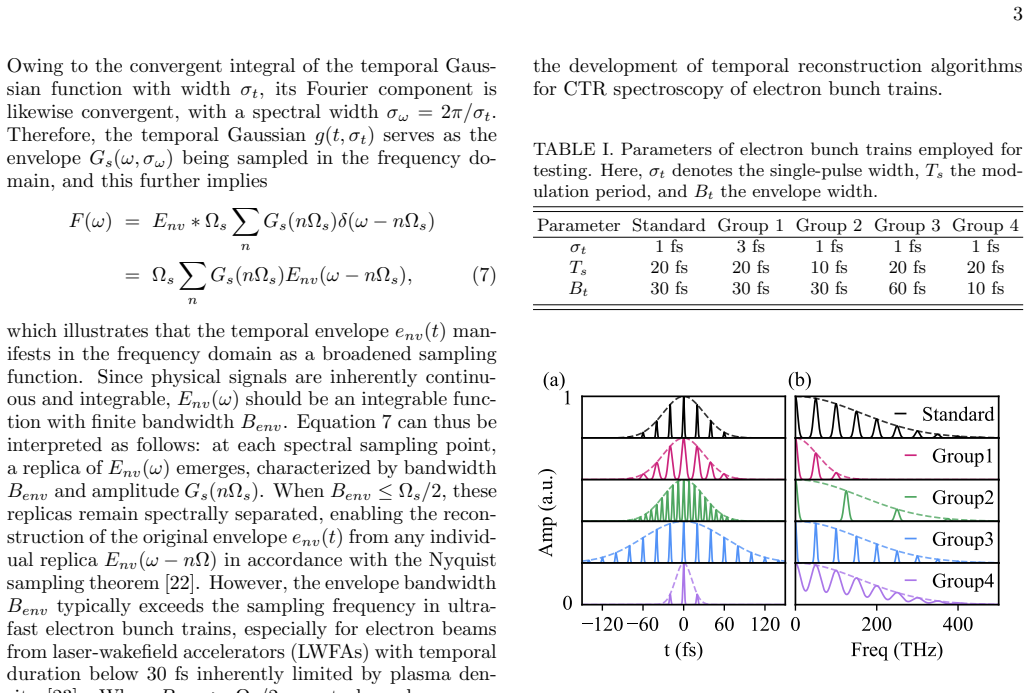
8 F(ω) = Ω s X n exp − n2Ω2 s 2σ2ω exp " −(ω−nΩ s)2 2B2ω # .(9) The corresponding spectra are plotted in Fig
The corresponding spectral representation is obtained via the Fourier transform of Eq. 8 F(ω) = Ω s X n exp − n2Ω2 s 2σ2ω exp " −(ω−nΩ s)2 2B2ω # .(9) The corresponding spectra are plotted in Fig. 1(b) af- ter retaining only the positive-frequency components. The duality properties discussed above are easily dis- cernible from these spectra, offering valu...
-
[2]
L.-H. Yu, M. Babzien, I. Ben-Zvi, L. F. DiMauro, A. Doyuran, W. Graves, E. Johnson, S. Krinsky, R. Mal- one, I. Pogorelsky, J. Skaritka, G. Rakowsky, L. Solomon, X. J. Wang, M. Woodle, V. Yakimenko, S. G. Biedron, J. N. Galayda, E. Gluskin, J. Jagger, V. Sajaev, and I. Vasserman, High-gain harmonic-generation free- electron laser, Science289, 932 (2000)
2000
-
[3]
J. M. J. Madey, H. A. Schwettman, and W. M. Fairbank, A free electron laser, IEEE Transactions on Nuclear Sci- ence20, 980 (1973)
1973
-
[4]
Morimoto and P
Y. Morimoto and P. Baum, Diffraction and microscopy with attosecond electron pulse trains, Nature Physics14, 252 (2018)
2018
-
[5]
Nabben, J
D. Nabben, J. Kuttruff, L. Stolz, A. Ryabov, and P. Baum, Attosecond electron microscopy of sub-cycle optical dynamics, Nature619, 63 (2023)
2023
-
[6]
M. C. Downer, R. Zgadzaj, A. Debus, U. Schramm, and M. C. Kaluza, Diagnostics for plasma-based electron ac- celerators, Rev. Mod. Phys.90, 035002 (2018)
2018
-
[7]
Alesini and F
D. Alesini and F. Marcellini, rf deflector design of the clic test facility ctf3 delay loop and beam loading effect analysis, Phys. Rev. ST Accel. Beams12, 031301 (2009)
2009
-
[8]
R. Akre, L. Bentson, P. Emma, and P. Krejcik, A trans- verse rf deflecting structure for bunch length and phase space diagnostics, inPACS2001. Proceedings of the 2001 Particle Accelerator Conference (Cat. No.01CH37268), Vol. 3 (2001) pp. 2353–2355 vol.3
2001
-
[9]
Castellano, V
M. Castellano, V. A. Verzilov, L. Catani, A. Cianchi, G. Orlandi, and M. Geitz, Measurements of coherent diffraction radiation and its application for bunch length diagnostics in particle accelerators, Phys. Rev. E63, 056501 (2001)
2001
-
[10]
Kung, H.-c
P. Kung, H.-c. Lihn, H. Wiedemann, and D. Bocek, Gen- eration and measurement of 50-fs (rms) electron pulses, Phys. Rev. Lett.73, 967 (1994)
1994
-
[11]
B. E. Billinghurst, J. C. Bergstrom, C. Baribeau, T. Bat- ten, T. E. May, J. M. Vogt, and W. A. Wurtz, Longitu- dinal bunch dynamics study with coherent synchrotron radiation, Phys. Rev. Accel. Beams19, 020704 (2016)
2016
-
[12]
I. M. Frank, Transition radiation and optical properties of matter, Soviet Physics Uspekhi8, 729 (1966)
1966
-
[13]
C. B. Schroeder, E. Esarey, J. van Tilborg, and W. P. Leemans, Theory of coherent transition radiation gen- erated at a plasma-vacuum interface, Phys. Rev. E69, 016501 (2004)
2004
-
[14]
Lundh, C
O. Lundh, C. Rechatin, J. Lim, V. Malka, and J. Faure, Experimental measurements of electron-bunch trains in a laser-plasma accelerator, Phys. Rev. Lett.110, 065005 (2013)
2013
-
[15]
Heigoldt, A
M. Heigoldt, A. Popp, K. Khrennikov, J. Wenz, S. W. Chou, S. Karsch, S. I. Bajlekov, S. M. Hooker, and B. Schmidt, Temporal evolution of longitudinal bunch profile in a laser wakefield accelerator, Phys. Rev. ST Accel. Beams18, 121302 (2015). 8
2015
-
[16]
LaBerge, B
M. LaBerge, B. Bowers, Y.-Y. Chang, J. C. Cabada` g, A. Debus, A. Hannasch, R. Pausch, S. Sch¨ obel, J. Tiebel, P. Ufer, A. Willmann, O. Zarini, R. Zgadzaj, A. H. Lumpkin, U. Schramm, A. Irman, and M. C. Downer, Re- vealing the three-dimensional structure of microbunched plasma-wakefield-accelerated electron beams, Nature Photonics18, 952 (2024)
2024
-
[17]
Lai and A
R. Lai and A. J. Sievers, Phase problem associated with the determination of the longitudinal shape of a charged particle bunch from its coherent far-ir spectrum, Phys. Rev. E52, 4576 (1995)
1995
-
[18]
Lai and A
R. Lai and A. Sievers, On using the coherent far ir radia- tion produced by a charged-particle bunch to determine its shape: I analysis, Nuclear Instruments and Meth- ods in Physics Research Section A: Accelerators, Spec- trometers, Detectors and Associated Equipment397, 221 (1997)
1997
-
[19]
S. I. Bajlekov, M. Heigoldt, A. Popp, J. Wenz, K. Khren- nikov, S. Karsch, and S. M. Hooker, Longitudinal elec- tron bunch profile reconstruction by performing phase retrieval on coherent transition radiation spectra, Phys. Rev. ST Accel. Beams16, 040701 (2013)
2013
-
[20]
Bakkali Taheri, I
F. Bakkali Taheri, I. V. Konoplev, G. Doucas, P. Bad- doo, R. Bartolini, J. Cowley, and S. M. Hooker, Electron bunch profile reconstruction based on phase-constrained iterative algorithm, Phys. Rev. Accel. Beams19, 032801 (2016). [20]2018 IEEE Advanced Accelerator Concepts Workshop (AAC)(2018)
2016
-
[21]
K. Feng, K. Jiang, R. Hu, S. Luan, W. Wang, and R. Li, Bunching enhancement for coherent harmonic generation by using phase merging effects, Matter and Radiation at Extremes9, 057201 (2024)
2024
-
[22]
A. V. Oppenheim, A. S. Willsky, and S. H. Nawab, Sam- pling, inSignals and Systems(Prentice Hall, Upper Sad- dle River, NJ, 1996) 2nd ed., Chap. 8, pp. 514–521
1996
-
[23]
Esarey, C
E. Esarey, C. B. Schroeder, and W. P. Leemans, Physics of laser-driven plasma-based electron accelerators, Rev. Mod. Phys.81, 1229 (2009)
2009
-
[24]
Shechtman, A
Y. Shechtman, A. Beck, and Y. C. Eldar, Gespar: Effi- cient phase retrieval of sparse signals, IEEE Transactions on Signal Processing62, 928 (2014)
2014
-
[25]
Q. Q. Su, J. F. Hua, Z. Nie, Y. Ma, S. Liu, Y. F. Zheng, C.-H. Pai, and W. Lu, Temporal diagnostics of femtosecond electron bunches with complex structures using sparsity-based algorithm, Phys. Rev. Accel. Beams 21, 112801 (2018)
2018
-
[26]
Butterworth, On the theory of filter amplifiers, wireless engineer (1929)
S. Butterworth, On the theory of filter amplifiers, wireless engineer (1929)
1929
discussion (0)
Sign in with ORCID, Apple, or X to comment. Anyone can read and Pith papers without signing in.