Recognition: unknown
Comparative Analysis of Direct-to-Cell (D2C) and 3GPP Non-Terrestrial Networks (NTN) for Global Connectivity
Pith reviewed 2026-05-08 05:06 UTC · model grok-4.3
The pith
D2C enables fast satellite access with existing phones, but NTN delivers superior performance, security and scalability as the base for 6G global networks.
A machine-rendered reading of the paper's core claim, the machinery that carries it, and where it could break.
Core claim
Direct-to-Cell (D2C) enables rapid market entry through legacy-device compatibility and existing terrestrial spectrum as a market-driven overlay for emergency connectivity. In contrast, 3GPP Non-Terrestrial Networks (NTN), standardized across Releases 17-19, offers a systematic satellite-native framework for long-term scalability, high-throughput broadband, and deep integration with terrestrial 5G/6G networks. The comparative analysis of standardization trajectories, network architectures, physical-layer innovations, security postures, and operational trade-offs shows that NTN provides superior performance, security, and scalability. This positions NTN as the foundational framework for 6G卫星-
What carries the argument
Side-by-side comparison of D2C and 3GPP NTN across architectures, physical layer, security, and trade-offs, applied to 6G scenarios such as autonomous driving redundancy.
If this is right
- NTN serves as the main structure for satellite-terrestrial integration in 6G networks.
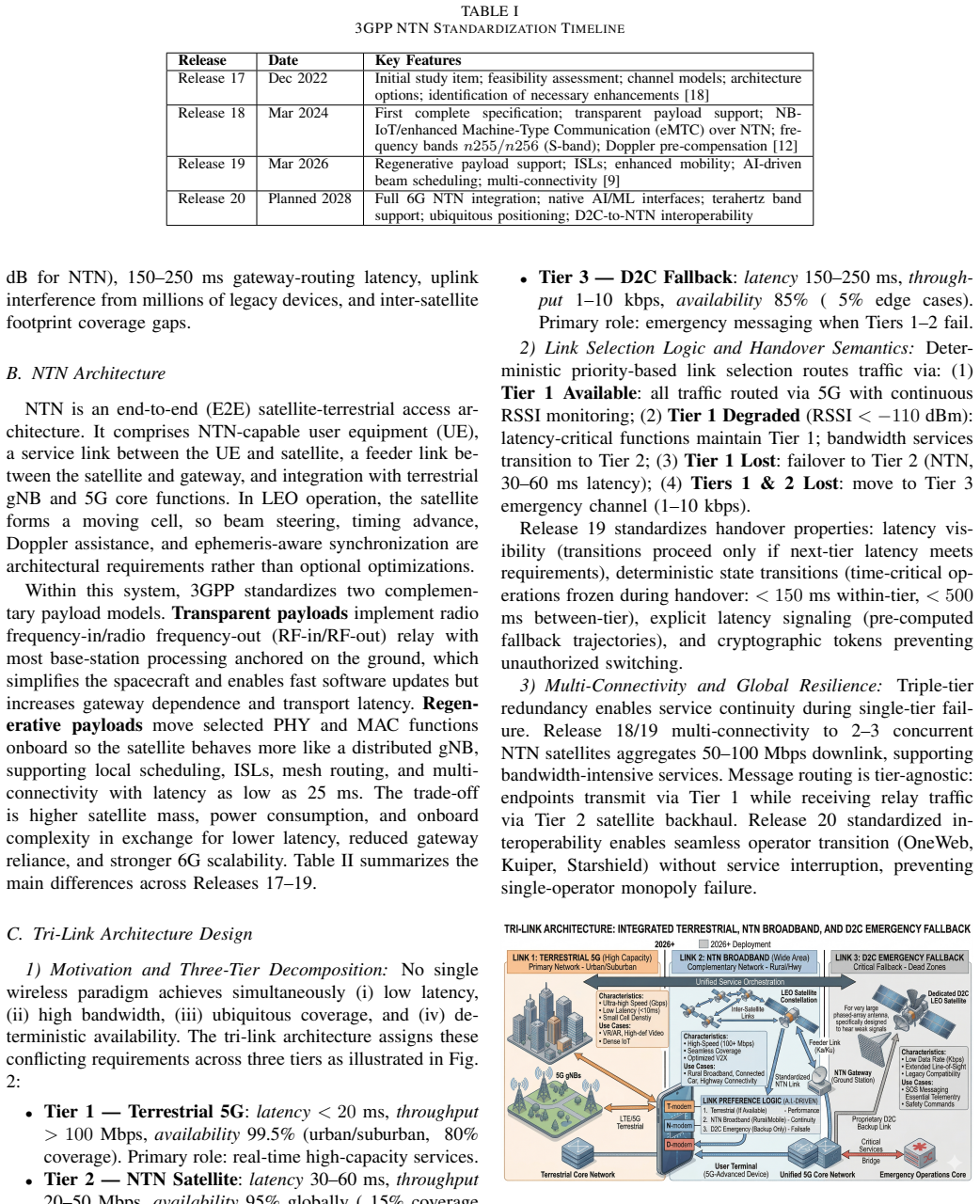
- Autonomous driving gains safety redundancy from a tri-link setup using terrestrial 5G, NTN broadband, and D2C fallback.
- D2C fits initial emergency coverage but cannot support high-throughput broadband needs.
- Standardized NTN achieves better security and growth potential than non-standard D2C approaches.
Where Pith is reading between the lines
- Network operators could deploy D2C first to fill immediate gaps while building out full NTN infrastructure for higher capacity.
- Real-world trials of the hybrid tri-link model in autonomous vehicle fleets would test the claimed redundancy benefits.
- Industry standards bodies might accelerate NTN adoption to reduce reliance on proprietary satellite solutions.
Load-bearing premise
The qualitative differences identified in architectures, physical layer, and security will produce corresponding real-world advantages in performance and scalability without quantitative data or field measurements.
What would settle it
A controlled side-by-side deployment or simulation that measures throughput, latency, coverage consistency, and security metrics for both D2C and NTN under matching remote-area conditions.
Figures

read the original abstract
The quest for ubiquitous mobile coverage has catalyzed two fundamentally distinct architectural paradigms: Direct-to-Cell (D2C) and standardized 3GPP Non-Terrestrial Networks (NTN). D2C, pioneered by SpaceX Starlink and AST SpaceMobile, leverages existing terrestrial spectrum and unmodified consumer handsets to provide emergency connectivity as a market-driven overlay. In contrast, 3GPP NTN, standardized across Releases 17-19, offers a systematic satellite-native framework designed for long-term scalability, high-throughput broadband, and deep integration with terrestrial 5G/6G networks. This paper presents a comprehensive technical comparison of these approaches, analyzing their standardization trajectories, network architectures, physical-layer innovations, security postures, and operational trade-offs. We further examine their implications for emerging 6G use cases, particularly autonomous driving, where safety-critical redundancy motivates a hybrid tri-link architecture combining terrestrial 5G, NTN broadband, and D2C emergency fallback. Our analysis shows that, although D2C enables rapid market entry through legacy-device compatibility, NTN provides superior performance, security, and scalability, positioning it as the foundational framework for 6G satellite-terrestrial convergence. A hybrid model that combines the strengths of both paradigms is identified as the most practical path toward truly global connectivity.
Editorial analysis
A structured set of objections, weighed in public.
Referee Report
Summary. The manuscript conducts a comparative analysis of Direct-to-Cell (D2C) satellite connectivity, as exemplified by Starlink and AST SpaceMobile, and the 3GPP-standardized Non-Terrestrial Networks (NTN) from Releases 17-19. It examines standardization paths, network architectures, physical-layer techniques, security mechanisms, and operational trade-offs. The paper discusses implications for 6G applications such as autonomous driving, proposing a hybrid architecture combining terrestrial 5G, NTN, and D2C. It concludes that while D2C facilitates rapid deployment using existing devices, NTN offers superior performance, security, and scalability, serving as the core for future satellite-terrestrial integration, with a hybrid approach being optimal for global connectivity.
Significance. If substantiated, the work would provide a useful overview of competing satellite connectivity paradigms for global coverage and 6G convergence, highlighting practical trade-offs between rapid-deployment overlays and standardized frameworks. The hybrid model suggestion for safety-critical uses like autonomous driving could inform system design discussions.
major comments (3)
- [Abstract] Abstract: The assertion that NTN 'provides superior performance, security, and scalability' and is the 'foundational framework' rests entirely on qualitative enumeration of standards and architectural features. No link-level or system-level simulations, throughput/latency/outage metrics, security overhead calculations, or parameter sweeps under common channel models (e.g., 3GPP NTN Doppler/attenuation vs. D2C assumptions) are presented to support measurable advantages.
- [Physical-layer innovations and operational trade-offs sections] Physical-layer innovations and operational trade-offs sections: The comparative discussion of PHY techniques and trade-offs contains no quantitative evaluation (e.g., no BER curves, capacity bounds, or outage probability analysis) that would allow verification of the claimed performance deltas between D2C and NTN.
- [Security postures section] Security postures section: Superior security for NTN is stated without any overhead calculations, attack surface comparisons, or analysis of authentication latency under satellite delays, leaving the claim unsupported by evidence.
minor comments (2)
- A summary table comparing key parameters (spectrum allocation, device compatibility, standardization timeline, and integration approach) would improve clarity and allow readers to quickly reference the enumerated differences.
- [6G use cases section] The hybrid tri-link architecture for autonomous driving is introduced conceptually; a block diagram or flowchart illustrating the fallback logic and redundancy mechanisms would aid comprehension.
Simulated Author's Rebuttal
We thank the referee for the constructive comments. The manuscript is a qualitative comparative analysis of D2C and NTN based on standardization, architectures, and high-level trade-offs. We have revised the abstract and relevant sections to qualify all claims, removing unsubstantiated assertions of measurable superiority.
read point-by-point responses
-
Referee: [Abstract] The assertion that NTN 'provides superior performance, security, and scalability' and is the 'foundational framework' rests entirely on qualitative enumeration of standards and architectural features. No link-level or system-level simulations, throughput/latency/outage metrics, security overhead calculations, or parameter sweeps under common channel models (e.g., 3GPP NTN Doppler/attenuation vs. D2C assumptions) are presented to support measurable advantages.
Authors: We agree that the original abstract phrasing implied measurable advantages without supporting quantitative data. The paper's scope is a standards-driven comparison of deployment speed, integration potential, and architectural features rather than a performance benchmarking study. We have revised the abstract to state that NTN provides a standardized framework positioned for long-term scalability and integration with 5G/6G, while D2C enables rapid deployment with legacy devices. The hybrid model is now presented as the recommended path without claiming unverified superiority. revision: yes
-
Referee: [Physical-layer innovations and operational trade-offs sections] The comparative discussion of PHY techniques and trade-offs contains no quantitative evaluation (e.g., no BER curves, capacity bounds, or outage probability analysis) that would allow verification of the claimed performance deltas between D2C and NTN.
Authors: The physical-layer discussion contrasts D2C's reuse of terrestrial waveforms against NTN's satellite-specific adaptations (e.g., Doppler compensation and timing advance per 3GPP Rel-17). We have revised the section to frame these strictly as design trade-offs drawn from standards documents and literature, without any performance delta claims or verification metrics. We explicitly note that quantitative evaluations such as BER curves would require dedicated link-level simulations outside the current overview scope. revision: yes
-
Referee: [Security postures section] Superior security for NTN is stated without any overhead calculations, attack surface comparisons, or analysis of authentication latency under satellite delays, leaving the claim unsupported by evidence.
Authors: We have revised the security section to describe NTN's use of the integrated 3GPP 5G security architecture (mutual authentication, key hierarchy) versus D2C's dependence on terrestrial mechanisms. All language asserting 'superior security' has been removed and replaced with neutral descriptions of protocol differences. No overhead or latency calculations are added, as these would require specific modeling and attack analysis not performed in the manuscript. revision: yes
Circularity Check
No Significant Circularity in Descriptive Qualitative Comparison
full rationale
The paper is a purely descriptive comparative analysis of D2C and 3GPP NTN architectures, standardization trajectories, physical-layer features, security postures, and trade-offs. It contains no equations, derivations, fitted parameters, predictions, or first-principles results that could reduce to inputs by construction. Central claims about NTN superiority and hybrid models follow from enumeration of external standards and qualitative feature lists rather than any self-referential loop, self-citation load-bearing premise, or ansatz smuggling. The analysis is self-contained against external benchmarks with no circular steps.
Axiom & Free-Parameter Ledger
axioms (1)
- domain assumption NTN's standardized framework inherently provides superior scalability and security compared to market-driven D2C overlays.
Reference graph
Works this paper leans on
-
[1]
Global mobile broadband coverage gap analysis,
GSMA, “Global mobile broadband coverage gap analysis,” GSMA Intelligence Report, 2024
2024
-
[2]
Global connectivity gap: Rural and remote area coverage analysis,
World Bank, “Global connectivity gap: Rural and remote area coverage analysis,” World Bank Technical Report, 2024
2024
-
[3]
‘connecting the unconnected’: a critical assessment of us satellite internet services,
M. Graydon and L. Parks, “‘connecting the unconnected’: a critical assessment of us satellite internet services,”Media, Culture & Society, vol. 42, no. 2, pp. 260–276, 2020
2020
-
[4]
An investigation on satellite internet: architecture, operation modes, and key technologies,
L. Sun, “An investigation on satellite internet: architecture, operation modes, and key technologies,” inFourth International Conference on Computer Technology, Information Engineering, and Electron Materials (CTIEEM 2024), vol. 13561. SPIE, 2025, pp. 7–13
2024
-
[5]
6g wireless communication systems: Applications, requirements, technolo- gies, challenges, and research directions,
M. Z. Chowdhury, M. Shahjalal, S. Ahmed, and Y . M. Jang, “6g wireless communication systems: Applications, requirements, technolo- gies, challenges, and research directions,”IEEE Open Journal of the Communications Society, vol. 1, pp. 957–975, 2020
2020
-
[6]
Toward 6g networks: Use cases and technologies,
M. Giordani, M. Polese, M. Mezzavilla, S. Numeroso, R. Riggio, and M. Zorzi, “Toward 6g networks: Use cases and technologies,”IEEE Communications Magazine, vol. 58, pp. 55–61, 2020
2020
-
[7]
Direct-to-cell technical specifications and ser- vice agreement,
SpaceX and T-Mobile, “Direct-to-cell technical specifications and ser- vice agreement,” FCC Filing WT Docket 24-55, 2024
2024
-
[8]
Bluewalker 3: Cellular connectivity from space,
AST SpaceMobile, “Bluewalker 3: Cellular connectivity from space,” Company Technical Overview, 2024. [Online]. Available: https: //www.ast-science.com
2024
-
[9]
Nr; nr and ng-ran overall description; stage 2,
3GPP, “Nr; nr and ng-ran overall description; stage 2,” 3rd Generation Partnership Project, Tech. Rep. TS 38.300 V19.0.0, 2026
2026
-
[10]
Mimo satellite communication systems: A survey from the phy layer perspective,
J. Heo, S. Sung, H. Lee, I. Hwang, and D. Hong, “Mimo satellite communication systems: A survey from the phy layer perspective,”IEEE Communications Surveys & Tutorials, vol. 25, no. 3, pp. 1543–1570, 2023
2023
-
[11]
6g vision and requirements: Ubiquitous and intelligent connectivity,
Samsung Electronics, “6g vision and requirements: Ubiquitous and intelligent connectivity,” Samsung Technical Report, 2024
2024
-
[12]
Nr; base station (bs) radio transmission and reception,
3GPP, “Nr; base station (bs) radio transmission and reception,” 3rd Generation Partnership Project, Tech. Rep. TS 38.104 V18.0.0, 2024
2024
-
[13]
Supplemental coverage from space (scs) regulatory framework,
Federal Communications Commission, “Supplemental coverage from space (scs) regulatory framework,” Regulatory Filing, 2024
2024
-
[14]
Mind the location leakage in leo direct-to-cell satellite networks,
W. Liu, Z. Lai, Q. Wu, H. Li, Y . Weng, and W. Liu, “Mind the location leakage in leo direct-to-cell satellite networks,” inProc. IEEE Symposium on Security and Privacy, May 2025
2025
-
[15]
SAE International,Taxonomy and Definitions for Terms Related to Driving Automation Systems for On-Road Motor Vehicles, Std., 2021
2021
-
[16]
A survey on the role of artificial intelligence and machine learning in 6g-v2x applications,
D. Wang, A. Qiu, Q. Zhou, and H. D. Schotten, “A survey on the role of artificial intelligence and machine learning in 6g-v2x applications,” in 2025 IEEE 11th World Forum on Internet of Things (WF-IoT). IEEE, 2025, pp. 1–7
2025
-
[17]
International Telecommunication Union,Radio Regulations, Edition of
-
[18]
[Online]
Geneva, Switzerland: ITU, 2024, article 22: Space services. [Online]. Available: https://www.itu.int/pub/R-REG-RR-2024
2024
-
[19]
Solutions for nr to support non-terrestrial networks,
3GPP, “Solutions for nr to support non-terrestrial networks,” 3rd Gen- eration Partnership Project, Tech. Rep. TR 38.821, Dec. 2022, release 17
2022
-
[20]
Final acts of the world radiocommunication conference (wrc-23),
International Telecommunication Union, “Final acts of the world radiocommunication conference (wrc-23),” ITU, Dubai, UAE, Tech. Rep., 2023. [Online]. Available: https://www.itu.int/pub/R-ACT-WRC. 15-2023
2023
-
[21]
Wrc-27 agenda item 1.11: Consideration of regulatory provisions for the operation of space-to-space links in specific frequency bands,
ITU, “Wrc-27 agenda item 1.11: Consideration of regulatory provisions for the operation of space-to-space links in specific frequency bands,” ITU, Agenda Item, 2023, crucial for Inter-Satellite Links (ISL) in NTN architectures
2023
-
[22]
Direct-to-cell: A first look into starlink’s direct satellite- to-device radio access network through crowdsourced measurements,
J. Garcia-Cabeza, J. Albert-Smet, Z. Frias, L. Mendo, S. A. Azcoitia, and E. Yraola, “Direct-to-cell: A first look into starlink’s direct satellite- to-device radio access network through crowdsourced measurements,” IEEE Communications Magazine, 2025
2025
-
[23]
Apple to expand its satellite services with globalstar,
J. Evans, “Apple to expand its satellite services with globalstar,”Computerworld, Nov. 2024, notes Apple’s 20% stake in Globalstar and 48% revenue contribution. [On- line]. Available: https://www.computerworld.com/article/3615811/ apple-to-expand-its-satellite-services-with-globalstar.html
-
[24]
The dark side of scale: Insecurity of direct-to-cell satellite mega-constellations,
W. Liu, Y . Li, H. Li, Y . Chen, Y . Wang, and J. Lan, “The dark side of scale: Insecurity of direct-to-cell satellite mega-constellations,” inProc. IEEE Symposium on Security and Privacy, May 2024
2024
-
[25]
6g ntn waveforms: A comparison of otfs, afdm and ocdm in leo satellite channels,
B. Mandal, A. Chandra, R. Roka, J. Wojtun, J. Kelner, and C. Ziołkowski, “6g ntn waveforms: A comparison of otfs, afdm and ocdm in leo satellite channels,”arXiv preprint arXiv:2602.09834, 2026
-
[26]
Study on further enhancements for NR non-terrestrial network (NTN) (release 20),
3GPP, “Study on further enhancements for NR non-terrestrial network (NTN) (release 20),” 3rd Generation Partnership Project (3GPP), Valbonne, France, Technical Report (TR) 3GPP TR 38.895 V20.0.0, Mar 2026, initial Publication/Study Draft. [Online]. Available: https://www.3gpp.org/ftp/Specs/archive/38 series/38.895/
2026
discussion (0)
Sign in with ORCID, Apple, or X to comment. Anyone can read and Pith papers without signing in.