Recognition: unknown
The multiple corrugations in the Galactic disk derived from the LAMOST and Gaia survey data
Pith reviewed 2026-05-08 07:55 UTC · model grok-4.3
The pith
Radial corrugations from two opposing waves explain the Milky Way disk's observed velocity oscillations.
A machine-rendered reading of the paper's core claim, the machinery that carries it, and where it could break.
Core claim
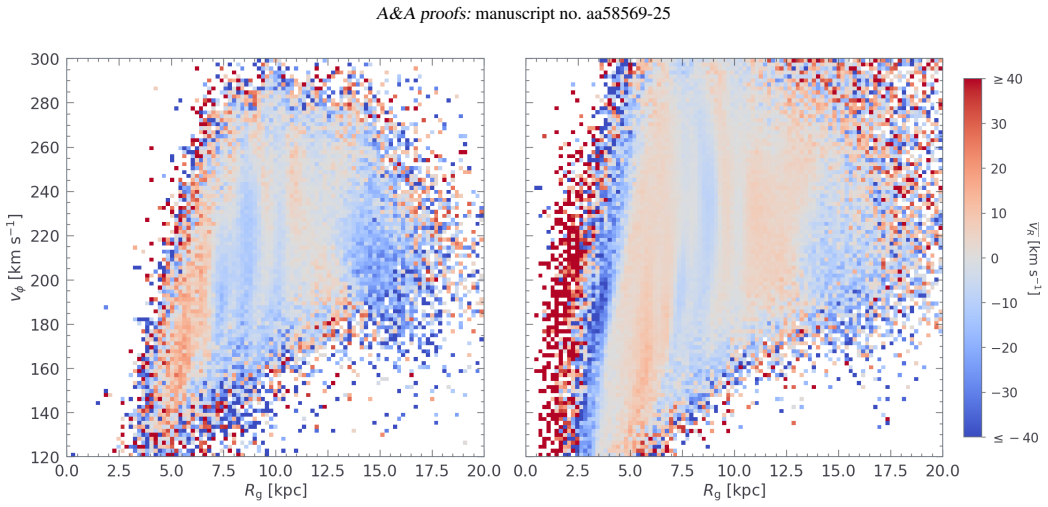
A two-wave radial corrugation model, with one wave moving inward and one outward, reproduces the observed periodic variation of VR with galactocentric radius in both LAMOST and Gaia samples; the superposition of the modes also matches the oscillatory pattern recovered in N-body simulations, thereby supplying a plausible physical interpretation for the wave-like kinematic features in the Galactic thin disk.
What carries the argument
Simplified two-wave corrugation model consisting of inward- and outward-propagating radial waves fitted to the VR pattern.
If this is right
- Rotational velocity and metallicity mark a clear structural transition between the inner and outer thin disks.
- Superposition of the two counter-propagating waves produces the observed periodic VR pattern.
- N-body simulations confirm that the same two-wave superposition generates matching oscillations.
- The disk's kinematic and chemical structure arises from multiple simultaneous perturbers rather than one dominant mechanism.
Where Pith is reading between the lines
- Chemical abundance trends across the waves could be used to date the perturbation events.
- The same corrugation framework might be tested against velocity fields in external disk galaxies observed at high resolution.
- If confirmed, the model implies that ongoing or recent dynamical heating continues to reshape the outer disk on kiloparsec scales.
Load-bearing premise
A simplified two-wave corrugation model fitted only to the VR pattern is enough to capture the main physics without large contributions from the galactic bar or spiral arms.
What would settle it
Independent measurements of VR at larger radii or with different stellar tracers that show oscillation periods or amplitudes incompatible with the fitted two-wave model would undermine the interpretation.
Figures


read the original abstract
Large spectroscopic and astrometric surveys have revealed complex wave-like features in the Milky Way disk, suggesting that its kinematic and chemical structures are shaped by time-dependent perturbations. Recent studies have reported oscillatory patterns in the Rg-Vphi-VR space, hinting at a possible structural transition in the outer disk. We aim to characterise the transition between the inner and outer Galactic thin disk and to investigate whether radial corrugations can provide a plausible physical interpretation of the observed features. We analysed two large stellar samples from LAMOST DR8 and Gaia DR3, combining spatial, kinematic, and chemical diagnostics. A simplified corrugation model consisting of two radial waves propagating in opposite directions was constructed and fitted to the observed VR pattern. We further validated the model using N-body simulations. Both LAMOST and Gaia samples reproduce the previously reported wave-like pattern in the Rg-Vphi-VR plane. We identify a clear transition between the inner and outer disks via the variations in rotational velocity and metallicities. The corrugation model naturally reproduces the periodic variation of VR with galactocentric radius, and the superposition of the inward and outward propagating modes gives rise to a comparable oscillatory pattern in both observations and simulations. Our modelling suggests that radial corrugations can provide a plausible interpretation of the observed kinematic signatures. The results highlight the complex, multi-perturber nature of the Galactic disk and motivate further investigation with upcoming surveys.
Editorial analysis
A structured set of objections, weighed in public.
Referee Report
Summary. The paper analyzes large samples from LAMOST DR8 and Gaia DR3 to identify wave-like kinematic patterns in the Rg-Vphi-VR plane of the Milky Way disk, reports a transition between inner and outer thin disk via changes in Vphi and [Fe/H], constructs a simplified two-wave radial corrugation model (inward- and outward-propagating) with free parameters fitted to the observed VR(Rg) pattern, validates it against N-body simulations, and concludes that radial corrugations offer a plausible interpretation of the kinematic signatures.
Significance. If the central claim holds, the work adds to the growing picture of the Galactic disk as a multi-perturber system by offering an explicit, simple corrugation model that reproduces the reported periodic VR signal and is checked against simulations. The use of two independent large surveys and the identification of the inner-outer disk transition via multiple diagnostics are positive elements. However, the significance is limited by the absence of quantitative fit statistics, error propagation, and direct tests against alternative drivers such as bar or spiral potentials.
major comments (3)
- [Model construction and fitting (inferred from abstract and results description)] The corrugation model is constructed with free parameters (amplitudes, wavelengths, phases of the two radial waves) that are explicitly fitted to the observed VR(Rg) pattern; this makes the reproduction of the periodic VR signal tautological by construction. The manuscript should demonstrate that the same model simultaneously reproduces the reported Vphi and [Fe/H] trends or provide a quantitative goodness-of-fit metric (e.g., reduced chi-squared or residual analysis) to establish that the fit is not merely descriptive.
- [N-body validation and discussion of alternative mechanisms] No quantitative comparison is presented showing that the observed VR oscillations cannot be produced (or are weaker) under bar or spiral-arm potentials alone. The N-body validation therefore leaves open whether corrugations are necessary or merely one possible mechanism, weakening the claim that they provide a plausible dominant interpretation.
- [Data analysis and methods] Details on sample selection criteria, completeness corrections, error analysis, and the precise fitting procedure (including any regularization or priors on the wave parameters) are not provided. Without these, the robustness of the reported transition and the model parameters cannot be assessed.
minor comments (2)
- [Data and coordinate definitions] Clarify the exact definition of Rg (guiding radius) and how it is computed from the data, as this is central to the Rg-Vphi-VR plane analysis.
- [Abstract] The abstract states that the model 'naturally reproduces' the VR pattern; this phrasing should be replaced with a more precise statement that the pattern is reproduced after parameter fitting.
Simulated Author's Rebuttal
We thank the referee for their constructive and detailed comments, which have helped us identify opportunities to improve the clarity and rigor of our analysis. We address each major point below, indicating where revisions will be made to the manuscript.
read point-by-point responses
-
Referee: The corrugation model is constructed with free parameters (amplitudes, wavelengths, phases of the two radial waves) that are explicitly fitted to the observed VR(Rg) pattern; this makes the reproduction of the periodic VR signal tautological by construction. The manuscript should demonstrate that the same model simultaneously reproduces the reported Vphi and [Fe/H] trends or provide a quantitative goodness-of-fit metric (e.g., reduced chi-squared or residual analysis) to establish that the fit is not merely descriptive.
Authors: We agree that the free parameters are optimized to match the observed VR(Rg) pattern, so reproduction of that specific signal follows by construction. The physical motivation for the two-wave (inward- and outward-propagating) corrugation model nevertheless provides a non-arbitrary framework grounded in the expected response of the disk to perturbations. The model is kinematic and focused on VR; it is not designed to reproduce the separately observed Vphi and [Fe/H] trends, which reflect the overall disk rotation curve and chemical gradients. To address the concern that the fit may be merely descriptive, we will add a quantitative goodness-of-fit evaluation (reduced chi-squared and residual analysis) for the VR fit in the revised manuscript. revision: yes
-
Referee: No quantitative comparison is presented showing that the observed VR oscillations cannot be produced (or are weaker) under bar or spiral-arm potentials alone. The N-body validation therefore leaves open whether corrugations are necessary or merely one possible mechanism, weakening the claim that they provide a plausible dominant interpretation.
Authors: Our manuscript states that radial corrugations 'can provide a plausible interpretation,' not that they are dominant or necessary. The N-body simulations illustrate that corrugation-like VR patterns arise naturally in a galactic disk that already contains bar and spiral perturbations. A dedicated quantitative test isolating bar or spiral potentials alone would require new simulation suites and is outside the scope of the present simplified analytic model. We will expand the discussion section to explicitly note this limitation and to clarify that the model is offered as one viable mechanism among others. revision: partial
-
Referee: Details on sample selection criteria, completeness corrections, error analysis, and the precise fitting procedure (including any regularization or priors on the wave parameters) are not provided. Without these, the robustness of the reported transition and the model parameters cannot be assessed.
Authors: We acknowledge that these methodological details were insufficiently documented. In the revised manuscript we will insert a dedicated Methods subsection that specifies the exact selection criteria applied to the LAMOST DR8 and Gaia DR3 samples, any completeness or selection-function corrections, the error propagation procedures, and the full fitting algorithm (including optimization method, any regularization, and priors placed on the wave amplitudes, wavelengths, and phases). revision: yes
Circularity Check
Two-wave corrugation model fitted to VR data reproduces VR oscillations by construction
specific steps
-
fitted input called prediction
[Abstract]
"A simplified corrugation model consisting of two radial waves propagating in opposite directions was constructed and fitted to the observed VR pattern. ... The corrugation model naturally reproduces the periodic variation of VR with galactocentric radius, and the superposition of the inward and outward propagating modes gives rise to a comparable oscillatory pattern in both observations and simulations."
The model parameters are adjusted to match the VR(Rg) pattern extracted from the LAMOST and Gaia samples; therefore the claimed reproduction of the periodic VR signal and the oscillatory pattern is achieved by construction through the fitting procedure, rather than arising as an independent derivation or prediction.
full rationale
The paper's central claim is that a simplified radial corrugation model provides a plausible physical interpretation of the observed wave-like kinematic signatures in the Rg-Vphi-VR plane from LAMOST DR8 and Gaia DR3. The model is explicitly constructed with two oppositely propagating radial waves whose parameters are fitted directly to the observed VR pattern. This fitting process ensures that the model reproduces the periodic VR variations, as stated in the abstract. While N-body simulations are invoked for validation and show comparable patterns, they do not independently generate the specific observed VR(Rg) signal without reference to the fitted parameters. No quantitative tests are described that rule out or compare against dominant contributions from the galactic bar or spiral arms, nor does the model simultaneously reproduce the reported Vphi and metallicity transitions. This creates moderate circularity because the 'natural reproduction' is a direct outcome of the data-fitting step rather than an emergent or predictive result from first principles. The derivation chain remains partially self-contained due to the external N-body grounding but does not fully escape dependence on the target VR measurements.
Axiom & Free-Parameter Ledger
free parameters (1)
- amplitudes, wavelengths, and phases of the two radial waves
axioms (1)
- domain assumption The observed wave-like VR pattern is produced by radial propagating corrugations
Reference graph
Works this paper leans on
-
[1]
The galaxy in context: structural, kinematic, and integrated properties , journal =
-
[2]
The Astrophysical Journal , volume=
The chemical evolution of the galaxy: the two-infall model , author=. The Astrophysical Journal , volume=. 1997 , publisher=
1997
-
[3]
The Astrophysical Journal , volume=
Abundance gradients and the formation of the Milky Way , author=. The Astrophysical Journal , volume=. 2001 , publisher=
2001
-
[4]
1998 , publisher=
Galactic astronomy , author=. 1998 , publisher=
1998
-
[5]
Astronomy & Astrophysics , volume=
Radial structure and formation of the Milky Way disc , author=. Astronomy & Astrophysics , volume=. 2021 , publisher=
2021
-
[6]
The apache point observatory galactic evolution experiment (APOGEE) , journal =
-
[7]
Research in Astronomy and Astrophysics , volume=
On the metallicity gradients of the Galactic disk as revealed by LSS-GAC red clump stars , author=. Research in Astronomy and Astrophysics , volume=. 2015 , publisher=
2015
-
[8]
The Astrophysical Journal Letters , volume=
An Inward-moving and Asymmetric Velocity Wave Detected in LAMOST-Gaia , author=. The Astrophysical Journal Letters , volume=. 2024 , publisher=
2024
-
[9]
The Astrophysical Journal , volume=
Radial migration from the metallicity gradient of open clusters and outliers , author=. The Astrophysical Journal , volume=. 2021 , publisher=
2021
-
[10]
The Astrophysical Journal , volume=
The inside-out growth of the Galactic disk , author=. The Astrophysical Journal , volume=. 2019 , publisher=
2019
-
[11]
Universe , volume=
Mapping the galactic metallicity gradient with open clusters: the state-of-the-art and future challenges , author=. Universe , volume=. 2022 , publisher=
2022
-
[12]
Monthly Notices of the Royal Astronomical Society , volume=
The outer low- disc of the Milky Way--I: evidence for the first pericentric passage of Sagittarius? , author=. Monthly Notices of the Royal Astronomical Society , volume=. 2024 , publisher=
2024
-
[13]
The Astrophysical Journal , volume=
Trigonometric parallaxes of high-mass star-forming regions: our view of the Milky Way , author=. The Astrophysical Journal , volume=. 2019 , publisher=
2019
-
[14]
Astronomy & Astrophysics , volume=
The great wave-Evidence of a large-scale vertical corrugation propagating outwards in the Galactic disc , author=. Astronomy & Astrophysics , volume=. 2025 , publisher=
2025
-
[15]
1.2 million giants from LAMOST DR8 , author=
The stellar parameters and elemental abundances from low-resolution spectra--I. 1.2 million giants from LAMOST DR8 , author=. Monthly Notices of the Royal Astronomical Society , volume=. 2022 , publisher=
2022
-
[16]
Monthly Notices of the Royal Astronomical Society , volume=
Exploring the ex-situ components within Gaia DR3 , author=. Monthly Notices of the Royal Astronomical Society , volume=. 2024 , publisher=
2024
-
[17]
Astronomy & Astrophysics , volume=
Gaia Early Data Release 3-Parallax bias versus magnitude, colour, and position , author=. Astronomy & Astrophysics , volume=. 2021 , publisher=
2021
-
[18]
The Gaia mission. , keywords =. doi:10.1051/0004-6361/201629272 , archivePrefix =. 1609.04153 , primaryClass =
-
[19]
Summary of the content and survey properties
Gaia Data Release 3. Summary of the content and survey properties. , keywords =. doi:10.1051/0004-6361/202243940 , archivePrefix =. 2208.00211 , primaryClass =
-
[20]
Research in Astronomy and Astrophysics , volume=
The first data release (DR1) of the LAMOST regular survey , author=. Research in Astronomy and Astrophysics , volume=. 2015 , publisher=
2015
-
[21]
Research in Astronomy and Astrophysics , volume=
LAMOST spectral survey—An overview , author=. Research in Astronomy and Astrophysics , volume=. 2012 , publisher=
2012
-
[22]
Astronomy & Astrophysics , volume=
Photo-astrometric distances, extinctions, and astrophysical parameters for Gaia EDR3 stars brighter than G= 18.5 , author=. Astronomy & Astrophysics , volume=. 2022 , publisher=
2022
-
[23]
From the bulge to the outer disc: StarHorse stellar parameters, distances, and extinctions for stars in APOGEE DR16 and other spectroscopic surveys. , keywords =. doi:10.1051/0004-6361/201937364 , archivePrefix =. 1912.09778 , primaryClass =
-
[24]
The Astrophysical Journal Supplement Series , volume=
The seventeenth data release of the Sloan Digital Sky Surveys: Complete release of MaNGA, MaStar, and APOGEE-2 data , author=. The Astrophysical Journal Supplement Series , volume=. 2022 , publisher=
2022
-
[25]
The Rotating Bulge and Halo in the Milky Way: Evidence of Angular Momentum Transferred from the Decelerating Bar. , keywords =. doi:10.3847/1538-4357/ade430 , archivePrefix =. 2506.12717 , primaryClass =
-
[26]
Monthly Notices of the Royal Astronomical Society , volume=
The mass distribution and gravitational potential of the Milky Way , author=. Monthly Notices of the Royal Astronomical Society , volume=. 2017 , publisher=
2017
-
[27]
Vertical waves in the solar neighbourhood in Gaia DR2. , keywords =. doi:10.1093/mnras/sty2813 , archivePrefix =. 1809.03507 , primaryClass =
-
[28]
Monthly Notices of the Royal Astronomical Society , volume=
Local kinematics and the local standard of rest , author=. Monthly Notices of the Royal Astronomical Society , volume=. 2010 , publisher=
2010
-
[29]
Astronomy & Astrophysics , volume=
Gaia data release 3-analysis of the gaia bp/rp spectra using the general stellar parameterizer from photometry , author=. Astronomy & Astrophysics , volume=. 2023 , publisher=
2023
-
[30]
2023, MNRAS, 520, 1832, doi: 10.1093/mnras/stad094
Self-consistent models of our Galaxy. , keywords =. doi:10.1093/mnras/stad094 , archivePrefix =. 2206.03523 , primaryClass =
-
[31]
2024, MNRAS, 527, 1915, doi: 10.1093/mnras/stad3312
Chemodynamical models of our Galaxy. , keywords =. doi:10.1093/mnras/stad3312 , archivePrefix =. 2306.11602 , adsurl =
-
[32]
Galactic Dynamics: Second Edition
-
[33]
2019a, MNRAS, 482, 1525, doi: 10.1093/mnras/sty2672
AGAMA: action-based galaxy modelling architecture. , keywords =. doi:10.1093/mnras/sty2672 , archivePrefix =. 1802.08239 , primaryClass =
-
[34]
Modelling the stellar halo with RR-Lyrae stars. , keywords =. doi:10.1093/mnras/stab3711 , archivePrefix =. 2109.02324 , primaryClass =
-
[35]
Our Galaxy's youngest disc. , keywords =. doi:10.1093/mnras/stac1788 , archivePrefix =. 2205.01455 , primaryClass =
-
[36]
The Rotation Curve, Mass Distribution, and Dark Matter Content of the Milky Way from Classical Cepheids. , keywords =. doi:10.3847/2041-8213/ab8d45 , archivePrefix =. 2004.13768 , primaryClass =
-
[37]
The Circular Velocity Curve of the Milky Way from 5 to 25 kpc. , keywords =. doi:10.3847/1538-4357/aaf648 , archivePrefix =. 1810.09466 , primaryClass =
-
[38]
Simulating cosmic structure formation with the GADGET-4 code,
Simulating cosmic structure formation with the GADGET-4 code. , keywords =. doi:10.1093/mnras/stab1855 , archivePrefix =. 2010.03567 , primaryClass =
-
[39]
Numerical hydrodynamic simulations based on semi-analytic galaxy merger trees: method and Milky Way-like galaxies. , keywords =. doi:10.1093/mnras/stt1702 , archivePrefix =. 1210.5522 , primaryClass =
-
[40]
2014, MNRAS, 440, 787, doi: 10.1093/mnras/stu297
Self-consistent flattened isochrones. , keywords =. doi:10.1093/mnras/stu297 , archivePrefix =. 1402.2512 , primaryClass =
-
[41]
Tango for three: Sagittarius, LMC, and the Milky Way. , keywords =. doi:10.1093/mnras/staa3673 , archivePrefix =. 2009.10726 , primaryClass =
-
[42]
Dynamical Friction. I. General Considerations: the Coefficient of Dynamical Friction. , year = 1943, month = mar, volume =. doi:10.1086/144517 , adsurl =
-
[43]
The large Galactic disc extending to 35 kpc , author=
Mapping the Milky Way with LAMOST--IV. The large Galactic disc extending to 35 kpc , author=. Monthly Notices of the Royal Astronomical Society , volume=. 2024 , publisher=
2024
-
[44]
, year = 1966, month = dec, volume =
Non-Axisymmetric Responses of Differentially Rotating Disks of Stars. , year = 1966, month = dec, volume =. doi:10.1086/148957 , adsurl =
-
[45]
On the Spiral Structure of Disk Galaxies, II. Outline of a Theory of Density Waves. Proceedings of the National Academy of Science , year = 1966, month = feb, volume =. doi:10.1073/pnas.55.2.229 , adsurl =
-
[46]
, year = 1969, month = dec, volume =
Group Velocity of Spiral Waves in Galactic Disks. , year = 1969, month = dec, volume =. doi:10.1086/150250 , adsurl =
-
[47]
Monthly Notices of the Royal Astronomical Society , author =
On the generating mechanism of spiral structure. , year = 1972, month = jan, volume =. doi:10.1093/mnras/157.1.1 , adsurl =
-
[48]
Theories of spiral structure. , keywords =. doi:10.1146/annurev.aa.15.090177.002253 , adsurl =
-
[49]
Structure and Evolution of Normal Galaxies , year = 1981, editor =
What amplifies the spirals. Structure and Evolution of Normal Galaxies , year = 1981, editor =
1981
-
[50]
A dynamically young and perturbed Milky Way disk. , keywords =. doi:10.1038/s41586-018-0510-7 , archivePrefix =. 1804.10196 , primaryClass =
-
[51]
The origin of the Gaia phase-plane spiral. , keywords =. doi:10.1093/mnras/sty2378 , archivePrefix =. 1807.09819 , primaryClass =
-
[52]
2022, MNRAS, 516, L7, doi: 10.1093/mnrasl/slac082
Multiple phase spirals suggest multiple origins in Gaia DR3. , keywords =. doi:10.1093/mnrasl/slac082 , archivePrefix =. 2206.06125 , primaryClass =
-
[53]
2019, MNRAS, 489, 4962, doi: 10.1093/mnras/stz2462
The GALAH survey and Gaia DR2: Linking ridges, arches, and vertical waves in the kinematics of the Milky Way. , keywords =. doi:10.1093/mnras/stz2462 , archivePrefix =. 1902.10113 , primaryClass =
-
[54]
Footprints of the Sagittarius dwarf galaxy in the Gaia data set. , keywords =. doi:10.1093/mnras/stz583 , archivePrefix =. 1808.00451 , primaryClass =
-
[55]
2021b, MNRAS, 504, 3168, doi: 10.1093/mnras/stab704
Galactic seismology: the evolving 'phase spiral' after the Sagittarius dwarf impact. , keywords =. doi:10.1093/mnras/stab704 , archivePrefix =. 2009.02434 , primaryClass =
-
[56]
A Comprehensive Perturbative Formalism for Phase Mixing in Perturbed Disks. I. Phase Spirals in an Infinite, Isothermal Slab. , keywords =. doi:10.3847/1538-4357/ac7ff9 , archivePrefix =. 2208.05038 , primaryClass =
-
[57]
Gaia DR3 features of the phase spiral and its possible relation to internal perturbations. , keywords =. doi:10.1093/mnras/stad2199 , archivePrefix =. 2303.06393 , primaryClass =
-
[58]
Iron Snails: Nonequilibrium Dynamics and Spiral Abundance Patterns. , keywords =. doi:10.3847/1538-4357/add5ea , archivePrefix =. 2407.07149 , primaryClass =
-
[59]
Origin of the two-armed vertical phase spiral in the inner Galactic disc. , keywords =. doi:10.1093/mnras/staf1566 , archivePrefix =. 2503.20869 , primaryClass =
-
[60]
G., Adelman, J., Anderson, Jr., J
The Sloan Digital Sky Survey: Technical Summary. , keywords =. doi:10.1086/301513 , archivePrefix =. astro-ph/0006396 , primaryClass =
-
[61]
The Radial Velocity Experiment (RAVE): First Data Release. , keywords =. doi:10.1086/506564 , archivePrefix =. astro-ph/0606211 , primaryClass =
-
[62]
SEGUE: A Spectroscopic Survey of 240,000 Stars with g = 14-20. , keywords =. doi:10.1088/0004-6256/137/5/4377 , archivePrefix =. 0902.1781 , primaryClass =
-
[63]
Astrometric and photometric star catalogues derived from the ESA HIPPARCOS Space Astrometry Mission
The HIPPARCOS and TYCHO catalogues. Astrometric and photometric star catalogues derived from the ESA HIPPARCOS Space Astrometry Mission. ESA Special Publication , year = 1997, editor =
1997
-
[64]
The Ghost of Sagittarius and Lumps in the Halo of the Milky Way. , keywords =. doi:10.1086/338983 , archivePrefix =. astro-ph/0111095 , primaryClass =
-
[65]
A Low-Latitude Halo Stream around the Milky Way. , keywords =. doi:10.1086/374220 , archivePrefix =. astro-ph/0301029 , primaryClass =
-
[66]
Detection of the Main-Sequence Turnoff of a Newly Discovered Milky Way Halo Structure in the Triangulum-Andromeda Region. , keywords =. doi:10.1086/424586 , archivePrefix =. astro-ph/0406221 , primaryClass =
-
[67]
Galactic Halo Stellar Structures in the Triangulum-Andromeda Region. , keywords =. doi:10.1086/522791 , archivePrefix =. astro-ph/0703506 , primaryClass =
-
[68]
Rings and Radial Waves in the Disk of the Milky Way. , keywords =. doi:10.1088/0004-637X/801/2/105 , archivePrefix =. 1503.00257 , primaryClass =
-
[69]
Warp, waves, and wrinkles in the Milky Way. , keywords =. doi:10.1093/mnras/sty1256 , archivePrefix =. 1712.06616 , primaryClass =
-
[70]
Radial distribution of stellar motions in Gaia DR2. , keywords =. doi:10.1093/mnrasl/sly107 , archivePrefix =. 1804.10175 , primaryClass =
-
[71]
Tidally induced spiral arm wraps encoded in phase space. , keywords =. doi:10.1051/0004-6361/202244064 , archivePrefix =. 2206.03495 , primaryClass =
-
[72]
Gaia Early Data Release 3. The Galactic anticentre. , keywords =. doi:10.1051/0004-6361/202039714 , archivePrefix =. 2101.05811 , primaryClass =
-
[73]
More than just a wrinkle: a wave-like pattern in U _ g versus L _ z from Gaia data. , keywords =. doi:10.1093/mnras/stz2951 , archivePrefix =. 1902.09569 , primaryClass =
discussion (0)
Sign in with ORCID, Apple, or X to comment. Anyone can read and Pith papers without signing in.