Recognition: unknown
Phase-Space Crystallization in Galactic Globular Clusters: A Gaia-Based Metric and Implications for Technosignature Searches
Pith reviewed 2026-05-08 07:43 UTC · model grok-4.3
The pith
A crystallization index from Gaia data shows most globular clusters are dynamically smooth, with only a few ranking as complex.
A machine-rendered reading of the paper's core claim, the machinery that carries it, and where it could break.
Core claim
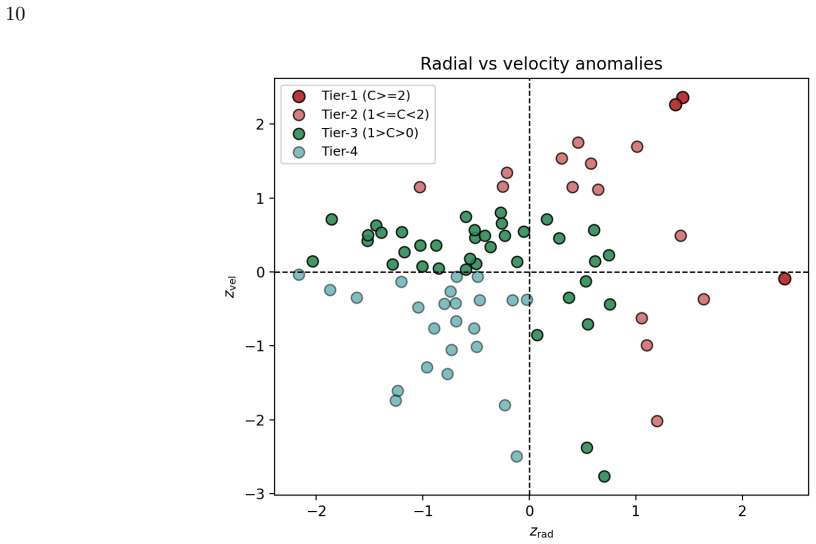
We construct a scalar crystallization index C_index by combining a radial inhomogeneity metric z_rad and a local tangential-velocity metric z_vel, each standardized against empirical null distributions drawn from the sample itself. The resulting distribution over 79 clusters is strongly non-Gaussian: the bulk of objects are consistent with smooth equilibrium expectations, while a high-C tail (C_index >= 2) identifies dynamically complex systems including NGC 5139 and NGC 104. Synthetic injection tests in quiet control clusters establish sensitivity to ultra-cold, shell-confined kinematic components down to a few to roughly 10-20 percent of core stars. Within these limits the data show no sub
What carries the argument
The crystallization index C_index, which quantifies the degree of ordered radial and kinematic substructure by merging standardized radial inhomogeneity and cluster-centric tangential velocity metrics.
Load-bearing premise
The empirical null distributions used to standardize the metrics accurately represent the expected properties of smooth equilibrium clusters without selection biases from the Gaia membership catalogue.
What would settle it
Re-analysis of the same clusters with an independent membership catalogue or deeper velocity measurements that either removes the high-C tail or uncovers substructure exceeding the injected sensitivity limits would falsify the current ranking and no-evidence conclusion.
Figures


read the original abstract
We develop a model-independent framework to quantify phase-space "crystallization", the degree of ordered radial and kinematic substructure, in 79 Galactic globular clusters using the Gaia EDR3-based membership catalogue of E. Vasiliev & H. Baumgardt (2021a). We construct a scalar crystallization index, C_index, by combining a radial inhomogeneity metric (z_rad) and a local, cluster-centric tangential-velocity metric (z_vel) standardized against empirical nulls. The population distribution is strongly non-Gaussian: most clusters are consistent with smooth, equilibrium expectations, while a small high-C tail (C_index >= 2) identifies dynamically complex systems, including NGC 5139 (\omega Cen) and NGC 104 (47 Tuc). Correlation and fixed-N tests show that sample size affects detectability, but does not by itself explain all high-rank objects. Through synthetic injection tests in dynamically "quiet" control clusters, we demonstrate sensitivity to ultra-cold, shell-confined kinematic components, ruling out single-shell structures comprising more than a few to ~ 10-20% of core stars in the best-sampled control clusters. We find no evidence, within the sensitivity of the adopted diagnostics, for phase-space structures that require explanations beyond known dynamical processes. However, C_index provides a useful tool for ranking clusters by dynamical extremeness, serving both as a diagnostic for internal complexity and as a quantitative metric for prioritizing follow-up dynamical or technosignature-oriented observations.
Editorial analysis
A structured set of objections, weighed in public.
Referee Report
Summary. The manuscript develops a model-independent framework to quantify phase-space crystallization in 79 Galactic globular clusters using the Gaia EDR3-based membership catalogue of Vasiliev & Baumgardt (2021). It constructs a scalar crystallization index C_index by combining a radial inhomogeneity metric (z_rad) and a local cluster-centric tangential-velocity metric (z_vel), both standardized against empirical null distributions derived from the same dataset. The population distribution is reported as strongly non-Gaussian, with most clusters consistent with smooth equilibrium expectations and a high-C tail (C_index >= 2) identifying dynamically complex systems such as NGC 5139 and NGC 104. Synthetic injection tests in control clusters demonstrate sensitivity to ultra-cold shell-confined kinematic components, and the authors conclude there is no evidence for phase-space structures requiring explanations beyond known dynamical processes, while positioning C_index as a ranking tool for dynamical extremeness and follow-up observations including technosignature searches.
Significance. If the empirical null standardization proves robust, the work supplies a practical, quantitative metric for ranking dynamical complexity across the globular cluster population. The synthetic injection tests provide concrete sensitivity bounds (ruling out single-shell structures above a few to 10-20% of core stars in best-sampled controls), which strengthens the null-result interpretation. This could usefully inform prioritization of detailed dynamical modeling or targeted observations, though the technosignature angle is secondary to the core astrophysical contribution.
major comments (2)
- [Section on empirical null construction (likely §3)] Section on empirical null construction (likely §3): The z_rad and z_vel metrics are standardized against empirical null distributions drawn directly from the Vasiliev & Baumgardt (2021) Gaia EDR3 membership catalogue. This risks incorporating catalogue-specific selection effects (membership probability thresholds, radial coverage limits, proper-motion cuts, or incompleteness) into the nulls themselves. Consequently the z-scores are not fully independent of the input data, which weakens the load-bearing claim that high-C outliers are absent beyond known processes; the abstract notes sample-size tests but provides no explicit robustness checks (e.g., jackknife or alternative membership cuts) on the null construction.
- [Results section describing the population distribution and C_index tail] Results section describing the population distribution and C_index tail: The assertion of a 'strongly non-Gaussian' distribution with a high-C tail (C_index >=2) identifying complex systems rests on the standardized metrics, yet the manuscript lacks visible details on error propagation, the exact standardization formulas, or formal statistical validation (e.g., goodness-of-fit tests against Gaussian or other distributions). This leaves the interpretation of the tail as dynamical complexity versus statistical fluctuation only partially supported.
minor comments (2)
- [Abstract] Abstract: The statement that 'sample size affects detectability, but does not by itself explain all high-rank objects' would benefit from a brief quantitative summary (e.g., Spearman rank correlation or p-value from the fixed-N tests) to allow readers to assess the strength of that control.
- [Throughout] Throughout: Ensure consistent notation for C_index (versus 'crystallization index') and provide a clear definition of all acronyms (e.g., z_rad, z_vel) on first use in the main text rather than relying solely on the abstract.
Simulated Author's Rebuttal
We thank the referee for their constructive and detailed review of our manuscript. The comments have highlighted areas where additional methodological details and robustness tests will strengthen the presentation. We address each major comment below and have revised the manuscript to incorporate the suggested improvements.
read point-by-point responses
-
Referee: Section on empirical null construction (likely §3): The z_rad and z_vel metrics are standardized against empirical null distributions drawn directly from the Vasiliev & Baumgardt (2021) Gaia EDR3 membership catalogue. This risks incorporating catalogue-specific selection effects (membership probability thresholds, radial coverage limits, proper-motion cuts, or incompleteness) into the nulls themselves. Consequently the z-scores are not fully independent of the input data, which weakens the load-bearing claim that high-C outliers are absent beyond known processes; the abstract notes sample-size tests but provides no explicit robustness checks (e.g., jackknife or alternative membership cuts) on the null construction.
Authors: The empirical nulls are constructed from the full catalogue precisely to embed the real selection effects, incompleteness, and coverage limits of the Gaia EDR3 membership data, so that z-scores measure deviations relative to the actual observed population rather than an idealized model. This is the intended model-independent approach. We agree, however, that explicit robustness checks were not sufficiently documented. In the revised manuscript we have added a dedicated subsection in §3 that presents jackknife resampling (repeatedly excluding random 20 % subsets of clusters when rebuilding the nulls) and tests with alternative membership probability thresholds (>0.5 and >0.9). These checks confirm that the high-C_index tail and the ranking of NGC 5139 and NGC 104 remain stable. The new material is summarized in an expanded Figure 3 and accompanying text. revision: yes
-
Referee: Results section describing the population distribution and C_index tail: The assertion of a 'strongly non-Gaussian' distribution with a high-C tail (C_index >=2) identifying complex systems rests on the standardized metrics, yet the manuscript lacks visible details on error propagation, the exact standardization formulas, or formal statistical validation (e.g., goodness-of-fit tests against Gaussian or other distributions). This leaves the interpretation of the tail as dynamical complexity versus statistical fluctuation only partially supported.
Authors: The standardization is defined as z_rad = (r_inhom − 〈r_inhom〉_null)/σ_null and z_vel = (v_tang − 〈v_tang〉_null)/σ_null, with C_index = √(z_rad² + z_vel²); the null moments are computed directly from the empirical distribution of the 79 clusters. Error propagation is assessed through the synthetic injection experiments and the fixed-N subsampling tests already reported. We acknowledge that formal goodness-of-fit statistics and the explicit formulas were not presented in the original text. The revised version now includes the formulas in §3, a Shapiro–Wilk test (p < 0.001) and a Kolmogorov–Smirnov test against normality for the C_index distribution, and an expanded discussion showing that the high-C tail correlates with independent dynamical indicators (e.g., relaxation time and known merger signatures) while the injection tests place quantitative upper limits on undetected shell-like structures. These additions support the interpretation that the tail reflects genuine dynamical complexity rather than statistical fluctuations alone. revision: yes
Circularity Check
Minor dependence on data-derived empirical nulls for z-score standardization in C_index construction
specific steps
-
fitted input called prediction
[Abstract]
"We construct a scalar crystallization index, C_index, by combining a radial inhomogeneity metric (z_rad) and a local, cluster-centric tangential-velocity metric (z_vel) standardized against empirical nulls. The population distribution is strongly non-Gaussian: most clusters are consistent with smooth, equilibrium expectations, while a small high-C tail (C_index >= 2) identifies dynamically complex systems"
Standardization of the metrics against empirical nulls from the identical catalogue normalizes the observed population such that the statement 'most clusters are consistent with smooth expectations' is partly enforced by the choice of null construction itself, rather than constituting an independent external test.
full rationale
The paper constructs C_index from z_rad and z_vel metrics that are standardized against empirical null distributions drawn from the same Vasiliev & Baumgardt Gaia EDR3 membership catalogue used for the full analysis. This introduces a limited data-dependence in the baseline for 'smooth equilibrium expectations,' but the central claim of no unexplained phase-space structures beyond known dynamics is supported by separate synthetic injection tests in control clusters and identification of known complex systems like ω Cen, rather than reducing directly to the standardization by construction. No load-bearing self-citations, ansatzes, or uniqueness theorems are invoked in the derivation chain.
Axiom & Free-Parameter Ledger
axioms (1)
- domain assumption Empirical nulls constructed from the Gaia membership catalogue represent the expected distribution for smooth equilibrium clusters.
Reference graph
Works this paper leans on
-
[1]
2018, MNRAS, 478, 1520, doi: 10.1093/mnras/sty1057
Baumgardt, H., & Hilker, M. 2018, Monthly Notices of the Royal Astronomical Society, 478, 1520–1557, doi: 10.1093/mnras/sty1057
-
[2]
Baumgardt, H., & Vasiliev, E. 2021, Monthly Notices of the Royal Astronomical Society, 505, 5957–5977, doi: 10.1093/mnras/stab1474
-
[3]
, year = 2012, month = jun, volume =
Buchhave, L. A., Latham, D. W., Johansen, A., et al. 2012, Nature, 486, 375, doi: 10.1038/nature11121 Di Stefano, R., & Ray, A. 2016, The Astrophysical Journal, 827, 54, doi: 10.3847/0004-637X/827/1/54 Gaia Collaboration, Brown, A. G. A., Vallenari, A., et al. 2021, Astronomy and Astrophysics, 649, A1, doi: 10.1051/0004-6361/202039657 Gaia Collaboration, ...
-
[4]
Gilliland, R. L., Brown, T. M., Guhathakurta, P., et al. 2000, The Astrophysical Journal Letters, 545, L47, doi: 10.1086/317334
-
[5]
G., Carretta, E., & Bragaglia, A
Gratton, R. G., Carretta, E., & Bragaglia, A. 2012, The Astronomy and Astrophysics Review, 20, 50, doi: 10.1007/s00159-012-0050-3
-
[6]
2017, The Astrophysical Journal, 850, 186, doi: 10.3847/1538-4357/aa974f
Heyl, J., Caiazzo, I., Richer, H., et al. 2017, The Astrophysical Journal, 850, 186, doi: 10.3847/1538-4357/aa974f
-
[7]
2025, arXiv preprint arXiv:2511.21085
Huang, B.-L., Tao, Z.-Z., Zhang, T.-J., & Gajjar, V. 2025, arXiv preprint arXiv:2511.21085
-
[8]
2019, Nature Astronomy, 3, 667–672, doi: 10.1038/s41550-019-0751-x
Bianchini, P. 2019, Nature Astronomy, 3, 667–672, doi: 10.1038/s41550-019-0751-x
-
[9]
2018, Monthly Notices of the Royal Astronomical Society, 473, 5591, doi: 10.1093/mnras/stx2719
Kamann, S., Husser, T.-O., Dreizler, S., & et al. 2018, Monthly Notices of the Royal Astronomical Society, 473, 5591, doi: 10.1093/mnras/stx2719
-
[10]
Libralato, M., Bellini, A., van der Marel, R. P., Anderson, J., et al. 2022, The Astrophysical Journal, 934, 150, doi: 10.3847/1538-4357/ac7727
-
[11]
Meylan, G., & Heggie, D. C. 1997, Astronomy and Astrophysics Review, 8, 1–143, doi: 10.1007/s001590050008
-
[12]
Milone, A. P., & Marino, A. F. 2022, Universe, 8, 359, doi: 10.3390/universe8070359 23
-
[13]
2019b, MNRAS, 484, 2832, doi: 10.1093/mnras/stz171
Vasiliev, E. 2019, Monthly Notices of the Royal Astronomical Society, 484, 2832–2850, doi: 10.1093/mnras/stz171
-
[14]
2021, MNRAS, 505, 5978, doi: 10.1093/mnras/stab1475 Villalobos, ´A., & Helmi, A
Vasiliev, E., & Baumgardt, H. 2021a, Monthly Notices of the Royal Astronomical Society, 505, 5978–6002, doi: 10.1093/mnras/stab1475
-
[15]
Vasiliev, E., & Baumgardt, H. 2021b, Catalogue of stars in Milky Way globular clusters from Gaia EDR3, Zenodo, doi: 10.5281/zenodo.4891252
-
[16]
Wright, J. T. 2018, in Handbook of Exoplanets, ed. H. J. Deeg & J. A. Belmonte (Cham: Springer), 3405–3412, doi: 10.1007/978-3-319-55333-7 186
-
[17]
T., Mullan, B., Sigurdsson, S., & Povich, M
Wright, J. T., Mullan, B., Sigurdsson, S., & Povich, M. S. 2014, Astrophysical Journal, 792, 26, doi: 10.1088/0004-637X/792/1/26
-
[18]
Ziliotto, T., Cordoni, G., Milone, A. P., Marino, A. F., et al. 2025, Astronomy and Astrophysics, 698, A209, doi: 10.1051/0004-6361/202554038
-
[19]
Ziliotto, T., Milone, A. P., Cordoni, G., Marino, A. F., et al. 2026, Astronomy and Astrophysics, 707, A86, doi: 10.1051/0004-6361/202556112
discussion (0)
Sign in with ORCID, Apple, or X to comment. Anyone can read and Pith papers without signing in.