Recognition: unknown
Floquet-induced suppression of thermalization in a quasiperiodic Ising chain
Pith reviewed 2026-05-08 03:23 UTC · model grok-4.3
The pith
Moderate-frequency Floquet driving suppresses the many-body localized phase and expands the many-body critical phase in a quasiperiodic Ising chain.
A machine-rendered reading of the paper's core claim, the machinery that carries it, and where it could break.
Core claim
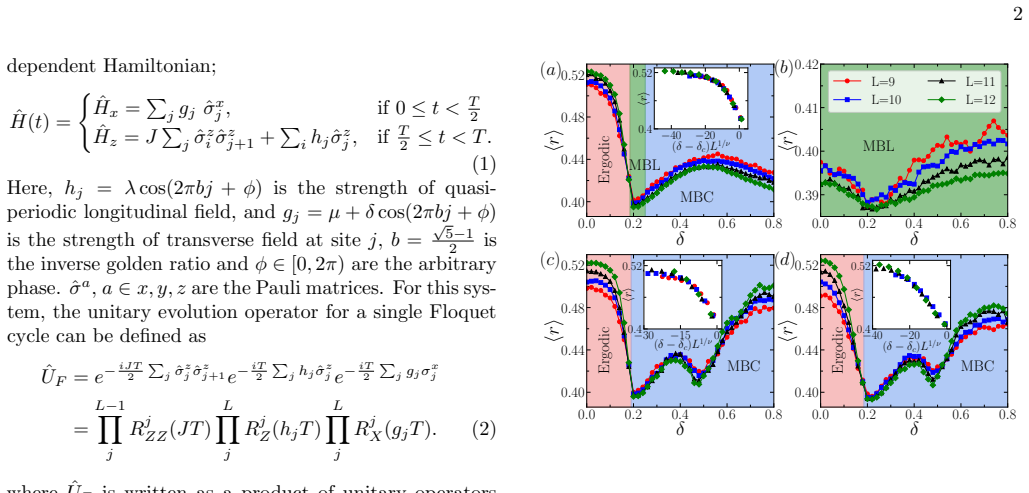
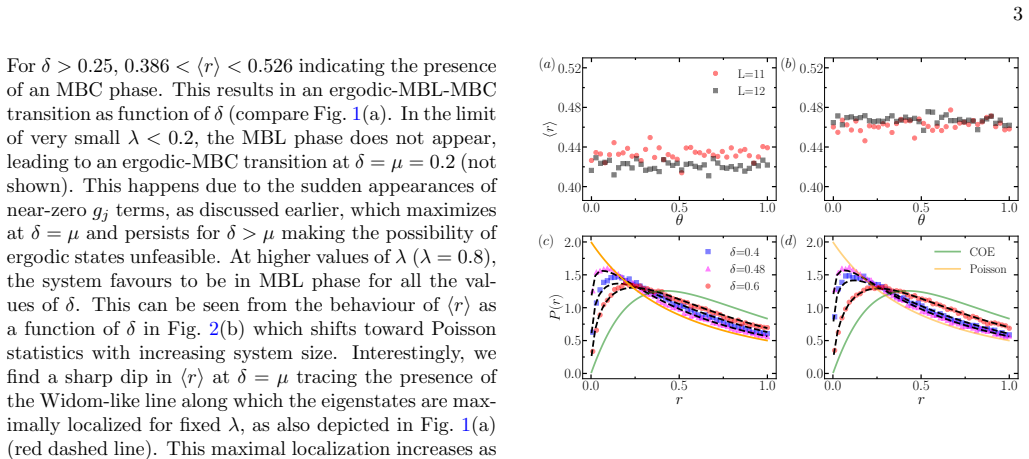
In the kicked quasiperiodic Ising chain, moderate-frequency Floquet driving completely suppresses the many-body localized phase while the many-body critical phase proliferates across the parameter space, diagnosed by quasienergy statistics, Floquet eigenstate properties, autocorrelation dynamics, and entanglement growth.
What carries the argument
Floquet driving protocol on the quasiperiodic Ising chain, which at moderate frequencies eliminates the many-body localized phase and enlarges the many-body critical phase.
If this is right
- At moderate driving frequencies the many-body localized phase vanishes from the phase diagram of the driven quasiperiodic Ising chain.
- The many-body critical phase occupies a significantly larger fraction of the available parameter space.
- Non-monotonic signatures appear in the nonergodic phases under varying driving frequencies.
- Floquet driving provides a tunable route to stabilize nonergodic extended phases instead of only localized ones.
Where Pith is reading between the lines
- The same moderate-frequency protocol might be tested in other quasiperiodic or weakly disordered spin models to see whether the critical phase similarly expands.
- Cold-atom or trapped-ion experiments could implement the kicked quasiperiodic Ising chain to observe the reported suppression of localization.
- The proliferation of the critical phase under driving raises the possibility that extended nonergodic states are more robust to periodic perturbations than localized states are.
Load-bearing premise
The numerical diagnostics based on quasienergy statistics, Floquet eigenstates, autocorrelation functions, and entanglement growth can correctly identify the many-body critical phase and separate it from the many-body localized phase without being dominated by finite-size effects or short evolution times.
What would settle it
A simulation on substantially larger chains or with much longer evolution times in which the many-body localized phase reappears or the many-body critical signatures disappear at moderate driving frequencies would falsify the suppression claim.
Figures


read the original abstract
Many-body localized (MBL) systems are known to thermalize in periodically driven systems. In this work, we demonstrate that under proper driving protocol, this thermalization this thermalization can be resisted such that the MBL phase turns into a non-ergodic extended phase, known as the many-body critical (MBC) phase. Considering a kicked quasiperiodic Ising chain, we show that while at high-frequency driving the ergodic, MBL, and the MBC phases coexist, at moderate driving frequencies the MBL phase is completely suppressed and the MBC phase proliferates in the parameter space. Using quasienergy statistics, Floquet eigenstates, autocorrelation dynamics, and entanglement growth, we characterize the emergent phases and identify non-monotonic signatures revealing richness of the nonergodic phases. Our results establish Floquet driving as a powerful route to stabilizing nonergodic extended many-body phases beyond the conventional Floquet-MBL paradigm.
Editorial analysis
A structured set of objections, weighed in public.
Referee Report
Summary. The manuscript studies Floquet driving in a kicked quasiperiodic Ising chain and claims that at high driving frequencies the ergodic, many-body localized (MBL), and many-body critical (MBC) phases coexist, while at moderate frequencies the MBL phase is entirely suppressed and the MBC phase occupies a larger region of parameter space. The phases are identified via quasienergy level statistics, properties of Floquet eigenstates, autocorrelation decay, and entanglement growth, with additional non-monotonic signatures noted in the non-ergodic regimes.
Significance. If the central numerical claim holds, the work demonstrates a concrete protocol for stabilizing non-ergodic extended (MBC) phases under periodic driving, thereby extending the conventional Floquet-MBL framework and providing a route to control thermalization in quasiperiodic many-body systems. The use of multiple independent diagnostics (level statistics, eigenstate properties, dynamics) is a strength.
major comments (3)
- [§4] §4 (moderate-frequency results): the claim of 'complete suppression' of the MBL phase is not accompanied by any finite-size scaling analysis or extrapolation; no system sizes L are stated for the exact-diagonalization or time-evolution data, nor are any convergence checks or error bars reported, so it is impossible to determine whether the apparent disappearance of the MBL window survives the L→∞ limit.
- [§3.2] §3.2 and Fig. 3: the distinction between MBC and MBL relies on quasienergy statistics and sub-ballistic entanglement growth, yet no explicit comparison of these quantities at fixed driving parameters across multiple L values is provided; without such data the reported proliferation of MBC could be a transient finite-size artifact.
- [§5] §5 (phase diagram): the boundaries separating ergodic, MBC, and MBL regions are drawn from diagnostics whose finite-time and finite-size convergence is not quantified; the non-monotonic signatures cited as evidence of richness therefore rest on unverified numerical resolution.
minor comments (2)
- [Abstract] Abstract contains a duplicated phrase ('this thermalization this thermalization').
- [§2] Notation for the driving amplitude and frequency is introduced without a dedicated table or equation summarizing the Hamiltonian parameters.
Simulated Author's Rebuttal
We thank the referee for the careful reading and constructive comments on our manuscript. The points raised regarding numerical convergence and finite-size effects are important, and we address each one below with commitments to revisions that add explicit details, comparisons, and discussions of limitations.
read point-by-point responses
-
Referee: [§4] §4 (moderate-frequency results): the claim of 'complete suppression' of the MBL phase is not accompanied by any finite-size scaling analysis or extrapolation; no system sizes L are stated for the exact-diagonalization or time-evolution data, nor are any convergence checks or error bars reported, so it is impossible to determine whether the apparent disappearance of the MBL window survives the L→∞ limit.
Authors: We acknowledge the omission of explicit system sizes and scaling details in the original text. In the revised manuscript we will state that exact diagonalization used L=10–16 and time evolution reached L=20. We will add a supplementary figure with quasienergy statistics and entanglement growth versus L at representative moderate frequencies, showing the MBL window remains absent. A full L→∞ extrapolation is computationally prohibitive at present; we will explicitly note this limitation while arguing that the observed trend with increasing L supports suppression within accessible sizes. Disorder-averaged error bars will be included. revision: partial
-
Referee: [§3.2] §3.2 and Fig. 3: the distinction between MBC and MBL relies on quasienergy statistics and sub-ballistic entanglement growth, yet no explicit comparison of these quantities at fixed driving parameters across multiple L values is provided; without such data the reported proliferation of MBC could be a transient finite-size artifact.
Authors: We agree that L-dependence must be shown explicitly. The revised version will augment Fig. 3 (or add a companion panel) with direct comparisons of the r-ratio and entanglement growth at fixed moderate driving frequencies for L=12, 14 and 16. These data will demonstrate that MBC signatures remain stable or strengthen with L while MBL features do not appear, thereby reducing the likelihood of a finite-size artifact. revision: yes
-
Referee: [§5] §5 (phase diagram): the boundaries separating ergodic, MBC, and MBL regions are drawn from diagnostics whose finite-time and finite-size convergence is not quantified; the non-monotonic signatures cited as evidence of richness therefore rest on unverified numerical resolution.
Authors: We will revise §5 to quantify convergence: maximum evolution times (t=1000 driving periods) and system-size dependence of the phase boundaries will be stated, with a note that boundaries stabilize for L>12. The non-monotonic features in autocorrelation and entanglement will be shown for multiple L values to confirm they are robust rather than resolution artifacts. revision: yes
Circularity Check
No circularity: phase identification uses independent standard diagnostics
full rationale
The paper defines a kicked quasiperiodic Ising chain, computes its Floquet operator, and applies established numerical diagnostics (quasienergy level-spacing ratio, eigenstate properties, autocorrelation decay, and entanglement growth) to map phases in the frequency-disorder plane. These diagnostics are general tools for distinguishing ergodic, MBL, and MBC regimes; they are not defined in terms of the driving frequency, the claimed suppression of MBL, or any fitted parameter that is then relabeled as a prediction. No equation reduces to its input by construction, no uniqueness theorem is imported from the authors' prior work, and no ansatz is smuggled via self-citation. The derivation chain is therefore self-contained against external benchmarks for many-body phase detection.
Axiom & Free-Parameter Ledger
free parameters (2)
- driving frequency
- driving amplitude
axioms (1)
- domain assumption The quasiperiodic Ising chain with periodic kicks is a faithful model for studying Floquet-MBL physics.
Reference graph
Works this paper leans on
-
[1]
Oka and H
T. Oka and H. Aoki, Photovoltaic hall effect in graphene, Phys. Rev. B79, 081406 (2009)
2009
-
[2]
N. H. Lindner, G. Refael, and V. Galitski, Floquet topo- logical insulator in semiconductor quantum wells, Nat. Phys.7, 490 (2011)
2011
-
[3]
Cayssol, B
J. Cayssol, B. D´ ora, F. Simon, and R. Moessner, Floquet topological insulators, Phys. Status Solidi RRL7, 101 (2013)
2013
-
[4]
Bukov, L
M. Bukov, L. D’Alessio, and A. Polkovnikov, Universal high-frequency behavior of periodically driven systems, Adv. Phys.64, 139 (2015)
2015
-
[5]
D. A. Abanin, E. Altman, I. Bloch, and M. Serbyn, Col- loquium: Many-body localization, thermalization, and entanglement, Reviews of Modern Physics91, 021001 (2019)
2019
-
[6]
D. A. Abanin, J. H. Bardarson, G. De Tomasi, S. Gopalakrishnan, V. Khemani, S. A. Parameswaran, F. Pollmann, A. C. Potter, M. Serbyn, and R. Vasseur, Distinguishing localization from chaos: Challenges in finite-size systems, Annals of Physics427, 168415 (2021)
2021
-
[7]
Sierant, M
P. Sierant, M. Lewenstein, A. Scardicchio, L. Vidmar, and J. Zakrzewski, Many-body localization in the age of classical computing, Reports on Progress in Physics88, 026502 (2025)
2025
-
[8]
S. Iyer, V. Oganesyan, G. Refael, and D. A. Huse, Many- body localization in a quasiperiodic system, Phys. Rev. B87, 134202 (2013)
2013
-
[9]
M. e. a. Schreiber, Observation of many-body localization of interacting fermions in a quasirandom optical lattice, Science349, 842 (2015)
2015
-
[10]
Khemani, D
V. Khemani, D. N. Sheng, and D. A. Huse, Two univer- sality classes for the many-body localization transition, Phys. Rev. Lett.119, 075702 (2017)
2017
-
[11]
Mac´ e, F
N. Mac´ e, F. Alet, and N. Laflorencie, Multifractal scal- ings across the many-body localization transition, Phys. Rev. Lett.123, 180601 (2019)
2019
-
[12]
D. A. Abanin, W. De Roeck, and F. Huveneers, Theory of many-body localization in periodically driven systems, Ann. Phys.372, 1 (2016)
2016
-
[13]
Lazarides, A
A. Lazarides, A. Das, and R. Moessner, Fate of many- body localization under periodic driving, Phys. Rev. Lett.115, 030402 (2015)
2015
-
[14]
Ponte, A
P. Ponte, A. Chandran, Z. Papi´ c, and D. A. Abanin, Pe- riodically driven ergodic and many-body localized quan- tum systems, Ann. Phys.353, 196 (2015)
2015
-
[15]
Bordia, H
P. Bordia, H. L¨ uschen, U. Schneider, M. Knap, and I. Bloch, Periodically driving a many-body localized quantum system, Nature Physics13, 460 (2017)
2017
-
[16]
D’Alessio and M
L. D’Alessio and M. Rigol, Long-time behavior of isolated periodically driven interacting lattice systems, Phys. Rev. X4, 041048 (2014)
2014
-
[17]
Ponte, Z
P. Ponte, Z. Papi´ c, F. Huveneers, and D. A. Abanin, Many-body localization in periodically driven systems, Phys. Rev. Lett.114, 140401 (2015)
2015
-
[18]
D. A. Abanin, W. De Roeck, W. W. Ho, and F. Hu- veneers, Effective hamiltonians, prethermalization, and slow energy absorption in periodically driven many-body systems, Phys. Rev. B95, 014112 (2017)
2017
-
[19]
Y. Wang, C. Cheng, X.-J. Liu, and D. Yu, Many-body critical phase: Extended and nonthermal, Physical Re- view Letters126, 080602 (2021)
2021
-
[20]
N. Roy, S. Mukerjee, and S. Banerjee, Many-body critical phase in a quasiperiodic chain and dynamical widom lines in fock-space properties, Physical Review B112, 155120 (2025)
2025
-
[21]
See supplementary material
-
[22]
M. L. Mehta,Random matrices, Vol. 142 (Elsevier, 2004)
2004
-
[23]
Regnault and R
N. Regnault and R. Nandkishore, Floquet thermaliza- tion: Symmetries and random matrix ensembles, Phys. Rev. B93, 104203 (2016)
2016
-
[24]
Pal and D
A. Pal and D. A. Huse, Many-body localization phase transition, Phys. Rev. B82, 174411 (2010). 6
2010
-
[25]
Khemani, A
V. Khemani, A. Lazarides, R. Moessner, and S. L. Sondhi, Phase structure of driven quantum systems, Phys. Rev. Lett.116, 250401 (2016)
2016
-
[26]
Dierckx, An algorithm for smoothing, differentiation and integration of experimental data using spline func- tions, Journal of Computational and Applied Mathemat- ics1, 165 (1975)
P. Dierckx, An algorithm for smoothing, differentiation and integration of experimental data using spline func- tions, Journal of Computational and Applied Mathemat- ics1, 165 (1975)
1975
-
[27]
Virtanen, R
P. Virtanen, R. Gommers, T. E. Oliphant, M. Haber- land, T. Reddy, D. Cournapeau, E. Burovski, P. Pe- terson, W. Weckesser, J. Bright, S. J. van der Walt, M. Brett, J. Wilson, K. J. Millman, N. Mayorov, A. R. J. Nelson, E. Jones, R. Kern, E. Larson, C. J. Carey, ˙I. Po- lat, Y. Feng, E. W. Moore, J. VanderPlas, D. Laxalde, J. Perktold, R. Cimrman, I. Henr...
2020
-
[28]
D. N. Page, Average entropy of a subsystem, Phys. Rev. Lett.71, 1291 (1993)
1993
-
[29]
Vidmar and M
L. Vidmar and M. Rigol, Entanglement entropy of eigen- states of quantum chaotic hamiltonians, Phys. Rev. Lett. 119, 220603 (2017)
2017
-
[30]
T. L. M. Lezama, S. Bera, and J. H. Bardarson, Ap- parent slow dynamics in the ergodic phase of a driven many-body localized system without extensive conserved quantities, Phys. Rev. B99, 161106 (2019)
2019
-
[31]
H. Zhou, X. Chen, X. Nie, J. Bian, Y. Ji, Z. Li, and X. Peng, Floquet-engineered quantum state transfer in spin chains, Science Bulletin64, 888 (2019)
2019
-
[32]
S. Geier, N. Thaicharoen, C. Hainaut, T. Franz, A. Salzinger, A. Tebben, D. Grimshandl, G. Z¨ urn, and M. Weidem¨ uller, Floquet hamil- tonian engineering of an isolated many- body spin system, Science374, 1149 (2021), https://www.science.org/doi/pdf/10.1126/science.abd9547
-
[33]
O. Katz, L. Feng, D. Porras, and C. Monroe, Floquet con- trol of interactions and edge states in a programmable quantum simulator, Nature Communications16, 8815 (2025)
2025
-
[34]
B¨ orner, C
S.-D. B¨ orner, C. Berke, D. P. DiVincenzo, S. Trebst, and A. Altland, Classical chaos in quantum computers, Phys. Rev. Res.6, 033128 (2024)
2024
-
[35]
Z.-C. Yang, S. Nicholls, and M. Cheng, Extended noner- godic regime and spin subdiffusion in disordered su(2)- symmetric floquet systems, Phys. Rev. B102, 214205 (2020)
2020
-
[36]
Montenegro, C
V. Montenegro, C. Mukhopadhyay, R. Yousefjani, S. Sarkar, U. Mishra, M. G. Paris, and A. Bayat, Re- view: Quantum metrology and sensing with many-body systems, Physics Reports1134, 1 (2025), review: Quan- tum metrology and sensing with many-body systems
2025
-
[37]
G. Mihailescu, U. Alushi, R. Di Candia, S. Felicetti, and K. Gietka, Critical quantum sensing: a tutorial on parameter estimation near quantum phase transitions, arXiv preprint arXiv:2510.02035 (2025)
-
[38]
Bluvstein, A
D. Bluvstein, A. Omran, H. Levine, A. Keesling, G. Se- meghini, S. Ebadi, T. T. Wang, A. A. Michailidis, N. Maskara, W. W. Ho, S. Choi, M. Serbyn, M. Greiner, V. Vuleti´ c, and M. D. Lukin, Controlling quantum many- body dynamics in driven rydberg atom arrays, Science 371, 1355 (2021)
2021
-
[39]
X. Mi, M. Sonner, M. Y. Niu, K. W. Lee, B. Foxen, R. Acharya, I. Aleiner, T. I. Andersen, F. Arute, K. Arya, A. Asfaw,et al., Noise-resilient edge modes on a chain of superconducting qubits, Science378, 785 (2022)
2022
-
[40]
X. Mi, M. Ippoliti, C. Quintana, A. Greene, Z. Chen, J. Gross, F. Arute, K. Arya, J. Atalaya, R. Babbush, et al., Time-crystalline eigenstate order on a quantum processor, Nature601, 531 (2022)
2022
-
[41]
Jordan and E
P. Jordan and E. Wigner, ¨Uber das paulische ¨ aquivalenzverbot, Zeitschrift f¨ ur Physik47, 631 (1928)
1928
-
[42]
X. Deng, S. Ray, S. Sinha, G. V. Shlyapnikov, and L. San- tos, One-dimensional quasicrystals with power-law hop- ping, Phys. Rev. Lett.123, 025301 (2019)
2019
-
[43]
Floquet-induced suppression of thermalization in a quasiperiodic Ising chain
T. Prosen, Exact time-correlation functions of quantum ising chain in a kicking transversal magnetic field: Spec- tral analysis of the adjoint propagator in heisenberg pic- ture, Progress of Theoretical Physics Supplement139, 191 (2000). 7 Supplementary materials for “Floquet-induced suppression of thermalization in a quasiperiodic Ising chain” S1. NUMERI...
2000
discussion (0)
Sign in with ORCID, Apple, or X to comment. Anyone can read and Pith papers without signing in.