Recognition: unknown
Time-Inhomogeneous Preconditioned Langevin Dynamics
Pith reviewed 2026-05-08 04:22 UTC · model grok-4.3
The pith
A time- and position-dependent preconditioner lets Langevin dynamics cover distant modes and explore ill-conditioned ones simultaneously.
A machine-rendered reading of the paper's core claim, the machinery that carries it, and where it could break.
Core claim
We introduce TIPreL, Langevin dynamics whose diffusion coefficient is allowed to depend on both time and position. The resulting process converges in Wasserstein-2 distance in continuous time and under a tamed Euler discretization; the argument requires only locally Lipschitz drifts and time-space dependent diffusion, extending all prior convergence results for preconditioned Langevin.
What carries the argument
The time- and position-dependent preconditioner inside the diffusion term of the SDE, which adapts the step-size scaling to the global landscape early and to local curvature later.
If this is right
- Convergence holds in Wasserstein-2 for the continuous-time dynamics.
- The same distance bound applies to the tamed Euler discretization.
- The result covers diffusion coefficients that vary with both time and space.
- Only locally Lipschitz drift coefficients are needed, not global Lipschitz.
Where Pith is reading between the lines
- Designers of sampling methods can now schedule the preconditioner to emphasize global exploration at early times and local refinement at late times without losing the theoretical guarantee.
- The same time-inhomogeneous construction may be portable to other Itô processes used in optimization or sampling.
- Numerical work would focus on cheap, unbiased approximations to the required time-position-dependent matrix at each step.
Load-bearing premise
A practical time- and position-dependent preconditioner can be constructed or approximated for any given target so that the required convergence conditions hold and no bias is introduced.
What would settle it
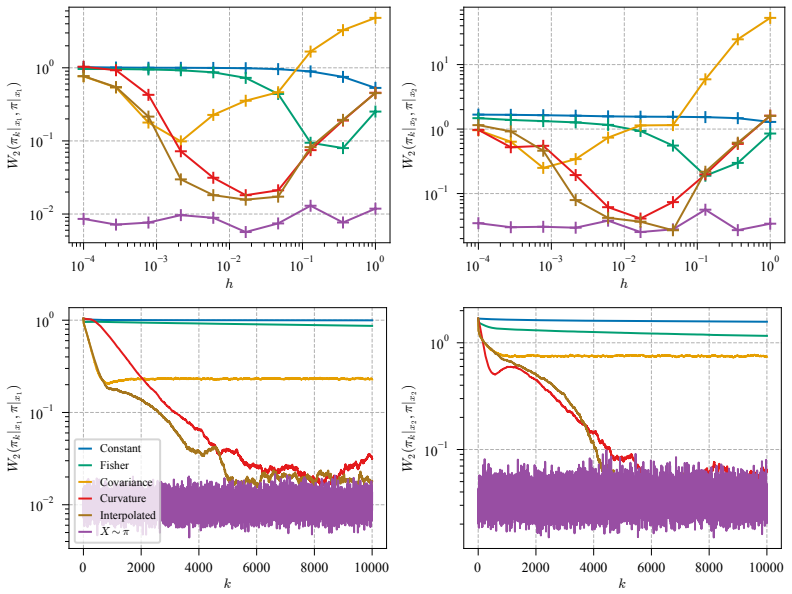
If the empirical Wasserstein-2 distance between the law of the discrete TIPreL iterates and the target fails to approach zero on a simple multimodal Gaussian mixture, the convergence claim would be refuted.
Figures






read the original abstract
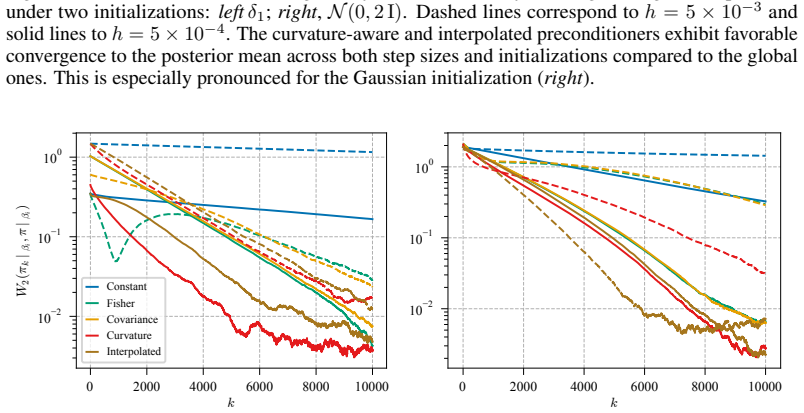
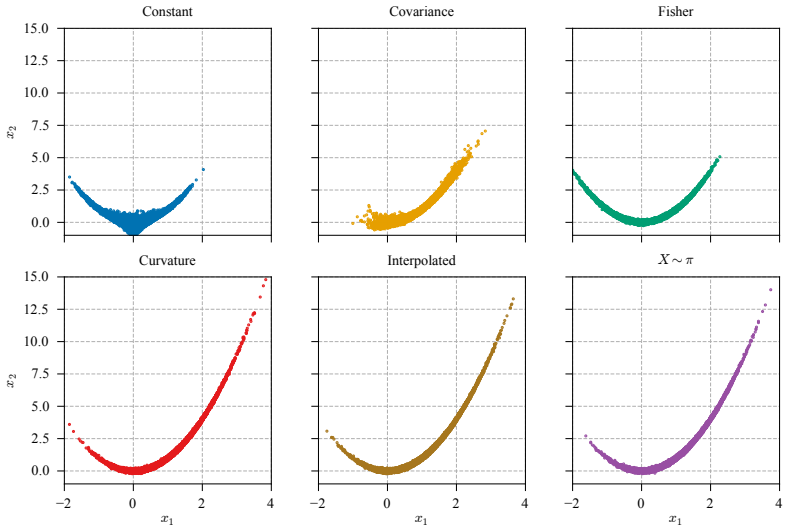
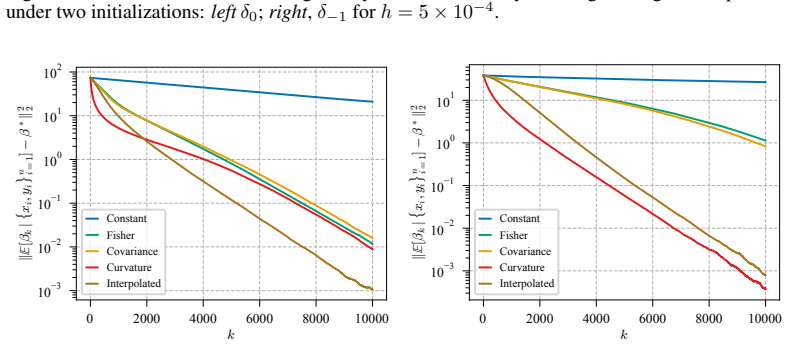
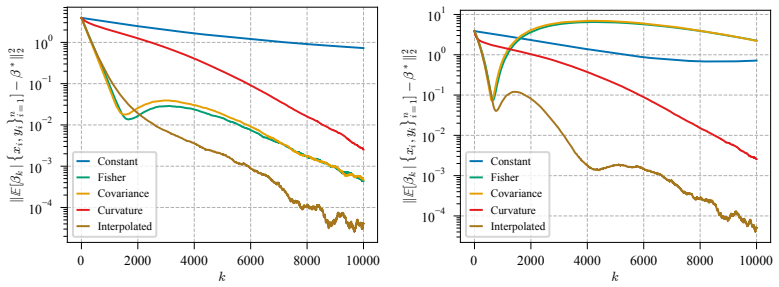
Langevin sampling from distributions of the form $p(x) \propto \exp(-\Psi(x))$ faces two major challenges: (global) mode coverage and (local) mode exploration. The first challenge is particularly relevant for multi-modal distributions with disjoint modes, whereas the second arises when the potential $\Psi$ exhibits diverse and ill-conditioned local mode geometry. To address these challenges, a common approach is to precondition Langevin dynamics with problem-specific information, such as the sample covariance or the local curvature of $\Psi$. However, existing preconditioner choices inherently involve a trade-off between global mode coverage and local mode exploration, and no prior method resolves both simultaneously. To overcome this limitation, we propose the TIPreL, which introduces a time- and position-dependent preconditioner. This design effectively addresses both challenges mentioned above within a single framework. We establish convergence of the resulting dynamics in the Wasserstein-2 distance both in continuous time and for a tamed Euler discretization. In particular, our analysis extends the existing state of the art by proving convergence under time- and space-dependent diffusion coefficients, and only locally Lipschitz drifts, which has not been covered by prior work. Finally, we experimentally compare TIPreL with competing preconditioning schemes on a two-dimensional, severely ill-posed example and on a Bayesian logistic regression task in higher dimensions, confirming the efficiency of the proposed method.
Editorial analysis
A structured set of objections, weighed in public.
Referee Report
Summary. The paper introduces Time-Inhomogeneous Preconditioned Langevin Dynamics (TIPreL), a Langevin sampler using a time- and position-dependent preconditioner to simultaneously address global mode coverage in multi-modal targets and local mode exploration in ill-conditioned potentials. It claims W2 convergence of the continuous dynamics and a tamed Euler discretization under time/space-dependent diffusion coefficients and merely locally Lipschitz drifts (extending prior work), and reports empirical gains over standard preconditioners on a 2D ill-posed example and Bayesian logistic regression.
Significance. If the bias-free construction of the preconditioner and the extended convergence theorems hold, the work would meaningfully advance preconditioned MCMC by removing the global/local trade-off and broadening the class of admissible drifts and diffusions. The combination of theory for time-inhomogeneous, position-dependent coefficients with practical experiments is a strength; reproducible code or explicit parameter-free constructions would further strengthen it.
major comments (3)
- [§2, §3] §2 (SDE definition) and §3 (invariant measure): for any position-dependent diffusion matrix the Fokker-Planck operator requires explicit Itô correction terms (divergence of the preconditioner) to ensure the stationary measure is exactly proportional to exp(−Ψ). The manuscript must state the precise SDE (including these terms) and verify that the resulting drift remains locally Lipschitz under the chosen preconditioner; otherwise the W2 convergence theorems do not apply to the intended target.
- [§4] Theorem on continuous-time W2 convergence (likely §4): the proof extends existing results to time- and space-dependent diffusion and locally Lipschitz drifts, but the argument relies on uniform ellipticity and growth conditions on the preconditioner. The paper should exhibit at least one explicit (or provably approximable) family of preconditioners that simultaneously satisfies these conditions, the exact invariant, and computational feasibility; the abstract’s claim that the design “effectively addresses both challenges” is not yet load-bearing without this construction.
- [§5] Tamed Euler discretization (discrete-time theorem): the taming function and step-size restrictions must be shown to preserve the local-Lipschitz property after the Itô corrections are included. If the taming alters the effective drift in a way that destroys the stationary measure or the ellipticity bound, the discrete convergence result does not follow from the continuous one.
minor comments (2)
- Notation for the preconditioner matrix and its divergence should be introduced once and used consistently; currently the abstract and main text appear to use slightly different symbols for the same object.
- The 2D experiment description should include the explicit form of the target potential and the chosen preconditioner schedule so that the reported efficiency gains can be reproduced.
Simulated Author's Rebuttal
We thank the referee for the constructive and detailed report. We address each major comment below, providing clarifications and indicating the revisions we will make to the manuscript.
read point-by-point responses
-
Referee: [§2, §3] §2 (SDE definition) and §3 (invariant measure): for any position-dependent diffusion matrix the Fokker-Planck operator requires explicit Itô correction terms (divergence of the preconditioner) to ensure the stationary measure is exactly proportional to exp(−Ψ). The manuscript must state the precise SDE (including these terms) and verify that the resulting drift remains locally Lipschitz under the chosen preconditioner; otherwise the W2 convergence theorems do not apply to the intended target.
Authors: We thank the referee for this comment. The SDE defining TIPreL in §2 is written in the Itô form that incorporates the divergence of the diffusion matrix (i.e., the Itô correction) in the drift term. This ensures that the associated Fokker-Planck equation has the target measure as its unique invariant. We will revise the presentation in §2 and §3 to display the SDE with the correction terms written out explicitly and to include a short verification that the resulting drift is locally Lipschitz for our choice of preconditioner. This will confirm the applicability of the W2 convergence results. revision: yes
-
Referee: [§4] Theorem on continuous-time W2 convergence (likely §4): the proof extends existing results to time- and space-dependent diffusion and locally Lipschitz drifts, but the argument relies on uniform ellipticity and growth conditions on the preconditioner. The paper should exhibit at least one explicit (or provably approximable) family of preconditioners that simultaneously satisfies these conditions, the exact invariant, and computational feasibility; the abstract’s claim that the design “effectively addresses both challenges” is not yet load-bearing without this construction.
Authors: We appreciate the referee's suggestion to make the preconditioner construction more explicit. The manuscript already introduces a specific family of time- and position-dependent preconditioners in §2 that is designed to balance global and local exploration, satisfies the uniform ellipticity and growth conditions, preserves the exact invariant measure, and is computationally feasible as demonstrated in the experiments. The convergence proof applies directly to this family. We believe this renders the abstract claim load-bearing; however, to address the concern, we will add a brief remark or proposition in §4 verifying that the construction meets all the stated assumptions. revision: partial
-
Referee: [§5] Tamed Euler discretization (discrete-time theorem): the taming function and step-size restrictions must be shown to preserve the local-Lipschitz property after the Itô corrections are included. If the taming alters the effective drift in a way that destroys the stationary measure or the ellipticity bound, the discrete convergence result does not follow from the continuous one.
Authors: The tamed Euler scheme in §5 applies the taming function to the complete drift, which includes the Itô correction terms arising from the position-dependent diffusion. The taming is constructed so as not to alter the stationary measure in the small-step-size limit and to preserve the local Lipschitz property and ellipticity bounds under the given step-size restrictions. We will augment §5 with an explicit statement or lemma showing that the tamed drift continues to satisfy the hypotheses of the continuous-time theorem, thereby ensuring the discrete convergence result holds. revision: yes
Circularity Check
No circularity: TIPreL proposal and W2 convergence proof are independent of inputs
full rationale
The paper defines a new time- and position-dependent preconditioner for Langevin dynamics and derives W2 convergence for the continuous process and tamed Euler scheme under time/space-dependent diffusion and locally Lipschitz drifts. No equation or claim reduces the target invariant, the preconditioner construction, or the convergence statement to a fitted parameter, self-definition, or unverified self-citation chain. The extension of prior SDE theory is presented as an independent analytic contribution, and the design choices are not shown to be tautological with the claimed stationary measure.
Axiom & Free-Parameter Ledger
axioms (2)
- domain assumption Existence and suitability of a time- and position-dependent preconditioner that meets the requirements for the dynamics and discretization.
- standard math Standard technical conditions for Wasserstein-2 convergence of SDEs with variable coefficients.
Reference graph
Works this paper leans on
-
[1]
Lorenzo Baldassari, Josselin Garnier, Knut Solna, and Maarten V de Hoop. Dimension-free multimodal sampling via preconditioned annealed langevin dynamics.arXiv preprint arXiv:2602.01449, 2026
-
[2]
A general metric for riemannian manifold hamiltonian monte carlo
Michael Betancourt. A general metric for riemannian manifold hamiltonian monte carlo. InInternational conference on geometric science of information, pages 327–334. Springer, 2013
2013
-
[3]
Sampling and estimation on manifolds using the langevin diffusion.Journal of Machine Learning Research, 26(71):1–50, 2025
Karthik Bharath, Alexander Lewis, Akash Sharma, and Michael V Tretyakov. Sampling and estimation on manifolds using the langevin diffusion.Journal of Machine Learning Research, 26(71):1–50, 2025
2025
-
[4]
American Mathematical Society, 2022
Vladimir I Bogachev, Nicolai V Krylov, Michael Röckner, and Stanislav V Shaposhnikov.Fokker–Planck– Kolmogorov Equations, volume 207. American Mathematical Society, 2022
2022
-
[5]
Concentration inequalities
Stéphane Boucheron, Gábor Lugosi, and Olivier Bousquet. Concentration inequalities. InSummer school on machine learning, pages 208–240. Springer, 2003
2003
-
[6]
The tamed unadjusted langevin algorithm.Stochastic Processes and their Applications, 129(10):3638–3663, 2019
Nicolas Brosse, Alain Durmus, Éric Moulines, and Sotirios Sabanis. The tamed unadjusted langevin algorithm.Stochastic Processes and their Applications, 129(10):3638–3663, 2019
2019
-
[7]
Omar Chehab, Anna Korba, Austin Stromme, and Adrien Vacher. Provable convergence and limitations of geometric tempering for langevin dynamics.arXiv preprint arXiv:2410.09697, 2024
-
[8]
Chatterji, Peter L
Xiang Cheng, Niladri S. Chatterji, Peter L. Bartlett, and Michael I. Jordan. Underdamped langevin mcmc: A non-asymptotic analysis. In Sébastien Bubeck, Vianney Perchet, and Philippe Rigollet, editors, Proceedings of the 31st Conference On Learning Theory, volume 75 ofProceedings of Machine Learning Research, pages 300–323. PMLR, 06–09 Jul 2018. URL https:...
2018
-
[9]
Expo- nential ergodicity of mirror-Langevin diffusions
Sinho Chewi, Thibaut Le Gouic, Chen Lu, Tyler Maunu, Philippe Rigollet, and Austin Stromme. Expo- nential ergodicity of mirror-Langevin diffusions. InAdvances in Neural Information Processing Systems, volume 33, pages 19573–19585. Curran Associates, Inc., 2020. URL https://proceedings.neurips. cc/paper/2020/hash/e3251075554389fe91d17a794861d47b-Abstract.html
2020
-
[10]
Schervish, Ketra A
Taeryon Choi, Mark J. Schervish, Ketra A. Schmitt, and Mitchell J. Small. A bayesian approach to a logistic regression model with incomplete information.Biometrics, 64(2):424–430, 2008
2008
-
[11]
Paula Cordero-Encinar, O Deniz Akyildiz, and Andrew B Duncan. Non-asymptotic analysis of diffusion annealed langevin monte carlo for generative modelling.arXiv preprint arXiv:2502.09306, 2025
-
[12]
Dalalyan
Arnak S. Dalalyan. Theoretical Guarantees for Approximate Sampling from Smooth and Log-Concave Densities.Journal of the Royal Statistical Society Series B: Statistical Methodology, 79(3):651–676, 2017
2017
-
[13]
UCI machine learning repository, 2017
Dheeru Dua and Casey Graff. UCI machine learning repository, 2017
2017
-
[14]
doi:10.1214/16-AAP1238 , journal =
Alain Durmus and Éric Moulines. Nonasymptotic convergence analysis for the unadjusted Langevin algorithm.The Annals of Applied Probability, 27(3):1551 – 1587, 2017. doi: 10.1214/16-AAP1238. URL https://doi.org/10.1214/16-AAP1238
-
[15]
Analysis of langevin monte carlo via convex optimization.J
Alain Oliviero Durmus, Szymon Majewski, and Bła˙zej Miasojedow. Analysis of langevin monte carlo via convex optimization.J. Mach. Learn. Res., 20:73:1–73:46, 2018
2018
-
[16]
An inertial langevin algorithm.arXiv preprint arXiv:2510.06723, 2025
Alexander Falk, Andreas Habring, Christoph Griesbacher, and Thomas Pock. An inertial langevin algorithm.arXiv preprint arXiv:2510.06723, 2025
-
[17]
Convergence of the riemannian langevin algorithm.arXiv preprint arXiv:2204.10818, 2022
Khashayar Gatmiry and Santosh S Vempala. Convergence of the riemannian langevin algorithm.arXiv preprint arXiv:2204.10818, 2022. 10
-
[18]
Mark Girolami and Ben Calderhead. Riemann manifold Langevin and Hamiltonian Monte Carlo methods.Journal of the Royal Statistical Society: Series B (Statistical Methodol- ogy), 73(2):123–214, 2011. ISSN 1467-9868. doi: 10.1111/j.1467-9868.2010.00765.x. URL https://onlinelibrary.wiley.com/doi/abs/10.1111/j.1467-9868.2010.00765.x. _eprint: https://rss.online...
-
[19]
Forward-kl convergence of time-inhomogeneous langevin diffusions
Andreas Habring and Martin Zach. Forward-kl convergence of time-inhomogeneous langevin diffusions. arXiv preprint arXiv:2601.22349, 2026
work page internal anchor Pith review arXiv 2026
-
[20]
Energy-based models for inverse imaging problems.arXiv preprint arXiv:2507.12432, 2025
Andreas Habring, Martin Holler, Thomas Pock, and Martin Zach. Energy-based models for inverse imaging problems.arXiv preprint arXiv:2507.12432, 2025
-
[21]
Diffusion at absolute zero: Langevin sampling using successive moreau envelopes.SIAM Journal on Imaging Sciences, 19(1):35–77, 2026
Andreas Habring, Alexander Falk, Martin Zach, and Thomas Pock. Diffusion at absolute zero: Langevin sampling using successive moreau envelopes.SIAM Journal on Imaging Sciences, 19(1):35–77, 2026
2026
-
[22]
Kenneth M. Hanson and Gregory S. Cunningham. Posterior sampling with improved efficiency. In Medical Imaging 1998: Image Processing, volume 3338, pages 371–382. SPIE, June 1998. doi: 10.1117/ 12.310914. URL https://www.spiedigitallibrary.org/conference-proceedings-of-spie/ 3338/0000/Posterior-sampling-with-improved-efficiency/10.1117/12.310914.full
-
[23]
Springer Science & Business Media, 1991
Ioannis Karatzas and Steven Shreve.Brownian motion and stochastic calculus, volume 113. Springer Science & Business Media, 1991
1991
-
[24]
H. Lamba, J. C. Mattingly, and A. M. Stuart. An adaptive euler–maruyama scheme for sdes: convergence and stability.IMA Journal of Numerical Analysis, 27(3):479–506, 07 2007. ISSN 0272-4979. doi: 10.1093/imanum/drl032. URLhttps://doi.org/10.1093/imanum/drl032
-
[25]
Benedict Leimkuhler, Charles Matthews, and Jonathan Weare. Ensemble preconditioning for Markov chain Monte Carlo simulation.Statistics and Computing, 28(2):277–290, March 2018. ISSN 1573-1375. doi: 10.1007/s11222-017-9730-1. URLhttps://doi.org/10.1007/s11222-017-9730-1
-
[26]
Elsevier, 2007
Xuerong Mao.Stochastic differential equations and applications. Elsevier, 2007
2007
-
[27]
Wilcox, Carsten Burstedde, and Omar Ghattas
James Martin, Lucas C. Wilcox, Carsten Burstedde, and Omar Ghattas. A Stochastic Newton MCMC Method for Large-Scale Statistical Inverse Problems with Application to Seismic Inversion.SIAM Journal on Scientific Computing, 34(3):A1460–A1487, January 2012. ISSN 1064-8275. doi: 10.1137/110845598. URL https://epubs.siam.org/doi/abs/10.1137/110845598. Publisher...
-
[28]
Dominik Narnhofer, Andreas Habring, Martin Holler, and Thomas Pock. Posterior-variance–based error quantification for inverse problems in imaging.SIAM Journal on Imaging Sciences, 17(1):301–333, 2024. doi: 10.1137/23M1546129
-
[29]
Wright.Numerical Optimization
Jorge Nocedal and Stephen J. Wright.Numerical Optimization. Springer series in operations research and financial engineering. Springer, New York, NY , second edition edition, 2006. ISBN 978-0-387-30303-1 978-0-387-40065-5
2006
-
[30]
F. Otto and C. Villani. Generalization of an inequality by talagrand and links with the logarithmic sobolev inequality.Journal of Functional Analysis, 173(2):361–400, 2000. ISSN 0022-1236. doi: https://doi.org/10.1006/jfan.1999.3557. URL https://www.sciencedirect.com/science/article/ pii/S0022123699935577
-
[31]
Hessian-based Markov Chain Monte-Carlo Algorithms
Yuan Qi and Tom Minka. Hessian-based Markov Chain Monte-Carlo Algorithms. September 2002. URL https://www.microsoft.com/en-us/research/publication/ hessian-based-markov-chain-monte-carlo-algorithms/
2002
-
[32]
Roberts and Richard L
Gareth O. Roberts and Richard L. Tweedie. Exponential convergence of Langevin distributions and their discrete approximations.Bernoulli, 2(4):341–363, 1996
1996
-
[33]
H. H. Rosenbrock. An Automatic Method for Finding the Greatest or Least Value of a Function.The Computer Journal, 3(3):175–184, January 1960. ISSN 0010-4620. doi: 10.1093/comjnl/3.3.175. URL https://doi.org/10.1093/comjnl/3.3.175
-
[34]
Stochastic quasi-newton langevin monte carlo
Umut Simsekli, Roland Badeau, Taylan Cemgil, and Gaël Richard. Stochastic quasi-newton langevin monte carlo. In Maria Florina Balcan and Kilian Q. Weinberger, editors,Proceedings of The 33rd International Conference on Machine Learning, volume 48 ofProceedings of Machine Learning Research, pages 642– 651, New York, New York, USA, 20–22 Jun 2016. PMLR. URL...
2016
-
[35]
Generative modeling by estimating gradients of the data distribution
Yang Song and Stefano Ermon. Generative modeling by estimating gradients of the data distribution. Advances in neural information processing systems, 32, 2019
2019
-
[36]
Vishwak Srinivasan, Andre Wibisono, and Ashia Wilson. High-accuracy sampling from constrained spaces with the metropolis-adjusted preconditioned langevin algorithm.arXiv preprint arXiv:2412.18701, 2024
-
[37]
Optimal preconditioning and fisher adaptive langevin sampling
Michalis Titsias. Optimal preconditioning and fisher adaptive langevin sampling. In A. Oh, T. Naumann, A. Globerson, K. Saenko, M. Hardt, and S. Levine, editors,Ad- vances in Neural Information Processing Systems, volume 36, pages 29449–29460. Curran Asso- ciates, Inc., 2023. URL https://proceedings.neurips.cc/paper_files/paper/2023/file/ 5da6d5818a156791...
2023
-
[38]
Li-Li Wang and Guang-Hui Zheng. Solving Bayesian inverse problems via Fisher adaptive Metropolis ad- justed Langevin algorithm, March 2025. URLhttp://arxiv.org/abs/2503.09374. arXiv:2503.09374 [math]
-
[39]
T. Xifara, C. Sherlock, S. Livingstone, S. Byrne, and M. Girolami. Langevin diffusions and the Metropolis- adjusted Langevin algorithm.Statistics & Probability Letters, 91:14–19, August 2014. ISSN 0167-7152. doi: 10.1016/j.spl.2014.04.002. URL https://www.sciencedirect.com/science/article/pii/ S0167715214001333
-
[40]
Computed tomography reconstruction using generative energy-based priors
Martin Zach, Erich Kobler, and Thomas Pock. Computed tomography reconstruction using generative energy-based priors. In Markus Seidl, Matthias Zeppelzauer, and Peter M. Roth, editors,Proceedings of the OAGM Workshop 2021, pages 52–58. Verlag der Technischen Universität Graz, December 2021. doi: 10.3217/978-3-85125-869-1-09
-
[41]
Zhiyuan Zhan and Masashi Sugiyama. Riemannian langevin dynamics: Strong convergence of geometric euler-maruyama scheme.arXiv preprint arXiv:2603.03626, 2026
-
[42]
Quasi-Newton Methods for Markov Chain Monte Carlo
Yichuan Zhang and Charles Sutton. Quasi-Newton Methods for Markov Chain Monte Carlo. InAdvances in Neural Information Processing Systems, volume 24. Curran As- sociates, Inc., 2011. URL https://proceedings.neurips.cc/paper/2011/hash/ e702e51da2c0f5be4dd354bb3e295d37-Abstract.html. A Postponed proofs In the following we provide a detailed convergence analy...
2011
discussion (0)
Sign in with ORCID, Apple, or X to comment. Anyone can read and Pith papers without signing in.