Recognition: unknown
Uncovering Entity Identity Confusion in Multimodal Knowledge Editing
Pith reviewed 2026-05-08 10:39 UTC · model grok-4.3
The pith
Multimodal knowledge editing produces entity identity confusion because it leaves image-entity bindings unchanged while only swapping entity names.
A machine-rendered reading of the paper's core claim, the machinery that carries it, and where it could break.
Core claim
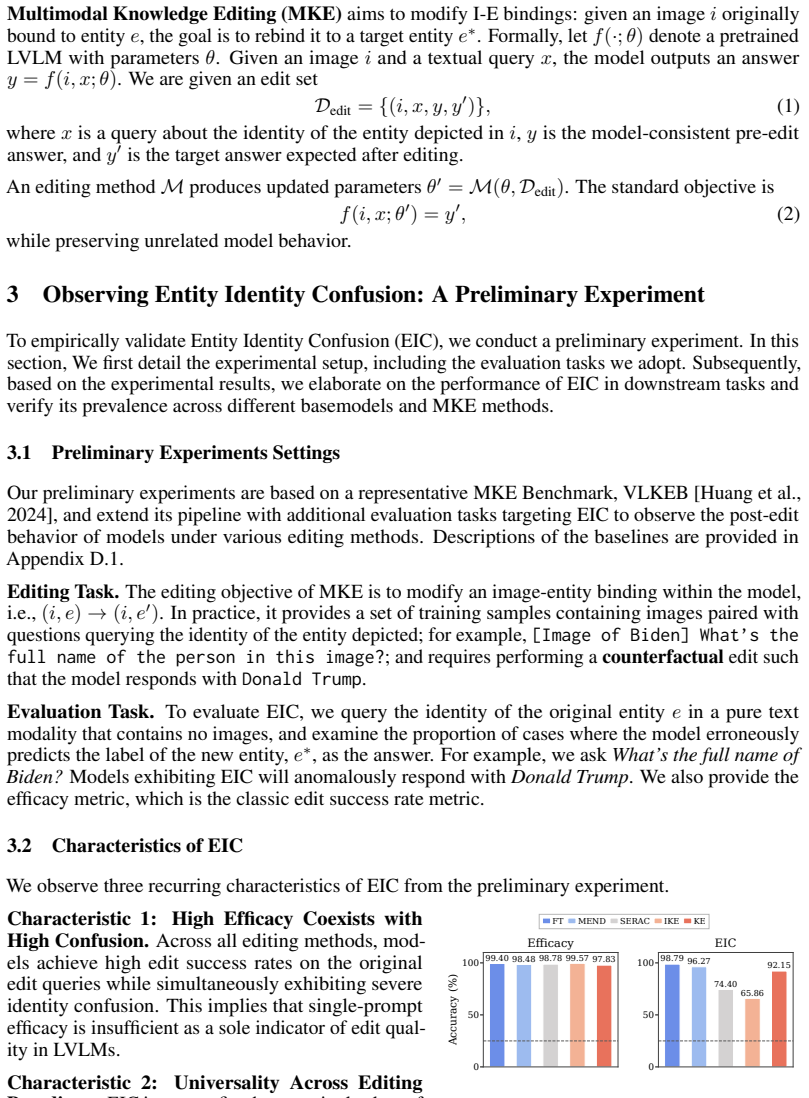
Edited models exhibit Entity Identity Confusion on text-only queries about the original entity, returning information tied to the new entity. This stems from methods that fail to isolate Image-Entity binding from Entity-Entity relational knowledge, so the model overfits the latter as a shortcut: the image remains bound to the original entity and the new name serves only as a spurious label. Directing edits specifically at the image-entity processing stage makes updates act on the binding itself and reduces the confusion.
What carries the argument
The separation of Image-Entity (I-E) binding from Entity-Entity (E-E) relational knowledge; existing methods conflate the two and therefore treat new names as labels rather than updating what the image represents.
If this is right
- Post-edit models will return new-entity facts for text queries that name only the original entity.
- Edits limited to the image-entity processing stage produce lower rates of identity confusion than unconstrained methods.
- Faithful multimodal knowledge editing must explicitly manage image-entity bindings separately from entity-entity relations to avoid spurious label associations.
- Diagnostic benchmarks that isolate binding shifts before and after editing are required to detect such failures.
Where Pith is reading between the lines
- The same binding shortcut could appear in mixed image-text queries that follow editing, not only in pure text probes.
- Methods that add explicit binding modules or loss terms during editing may generalize the reduction in confusion to other editing scenarios.
- The distinction between binding and relational knowledge offers a template for diagnosing editing failures in other multimodal or multi-relational settings.
Load-bearing premise
The observed text-only confusion arises because the model keeps the original image-entity binding and uses the new name only as a spurious label, rather than from unrelated internal factors or query design.
What would settle it
Apply I-E-constrained edits to the same models and measure whether text-only queries about the original entity still return new-entity information at the same rate as standard edits; a lack of reduction would falsify the binding-shortcut explanation.
Figures


read the original abstract
Multimodal knowledge editing (MKE) aims to correct the internal knowledge of large vision-language models after deployment, yet the behavioral patterns of post-edit models remain underexplored. In this paper, we identify a systemic failure mode in edited models, termed Entity Identity Confusion (EIC): edited models exhibit an absurd behavior where text-only queries about the original entity's identity unexpectedly return information about the new entity. To rigorously investigate EIC, we construct EC-Bench, a diagnostic benchmark that directly probes how image-entity bindings shift before and after editing. Our analysis reveals that EIC stems from existing methods failing to distinguish between Image-Entity (I-E) binding and Entity-Entity (E-E) relational knowledge in the model, causing models to overfit E-E associations as a shortcut: the image is still perceived as the original entity, with the new entity's name serving only as a spurious identity label. We further explore potential mitigation strategies, showing that constraining edits to the model's I-E processing stage encourages edits to act more faithfully on I-E binding, thereby substantially reducing EIC. Based on these findings, we discuss principled desiderata for faithful MKE and provide methodological guidance for future research.
Editorial analysis
A structured set of objections, weighed in public.
Referee Report
Summary. The paper identifies Entity Identity Confusion (EIC) as a failure mode in multimodal knowledge editing (MKE) of vision-language models, where post-edit models return facts about the new entity in response to text-only queries about the original entity. It introduces the EC-Bench diagnostic benchmark to measure shifts in image-entity bindings, attributes EIC to existing methods' failure to separate Image-Entity (I-E) bindings from Entity-Entity (E-E) relational knowledge (leading to retention of original image bindings and treatment of the new name as a spurious label), demonstrates that constraining edits to the I-E processing stage reduces EIC, and discusses desiderata for faithful MKE.
Significance. If the empirical results and causal attribution hold, the work is significant for exposing an underexplored behavioral pathology in MKE, supplying a targeted diagnostic benchmark (EC-Bench), and offering a concrete mitigation direction. These contributions could guide more reliable cross-modal editing techniques, particularly given the growing deployment of vision-language models.
major comments (2)
- [Abstract and analysis section] Abstract and analysis section: The claim that EIC arises specifically because methods fail to distinguish I-E binding from E-E relations (with the image still bound to the original entity) rests on behavioral observations from text-only queries in EC-Bench. No direct internal evidence (e.g., cross-modal attention maps, embedding cosine similarities between image and entity representations, or targeted interventions on vision-language layers) is reported to isolate retained I-E bindings from alternatives such as editing-induced shifts in language priors or query formulation artifacts.
- [Mitigation experiments] Mitigation experiments: The finding that constraining edits to the I-E processing stage substantially reduces EIC requires explicit specification of the implementation (targeted layers, modified loss, or architectural constraints) and ablations confirming that the improvement is not simply due to weaker overall editing or reduced edit success on standard MKE metrics.
minor comments (2)
- [Introduction] The paper should include a clear diagram or formal notation defining I-E versus E-E bindings early in the text to aid readability.
- [Benchmark construction] Ensure EC-Bench construction details (query templates, entity selection criteria, and controls for phrasing variations) are fully documented to allow reproduction.
Simulated Author's Rebuttal
We sincerely thank the referee for their insightful comments, which help clarify the presentation of our contributions on Entity Identity Confusion (EIC) in multimodal knowledge editing. We address each major comment below and have revised the manuscript to incorporate additional details and analyses where needed.
read point-by-point responses
-
Referee: [Abstract and analysis section] Abstract and analysis section: The claim that EIC arises specifically because methods fail to distinguish I-E binding from E-E relations (with the image still bound to the original entity) rests on behavioral observations from text-only queries in EC-Bench. No direct internal evidence (e.g., cross-modal attention maps, embedding cosine similarities between image and entity representations, or targeted interventions on vision-language layers) is reported to isolate retained I-E bindings from alternatives such as editing-induced shifts in language priors or query formulation artifacts.
Authors: We thank the referee for this observation. Our primary evidence for the I-E vs. E-E distinction indeed derives from the controlled behavioral probes in EC-Bench, which include multiple controls (unedited baselines, varied query formulations, and comparisons across editing methods) to make alternative explanations such as language prior shifts or query artifacts less plausible. That said, we agree that internal mechanistic evidence would provide stronger causal support. In the revised manuscript, we will add embedding cosine similarity analyses between image representations and entity token embeddings pre- and post-edit, along with a brief discussion of how these results align with the behavioral findings and rule out the alternatives raised. revision: yes
-
Referee: [Mitigation experiments] Mitigation experiments: The finding that constraining edits to the I-E processing stage substantially reduces EIC requires explicit specification of the implementation (targeted layers, modified loss, or architectural constraints) and ablations confirming that the improvement is not simply due to weaker overall editing or reduced edit success on standard MKE metrics.
Authors: We appreciate this request for greater specificity. The original manuscript outlines the high-level strategy of constraining edits to the I-E processing stage but does not fully detail the implementation. In the revision, we will explicitly describe the targeted layers within the vision-language architecture, the precise form of the constraint (including any modified loss terms), and the architectural choices used. We will also include new ablations that report edit success rates on standard MKE metrics (fact recall, generalization, and locality) for both constrained and unconstrained variants, demonstrating that the reduction in EIC occurs without a corresponding drop in overall editing performance. revision: yes
Circularity Check
No circularity: empirical benchmark analysis with interpretive causal claim
full rationale
The paper defines Entity Identity Confusion (EIC) directly from observed post-edit model behavior on text-only queries and introduces EC-Bench as an independent diagnostic to probe image-entity binding shifts. The attribution of EIC to failure in distinguishing I-E bindings from E-E relations is presented as an interpretation of benchmark results rather than a derivation that reduces to fitted parameters, self-definitions, or self-citation chains. No equations, uniqueness theorems, or ansatzes are invoked that collapse the central claim back to its inputs by construction. The mitigation experiments and desiderata follow from the same empirical observations, keeping the work self-contained against external benchmarks.
Axiom & Free-Parameter Ledger
axioms (1)
- domain assumption Multimodal models internally maintain distinguishable Image-Entity bindings separate from Entity-Entity relational knowledge.
invented entities (2)
-
Entity Identity Confusion (EIC)
no independent evidence
-
EC-Bench
no independent evidence
Reference graph
Works this paper leans on
-
[1]
Transformer Feed-Forward Layers Are Key-Value Memories
Association for Computational Linguistics. doi: 10.18653/v1/2021.emnlp-main.446. URL https://aclanthology.org/2021.emnlp-main.446/. Mor Geva, Jasmijn Bastings, Katja Filippova, and Amir Globerson. Dissecting recall of factual associations in auto-regressive language models. In Houda Bouamor, Juan Pino, and Kalika Bali, editors,Proceedings of the 2023 Conf...
work page internal anchor Pith review doi:10.18653/v1/2021.emnlp-main.446 2021
-
[2]
Who is the actor featured in this image?
URLhttps://arxiv.org/abs/2601.11042. 11 Junzhe Zhang, Huixuan Zhang, Xunjian Yin, Baizhou Huang, Xu Zhang, Xinyu Hu, and Xiaojun Wan. MC-MKE: A fine-grained multimodal knowledge editing benchmark emphasizing modality consistency. In Wanxiang Che, Joyce Nabende, Ekaterina Shutova, and Mohammad Taher Pilehvar, editors,Findings of the Association for Computa...
-
[3]
Choose a very simple property, relation, or description of the pred entity that makes the correct option highly predictable
-
[4]
The question must strongly guide the model to output exactly one letter: A or B
-
[5]
The question must end with a strong answer cue that explicitly requests one letter only
-
[6]
Option A must be the correct completion for the pred entity
-
[7]
Option B must be the correct completion for the alt entity
-
[8]
Keep both options short, factual, and easy to read
-
[9]
Use the exact four labels below
-
[10]
Answer with one letter only (A or B):
Output exactly four lines: •question_template: <sentence with __SUBJECT__ placeholder and no options> •answer_a: <pred answer option> •answer_b: <alt answer option> 15 •question_suffix: <strong final cue, for example “Answer with one letter only (A or B):”> Rules:
-
[11]
Do not use yes/no wording
-
[12]
Do not output explanations
-
[13]
Do not make the question too hard or too specific
-
[14]
Do not use punctuation that makes the answer ambiguous
-
[15]
Keep option text lowercase if possible
-
[16]
the man in this image
Do not include the options inside the template line. Example 1: Input: pred entity: Monte Carlo alt entity: Marrakesh Output: question_template: __SUBJECT__ is a district of the principality of answer_a: monaco answer_b: morocco question_suffix: Answer with one letter only (A or B): Example 2: Input: pred entity: Shine (film) alt entity: Please Give Outpu...
2004
discussion (0)
Sign in with ORCID, Apple, or X to comment. Anyone can read and Pith papers without signing in.