Recognition: unknown
Two-mode geometry controls multiscale organization in bipartite systems
Pith reviewed 2026-05-08 04:02 UTC · model grok-4.3
The pith
Structural imbalance in bipartite networks reshapes multiscale organization while leaving scaling properties unchanged.
A machine-rendered reading of the paper's core claim, the machinery that carries it, and where it could break.
Core claim
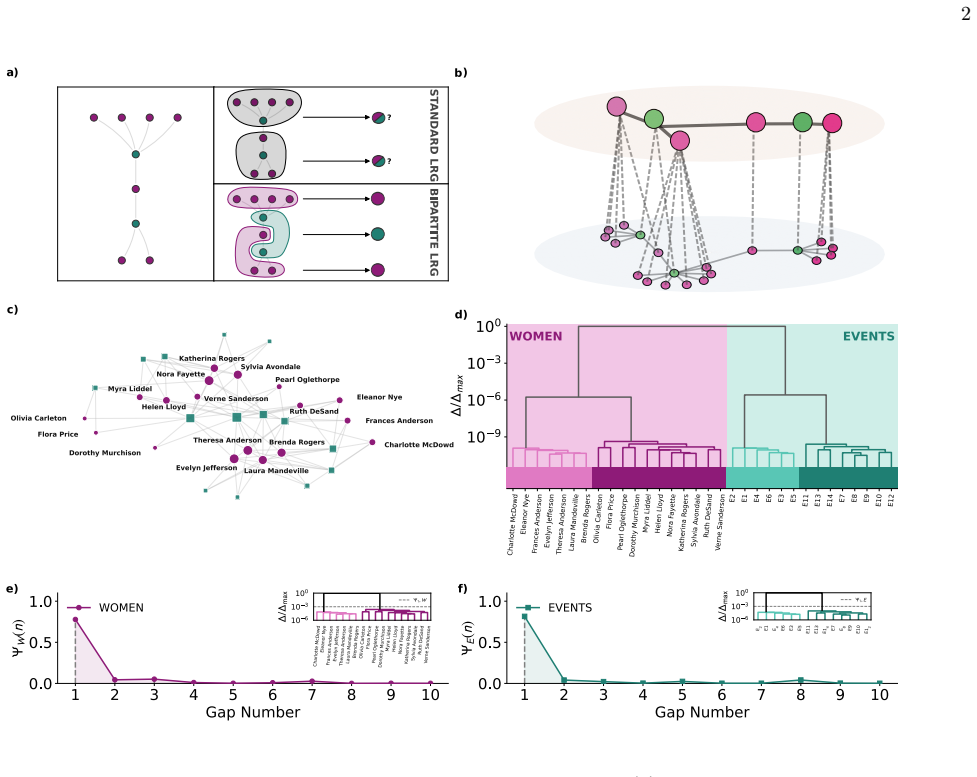
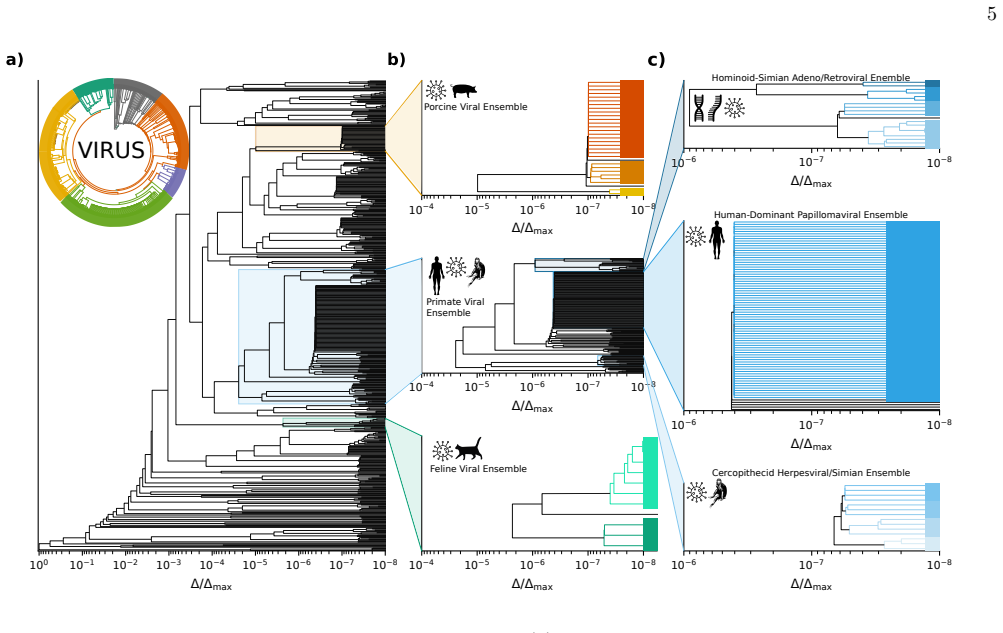
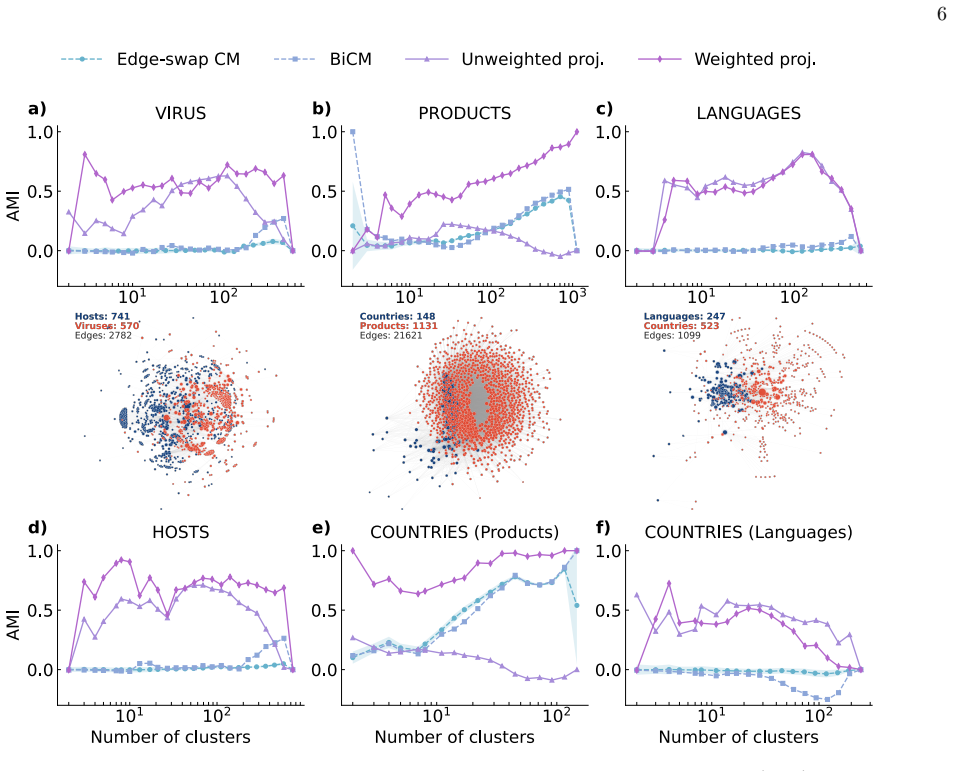
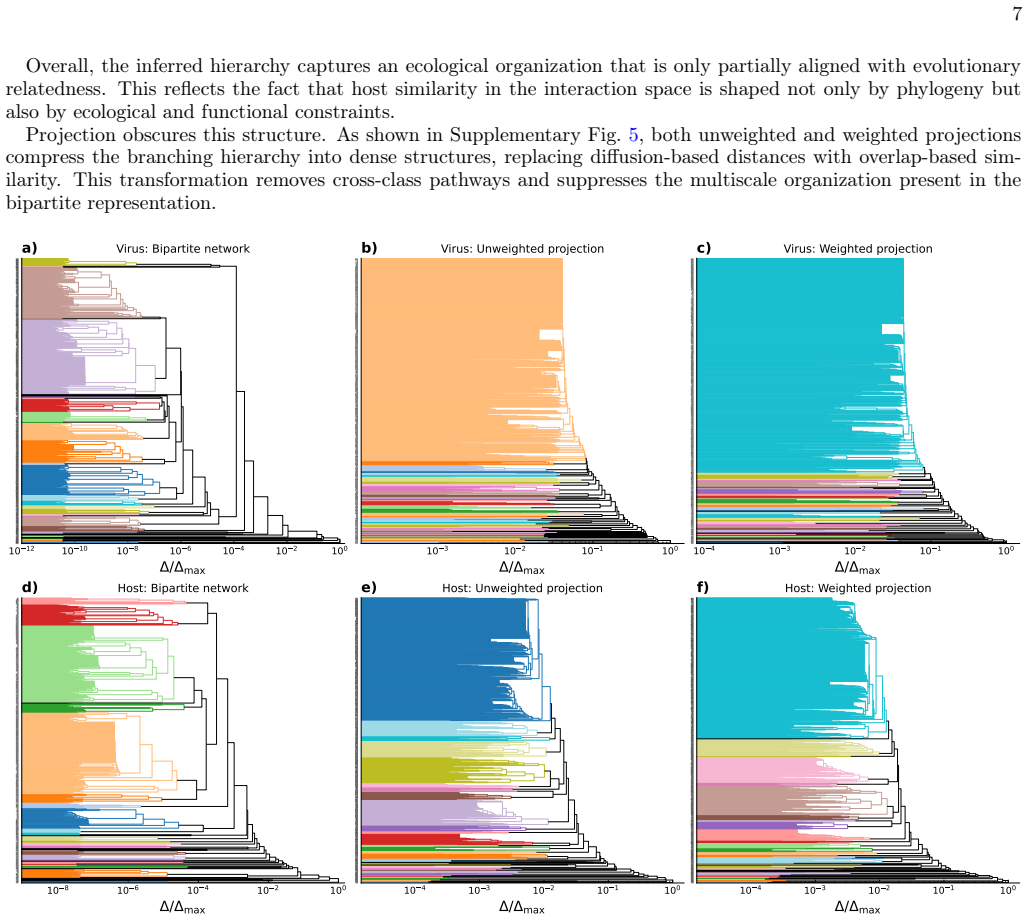
A Laplacian-based renormalization framework is defined that performs coarse-graining while keeping the two node partitions distinct. On critical bipartite ensembles, variation in structural imbalance produces different organization patterns at successive scales, yet the scaling relations stay invariant. In empirical networks the direct method exposes nontrivial multiscale hierarchies for both partitions; performing renormalization after one-mode projection, which restricts diffusion to nearest neighbors, produces qualitatively different structures.
What carries the argument
Laplacian-based renormalization framework that operates directly on the bipartite architecture to enable scale transformations while retaining role differentiation.
If this is right
- Scaling properties of bipartite networks remain unchanged under different levels of structural imbalance.
- Multiscale hierarchies observed in empirical bipartite data require direct two-mode renormalization to appear correctly.
- One-mode projections truncate diffusion paths and therefore produce incorrect multiscale structures.
- Role separation is maintained across coarse-grained scales only when the original bipartite geometry is preserved.
Where Pith is reading between the lines
- The separation of scaling invariance from geometry suggests that bipartite critical behavior may fall into the same universality class irrespective of balance ratios.
- Applying the framework to additional real-world bipartite systems could test whether the revealed hierarchies are a general feature of role-separated networks.
- Analogous direct renormalization schemes may be required for other systems with strict partition constraints to avoid projection-induced distortions.
Load-bearing premise
The Laplacian-based renormalization correctly preserves the essential multiscale features of bipartite systems without artifacts from the coarse-graining steps.
What would settle it
In controlled critical bipartite ensembles, observing that scaling exponents shift when structural imbalance is varied would disprove the claimed invariance.
Figures







read the original abstract
Many complex systems are organized around complementary roles and naturally described as bipartite networks. Unveiling their multiscale structure presents a fundamental challenge because coarse-graining procedures must preserve role separation, whereas standard approaches collapse it via one-mode projections. Here we introduce a Laplacian-based renormalization framework that operates directly on the bipartite architecture, enabling scale transformations while retaining role differentiation. Using controlled bipartite ensembles at criticality, we show that structural imbalance systematically reshapes organization across scales while leaving scaling properties invariant, revealing a separation between universality and geometry. Applying the coarse-graining framework to empirical bipartite networks, we uncover nontrivial multiscale hierarchies for both roles. In contrast, renormalization performed after one-mode projection -- which truncates diffusion paths to nearest neighbors -- yields qualitatively different structures. Our results identify two-mode geometry as a fundamental constraint for revealing multiscale organization in systems with role separation.
Editorial analysis
A structured set of objections, weighed in public.
Referee Report
Summary. The paper introduces a Laplacian-based renormalization framework that operates directly on bipartite networks to enable coarse-graining while preserving the separation between the two modes, avoiding artifacts from one-mode projections. Using controlled bipartite ensembles tuned to criticality, it demonstrates that structural imbalance reshapes multiscale organization across scales but leaves scaling properties invariant, thereby separating geometric effects from universal scaling behavior. The framework is then applied to empirical bipartite networks, uncovering nontrivial multiscale hierarchies for both roles, with explicit contrasts showing that post-projection renormalization produces qualitatively different structures.
Significance. If the central claims hold, the work provides a valuable tool for analyzing multiscale organization in bipartite systems with role separation, such as ecological or social networks, by isolating the effects of two-mode geometry. Strengths include the use of controlled critical ensembles for testing invariance and direct empirical comparisons against projection-based methods, which supply internal consistency checks. The separation of universality from geometry is a potentially impactful conceptual contribution to network science.
minor comments (3)
- The description of the bipartite Laplacian renormalization procedure would benefit from an explicit statement of how the coarse-graining operator is constructed to ensure it does not truncate diffusion paths in a manner analogous to projections; a short derivation or pseudocode would aid reproducibility.
- In the empirical section, the specific metrics used to identify 'nontrivial multiscale hierarchies' (e.g., community detection scores, participation coefficients, or renormalization flow diagrams) should be defined with reference to the relevant equations or figures.
- The abstract states that scaling properties remain invariant; a brief parenthetical example of the invariant quantity (such as a particular exponent or correlation function) would help readers immediately grasp the distinction from the geometry-driven reorganization.
Simulated Author's Rebuttal
We thank the referee for their supportive summary and recommendation of minor revision. We are pleased that the conceptual separation between two-mode geometry and scaling invariance, along with the direct comparisons to projection-based renormalization, is viewed as a potentially impactful contribution.
Circularity Check
No significant circularity; derivation self-contained
full rationale
The paper introduces a Laplacian-based renormalization framework operating directly on bipartite graphs, then applies it to independently generated critical ensembles and empirical networks to demonstrate invariant scaling alongside geometry-driven reorganization. Claims rest on explicit contrasts with one-mode projections and controlled tests rather than any fitted parameter renamed as prediction, self-referential definition, or load-bearing self-citation chain. No equation or step reduces by construction to its own input; the separation of universality from two-mode geometry follows from the framework's application to external benchmarks.
Axiom & Free-Parameter Ledger
axioms (1)
- domain assumption A Laplacian operator exists that enables renormalization directly on bipartite graphs while preserving bipartiteness and role differentiation.
Reference graph
Works this paper leans on
-
[1]
H. A. Simon, Proc. Am. Philos. Soc.106, 467 (1962)
1962
-
[2]
Bascompte, P
J. Bascompte, P. Jordano, C. J. Melián, and J. M. Ole- sen, Proc. Natl. Acad. Sci. U.S.A.100, 9383 (2003)
2003
-
[3]
Latapy, C
M. Latapy, C. Magnien, and N. Del Vecchio, Soc. Netw. 30, 31 (2008)
2008
-
[4]
Latora, V
V. Latora, V. Nicosia, and G. Russo,Complex Networks: Principles, Methods and Applications(Cambridge Uni- versity Press, New York, NY, USA, 2017)
2017
-
[5]
S. P. Borgatti and M. G. Everett, Soc. Netw.19, 243 (1997)
1997
-
[6]
Holme, F
P. Holme, F. Liljeros, C. R. Edling, and B. J. Kim, Phys. Rev. E68, 056107 (2003)
2003
-
[7]
Guillaume and M
J.-L. Guillaume and M. Latapy, Information Processing Letters90, 215 (2004)
2004
-
[8]
Bastolla, M
U. Bastolla, M. A. Fortuna, A. Pascual-García, A. Fer- rera, B. Luque, and J. Bascompte, Nature458, 1018 (2009)
2009
-
[9]
C. A. Hidalgo, B. Klinger, A.-L. Barabási, and R. Haus- mann, Science317, 482 (2007)
2007
-
[10]
Jeong, B
H. Jeong, B. Tombor, R. Albert, Z. N. Oltvai, and A.-L. Barabási, Nature407, 651 (2000)
2000
-
[11]
M. E. J. Newman, Phys. Rev. E64, 016131 (2001)
2001
-
[12]
Bascompte and P
J. Bascompte and P. Jordano, Annu. Rev. Ecol. Evol. Syst.38, 567 (2007)
2007
-
[13]
P. R. Guimarães, Annu. Rev. Ecol. Evol. Syst.51, 433 (2020)
2020
-
[14]
M. J. Barber, Phys. Rev. E76, 066102 (2007)
2007
-
[15]
Guimerà, M
R. Guimerà, M. Sales-Pardo, and L. A. N. Amaral, Phys. Rev. E76, 036102 (2007)
2007
-
[16]
D. B. Larremore, A. Clauset, and A. Z. Jacobs, Phys. Rev. E90, 012805 (2014)
2014
-
[17]
Fortunato, Phys
S. Fortunato, Phys. Rep.486, 75 (2010)
2010
-
[18]
T. P. Peixoto, Phys. Rev. X4, 011047 (2014)
2014
-
[19]
T. Zhou, J. Ren, M. c. v. Medo, and Y.-C. Zhang, Phys. Rev. E76, 046115 (2007)
2007
-
[20]
Kitsak, F
M. Kitsak, F. Papadopoulos, and D. Krioukov, Phys. Rev. E95, 032309 (2017)
2017
-
[21]
Villegas, T
P. Villegas, T. Gili, G. Caldarelli, and A. Gabrielli, Nat. Phys.19, 445 (2023)
2023
-
[22]
P.Villegas, A.Gabrielli, A.Poggialini, andT.Gili,Phys. Rev. Res.7, 013065 (2025)
2025
-
[23]
Villegas, A
P. Villegas, A. Gabrielli, F. Santucci, G. Caldarelli, and T. Gili, Phys. Rev. Res.4, 033196 (2022)
2022
-
[24]
Caldarelli, A
G. Caldarelli, A. Gabrielli, T. Gili, and P. Villegas, J. Stat. Mech.: Theory Exp.2024, 084002 (2024)
2024
-
[25]
Poggialini, P
A. Poggialini, P. Villegas, M. A. Muñoz, and A. Gabrielli, Phys. Rev. Lett.134, 057401 (2025)
2025
-
[26]
De Domenico and J
M. De Domenico and J. Biamonte, Phys. Rev. X6, 041062 (2016)
2016
-
[27]
Davis, B
A. Davis, B. B. Gardner, and M. R. Gardner,Deep South: A Social Anthropological Study of Caste and Class (University of Chicago Press, Chicago, IL, 1941)
1941
-
[28]
Cui and X
Y. Cui and X. Wang, Phys. A: Stat. Mech. Appl.407, 7 (2014)
2014
-
[29]
M. E. J. Newman, S. H. Strogatz, and D. J. Watts, Phys. Rev. E64, 026118 (2001)
2001
-
[30]
Jankowski, R
R. Jankowski, R. Aliakbarisani, M. Á. Serrano, and M. Boguñá, Comm. Phys.9, 35 (2026)
2026
-
[31]
J. Alt, R. Ducatez, and A. Knowles, Commun. Math. Phys.405, 9 (2024)
2024
-
[32]
K. J. Olival, P. R. Hosseini, C. Zambrana-Torrelio, N. Ross, T. L. Bogich, and P. Daszak, Nature546, 646 (2017)
2017
-
[33]
Saracco, R
F. Saracco, R. Di Clemente, A. Gabrielli, and T. Squar- tini, Sci. Rep.5, 10595 (2015)
2015
-
[34]
Strona, D
G. Strona, D. Nappo, F. Boccacci, S. Fattorini, and J. San-Miguel-Ayanz, Nat. Commun.5, 4114 (2014)
2014
-
[35]
Tumminello, S
M. Tumminello, S. Miccichè, F. Lillo, J. Piilo, and R. N. Mantegna, PLoS ONE6, e17994 (2011)
2011
-
[36]
Gualdi, G
S. Gualdi, G. Cimini, K. Primicerio, R. Di Clemente, and D. Challet, Sci. Rep.6, 39467 (2016)
2016
-
[37]
Saracco, M
F. Saracco, M. J. Straka, R. Di Clemente, A. Gabrielli, G. Caldarelli, and T. Squartini, New J. Phys.19, 053022 (2017)
2017
-
[38]
Tamarit, M
I. Tamarit, M. Pereda, and J. A. Cuesta, Phys. Rev. E 102, 042304 (2020)
2020
-
[39]
Cimini, A
G. Cimini, A. Carra, L. Didomenicantonio, F. Saracco, and T. Squartini, Commun. Phys.5, 76 (2022)
2022
-
[40]
Neal, Social Networks39, 84 (2014)
Z. Neal, Social Networks39, 84 (2014)
2014
-
[41]
Z. P. Neal, A. Cadieux, D. Garlaschelli, N. J. Gotelli, F. Saracco, T. Squartini, S. T. Shutters, W. Ulrich, G. Wang, and G. Strona, PLOS Complex Syst.1, e0000010 (2024)
2024
-
[43]
Bartomeus, M
I. Bartomeus, M. Vila, and L. Santamaria, Oecologia 155, 761 (2008)
2008
-
[44]
Schleuning, N
M. Schleuning, N. Blüthgen, M. Flörchinger, J. Braun, H. M. Schaefer, and K. Böhning-Gaese, Ecology92, 26 (2011). 9
2011
-
[45]
Tacchella, M
A. Tacchella, M. Cristelli, G. Caldarelli, A. Gabrielli, and L. Pietronero, Sci. Rep.2, 723 (2012)
2012
-
[46]
Caccioli, M
F. Caccioli, M. Shrestha, C. Moore, and J. D. Farmer, J. Bank. Financ.46, 233 (2014)
2014
-
[47]
Kunegis, inProceedings of the 22nd International Con- ference on World Wide Web Companion, WWW ’13 Companion (Association for Computing Machinery, New York, NY, USA, 2013) pp
J. Kunegis, inProceedings of the 22nd International Con- ference on World Wide Web Companion, WWW ’13 Companion (Association for Computing Machinery, New York, NY, USA, 2013) pp. 1343–1350
2013
-
[48]
A. A. Bogdanov,Essays in Tektology: The General Sci- ence of Organization(IntersystemsPublications,Seaside, CA, 1996) originally published in Russian (1912–1917). Two-mode geometry controls multiscale organization in bipartite systems Supplementary Materials Ottavia Falconi,1, 2 Giulio Cimini,3, 2 and Pablo Villegas2, 4,∗ 1Physics Department University of...
1996
-
[49]
Random bipartite network generation 2 1.2
Percolation transition and finite-size scaling in imbalanced bipartite networks 2 1.1. Random bipartite network generation 2 1.2. Analytical percolation threshold via generating functions 2 1.3. Finite-size scaling and universality 3 1.4. b-LRG flow and multiscale geometry 4
-
[50]
Host multiscale hierarchy and taxonomic correlation 6
-
[51]
Davis Southern Women: a low-complexity regime 8 3.2
Topological limits and structural dependencies of one-mode projections 8 3.1. Davis Southern Women: a low-complexity regime 8 3.2. Projection fidelity across complementary partitions 9 3.3. Ecological interaction networks 11 3.3.1. Barrett plant–pollinator network: sparse, hierarchy-dominated regime 11 3.3.2. Bartomeus plant–pollinator network: high-overl...
-
[52]
PERCOLATION TRANSITION AND FINITE-SIZE SCALING IN IMBALANCED BIPARTITE NETWORKS 1.1. Random bipartite network generation To probe how partition asymmetry affects the internal geometry of the critical backbone, we study random bipartite networks composed of two disjoint sets of nodes,AandB, with sizesN A andN B. The total number of nodes is N=N A +NB, and ...
-
[53]
Here, we extend the analysis to the host partition within the same interaction space
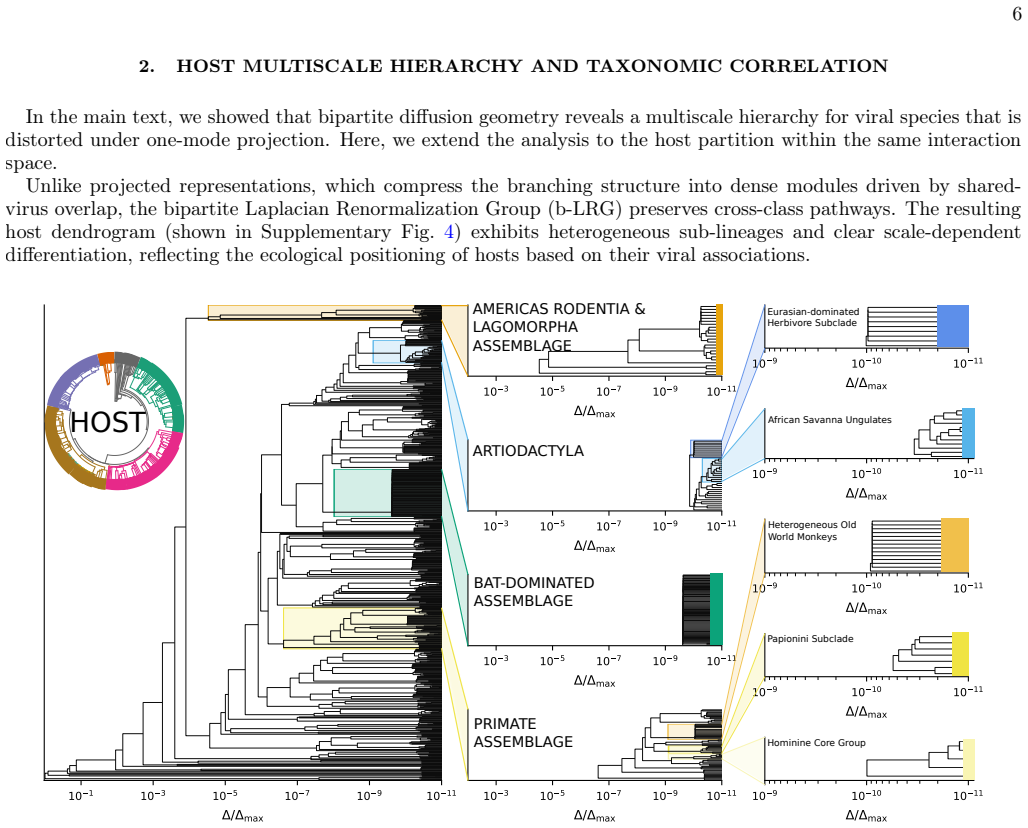
HOST MULTISCALE HIERARCHY AND TAXONOMIC CORRELATION In the main text, we showed that bipartite diffusion geometry reveals a multiscale hierarchy for viral species that is distorted under one-mode projection. Here, we extend the analysis to the host partition within the same interaction space. Unlike projected representations, which compress the branching ...
-
[54]
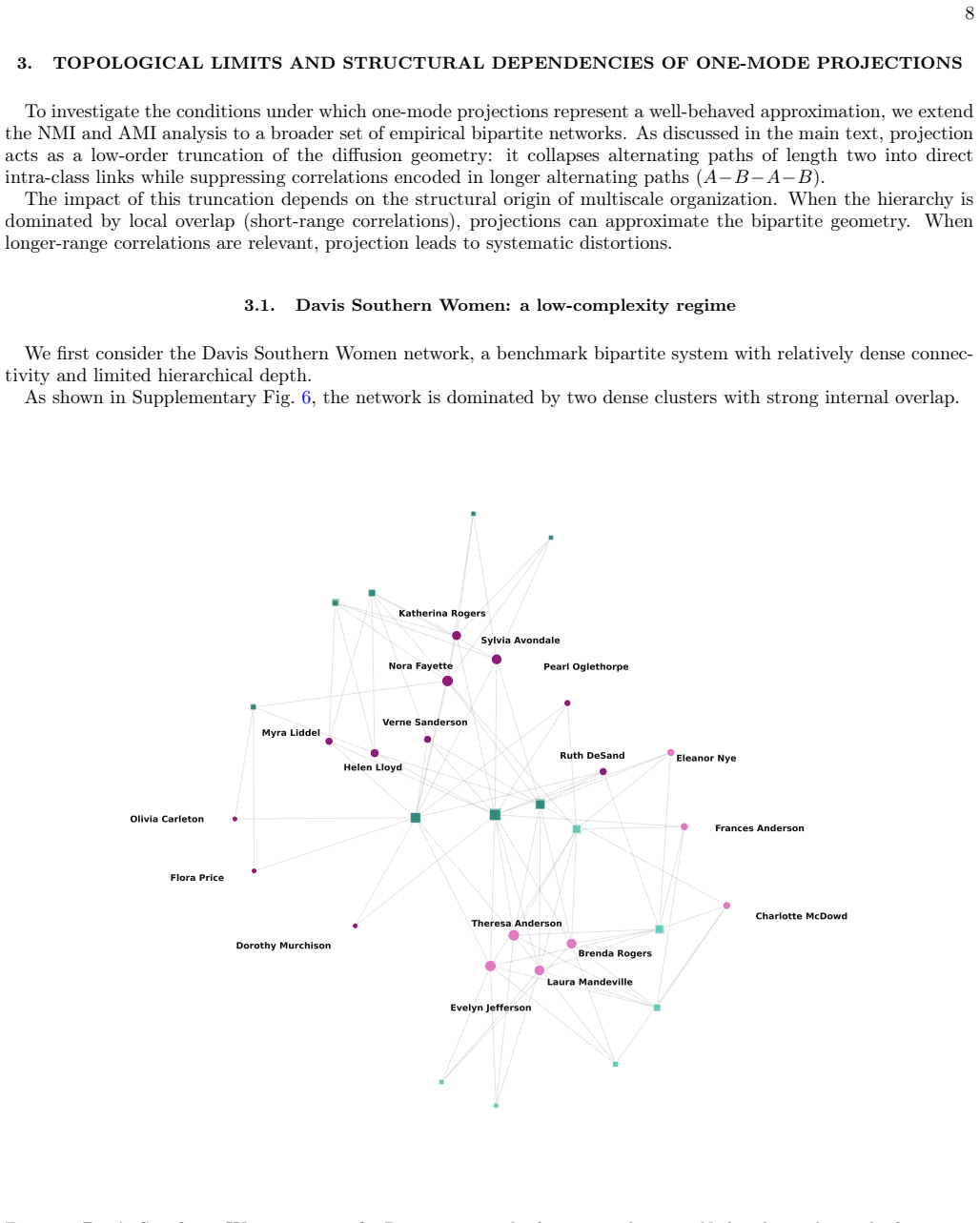
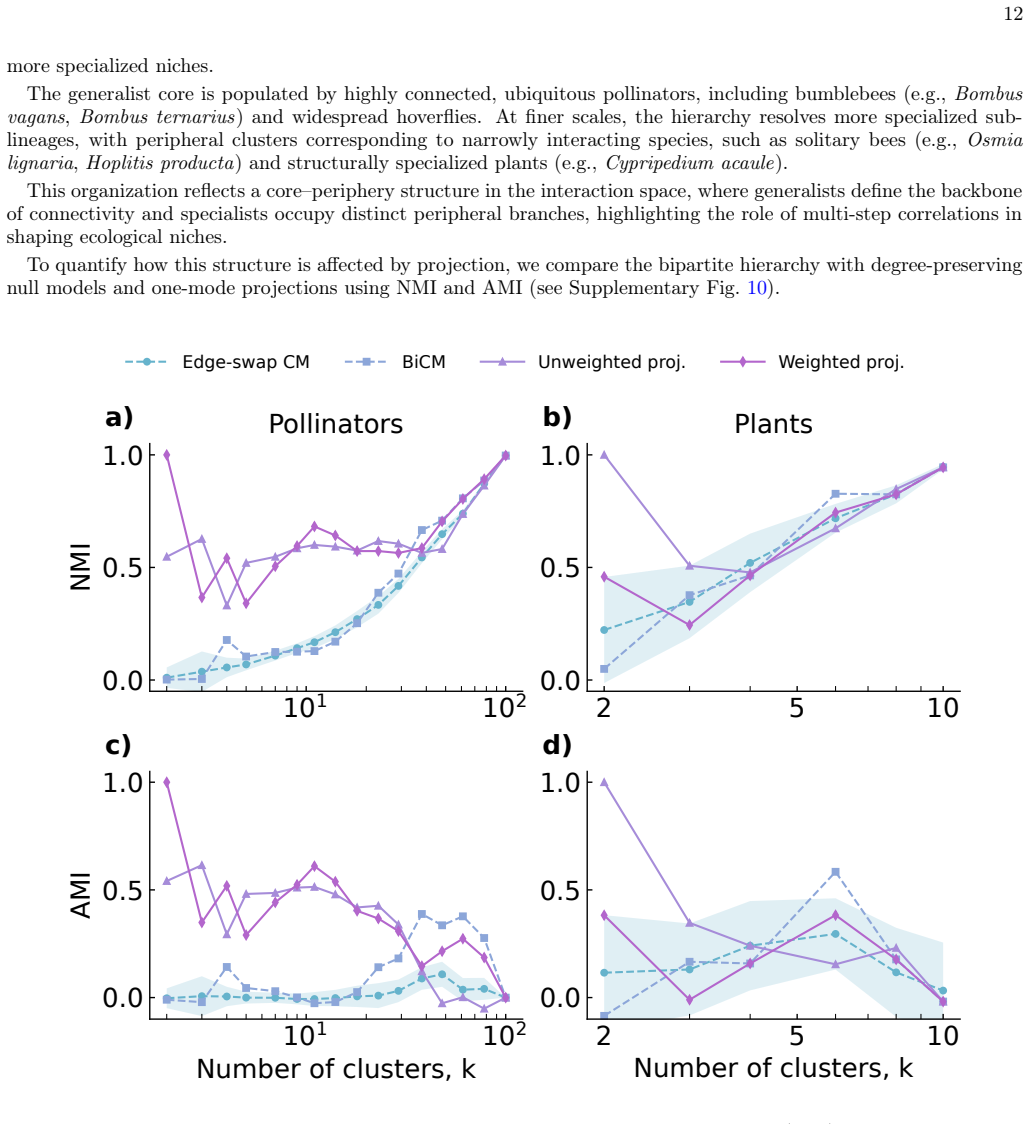
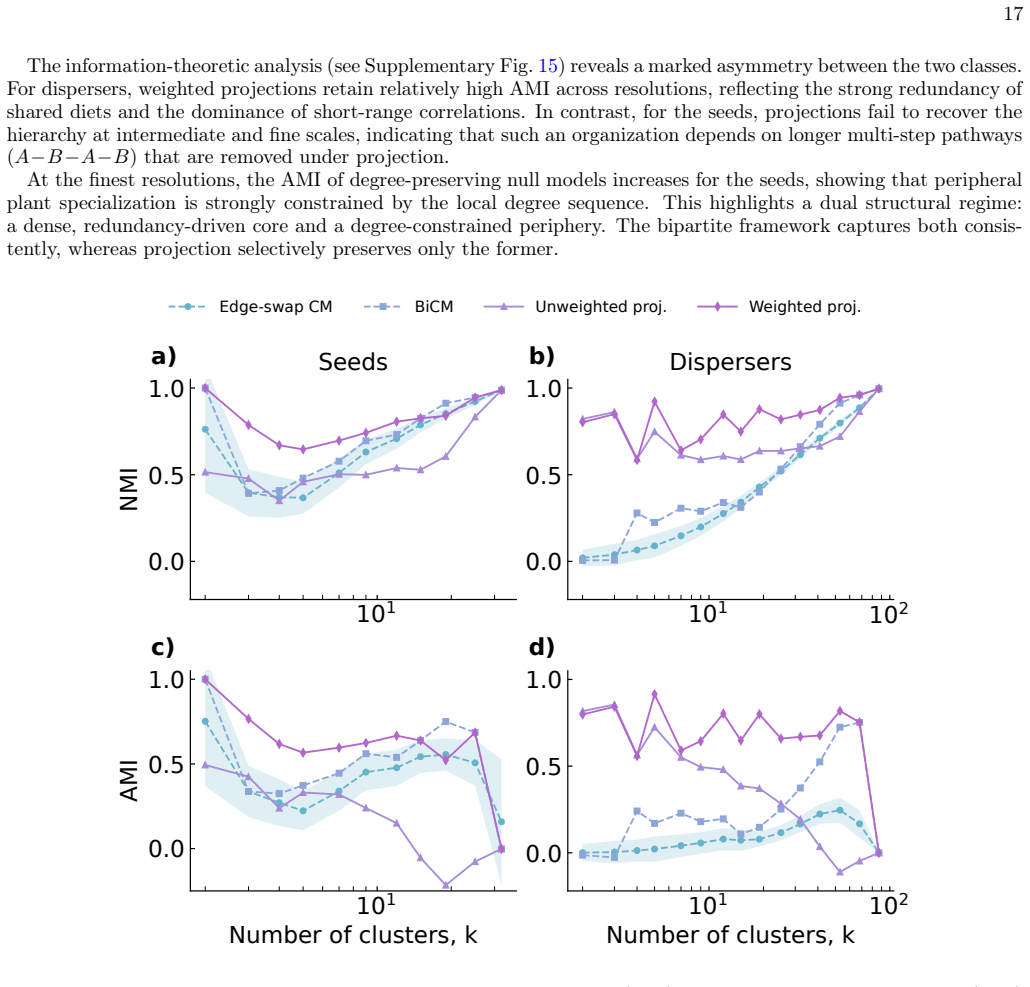
TOPOLOGICAL LIMITS AND STRUCTURAL DEPENDENCIES OF ONE-MODE PROJECTIONS To investigate the conditions under which one-mode projections represent a well-behaved approximation, we extend the NMI and AMI analysis to a broader set of empirical bipartite networks. As discussed in the main text, projection acts as a low-order truncation of the diffusion geometry...
-
[55]
S. C. H. Barrett and K. Helenurm, Can. J. Bot.65, 2036 (1987)
2036
-
[56]
Bartomeus, M
I. Bartomeus, M. Vila, and L. Santamaria, Oecologia155, 761 (2008)
2008
-
[57]
Schleuning, N
M. Schleuning, N. Blüthgen, M. Flörchinger, J. Braun, H. M. Schaefer, and K. Böhning-Gaese, Ecology92, 26 (2011)
2011
discussion (0)
Sign in with ORCID, Apple, or X to comment. Anyone can read and Pith papers without signing in.