Recognition: unknown
Higher-order interactions in ecology can be hidden in plain sight
Pith reviewed 2026-05-08 03:27 UTC · model grok-4.3
The pith
Higher-order Lotka-Volterra dynamics can be accurately reproduced by effective pairwise models fitted to abundance time series.
A machine-rendered reading of the paper's core claim, the machinery that carries it, and where it could break.
Core claim
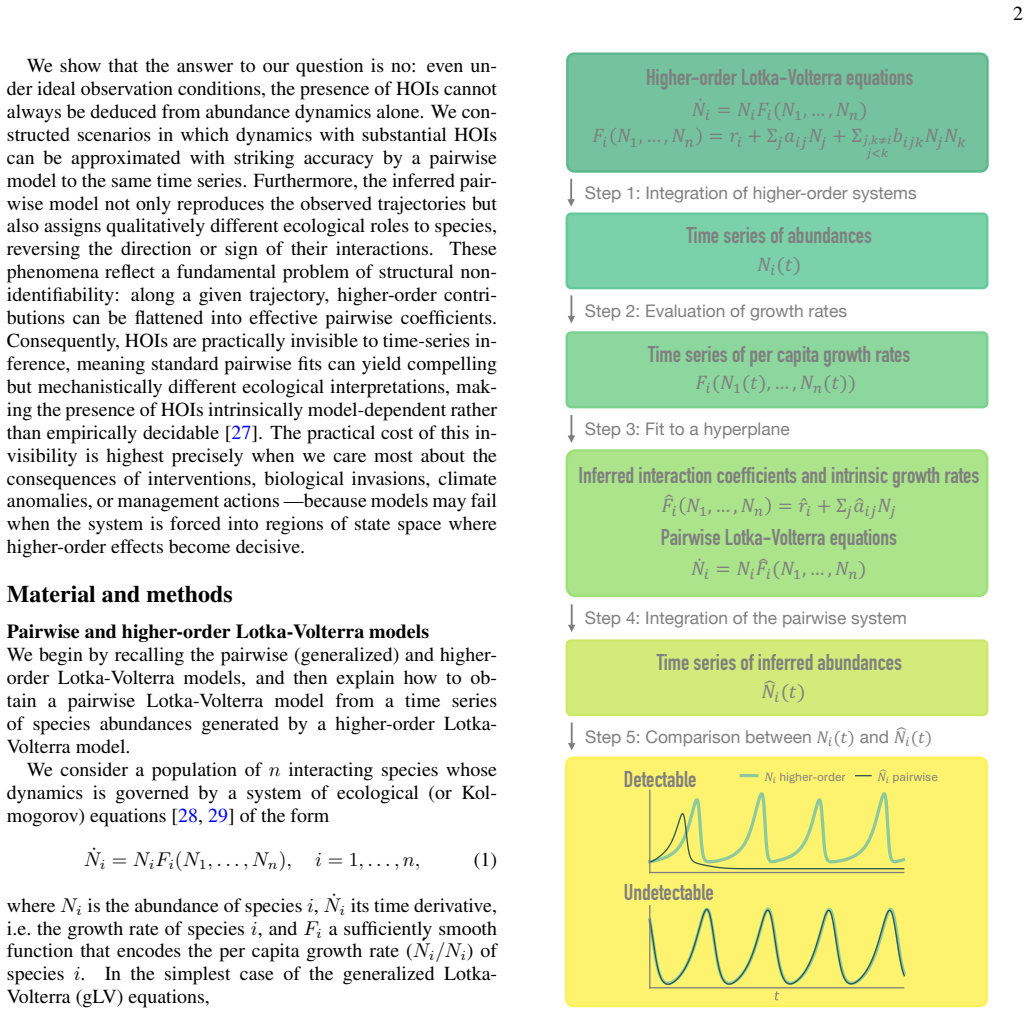
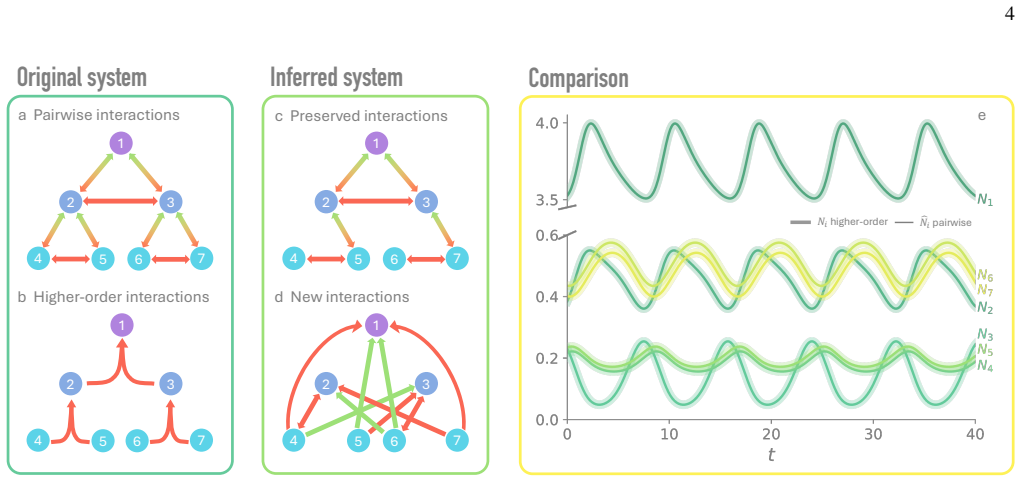
Higher-order Lotka-Volterra dynamics can, in some scenarios, be accurately reproduced by effective pairwise models fitted to the same abundance time series. Consequently, higher-order interactions cannot, in general, be inferred from time-series data alone. Distinct interaction mechanisms generate nearly indistinguishable dynamics, potentially leading to accurate yet misleading ecological interpretations.
What carries the argument
Effective pairwise Lotka-Volterra models fitted to time-series data generated by higher-order systems, which reproduce the observed abundance trajectories without explicit higher-order terms.
If this is right
- Time-series data alone is insufficient to distinguish between pairwise and higher-order interaction structures in ecological models.
- Fitted pairwise models may yield good predictive accuracy even when higher-order interactions are actually present.
- Ecological inferences drawn from pairwise models fitted to abundance data risk misidentifying the underlying interaction mechanisms.
- Reliable inference of interaction structure requires complementary ecological information beyond time series.
Where Pith is reading between the lines
- Experimental perturbations or spatial data could be needed to break the identifiability between pairwise and higher-order mechanisms.
- Many existing pairwise ecological models may remain useful as effective descriptions even if higher-order terms exist in nature.
- Similar identifiability challenges likely appear in other dynamical systems, such as chemical reaction networks or neural population models.
- Testing the finding on empirical datasets from real ecosystems with known interaction structures would clarify its practical scope.
Load-bearing premise
The scenarios examined are representative enough of real ecological systems and that the accuracy of the pairwise reproduction is high enough to produce genuinely misleading inferences in practice.
What would settle it
A controlled experiment or simulation in which a known higher-order interaction produces dynamics that no pairwise model fitted to the same time series can reproduce or predict under perturbation.
Figures

read the original abstract
Higher-order interactions are increasingly recognized as a key component of ecological dynamics. However, we show that higher-order Lotka-Volterra dynamics can, in some scenarios, be accurately reproduced by effective pairwise models fitted to the same abundance time series. Consequently, higher-order interactions cannot, in general, be inferred from time-series data alone. We further identify a fundamental problem of mechanistic identifiability, whereby distinct interaction mechanisms generate nearly indistinguishable dynamics, potentially leading to accurate yet misleading ecological interpretations. Our results highlight the need to complement time-series data with additional ecological information to infer interaction structure reliably.
Editorial analysis
A structured set of objections, weighed in public.
Referee Report
Summary. The manuscript claims that higher-order Lotka-Volterra dynamics can, in selected scenarios, be accurately reproduced by effective pairwise models fitted to the same abundance time series. It concludes that higher-order interactions therefore cannot in general be inferred from time-series data alone and identifies a broader mechanistic identifiability problem in which distinct interaction mechanisms produce nearly indistinguishable dynamics.
Significance. If the quantitative accuracy of the pairwise reproductions and the representativeness of the examined regimes are established, the result would be significant for theoretical ecology: it supplies a concrete cautionary demonstration that time-series fitting alone is insufficient to distinguish interaction orders or mechanisms, thereby supporting calls for complementary data sources in empirical inference.
major comments (2)
- [Abstract] Abstract: the central claim that pairwise models can 'accurately reproduce' higher-order dynamics is load-bearing for the inference warning, yet the abstract (and the described results) supplies no quantitative fit metrics, no description of the fitting procedure, and no error measures, preventing evaluation of whether the reproduction is close enough to produce genuinely misleading inferences in practice.
- [Results] Results (scenarios section): the demonstration is limited to specific simulated cases; without systematic variation of higher-order term magnitudes, noise levels, or comparison to empirical time-series characteristics, the step from 'possible in some cases' to 'cannot in general be inferred' rests on an untested extrapolation about practical identifiability.
minor comments (2)
- [Abstract] The abstract and introduction would benefit from a brief statement of the precise model equations used for both the higher-order and effective pairwise systems.
- [Methods] Clarify whether the fitting is performed via least-squares, maximum likelihood, or another method, and whether parameters are constrained.
Simulated Author's Rebuttal
We thank the referee for their constructive and insightful comments, which have helped us improve the clarity and scope of our manuscript. We address each major comment below and indicate the revisions made.
read point-by-point responses
-
Referee: [Abstract] Abstract: the central claim that pairwise models can 'accurately reproduce' higher-order dynamics is load-bearing for the inference warning, yet the abstract (and the described results) supplies no quantitative fit metrics, no description of the fitting procedure, and no error measures, preventing evaluation of whether the reproduction is close enough to produce genuinely misleading inferences in practice.
Authors: We agree that the abstract requires quantitative support for the reproduction claim. In the revised manuscript, we have updated the abstract to describe the fitting procedure (nonlinear least-squares minimization of trajectory discrepancies between the full higher-order Lotka-Volterra model and the effective pairwise model) and to report key metrics from the simulations: R² values > 0.97 and normalized RMSE < 0.05 across the examined time series. These values indicate that the effective pairwise models reproduce the dynamics closely enough to support the warning about potential misinference of interaction structure. revision: yes
-
Referee: [Results] Results (scenarios section): the demonstration is limited to specific simulated cases; without systematic variation of higher-order term magnitudes, noise levels, or comparison to empirical time-series characteristics, the step from 'possible in some cases' to 'cannot in general be inferred' rests on an untested extrapolation about practical identifiability.
Authors: The selected scenarios were designed as representative cases in which higher-order terms are non-negligible yet the dynamics remain reproducible by pairwise models, thereby establishing the existence of an identifiability problem. We acknowledge that broader systematic sweeps would be valuable. The revised results section now includes additional simulations that vary higher-order coefficient magnitudes (from 0.1 to 1.0 times pairwise strengths) and additive noise levels (up to 10% of signal variance), confirming that the reproduction accuracy holds across these ranges. On empirical time-series characteristics, our study is primarily theoretical; we have added discussion text noting that the same mechanistic ambiguity would apply to noisy observational data and emphasizing the need for complementary information sources, without claiming exhaustive empirical validation. revision: partial
Circularity Check
No significant circularity detected
full rationale
The paper demonstrates via simulation that pairwise Lotka-Volterra models fitted to time series generated from higher-order dynamics can reproduce the observed abundances in selected scenarios, then concludes that higher-order interactions are not generally inferable from time series alone. This is an independent computational result obtained by generating synthetic data under one model class and fitting another; it does not reduce by definition or by construction to the input assumptions. No self-citation chains, uniqueness theorems, or ansatzes are invoked to force the reproduction result, and the identifiability claim follows directly from the reported fitting accuracies rather than from renaming or tautological re-use of fitted parameters as predictions.
Axiom & Free-Parameter Ledger
Reference graph
Works this paper leans on
-
[1]
P. A. Abrams, Arguments in favor of higher-order interactions, The American Naturalist121, 887 (1983)
1983
-
[2]
Billick and T
I. Billick and T. J. Case, Higher-order interactions in ecological communities: What are they and how can they be detected?, Ecology75, 1529 (1994)
1994
-
[3]
higher-order interactions
M. J. Pomerantz, Do "higher-order interactions" in competition systems really exist?, The American Naturalist117, 583 (1981)
1981
-
[4]
J. T. Wootton, Putting the pieces together: Testing the inde- pendence of interactions among organisms, Ecology75, 1544 (1994)
1994
-
[5]
T. J. Case and E. A. Bender, Testing for higher-order interac- tions, The American Naturalist118, 920 (1981)
1981
-
[6]
Yodzis, The indeterminacy of ecological interactions as perceived through perturbation experiments, Ecology69, 508 (1988)
P. Yodzis, The indeterminacy of ecological interactions as perceived through perturbation experiments, Ecology69, 508 (1988)
1988
-
[7]
Grilli, G
J. Grilli, G. Barabás, M. J. Michalska-Smith, and S. Allesina, Higher-order interactions stabilize dynamics in competitive net- work models, Nature548, 210 (2017)
2017
-
[8]
Battiston, E
F. Battiston, E. Amico, A. Barrat,et al., The physics of higher- order interactions in complex systems, Nature Physics17, 1093 (2021)
2021
-
[9]
T. L. Gibbs, G. Gellner, S. A. Levin, K. S. McCann, A. Hast- ings, and J. M. Levine, When can higher-order interactions pro- duce stable coexistence?, Ecology Letters27, e14458 (2024)
2024
-
[10]
Buche, L
L. Buche, L. G. Shoemaker, L. M. Hallett, I. Bartomeus, P. Vesk, C. Weiss-Lehman, M. Mayfield, and O. Godoy, A continuum from positive to negative interactions drives plant species’ performance in a diverse community, Ecology Letters 28, e70059 (2025)
2025
-
[11]
Buche, I
L. Buche, I. Bartomeus, and O. Godoy, Multitrophic higher- order interactions modulate species persistence, The American Naturalist203, 458 (2024)
2024
-
[13]
A. R. Kleinhesselink, N. J. B. Kraft, S. W. Pacala, and J. M. Levine, Detecting and interpreting higher-order interactions in ecological communities, Ecology Letters25, 1604 (2022)
2022
-
[14]
Sanchez, Defining higher-order interactions in synthetic ecology: lessons from physics and quantitative genetics, Cell systems9, 519 (2019)
A. Sanchez, Defining higher-order interactions in synthetic ecology: lessons from physics and quantitative genetics, Cell systems9, 519 (2019)
2019
-
[15]
Bairey, E
E. Bairey, E. D. Kelsic, and R. Kishony, High-order species in- teractions shape ecosystem diversity, Nature Communications 7, 12285 (2016)
2016
-
[16]
Gibbs, S
T. Gibbs, S. A. Levin, and J. M. Levine, Coexistence in diverse communities with higher-order interactions, Proceedings of the National Academy of Sciences119, e2205063119 (2022)
2022
-
[17]
M. M. Mayfield and D. B. Stouffer, Higher-order interactions capture unexplained complexity in diverse communities, Nature Ecology & Evolution1, 1 (2017)
2017
-
[18]
K. Aho, D. Derryberry, and T. Peterson, Model selection for ecologists: the worldviews of aic and bic, Ecology95, 631 (2014)
2014
-
[19]
K. A. Aho,F oundational and applied statistics for biologists using R(CRC Press, 2016)
2016
-
[20]
S. H. Strogatz,Nonlinear dynamics and chaos: with applica- tions to physics, biology, chemistry, and engineering, 2nd ed. (CRC Press, 2015)
2015
-
[21]
AlAdwani and S
M. AlAdwani and S. Saavedra, Ecological models: higher com- plexity in, higher feasibility out, Journal of The Royal Society Interface17, 20200607 (2020)
2020
-
[22]
H. R. Lai, P. J. Bellingham, J. K. McCarthy, S. J. Richard- son, S. K. Wiser, and D. B. Stouffer, Detecting nonadditive bi- otic interactions and assessing their biological relevance among temperate rainforest trees, The American Naturalist204, 105 (2024)
2024
-
[23]
W. B. Ludington, Higher-order microbiome interactions and how to find them, Trends in Microbiology30, 618 (2022)
2022
-
[24]
J. D. Davis, D. V . Olivença, S. P. Brown, and E. O. V oit, Methods of quantifying interactions among populations using lotka-volterra models, Frontiers in Systems Biology2, 1021897 (2022)
2022
-
[25]
Malizia, A
F. Malizia, A. Corso, L. V . Gambuzza, G. Russo, V . Latora, and M. Frasca, Reconstructing higher-order interactions in coupled dynamical systems, Nature Communications15, 5184 (2024)
2024
-
[26]
Mickalide and S
H. Mickalide and S. Kuehn, Higher-order interaction between species inhibits bacterial invasion of a phototroph-predator mi- crobial community, Cell systems9, 521 (2019)
2019
-
[27]
Lucas, L
M. Lucas, L. Gallo, A. Ghavasieh, F. Battiston, and M. De Domenico, Reducibility of higher-order networks from dynamics, Nature Communications17, 1551 (2026)
2026
-
[28]
Sigmund, Kolmogorov and population dynamics, inKol- mogorov’s heritage in mathematics(Springer, 2007) pp
K. Sigmund, Kolmogorov and population dynamics, inKol- mogorov’s heritage in mathematics(Springer, 2007) pp. 177– 186
2007
-
[29]
Patel and S
S. Patel and S. J. Schreiber, Robust permanence for ecologi- cal equations with internal and external feedbacks, Journal of mathematical biology77, 79 (2018)
2018
-
[30]
A. J. Lotka,Elements of mathematical biology(Dover Publica- tions, 1956)
1956
-
[31]
R. H. MacArthur, Species packing and competitive equilibrium for many species, Theoretical Population Biology1, 1 (1970)
1970
-
[32]
R. M. May,Stability and complexity in model ecosystems (Princeton University Press, 1973)
1973
-
[33]
A. D. Letten and D. B. Stouffer, The mechanistic basis for higher-order interactions and non-additivity in competitive communities, Ecology Letters22, 423 (2019)
2019
-
[34]
F. Latrémolière, S. Narayanappa, and P. V ojt ˇechovsk`y, Esti- mating the jacobian matrix of an unknown multivariate func- tion from sample values by means of a neural network, arXiv (2022), arXiv:2204.00523
-
[35]
Vandermeer and S
J. Vandermeer and S. Maruca, Indirect effects with a keystone predator: coexistence and chaos, Theoretical Population Biol- ogy54, 38 (1998)
1998
-
[36]
Song and S
C. Song and S. Saavedra, Bridging parametric and nonparamet- ric measures of species interactions unveils new insights of non- equilibrium dynamics, Oikos130, 1027 (2021)
2021
-
[37]
S. P. Hart, R. P. Freckleton, and J. M. Levine, How to quantify competitive ability, Journal of Ecology106, 1902 (2018)
1902
-
[38]
B. D. Inouye, Response surface experimental designs for inves- tigating interspecific competition, Ecology82, 2696 (2001)
2001
-
[39]
J. Llabrés, R. Toral, M. S. Miguel, and F. Vázquez, Reducibility of higher-order to pairwise interactions: Social impact models on hypergraphs, arXiv preprint arXiv:2601.05169 (2026)
- [40]
-
[41]
L. Lacasa, On the equivalence between nonlinear graph-based dynamics and linear dynamics on higher-order networks, arXiv preprint arXiv:2602.21727 (2026)
-
[42]
Singh and G
P. Singh and G. Baruah, Higher order interactions and species coexistence, Theoretical Ecology14, 71 (2021)
2021
-
[43]
Majer, A
A. Majer, A. Skoracka, J. Spaak, and L. Kuczy ´nski, Higher- order species interactions cause time-dependent niche and fitness differences: Experimental evidence in plant-feeding arthropods, Ecology Letters27, e14428 (2024)
2024
-
[44]
Chen, X.-W
C. Chen, X.-W. Wang, and Y .-Y . Liu, Stability of ecological systems: A theoretical review, Physics reports1088, 1 (2024)
2024
-
[45]
Cenci and S
S. Cenci and S. Saavedra, Structural stability of nonlinear pop- ulation dynamics, Physical Review E97, 012401 (2018)
2018
-
[46]
D. Sundarraman, E. A. Hay, D. M. Martins, D. S. Shields, N. L. Pettinari, and R. Parthasarathy, Higher-Order Interac- tions Dampen Pairwise Competition in the Zebrafish Gut Mi- crobiome, mBio11, 10.1128/mbio.01667 (2020)
-
[47]
Godoy and J
O. Godoy and J. M. Levine, Phenology effects on invasion suc- cess: insights from coupling field experiments to coexistence theory, Ecology95, 726 (2014)
2014
discussion (0)
Sign in with ORCID, Apple, or X to comment. Anyone can read and Pith papers without signing in.