Recognition: unknown
Global self-optimizing control of batch processes
Pith reviewed 2026-05-08 07:57 UTC · model grok-4.3
The pith
Batch processes achieve near-optimal operation by recasting global self-optimizing control in vectorized form where causality constraints become linear.
A machine-rendered reading of the paper's core claim, the machinery that carries it, and where it could break.
Core claim
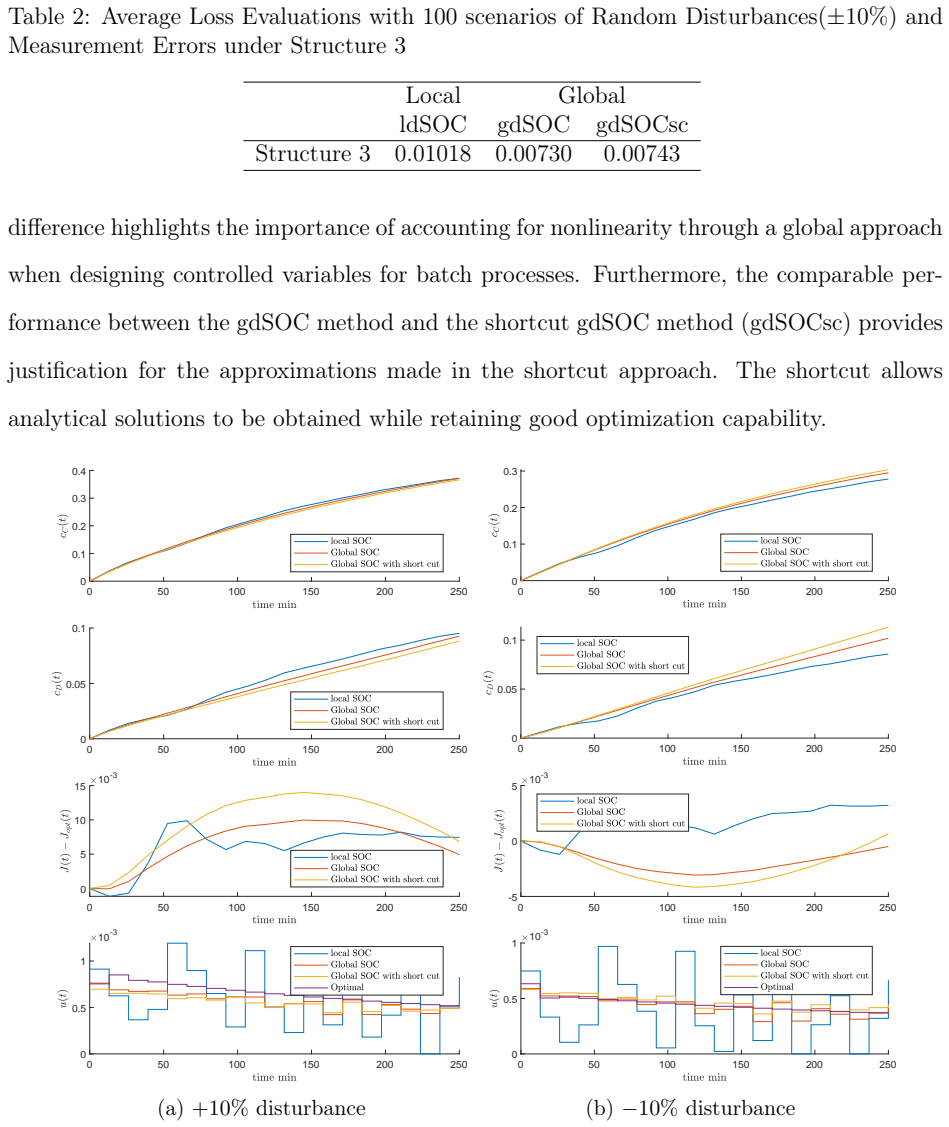
The gSOC problem is recast in a vectorized formulation and it is proved that the structural constraints considered are linear in the vectorized formulation. Moreover, a novel shortcut method is proposed to efficiently find sub-optimal but more transparent solutions for this problem. The effectiveness of the new approach is validated through a case study of a fed-batch reactor, where CVs are constructed through a combination matrix with a repetitive structure, resulting in a simple SOC scheme.
What carries the argument
The vectorized formulation of the gSOC problem, which converts causality-induced structural constraints on controlled variables into linear constraints and supports a shortcut method for selecting transparent measurement combinations.
If this is right
- The resulting SOC scheme uses simple linear combinations of measurements that automatically respect dynamic causality.
- Near-optimal batch operation becomes achievable with a fixed, transparent control law rather than repeated nonconvex optimization.
- The repetitive structure in the combination matrix simplifies implementation and improves robustness across batch cycles.
Where Pith is reading between the lines
- The vectorized approach could extend to other constrained dynamic systems, such as periodic or semi-batch processes with similar causality.
- Transparent solutions may help practitioners identify which measurements most influence long-term economic performance in batch operations.
Load-bearing premise
The causality constraints arising from batch dynamics can be captured by linear structural constraints in the vectorized formulation without materially degrading the near-optimality of the resulting controlled-variable selection.
What would settle it
Demonstration that the true optimal controlled variables for the fed-batch reactor require combinations violating the linearity of the structural constraints in the vectorized form, or that the shortcut solutions deviate substantially from the performance of the full global optimum.
Figures


read the original abstract
This work considers to achieve near-optimal operation for a class of batch processes by employing self-optimizing control (SOC). Comparing with a continuous one, a batch process exhibits stronger nonlinearity with dynamics because of the non-steady operation condition. This necessitates a global version of SOC to achieve satisfactory performance. Meanwhile, it also makes the existing global SOC (gSOC) not directly applicable to batch processes due to the causality amongst variables. Therefore, it is necessary to extend the original gSOC to batch processes. In addition to the nonconvexity challenge of the original gSOC problem, the new extension for batch processes has to face even more challenges. Particularly, the causality due to dynamics of batch processes brings in structural constraints on controlled variables (CVs), making a CV selection problem even more difficult. To address these challenges, the gSOC problem is recast in a vectorized formulation and it is proved that the structural constraints considered are linear in the vectorized formulation. Moreover, a novel shortcut method is proposed to efficiently find sub-optimal but more transparent solutions for this problem. The effectiveness of the new approach is validated through a case study of a fed-batch reactor, where CVs are constructed through a combination matrix with a repetitive structure, resulting in a simple SOC scheme. This simplicity facilitates the implementation of the SOC approach and enhances its practical applicability and robustness.
Editorial analysis
A structured set of objections, weighed in public.
Referee Report
Summary. The paper extends global self-optimizing control (gSOC) to batch processes by recasting the problem in a vectorized formulation, proving that causality-induced structural constraints on controlled variables become linear in this setting. It further proposes a novel shortcut method to compute sub-optimal but transparent CV selections and validates the approach on a fed-batch reactor case study, where a repetitive-structure combination matrix yields a simple SOC scheme.
Significance. If the vectorized linearity result holds without significant relaxation of dynamic causality and the shortcut remains sufficiently close to the true optimum, the work would offer a practical route to near-optimal batch operation in nonlinear dynamic systems common to chemical and pharmaceutical manufacturing. The focus on transparent, implementable CVs with repetitive structure directly addresses robustness and ease of deployment, which are often barriers for SOC methods in industry.
major comments (3)
- [Abstract] Abstract: The claim that structural constraints are linear in the vectorized formulation is asserted without any derivation steps, explicit vectorized equations, or demonstration of how time-varying input-output causality maps to linear inequalities; this is load-bearing for the central extension of gSOC.
- [Case study] Case study: The fed-batch reactor example reports only a qualitative 'simple SOC scheme' with repetitive structure; no quantitative metrics (e.g., economic loss, sub-optimality gap, or comparison to non-vectorized gSOC or optimal trajectories) are supplied, leaving the practical usefulness of the shortcut unverified.
- [Formulation] Formulation section: The assumption that linear structural constraints fully capture batch causality without materially degrading near-optimality is not accompanied by any error bound, sensitivity analysis, or numerical check against a non-vectorized reference formulation under the process nonlinearities.
minor comments (2)
- [Abstract] Abstract: The phrasing 'This work considers to achieve' is grammatically awkward and should be revised to 'This work considers achieving'.
- The manuscript would benefit from explicit statements of the vectorized variables and the precise form of the linear structural constraints to aid reproducibility.
Simulated Author's Rebuttal
We thank the referee for the constructive and detailed comments, which help improve the clarity and completeness of the manuscript. We address each major comment point by point below, indicating the revisions we plan to make.
read point-by-point responses
-
Referee: [Abstract] Abstract: The claim that structural constraints are linear in the vectorized formulation is asserted without any derivation steps, explicit vectorized equations, or demonstration of how time-varying input-output causality maps to linear inequalities; this is load-bearing for the central extension of gSOC.
Authors: The derivation of the vectorized formulation, the explicit equations, and the proof that time-varying causality constraints map to linear inequalities are provided in full in Section 3, including Theorem 1 and the associated vectorized problem statement. The abstract serves as a concise summary and cannot accommodate complete derivations. We will revise the abstract to explicitly reference the vectorized reformulation and the resulting linearity of the structural constraints. revision: partial
-
Referee: [Case study] Case study: The fed-batch reactor example reports only a qualitative 'simple SOC scheme' with repetitive structure; no quantitative metrics (e.g., economic loss, sub-optimality gap, or comparison to non-vectorized gSOC or optimal trajectories) are supplied, leaving the practical usefulness of the shortcut unverified.
Authors: We agree that quantitative validation would strengthen the demonstration of the shortcut method's usefulness. In the revised manuscript, we will add quantitative metrics for the fed-batch reactor, including economic loss relative to the true optimum, the sub-optimality gap, and direct comparisons to both the non-vectorized gSOC formulation and the optimal trajectories. revision: yes
-
Referee: [Formulation] Formulation section: The assumption that linear structural constraints fully capture batch causality without materially degrading near-optimality is not accompanied by any error bound, sensitivity analysis, or numerical check against a non-vectorized reference formulation under the process nonlinearities.
Authors: Theorem 1 in Section 3 establishes that the vectorized formulation captures the causality constraints exactly as linear inequalities with no relaxation. To further address potential effects on near-optimality under nonlinear dynamics, we will add a sensitivity analysis and numerical comparison to a non-vectorized reference formulation in the revised case study section, including error bounds where they can be derived. revision: yes
Circularity Check
No circularity in vectorized gSOC reformulation or shortcut method
full rationale
The paper recasts the gSOC problem into a vectorized formulation and proves linearity of causality-induced structural constraints as a direct mathematical step. A novel shortcut method is proposed for sub-optimal CV selection, with effectiveness shown via independent fed-batch reactor case study validation. No steps equate outputs to inputs by construction, rename fitted quantities as predictions, or rely on load-bearing self-citations that circularly justify core claims. The derivation chain consists of reformulation, proof, and heuristic proposal supported by external validation, remaining self-contained without reduction to its own target results.
Axiom & Free-Parameter Ledger
axioms (2)
- domain assumption A dynamic model of the batch process is known and can be used to evaluate the self-optimizing performance criterion.
- domain assumption The structural constraints induced by causality admit a linear representation once the problem is vectorized.
Reference graph
Works this paper leans on
-
[1]
Optimizing Control Based on Output Feedback , author =. 2009 , month = jan, journal =. doi:10.1016/j.compchemeng.2008.07.017 , urldate =
-
[2]
2021 , month = apr, journal =
Iterative Learning Control for Multiphase Batch Processes With Asynchronous Switching , author =. 2021 , month = apr, journal =
2021
-
[3]
2006 , month = jun, journal =
A Survey of Iterative Learning Control , author =. 2006 , month = jun, journal =
2006
-
[4]
Integrated Batch-to-Batch Control and within Batch Control of Batch Processes Using Neural Network Models , booktitle =
Zhang, Jie , year =. Integrated Batch-to-Batch Control and within Batch Control of Batch Processes Using Neural Network Models , booktitle =
-
[5]
Abernethy and Gareth M
Colin D. Abernethy and Gareth M. Codd and Mark D. Spicer and Michelle K. Taylor , title =. J. Am. Chem. Soc. , year =
-
[6]
Arduengo, III, Anthony J. and H. V. Rasika Dias and Richard L. Harlow and Michael Kline , title =. J. Am.\ Chem.\ Soc. , year =
-
[7]
and Siegfried F
Arduengo, III, Anthony J. and Siegfried F. Gamper and Joseph C. Calabrese and Fredric Davidson , title =. 1994 , volume =
1994
-
[8]
and Zuccaccia, Daniele and Kovacevic, Anes and Chianese, Anthony R
Appelhans, Leah N. and Zuccaccia, Daniele and Kovacevic, Anes and Chianese, Anthony R. and Miecznikowski, John R. and Macchioni, Aleco and Clot, Eric and Eisenstein, Odile and Crabtree, Robert H. , title =. J. Am.\ Chem. Soc. , year =
-
[9]
2006 , editor =
The. 2006 , editor =
2006
-
[10]
1999 , author =
Advanced Inorganic Chemistry , publisher =. 1999 , author =
1999
-
[11]
Communication from the European Commission to the European Council and the European Parliament: 20 20 by 2020: Europe's climate change opportunity , year =
2020
-
[12]
Friedman-Hill , booktitle =
E. Friedman-Hill , booktitle =. Writing Rules in Jess , edition =
-
[13]
1-(Alkylsubstituted phenyl)imidazoles useful in
Johnson, Alexander Lawrence , organization =. 1-(Alkylsubstituted phenyl)imidazoles useful in
-
[14]
M. J. Frisch and G. W. Trucks and H. B. Schlegel and G. E. Scuseria and M. A. Robb and J. R. Cheeseman and Montgomery and Jr. and J. A. and T. Vreven and K. N. Kudin and J. C. Burant and J. M. Millam and S. S. Iyengar and J. Tomasi and V. Barone and B. Mennucci and M. Cossi and G. Scalmani and N. Rega and G. A. Petersson and H. Nakatsuji and M. Hada and M...
2004
-
[15]
Ammonolysis of mono(pentamethylcyclopentadienyl) titanium(
Angel Abarca and Pilar G. Ammonolysis of mono(pentamethylcyclopentadienyl) titanium(. Inorg. Chem. , year =
-
[16]
Berber, R. , doi =. Chemical Engineering Research and Design , keywords =
-
[17]
IEEE Control Systems , mendeley-groups =
Bonvin, Dominique and Srinivasan, Bala and Hunkeler, David , doi =. IEEE Control Systems , mendeley-groups =
-
[18]
AIChE Journal , keywords =
Aumi, Siam and Mhaskar, Prashant , doi =. AIChE Journal , keywords =
-
[19]
Ellis, Matthew and Durand, Helen and Christofides, Panagiotis D. , doi =. Journal of Process Control , keywords =
-
[20]
Yoo, Haeun and Byun, Ha Eun and Han, Dongho and Lee, Jay H. , doi =. Annual Reviews in Control , mendeley-groups =
-
[21]
AIChE Journal , keywords =
Morari, Manfred and Arkun, Yaman and Stephanopoulos, George , doi =. AIChE Journal , keywords =
-
[22]
Journal of Process Control , mendeley-groups =
Skogestad, Sigurd , doi =. Journal of Process Control , mendeley-groups =
-
[23]
Annual Reviews in Control , keywords =
J. Annual Reviews in Control , keywords =. doi:10.1016/J.ARCONTROL.2017.03.001 , file =
-
[24]
Computer Aided Chemical Engineering , keywords =
Krishnamoorthy, Dinesh and Skogestad, Sigurd , doi =. Computer Aided Chemical Engineering , keywords =
-
[25]
Computers
Narraway, Lawrence and Perkins, John , doi =. Computers
-
[26]
Industrial and Engineering Chemistry Research , mendeley-groups =
Kariwala, Vinay , doi =. Industrial and Engineering Chemistry Research , mendeley-groups =
-
[27]
and Skogestad, Sigurd and Morud, John C
Halvorsen, Ivar J. and Skogestad, Sigurd and Morud, John C. and Alstad, Vidar , doi =. Industrial and Engineering Chemistry Research , mendeley-groups =
-
[28]
Alstad, Vidar and Skogestad, Sigurd and Hori, Eduardo S. , doi =. Journal of Process Control , keywords =
-
[29]
Kariwala, Vinay and Cao, Yi and Janardhanan, S , doi =
-
[30]
Alstad, Vidar and Skogestad, Sigurd , doi =
-
[31]
Industrial and Engineering Chemistry Research , mendeley-groups =
Ye, Lingjian and Cao, Yi and Yuan, Xiaofeng , doi =. Industrial and Engineering Chemistry Research , mendeley-groups =
-
[32]
Industrial and Engineering Chemistry Research , title =
Ye, Lingjian and Cao, Yi and Li, Yingdao and Song, Zhihuan , doi =. Industrial and Engineering Chemistry Research , title =
-
[33]
Computers
Ye, Lingjian and Cao, Yi and Yang, Shuanghua , doi =. Computers
-
[34]
Proceedings of the IEEE Conference on Decision and Control , doi =
J. Proceedings of the IEEE Conference on Decision and Control , doi =
-
[35]
doi:10.1109/ICIEA.2013.6566658 , isbn =
Ye, Lingjian and Kariwala, Vinay and Cao, Yi , booktitle =. doi:10.1109/ICIEA.2013.6566658 , isbn =
-
[36]
IFAC-PapersOnLine , mendeley-groups =
de Oliveira, Vinicius and J. IFAC-PapersOnLine , mendeley-groups =. doi:10.1016/J.IFACOL.2016.07.378 , file =
-
[37]
IFAC Proceedings Volumes , keywords =
Hu, Wuhua and Mao, Jianfeng and Xiao, Gaoxi and Kariwala, Vinay , doi =. IFAC Proceedings Volumes , keywords =
-
[38]
Journal of Process Control , keywords =
Fran. Journal of Process Control , keywords =. doi:10.1016/j.jprocont.2004.11.006 , issn =
-
[39]
and Bonvin, D
Srinivasan, B. and Bonvin, D. , doi =. Industrial and Engineering Chemistry Research , mendeley-groups =
-
[40]
Journal of Process Control , keywords =
Ye, Lingjian and Shen, Feifan and Ma, Xie and Zhang, Hongwei , doi =. Journal of Process Control , keywords =
-
[41]
Proceedings of the American Control Conference , doi =
Dahl-Olsen, H. Proceedings of the American Control Conference , doi =
-
[42]
Journal of Process Control , mendeley-groups =
Ye, Lingjian and Shen, Feifan and Guan, Hongwei , doi =. Journal of Process Control , mendeley-groups =
-
[43]
The Canadian Journal of Chemical Engineering , keywords =
Ye, Lingjian and Guan, Hongwei and Yuan, Xiaofeng and Ma, Xiushui , doi =. The Canadian Journal of Chemical Engineering , keywords =
-
[44]
and Srinivasan, B
Chachuat, B. and Srinivasan, B. and Bonvin, D. , doi =. Computers
-
[45]
International Journal of Automation and Computing 2005 2:1 , keywords =
Cao, Yi , doi =. International Journal of Automation and Computing 2005 2:1 , keywords =
2005
-
[46]
Journal of Process Control , keywords =
Manum, Henrik and Skogestad, Sigurd , doi =. Journal of Process Control , keywords =
-
[47]
Journal of Process Control , keywords =
Hu, Wuhua and Umar, Lia Maisarah and Xiao, Gaoxi and Kariwala, Vinay , doi =. Journal of Process Control , keywords =
-
[48]
Computers
Ye, Lingjian and Skogestad, Sigurd , doi =. Computers
-
[49]
Journal of Process Control , keywords =
Yelchuru, Ramprasad and Skogestad, Sigurd , doi =. Journal of Process Control , keywords =
-
[50]
Andersson, Joel A. E. and Gillis, Joris and Horn, Greg and Rawlings, James B. and Diehl, Moritz , date =. CasADi: A Software Framework for Nonlinear Optimization and Optimal Control , shorttitle =. doi:10.1007/s12532-018-0139-4 , url =
-
[51]
doi:10.1080/21642583.2021.2024916 , url =
An Intelligent Approach of Controlled Variable Selection for Constrained Process Self-Optimizing Control , author =. doi:10.1080/21642583.2021.2024916 , url =
-
[52]
Biegler, L. T. and Zavala, V. M. , date =. Large-Scale Nonlinear Programming Using IPOPT: An Integrating Framework for Enterprise-Wide Dynamic Optimization , shorttitle =. doi:10.1016/j.compchemeng.2008.08.006 , url =
-
[53]
Gros, S. and Srinivasan, B. and Chachuat, B. and Bonvin, D. , date =. Neighbouring-Extremal Control for Singular Dynamic Optimisation Problems. Part I: Single-Input Systems , shorttitle =. doi:10.1080/00207170802460024 , url =
-
[54]
Characterization of the Nominal Solution , author =
Dynamic Optimization of Batch Processes: I. Characterization of the Nominal Solution , author =. 2003 , month = jan, journal =. doi:10.1016/S0098-1354(02)00116-3 , urldate =
-
[55]
doi:10.1016/J.JPROCONT.2022.06.003 , url =
Convex Reformulations for Self-Optimizing Control Optimization Problem: Linear Matrix Inequality Approach , author =. doi:10.1016/J.JPROCONT.2022.06.003 , url =
-
[56]
Bidirectional Branch and Bound for Controlled Variable Selection: Part I
Cao, Yi and Kariwala, Vinay , year =. Bidirectional Branch and Bound for Controlled Variable Selection: Part I. Principles and Minimum Singular Value Criterion , shorttitle =. Computers & Chemical Engineering , volume =. doi:10.1016/j.compchemeng.2007.11.011 , urldate =
-
[57]
Part II: Exact Local Method for Self-Optimizing Control , author =
Bidirectional Branch and Bound for Controlled Variable Selection. Part II: Exact Local Method for Self-Optimizing Control , author =. 2009 , journal =
2009
-
[58]
Bidirectional Branch and Bound for Controlled Variable Selection Part III: Local Average Loss Minimization , shorttitle =
Kariwala, Vinay and Cao, Yi , year =. Bidirectional Branch and Bound for Controlled Variable Selection Part III: Local Average Loss Minimization , shorttitle =. IEEE Transactions on Industrial Informatics , volume =
-
[59]
2016 , edition =
Introduction to Linear Algebra , author =. 2016 , edition =
2016
discussion (0)
Sign in with ORCID, Apple, or X to comment. Anyone can read and Pith papers without signing in.