Recognition: unknown
DINORANKCLIP: DINOv3 Distillation and Injection for Vision-Language Pretraining with High-Order Ranking Consistency
Pith reviewed 2026-05-08 12:24 UTC · model grok-4.3
The pith
DINORANKCLIP injects local features from a frozen DINOv3 teacher into CLIP via a gated multi-scale fusion module while extending the ranking loss to consider triple-wise matches, yielding gains on fine-grained and out-of-distribution tasks.
A machine-rendered reading of the paper's core claim, the machinery that carries it, and where it could break.
Core claim
The central claim is that a frozen DINOv3 teacher can be distilled into the CLIP trunk through the described fusion module without breaking first-order alignment, and that the resulting high-order Plackett-Luce model (of which CLIP is the zero-order case and RANKCLIP the first-order case) produces consistent improvements over prior methods under identical compute, with the largest lifts appearing on fine-grained and out-of-distribution evaluations.
What carries the argument
The high-order Plackett-Luce ranking model whose utility at each position is augmented by attention-parameterised pairwise and tuple-wise transition terms, together with the multi-scale fusion module that injects DINOv3 local features while preserving cross-modal alignment.
If this is right
- The largest gains appear on tasks that require local structural reasoning rather than global scene matching.
- The optimal ranking order is three across all benchmarks examined.
- The entire training run completes in 72 hours on a single eight-GPU H100 node using only Conceptual Captions 3M.
- The method outperforms CLIP, CyCLIP, ALIP, and RANKCLIP under matched compute budgets.
Where Pith is reading between the lines
- The same gated-injection pattern could be tested with other frozen local-feature teachers beyond DINOv3.
- High-order ranking terms may transfer to contrastive setups outside vision-language, such as video-audio or graph-text pairs.
- If the conflict-aware gate proves robust, similar lightweight adapters might allow incremental addition of other inductive biases to existing contrastive models without full retraining.
Load-bearing premise
The fusion module's attention and gating layers are able to add DINOv3 local structure without disturbing the first-order cross-modal alignment already learned by the contrastive trunk.
What would settle it
A controlled ablation that removes either the high-order transition terms or the DINOv3 branch and then measures zero or negative change on the five-dataset Fine-grained Probe suite would falsify the joint benefit.
Figures




read the original abstract
Contrastive language-image pretraining (CLIP) suffers from two structural weaknesses: the symmetric InfoNCE loss discards the relative ordering among unmatched in-batch pairs, and global pooling collapses the visual representation into a semantic bottleneck that is poorly sensitive to fine-grained local structure. RANKCLIP partially addresses the first issue with a list-wise Plackett-Luce ranking-consistency loss, but its model is strictly first-order and inherits the second weakness untouched. We propose DINORANKCLIP, a pretraining framework that addresses both jointly. Our principal contribution is injecting a frozen DINOv3 teacher into the contrastive trunk through a dual-branch lightweight student and a multi-scale fusion module with channel-spatial attention, a self-attention refiner, and a conflict-aware gate that preserves the cross-modal alignment up to first order. Complementarily, we introduce a high-order Plackett-Luce ranking model in which the per-position utility is augmented with attention-parameterised pairwise and tuple-wise transition terms; the family contains CLIP and RANKCLIP as nested zero-order and first-order special cases, and the optimal order on every benchmark is $R^*=3$. The full empirical study -- order sweep, Fine-grained Probe on five datasets, four-node Modality-Gap analysis, six-variant Fusion ablation -- fits in 72 hours on a single eight-GPU H100 node and trains entirely on Conceptual Captions 3M. DINORANKCLIP consistently outperforms CLIP, CyCLIP, ALIP, and RANKCLIP under matched compute, with the largest relative gains on the fine-grained and out-of-distribution evaluations that most directly stress local structural reasoning.
Editorial analysis
A structured set of objections, weighed in public.
Referee Report
Summary. The paper introduces DINORANKCLIP, a vision-language pretraining framework that injects frozen DINOv3 local features into a contrastive trunk via a dual-branch student and multi-scale fusion module (channel-spatial attention, self-attention refiner, conflict-aware gate), while extending the ranking-consistency loss to a high-order Plackett-Luce model with attention-parameterized pairwise and tuple-wise transitions. The high-order family nests CLIP (order 0) and RANKCLIP (order 1) as special cases; an order sweep identifies R^*=3 as optimal on all benchmarks. The model is trained on Conceptual Captions 3M and claims consistent gains over CLIP, CyCLIP, ALIP, and RANKCLIP, largest on fine-grained and OOD tasks, supported by order sweep, five-dataset fine-grained probe, four-node modality-gap analysis, and six-variant fusion ablation, all fitting in 72 hours on one 8-GPU H100 node.
Significance. If the central claims hold, the work would be significant for jointly addressing CLIP's loss of ranking information and global-pooling bottleneck through higher-order ranking and DINOv3 local injection. Strengths include the nested model family, extensive ablations (order sweep, fusion variants, modality-gap analysis), and efficient single-node training on CC3M, which together provide a reproducible template for controlled VL pretraining experiments.
major comments (2)
- Abstract and fusion ablation: the claim that the multi-scale fusion module 'preserves the cross-modal alignment up to first order' is load-bearing for attributing gains over RANKCLIP to the DINOv3 injection rather than to DINOv3 alone, yet no direct supporting measurements (pre/post-injection modality-gap statistics, zero-shot retrieval deltas on the same checkpoint, or gate ablation on the InfoNCE term) are provided.
- Order sweep and abstract: reporting R^*=3 as optimal 'on every benchmark' creates a circularity risk if the order selection was performed on the same evaluation sets used for final performance reporting; this undermines the generalizability of the high-order ranking claim and requires explicit description of the selection protocol and held-out validation.
minor comments (2)
- The attention-parameterized transition terms in the high-order Plackett-Luce model are learned from data, so the family is not strictly 'parameter-free' beyond the discrete order R; this should be stated explicitly when contrasting with prior models.
- Notation for the per-position utility and transition terms would benefit from a single consolidated equation block rather than scattered definitions across the ranking section.
Simulated Author's Rebuttal
We thank the referee for the constructive feedback and for recognizing the significance of jointly addressing CLIP's ranking loss and global-pooling limitations via DINOv3 injection and high-order ranking. We address each major comment below and will revise the manuscript accordingly.
read point-by-point responses
-
Referee: Abstract and fusion ablation: the claim that the multi-scale fusion module 'preserves the cross-modal alignment up to first order' is load-bearing for attributing gains over RANKCLIP to the DINOv3 injection rather than to DINOv3 alone, yet no direct supporting measurements (pre/post-injection modality-gap statistics, zero-shot retrieval deltas on the same checkpoint, or gate ablation on the InfoNCE term) are provided.
Authors: We agree that direct pre/post measurements would strengthen attribution of gains to the DINOv3 injection. The manuscript already reports a four-node Modality-Gap analysis and six-variant Fusion ablation showing that the conflict-aware gate and multi-scale fusion maintain first-order alignment while adding local structure. To address the comment explicitly, we will add pre/post-injection modality-gap statistics, zero-shot retrieval deltas on the same checkpoint, and a gate ablation isolating its effect on the InfoNCE term in the revised fusion section. revision: yes
-
Referee: Order sweep and abstract: reporting R^*=3 as optimal 'on every benchmark' creates a circularity risk if the order selection was performed on the same evaluation sets used for final performance reporting; this undermines the generalizability of the high-order ranking claim and requires explicit description of the selection protocol and held-out validation.
Authors: We agree that the order-selection protocol must be stated explicitly to eliminate any circularity concern. The sweep identifying R^*=3 was performed on a held-out validation split of Conceptual Captions 3M, separate from all reported evaluation benchmarks. We will revise the Experimental Setup section to describe this protocol in full, include the validation curves for orders 0-4, and confirm that test benchmarks were withheld from the sweep. revision: yes
Circularity Check
Ranking family nests priors by design; R* selected on evaluation benchmarks
specific steps
-
fitted input called prediction
[Abstract]
"the family contains CLIP and RANKCLIP as nested zero-order and first-order special cases, and the optimal order on every benchmark is R^*=3"
The ranking model is constructed by design to nest the prior models as special cases. The specific order is then chosen as the one that performs best on the benchmarks also used to report the final outperformance results, making the superiority of DINORANKCLIP with R^*=3 a post-hoc fitted outcome rather than an independent prediction.
full rationale
The paper defines a high-order Plackett-Luce model explicitly as a generalization containing CLIP (zero-order) and RANKCLIP (first-order) as special cases, then reports that the optimal order R^*=3 on every benchmark. This selection occurs via order sweep on the same evaluation sets used for final claims, creating a fitted-input dependence. The fusion module's preservation of first-order alignment is asserted via its component design (channel-spatial attention, refiner, conflict-aware gate) without an independent derivation or direct pre/post modality-gap measurement, though ablations are provided. The central outperformance results remain independently testable and do not fully reduce to these choices.
Axiom & Free-Parameter Ledger
free parameters (2)
- ranking order R =
3
- attention parameters for pairwise and tuple-wise transition terms
axioms (1)
- domain assumption DINOv3 teacher supplies local structural information that complements global CLIP features without breaking cross-modal alignment when fused via attention and gating.
Reference graph
Works this paper leans on
-
[1]
Food-101 – mining discriminative com- ponents with random forests
Lukas Bossard, Matthieu Guillaumin, and Luc Van Gool. Food-101 – mining discriminative com- ponents with random forests. InEuropean Conference on Computer Vision (ECCV), 2014. doi: 10.1007/978-3-319-10599-4_29
-
[2]
In: 2021 IEEE/CVF International Conference on Computer Vision (ICCV)
Mathilde Caron, Hugo Touvron, Ishan Misra, Hervé Jégou, Julien Mairal, Piotr Bojanowski, and Armand Joulin. Emerging properties in self-supervised vision transformers. InIEEE/CVF International Conference on Computer Vision (ICCV), 2021. doi: 10.1109/ICCV48922.2021.00951
-
[3]
Rossi, Vishwa Vinay, and Aditya Grover
Shashank Goel, Hritik Bansal, Sumit Bhatia, Ryan A. Rossi, Vishwa Vinay, and Aditya Grover. Cy- CLIP: Cyclic contrastive language-image pretraining. InAdvances in Neural Information Process- ing Systems (NeurIPS), 2022. URL http://papers.nips.cc/paper_files/paper/2022/hash/ 2cd36d327f33d47b372d4711edd08de0-Abstract-Conference.html
2022
-
[4]
Kaiming He, Xiangyu Zhang, Shaoqing Ren, and Jian Sun. Spatial pyramid pooling in deep convolutional networks for visual recognition.IEEE Transactions on Pattern Analysis and Machine Intelligence, 2015. doi: 10.1109/TPAMI.2015.2389824
-
[5]
In: 2021 IEEE/CVF International Conference on Computer Vision (ICCV)
Dan Hendrycks, Steven Basart, Norman Mu, Saurav Kadavath, Frank Wang, Evan Dorundo, Rahul Desai, Tyler Zhu, Samyak Parajuli, Mike Guo, Dawn Song, Jacob Steinhardt, and Justin Gilmer. The many faces of robustness: A critical analysis of out-of-distribution generalization. InIEEE/CVF International Conference on Computer Vision (ICCV), 2021. doi: 10.1109/ICC...
-
[6]
Distilling the Knowledge in a Neural Network
Geoffrey E. Hinton, Oriol Vinyals, and Jeffrey Dean. Distilling the knowledge in a neural network.arXiv preprint arXiv:1503.02531, 2015
work page internal anchor Pith review arXiv 2015
-
[7]
Weixin Liang, Yuhui Zhang, Yongchan Kwon, Serena Yeung, and James Y . Zou. Mind the gap: Understand- ing the modality gap in multi-modal contrastive representation learning. InAdvances in Neural Information Processing Systems (NeurIPS), 2022. URL http://papers.nips.cc/paper_files/paper/2022/ hash/702f4db7543a7432431df588d57bc7c9-Abstract-Conference.html
2022
-
[8]
Tsung-Yi Lin, Michael Maire, Serge J. Belongie, James Hays, Pietro Perona, Deva Ramanan, Piotr Dollár, and C. Lawrence Zitnick. Microsoft COCO: Common objects in context. InEuropean Conference on Computer Vision (ECCV), 2014. doi: 10.1007/978-3-319-10602-1_48
-
[9]
Fine-Grained Visual Classification of Aircraft
Subhransu Maji, Esa Rahtu, Juho Kannala, Matthew B. Blaschko, and Andrea Vedaldi. Fine-grained visual classification of aircraft.arXiv preprint arXiv:1306.5151, 2013
work page internal anchor Pith review arXiv 2013
-
[10]
Wagner, and Saining Xie
Norman Mu, Alexander Kirillov, David A. Wagner, and Saining Xie. SLIP: Self-supervision meets language-image pre-training. InEuropean Conference on Computer Vision (ECCV), 2022. doi: 10.1007/ 978-3-031-19809-0_30
2022
-
[11]
Maxime Oquab, Timothée Darcet, Théo Moutakanni, Huy V . V o, Marc Szafraniec, Vasil Khalidov, Pierre Fernandez, Daniel Haziza, Francisco Massa, Alaaeldin El-Nouby, Mahmoud Assran, Nicolas Ballas, Wojciech Galuba, Russell Howes, Po-Yao Huang, Shang-Wen Li, Ishan Misra, Michael Rabbat, Vasu Sharma, Gabriel Synnaeve, Hu Xu, Hervé Jégou, Julien Mairal, Patric...
2024
-
[12]
Relational knowledge distillation
Wonpyo Park, Dongju Kim, Yan Lu, and Minsu Cho. Relational knowledge distillation. InIEEE/CVF Conference on Computer Vision and Pattern Recognition (CVPR), 2019
2019
-
[13]
Learning trans- ferable visual models from natural language supervision
Alec Radford, Jong Wook Kim, Chris Hallacy, Aditya Ramesh, Gabriel Goh, Sandhini Agarwal, Girish Sastry, Amanda Askell, Pamela Mishkin, Jack Clark, Gretchen Krueger, and Ilya Sutskever. Learning trans- ferable visual models from natural language supervision. InProceedings of the 38th International Confer- ence on Machine Learning (ICML), 2021. URLhttp://p...
2021
-
[14]
Do ImageNet classifiers generalize to ImageNet? InProceedings of the 36th International Conference on Machine Learning (ICML), 2019
Benjamin Recht, Rebecca Roelofs, Ludwig Schmidt, and Vaishaal Shankar. Do ImageNet classifiers generalize to ImageNet? InProceedings of the 36th International Conference on Machine Learning (ICML), 2019. URLhttp://proceedings.mlr.press/v97/recht19a.html
2019
-
[15]
Conceptual captions: A cleaned, hypernymed, image alt-text dataset for automatic image captioning
Piyush Sharma, Nan Ding, Sebastian Goodman, and Radu Soricut. Conceptual captions: A cleaned, hypernymed, image alt-text dataset for automatic image captioning. InProceedings of the 56th Annual Meeting of the Association for Computational Linguistics (ACL), 2018. URL https://aclanthology. org/P18-1238/. 11
2018
-
[16]
Contrastive representation distillation
Yonglong Tian, Dilip Krishnan, and Phillip Isola. Contrastive representation distillation. InInternational Conference on Learning Representations (ICLR), 2020. URL https://openreview.net/forum?id= SkgpBJrtvS
2020
-
[17]
CBAM: Convolutional block attention module
Sanghyun Woo, Jongchan Park, Joon-Young Lee, and In So Kweon. CBAM: Convolutional block attention module. InEuropean Conference on Computer Vision (ECCV), 2018. doi: 10.1007/978-3-030-01234-2_1
-
[18]
In: Proceedings of the IEEE/CVF International Conference on Computer Vision, pp
Kaicheng Yang, Jiankang Deng, Xiang An, Jiawei Li, Ziyong Feng, Jia Guo, Jing Yang, and Tongliang Liu. ALIP: Adaptive language-image pre-training with synthetic caption. InIEEE/CVF International Conference on Computer Vision (ICCV), 2023. doi: 10.1109/ICCV51070.2023.00273
-
[19]
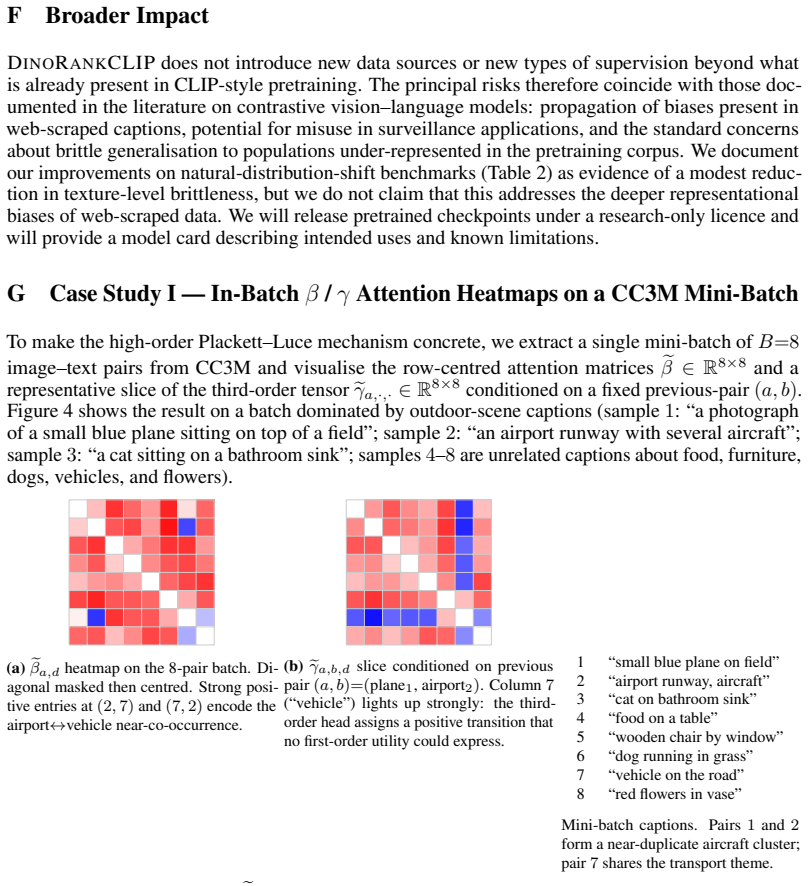
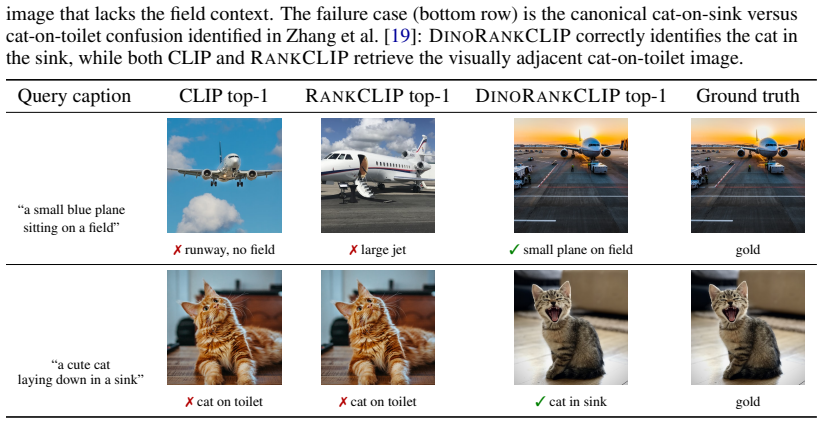
a photograph of a small blue plane sitting on top of a field
Yiming Zhang, Zhuokai Zhao, Zhaorun Chen, Zhili Feng, Zenghui Ding, and Yining Sun. RANKCLIP: Ranking-consistent language-image pretraining.arXiv preprint arXiv:2404.09387, 2024. doi: 10.48550/ arXiv.2404.09387. 12 A Hyperparameters Table 6 reports every hyperparameter used in our main experiments. The cosine schedule on the cross-modal and in-modal ranki...
discussion (0)
Sign in with ORCID, Apple, or X to comment. Anyone can read and Pith papers without signing in.