Recognition: unknown
Point sets avoiding near-integer distances
Pith reviewed 2026-05-08 08:04 UTC · model grok-4.3
The pith
In three dimensions, point sets avoiding near-integer distances can reach size X to the power 1 minus any epsilon for small enough delta, and achieve linear size in four dimensions.
A machine-rendered reading of the paper's core claim, the machinery that carries it, and where it could break.
Core claim
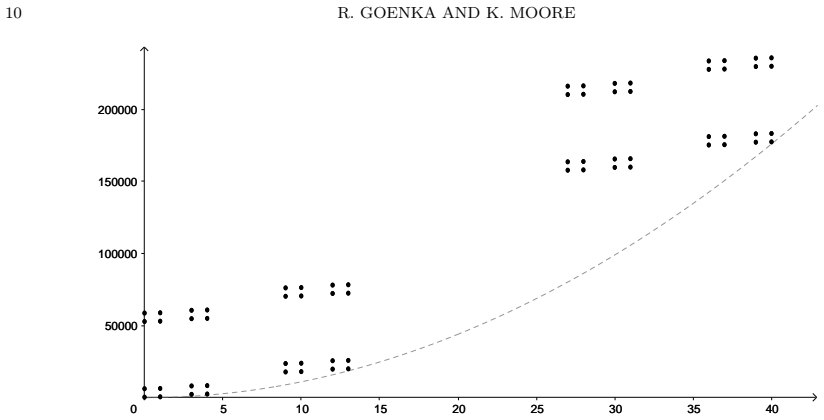
Extending Sárközy's construction, we show that for every ε > 0, N_3(X, δ) = Ω_δ(X^{1-ε}) for δ sufficiently small in terms of ε. We also provide a lifting lemma from integer distance sets to sets avoiding near-integer distances via bilipschitz embeddings of snowflaked Euclidean spaces. This allows us to prove a linear lower bound N_4(X,δ) = Ω_δ(X) for all sufficiently small δ. Finally, adapting Konyagin's approach, we prove the upper bound N_d(X, δ) = O_{d, δ}(X^{d/2}) for all d ∈ ℕ.
What carries the argument
A lifting lemma that uses bilipschitz embeddings of snowflaked Euclidean spaces to transfer sets avoiding exact integer distances into sets avoiding near-integer distances.
If this is right
- In three dimensions the largest such set has size at least X to the power 1 minus epsilon for any epsilon when delta is small enough.
- In four dimensions the largest such set has size at least a positive constant times X when delta is sufficiently small.
- In any dimension d the largest such set has size at most a constant depending on d and delta times X to the power d over 2.
- These bounds partially answer questions of Erdős and Sárközy on the growth rate of such sets in dimensions greater than two.
Where Pith is reading between the lines
- The lifting lemma could be applied to other problems of avoiding distances in specific sets rather than just the integers.
- The remaining gap between the lower and upper exponents in dimensions three and higher indicates that tighter constructions or different upper-bound methods may still be possible.
- Numerical checks of the lifting construction in low dimensions could reveal how small delta must be in practice for the linear bound to appear.
Load-bearing premise
The lower bounds require δ to be small enough depending on ε or the dimension, and the lifting step requires bilipschitz embeddings of snowflaked spaces that preserve the avoidance of near-integer distances.
What would settle it
An explicit 4-dimensional construction whose size grows linearly in X for some fixed positive δ independent of X, or a matching upper bound showing that N_4(X, δ) = o(X) for every δ > 0 as X tends to infinity.
Figures
read the original abstract
Let $d \in \mathbb{N}$, $\delta \in (0, 1/2)$, and $X > 0$. Denote by $N_d(X, \delta)$ the maximum number of points in a subset of the closed Euclidean ball of radius $X$ in $\mathbb{R}^d$ such that every pairwise distance is at least $\delta$ away from any integer. In the planar case, S\'ark\"ozy proved that for every $\varepsilon > 0$, $N_2(X, \delta) = \Omega_\delta(X^{1/2-\varepsilon})$ as $X \rightarrow \infty$ whenever $\delta$ is sufficiently small in terms of $\varepsilon$, while Konyagin proved the almost matching upper bound $N_2(X,\delta) = O_\delta(X^{1/2})$. We study this problem in higher dimensions, addressing a question of Erd\H{o}s and S\'ark\"ozy. Extending S\'ark\"ozy's construction, we show that for every $\varepsilon > 0$, $N_3(X, \delta) = \Omega_\delta(X^{1-\varepsilon})$ for $\delta$ sufficiently small in terms of $\varepsilon$. We also provide a lifting lemma from integer distance sets to sets avoiding near-integer distances via bilipschitz embeddings of snowflaked Euclidean spaces. This allows us to prove a linear lower bound $N_4(X,\delta) = \Omega_\delta(X)$ for all sufficiently small $\delta$. Finally, adapting Konyagin's approach, we prove the upper bound $N_d(X, \delta) = O_{d, \delta}(X^{d/2})$ for all $d \in \mathbb{N}$.
Editorial analysis
A structured set of objections, weighed in public.
Referee Report
Summary. The paper defines N_d(X, δ) as the largest number of points inside a Euclidean ball of radius X in R^d such that every pairwise distance lies at least δ away from any integer. Extending Sárközy's planar construction, the authors prove N_3(X, δ) = Ω_δ(X^{1-ε}) for every ε > 0 whenever δ is sufficiently small in terms of ε. They introduce a lifting lemma that converts integer-distance sets into near-integer-avoiding sets via bilipschitz embeddings of snowflaked Euclidean metrics; this yields the linear lower bound N_4(X, δ) = Ω_δ(X) for all sufficiently small δ. Adapting Konyagin's method, they establish the general upper bound N_d(X, δ) = O_{d,δ}(X^{d/2}).
Significance. If the lifting lemma and the extended constructions hold, the work substantially advances the Erdős–Sárközy problem on point sets avoiding near-integer distances. The near-linear lower bound in dimension 3 and the linear lower bound in dimension 4 are notable improvements that approach the scale of the ambient space while respecting the distance restriction. The snowflake-embedding technique is a novel technical device with potential applications in metric embedding and combinatorial geometry. The dimension-dependent upper bound supplies a uniform benchmark against which the lower bounds can be compared.
major comments (2)
- [Lifting lemma] Lifting lemma (central to the N_4 claim): the argument relies on composing a snowflake map d ↦ d^α (α < 1) with a bilipschitz Euclidean embedding. The manuscript must specify whether α and the distortion constant may be chosen independently of the cardinality of the input integer-distance set. If the distortion grows with set size, distances that were integers may be mapped into [n−δ, n+δ] for any fixed δ > 0, which would invalidate the claimed linear lower bound N_4(X, δ) = Ω_δ(X).
- [3-dimensional lower bound] § on the 3-dimensional construction: the extension of Sárközy's method is asserted to produce N_3(X, δ) = Ω_δ(X^{1-ε}). The proof sketch should explicitly verify that the auxiliary parameters (e.g., the number of scales or the choice of δ relative to ε) remain uniform when the construction is lifted from the plane to R^3; otherwise the exponent 1−ε cannot be guaranteed for arbitrarily small δ.
minor comments (2)
- [Abstract] The abstract states the 4-dimensional lower bound holds 'for all sufficiently small δ' while the 3-dimensional bound requires δ small in terms of ε. This distinction should be stated uniformly in the theorem statements and introduction.
- [Notation and statements] Notation: the implied constants in the Ω_δ and O_{d,δ} statements depend on δ and d; making this dependence explicit in each theorem would improve readability.
Simulated Author's Rebuttal
We thank the referee for the careful reading of our manuscript and for the constructive comments. We address each of the major comments below.
read point-by-point responses
-
Referee: [Lifting lemma] Lifting lemma (central to the N_4 claim): the argument relies on composing a snowflake map d ↦ d^α (α < 1) with a bilipschitz Euclidean embedding. The manuscript must specify whether α and the distortion constant may be chosen independently of the cardinality of the input integer-distance set. If the distortion grows with set size, distances that were integers may be mapped into [n−δ, n+δ] for any fixed δ > 0, which would invalidate the claimed linear lower bound N_4(X, δ) = Ω_δ(X).
Authors: We appreciate the referee highlighting this important point regarding the independence of parameters in the lifting lemma. In our construction, the snowflake exponent α is selected depending solely on δ (for instance, α close to 1 but sufficiently less than 1 to ensure the image distances avoid integers by a margin proportional to δ), and this choice is independent of the cardinality of the integer-distance set. The bilipschitz embedding of the snowflaked metric into Euclidean space is achieved with a distortion constant that depends only on the dimension and α, hence independent of the set size, by appealing to known results on embedding snowflaked metrics (such as those from Assouad's theorem or similar embedding theorems for doubling metrics). For the specific integer-distance sets used in the proof (e.g., large subsets of integer lattices or other rigid structures), the embedding can be realized explicitly with uniform constants. We will revise the statement and proof of the lifting lemma to explicitly state these independence properties, thereby confirming that the mapped distances remain at least δ away from integers. revision: yes
-
Referee: [3-dimensional lower bound] § on the 3-dimensional construction: the extension of Sárközy's method is asserted to produce N_3(X, δ) = Ω_δ(X^{1-ε}). The proof sketch should explicitly verify that the auxiliary parameters (e.g., the number of scales or the choice of δ relative to ε) remain uniform when the construction is lifted from the plane to R^3; otherwise the exponent 1−ε cannot be guaranteed for arbitrarily small δ.
Authors: We agree that the current proof sketch in the section on the three-dimensional construction would benefit from greater explicitness regarding the uniformity of parameters. The extension from Sárközy's planar construction to R^3 involves iterating the planar construction across a third dimension while controlling the distances via a suitable discretization of scales. The number of scales is chosen as a function of ε only, and δ is taken sufficiently small depending on ε (but independent of X), ensuring that the error terms from the lifting do not accumulate to violate the distance condition. The exponent 1-ε arises from the planar exponent 1/2 - ε/2 or similar, combined with the linear factor in the third dimension. We will expand the proof to include a detailed verification of these parameter choices, making the uniformity explicit. revision: yes
Circularity Check
No circularity; bounds obtained from explicit constructions and independent lemmas
full rationale
The paper defines N_d(X, δ) externally as the maximum size of a point set in the ball of radius X with all pairwise distances at least δ from integers. Lower bounds for d=3 are obtained by extending Sárközy's explicit construction; the d=4 linear lower bound follows from a lifting lemma that composes snowflaking with a bilipschitz embedding of Euclidean space, mapping known integer-distance sets into the desired avoidance class. Upper bounds adapt Konyagin's combinatorial argument. None of these steps define N_d in terms of itself, rename a fitted parameter as a prediction, or reduce the central claim to a self-citation whose content is unverified. The lifting lemma invokes an external embedding theorem whose assumptions do not presuppose the target bound. The derivation chain is therefore self-contained and non-circular.
Axiom & Free-Parameter Ledger
axioms (2)
- standard math Euclidean distance satisfies the triangle inequality and is bilipschitz equivalent under snowflaking with exponent <1
- domain assumption Sárközy's planar construction and Konyagin's upper-bound argument extend verbatim to higher dimensions once δ is small enough
Reference graph
Works this paper leans on
-
[1]
Noga Alon, Matija Bucić, and Lisa Sauermann,Unit and distinct distances in typical norms, Geom. Funct. Anal.35(2025), no. 1, 1–42. MR4865130
2025
-
[2]
Patrice Assouad,Plongements lipschitziens dansR n, Bull. Soc. Math. France111(1983), no. 4, 429–448. MR763553 POINT SETS A VOIDING NEAR-INTEGER DISTANCES 15
1983
-
[3]
Bloom,Erdős problems,https://www.erdosproblems.com, Accessed April 2026
Thomas F. Bloom,Erdős problems,https://www.erdosproblems.com, Accessed April 2026
2026
-
[4]
Boris Bukh,Measurable sets with excluded distances, Geom. Funct. Anal.18(2008), no. 3, 668–697. MR2438995
2008
-
[5]
III, Number theory day (Proc
Paul Erdős,Problems and results on combinatorial number theory. III, Number theory day (Proc. Conf., Rockefeller Univ., New York, 1976), Lecture Notes in Math., vol. Vol. 626, Springer, Berlin-New York, 1977, pp. 43–72. MR472752
1976
-
[6]
Stud., vol
,Some of my favourite problems which recently have been solved, Proceedings of the International Mathematical Conference, Singapore 1981 (Singapore, 1981), North-Holland Math. Stud., vol. 74, North- Holland, Amsterdam-New York, 1982, pp. 59–79. MR690096
1981
-
[7]
Paul Erdős and Ronald L. Graham,Old and new problems and results in combinatorial number theory, MonographiesdeL’EnseignementMathématique, vol.28, UniversitédeGenève, L’EnseignementMathématique, Geneva, 1980. MR592420
1980
-
[8]
Slovaca28(1978), no
Paul Erdős and András Sárközy,Some solved and unsolved problems in combinatorial number theory, Math. Slovaca28(1978), no. 4, 407–421. MR534819
1978
-
[9]
K. J. Falconer,The realization of small distances in plane sets of positive measure, Bull. London Math. Soc. 18(1986), no. 5, 475–477. MR847987
1986
-
[10]
Philippe Flajolet and Robert Sedgewick,Analytic combinatorics, Cambridge University Press, Cambridge,
-
[11]
Folland,Real analysis: Modern techniques and their applications, 2 ed., Wiley, New York, 1999
Gerald B. Folland,Real analysis: Modern techniques and their applications, 2 ed., Wiley, New York, 1999. MR1681462
1999
-
[12]
5, Springer, Berlin, 1990, pp
Hillel Furstenberg, Yitzchak Katznelson, and Benjamin Weiss,Ergodic theory and configurations in sets of positive density, Mathematics of Ramsey theory, Algorithms Combin., vol. 5, Springer, Berlin, 1990, pp. 184–198. MR1083601
1990
- [13]
-
[14]
Konyagin,On distances between points on the plane, Mat
Sergei V. Konyagin,On distances between points on the plane, Mat. Zametki69(2001), no. 4, 630–633, English transl.: Math. Notes 69 (2001), no. 4, 578–581. MR1846004
2001
-
[15]
Geom.50(2013), no
Sascha Kurz and Valery Mishkin,Open sets avoiding integral distances, Discrete Comput. Geom.50(2013), no. 1, 99–123. MR3070543
2013
-
[16]
MR924157
Walter Rudin,Real and complex analysis, 3 ed., International Series in Pure and Applied Mathematics, McGraw-Hill, New York, 1987. MR924157
1987
-
[17]
MR1157815
,Functional analysis, 2 ed., International Series in Pure and Applied Mathematics, McGraw-Hill, New York, 1991. MR1157815
1991
-
[18]
András Sárközy,On distances near integers, I, Studia Sci. Math. Hungar.11(1976), 37–50. MR0545094
1976
-
[19]
,On distances near integers, II, Studia Sci. Math. Hungar.11(1976), 105–112. MR0545094
1976
-
[20]
Geom.30(2003), no
József Solymosi,Note on integral distances, Discrete Comput. Geom.30(2003), no. 2, 337–342. MR2007970
2003
-
[21]
Vu,Near optimal bounds for the Erdős distinct distances problem in high dimensions, Combinatorica28(2008), no
József Solymosi and Van H. Vu,Near optimal bounds for the Erdős distinct distances problem in high dimensions, Combinatorica28(2008), no. 1, 113–125. MR2399013
2008
-
[22]
307, Birkhäuser/Springer, Cham, 2014
Xavier Tolsa,Analytic capacity, the Cauchy transform, and non-homogeneous Calderón–Zygmund theory, Progress in Mathematics, vol. 307, Birkhäuser/Springer, Cham, 2014. MR3154530 Mathematical Institute, University of Oxford, Oxford, United Kingdom Email address:ritesh.goenka@maths.ox.ac.uk HUN-REN Alfréd Rényi Institute of Mathematics, Budapest, Hungary Ema...
2014
discussion (0)
Sign in with ORCID, Apple, or X to comment. Anyone can read and Pith papers without signing in.