Recognition: no theorem link
GraphDC: A Divide-and-Conquer Multi-Agent System for Scalable Graph Algorithm Reasoning
Pith reviewed 2026-05-11 01:24 UTC · model grok-4.3
The pith
GraphDC uses a divide-and-conquer strategy with multiple agents to let large language models reason about graph algorithms more effectively on large instances.
A machine-rendered reading of the paper's core claim, the machinery that carries it, and where it could break.
Core claim
The GraphDC framework decomposes an input graph into smaller subgraphs, assigns each subgraph to a specialized agent for local reasoning, and uses a master agent to integrate the local outputs with inter-subgraph information to produce the final solution. This design reduces the reasoning burden on individual agents, alleviates computational bottlenecks, and improves robustness on large graph instances. Extensive experiments demonstrate that GraphDC consistently outperforms existing methods across diverse tasks and scales, particularly on larger graphs where end-to-end reasoning is unreliable.
What carries the argument
The divide-and-conquer multi-agent framework with subgraph decomposition for local agent reasoning and master-agent integration for combining results while retaining cross-subgraph information.
If this is right
- Individual agents face smaller reasoning problems, making their outputs more accurate and less prone to errors on complex graphs.
- The system scales better to large graphs without proportional increases in computational demands on any single model.
- Inter-subgraph information is preserved during integration, preventing loss of connectivity details that could affect the overall solution.
- Performance gains are most pronounced on larger instances, closing the gap where traditional methods degrade.
Where Pith is reading between the lines
- This approach might generalize to other domains involving structured data, such as molecular graphs or knowledge networks, if similar decomposition strategies apply.
- Developers could combine GraphDC with existing graph libraries to preprocess decompositions before feeding to agents.
- Testing on graphs with specific properties, like high connectivity, would reveal if the decomposition strategy needs adjustments for different topologies.
Load-bearing premise
The master agent successfully combines local subgraph results without losing essential information about how the subgraphs connect to each other.
What would settle it
A direct comparison experiment on large graphs where a single end-to-end LLM reasoning approach achieves equal or higher accuracy than GraphDC would disprove the advantage of the hierarchical design.
Figures


read the original abstract
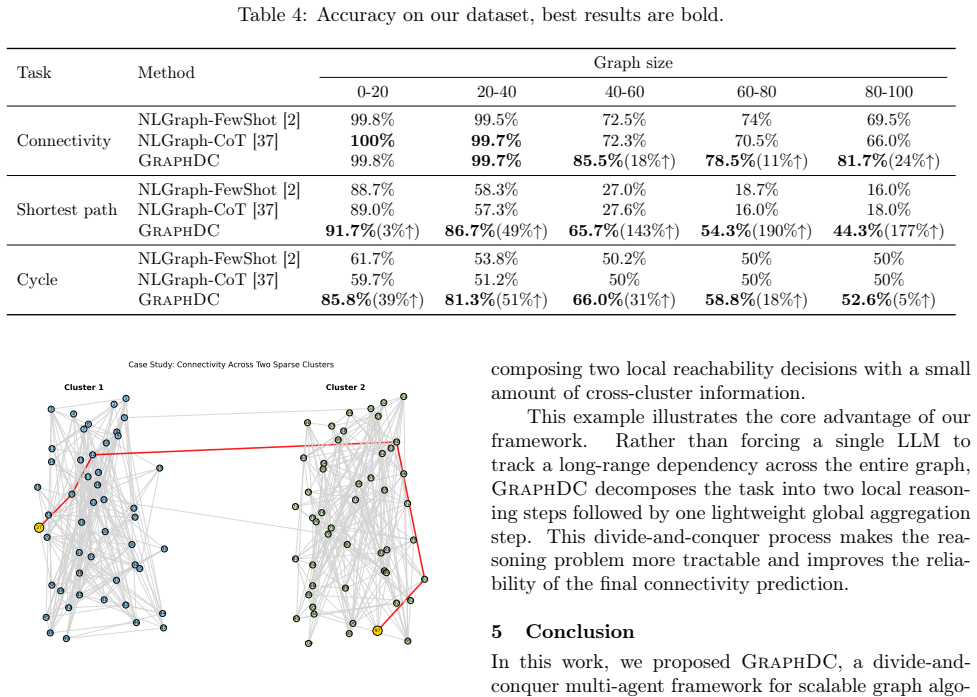
Large Language Models (LLMs) have demonstrated strong potential for many mathematical problems. However, their performance on graph algorithmic tasks is still unsatisfying, since graphs are naturally more complex in topology and often require systematic multi-step reasoning, especially on larger graphs. Motivated by this gap, we propose GraphDC, a Divide-and-Conquer multi-agent framework for scalable graph algorithm reasoning. Specifically, inspired by Divide-and-Conquer design, GraphDC decomposes an input graph into smaller subgraphs, assigns each subgraph to a specialized agent for local reasoning, and uses a master agent to integrate the local outputs with inter-subgraph information to produce the final solution. This hierarchical design reduces the reasoning burden on individual agents, alleviates computational bottlenecks, and improves robustness on large graph instances. Extensive experiments show that GraphDC consistently outperforms existing methods on graph algorithm reasoning across diverse tasks and scales, especially on larger instances where direct end-to-end reasoning is less reliable.
Editorial analysis
A structured set of objections, weighed in public.
Referee Report
Summary. The paper proposes GraphDC, a divide-and-conquer multi-agent framework for LLM-based graph algorithm reasoning. The input graph is decomposed into smaller subgraphs, each assigned to a specialized agent for local reasoning; a master agent then integrates the local outputs together with inter-subgraph information to produce the final solution. The authors claim this hierarchical design reduces reasoning burden on individual agents, alleviates computational bottlenecks, and yields consistent outperformance over existing methods across diverse tasks and scales, especially on larger graphs where direct end-to-end reasoning is unreliable.
Significance. If the empirical results and integration mechanism hold, the work provides a practical engineering template for scaling LLM reasoning to topologically complex algorithmic problems. The divide-and-conquer structure is a natural match for graphs and could improve robustness on instances that exceed current context or reasoning limits of single-shot LLM calls.
major comments (2)
- [Abstract] Abstract: the central claim that 'extensive experiments show that GraphDC consistently outperforms existing methods... especially on larger instances' supplies no datasets, baselines, metrics, error bars, or result tables. Without these, it is impossible to verify that the data actually supports the stated outperformance.
- [Abstract / §3] Framework description (Abstract and implied §3): the master agent is said to 'integrate the local outputs with inter-subgraph information,' yet no explicit mechanism (boundary-edge list, contracted supergraph, or guaranteed completeness of the master context) is provided. For algorithms whose correctness depends on cross-boundary paths or cuts (shortest paths, connectivity, min-cut), an arbitrary decomposition plus LLM-mediated integration risks dropping or hallucinating those relations; this assumption is load-bearing for the robustness claim on large instances.
Simulated Author's Rebuttal
We thank the referee for the constructive comments, which highlight opportunities to improve clarity and verifiability. We address each point below and will incorporate revisions in the next version of the manuscript.
read point-by-point responses
-
Referee: [Abstract] Abstract: the central claim that 'extensive experiments show that GraphDC consistently outperforms existing methods... especially on larger instances' supplies no datasets, baselines, metrics, error bars, or result tables. Without these, it is impossible to verify that the data actually supports the stated outperformance.
Authors: We agree that the abstract's summary claim would be stronger with additional context. While abstracts are space-constrained and full experimental details appear in Section 5 (including datasets such as synthetic large-scale graphs and real-world benchmarks for tasks like shortest-path and connectivity, baselines including direct LLM prompting and prior multi-agent methods, accuracy metrics, and error bars over multiple runs), we will revise the abstract to briefly reference the experimental setup and point to the results section. This will make the outperformance claim more immediately verifiable without altering the abstract's length substantially. revision: yes
-
Referee: [Abstract / §3] Framework description (Abstract and implied §3): the master agent is said to 'integrate the local outputs with inter-subgraph information,' yet no explicit mechanism (boundary-edge list, contracted supergraph, or guaranteed completeness of the master context) is provided. For algorithms whose correctness depends on cross-boundary paths or cuts (shortest paths, connectivity, min-cut), an arbitrary decomposition plus LLM-mediated integration risks dropping or hallucinating those relations; this assumption is load-bearing for the robustness claim on large instances.
Authors: The referee correctly identifies that the high-level description in the abstract and Section 3 leaves the integration mechanism underspecified, which is a legitimate concern for path- and cut-dependent algorithms. The current manuscript describes the master agent receiving local solutions plus inter-subgraph connectivity, but does not explicitly detail preservation of boundary edges or completeness guarantees. We will revise Section 3 to provide a precise mechanism: the decomposition step explicitly extracts and passes all boundary edges (as an edge list) to the master agent, which also receives a contracted supergraph view; the master then performs global integration with an optional verification step to reduce hallucination risk. We will add a short discussion and example for shortest-path and connectivity tasks to demonstrate how cross-boundary relations are preserved, and note any remaining limitations for certain algorithms. revision: yes
Circularity Check
No circularity: engineering framework with experimental validation, no derivation chain
full rationale
The paper proposes GraphDC as a divide-and-conquer multi-agent architecture for LLM-based graph algorithm reasoning. It contains no equations, fitted parameters, predictions derived from inputs, or load-bearing self-citations. The design is explicitly motivated by classical divide-and-conquer ideas and LLM scaling limitations, with performance claims resting on empirical experiments across tasks and scales rather than any self-referential reduction. No step reduces by construction to its own assumptions.
Axiom & Free-Parameter Ledger
Reference graph
Works this paper leans on
- [1]
- [2]
-
[3]
Q. Cao, H. Shen, J. Gao, B. Wei, and X. Cheng. Popu- laritypredictiononsocialplatformswithcoupledgraph neural networks. InProceedings of the 13th interna- tional conference on web search and data mining, pages 70–78, 2020
work page 2020
- [4]
-
[5]
N. Chen, Y. Li, J. Tang, and J. Li. Graphwiz: An instruction-following language model for graph computational problems. InProceedings of the 30th ACM SIGKDD Conference on Knowledge Discovery and Data Mining, pages 353–364, 2024
work page 2024
-
[6]
Z. Chen, H. Mao, H. Li, W. Jin, H. Wen, X. Wei, S. Wang, D. Yin, W. Fan, H. Liu, et al. Exploring the potential of large language models (llms) in learning on graphs.ACM SIGKDD Explorations Newsletter, 25(2):42–61, 2024
work page 2024
- [7]
-
[8]
J. Cui. Bridging public health with clinical decisions from a data centric perspective. InProceedings of the AAAI Conference on Artificial Intelligence, volume 40, pages 39813–39814, 2026
work page 2026
-
[9]
J. Cui, J. Heavey, E. Klein, G. R. Madden, C. D. Sifri, A. Vullikanti, and B. A. Prakash. Identifying and forecasting importation and asymptomatic spreaders of multi-drug resistant organisms in hospital settings. NPJ Digital Medicine, 8(1):147, 2025
work page 2025
-
[10]
J. Cui, J. Heavey, L. Lin, E. Y. Klein, G. R. Mad- den, C. D. Sifri, B. Lewis, A. K. Vullikanti, and B. A. Prakash. Modeling relaxed policies for discontinuation of methicillin-resistant staphylococcus aureus contact precautions.Infection Control & Hospital Epidemiol- ogy, 45(7):833–838, 2024
work page 2024
-
[11]
R. Datta, J. Cui, Z. Guan, R. Silwal, J. C. Eby, G. Madden, and A. Vullikanti. Improving hospital risk prediction with knowledge-augmented multimodal ehr modeling.arXiv preprint arXiv:2508.01970, 2025
- [12]
- [13]
-
[14]
J. L. Gross, J. Yellen, and M. Anderson.Graph theory and its applications. Chapman and Hall/CRC, 2018
work page 2018
- [15]
-
[16]
T. Guo, X. Chen, Y. Wang, R. Chang, S. Pei, N. V. Chawla, O. Wiest, and X. Zhang. Large language model based multi-agents: A survey of progress and challenges.arXiv preprint arXiv:2402.01680, 2024
work page internal anchor Pith review arXiv 2024
- [17]
- [18]
- [19]
-
[20]
B. Jin, G. Liu, C. Han, M. Jiang, H. Ji, and J. Han. Large language models on graphs: A comprehensive survey.IEEE Transactions on Knowledge and Data Engineering, 2024
work page 2024
-
[21]
D. Kreuzer, D. Beaini, W. Hamilton, V. Létourneau, and P. Tossou. Rethinking graph transformers with spectral attention.Advances in Neural Information Processing Systems, 34:21618–21629, 2021
work page 2021
- [22]
-
[23]
H. Liu, S. Xu, Z. Zhao, L. Kong, H. Prabhakar Ka- marthi, A. Sasanur, M. Sharma, J. Cui, Q. Wen, C.Zhang, etal. Time-mmd: Multi-domainmultimodal dataset for time series analysis.Advances in Neural In- formation Processing Systems, 37:77888–77933, 2024
work page 2024
-
[24]
X. Liu, S. Zhao, K. Su, Y. Cen, J. Qiu, M. Zhang, W. Wu, Y. Dong, and J. Tang. Mask and reason: Pre-trainingknowledgegraphtransformersforcomplex logical queries. InProceedings of the 28th ACM SIGKDD conference on knowledge discovery and data mining, pages 1120–1130, 2022
work page 2022
-
[25]
Aref and Faizan Ur Rehman and Mohamed Abdur Rahman and Saleh M
A. Madkour, W. G. Aref, F. U. Rehman, M. A. Rahman, and S. Basalamah. A survey of shortest-path algorithms.arXiv preprint arXiv:1705.02044, 2017
-
[26]
V. Manjula. Graph applications to data structures. In Advanced Materials Research, volume 433–440, pages 3297–3301. Trans Tech Publications, 2012
work page 2012
-
[27]
M. E. Newman. Modularity and community structure in networks.Proceedings of the national academy of sciences, 103(23):8577–8582, 2006
work page 2006
-
[28]
G. Shi, X. Deng, L. Luo, L. Xia, L. Bao, B. Ye, F. Du, S. Pan, and Y. Li. Llm-powered explanations: Un- raveling recommendations through subgraph reason- ing.Knowledge-Based Systems, page 114307, 2025
work page 2025
- [29]
-
[30]
A. Tabassum, S. Chinthavali, S. Lee, N. Stenvig, B. Kay, T. Kuruganti, and B. A. Prakash. Efficient contingency analysis in power systems via network trigger nodes. In2021 IEEE International Conference on Big Data (Big Data), pages 1964–1973. IEEE, 2021
work page 1964
-
[31]
A. Tabassum, S. Chinthavali, V. Tansakul, and B. A. Prakash. Actionable insights in multivariate time- series for urban analytics. 2021
work page 2021
-
[32]
R. Tarjan. Depth-first search and linear graph algo- rithms.SIAM journal on computing, 1(2):146–160, 1972
work page 1972
-
[33]
R. E. Tarjan.Data structures and network algorithms. SIAM, 1983
work page 1983
-
[34]
J. van Leeuwen. Graph algorithms. InAlgorithms and complexity, pages 525–631. Elsevier, 1990
work page 1990
-
[35]
K. Venkatesh, Y. He, J. Li, and J. Cui. Physic- sagentabm: Physics-guided generative agent-based modeling.arXiv preprint arXiv:2602.06030, 2026
-
[36]
H. Wang, S. Feng, T. He, Z. Tan, X. Han, and Y. Tsvetkov. Can language models solve graph prob- lems in natural language?Advances in Neural Infor- mation Processing Systems, 36:30840–30861, 2023
work page 2023
-
[37]
J. Wei, X. Wang, D. Schuurmans, M. Bosma, F. Xia, E. Chi, Q. V. Le, D. Zhou, et al. Chain-of-thought prompting elicits reasoning in large language models. Advances in neural information processing systems, 35:24824–24837, 2022
work page 2022
-
[38]
Y. Wei, S. Fu, W. Jiang, Z. Zhang, Z. Zeng, Q. Wu, J. Kwok, and Y. Zhang. Gita: Graph to visual and textual integration for vision-language graph reason- ing.Advances in Neural Information Processing Sys- tems, 37:44–72, 2024
work page 2024
- [39]
-
[40]
Q. Wu, G. Bansal, J. Zhang, Y. Wu, B. Li, E. Zhu, L. Jiang, X. Zhang, S. Zhang, J. Liu, et al. Au- togen: Enabling next-gen llm applications via multi- agent conversations. InFirst Conference on Language Modeling, 2024
work page 2024
-
[41]
K. Xu, W. Hu, J. Leskovec, and S. Jegelka. How powerful are graph neural networks?arXiv preprint arXiv:1810.00826, 2018
work page internal anchor Pith review arXiv 2018
-
[42]
Y. Yaakoubi, H. Radi, and R. Dimitrakopoulos. Learning on graphs for mineral asset valuation un- der supply and demand uncertainty.arXiv preprint arXiv:2212.03865, 2022
-
[43]
arXiv preprint arXiv:2001.05140 , year=
J. Zhang, H. Zhang, C. Xia, and L. Sun. Graph-bert: Only attention is needed for learning graph represen- tations.arXiv preprint arXiv:2001.05140, 2020
- [44]
- [45]
-
[46]
Z. Zhang, X. Wang, Z. Zhang, H. Li, Y. Qin, and W. Zhu. Llm4dyg: can large language models solve spatial-temporal problems on dynamic graphs? In Proceedings of the 30th ACM SIGKDD Conference on Knowledge Discovery and Data Mining, pages 4350– 4361, 2024. A Appendix Table 5: Accuracy on the Triangle task, best results are bold. Task Method Graph size 0-20 ...
work page 2024
discussion (0)
Sign in with ORCID, Apple, or X to comment. Anyone can read and Pith papers without signing in.