Recognition: no theorem link
A Wasserstein GAN-based climate scenario generator for risk management and insurance: the case of soil subsidence
Pith reviewed 2026-05-11 01:26 UTC · model grok-4.3
The pith
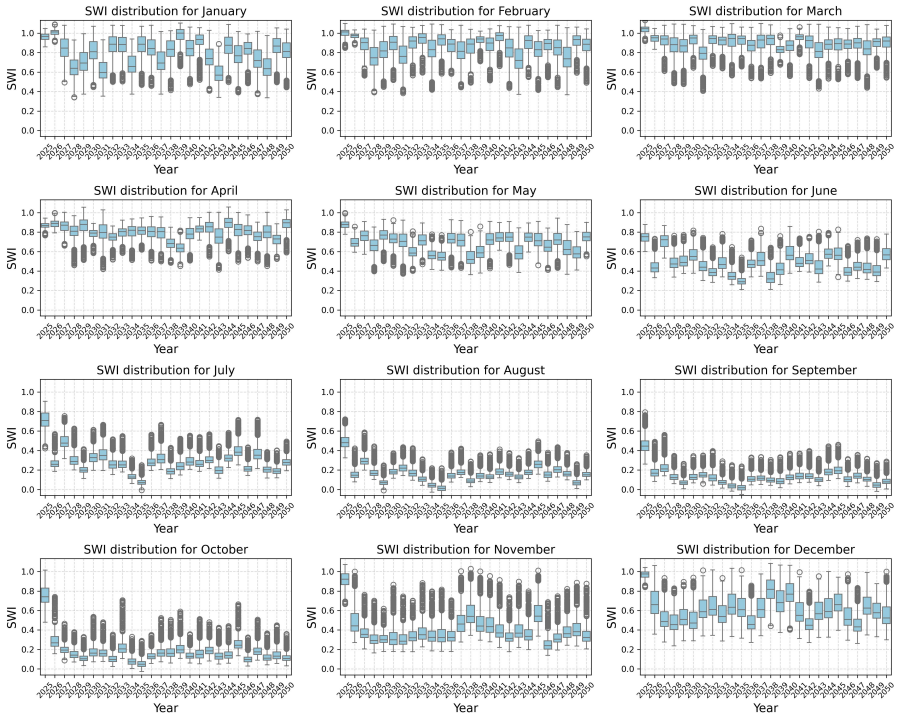
A conditional Wasserstein GAN called SwiGAN generates sequences of future soil wetness maps to simulate drought propagation in France through 2050.
A machine-rendered reading of the paper's core claim, the machinery that carries it, and where it could break.
Core claim
SwiGAN, a conditional Wasserstein GAN, learns to generate realistic future sequences of SWI maps that reproduce drought propagation patterns up to 2050 under climate change scenarios, thereby supplying a data-driven generator of climate trajectories for use in risk management and insurance pricing.
What carries the argument
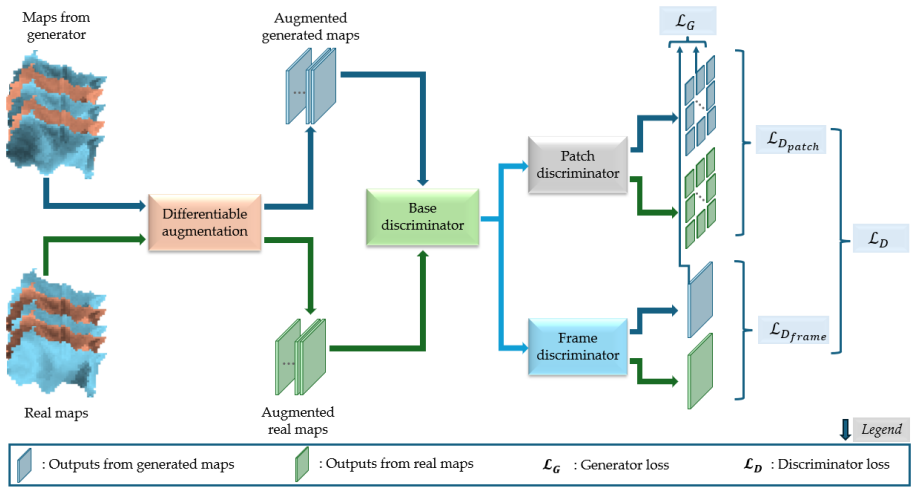
SwiGAN, a conditional Wasserstein GAN that takes climate scenario inputs and outputs sequences of SWI maps, thereby capturing the spatial and temporal evolution of drought.
If this is right
- Insurers gain medium- to long-term scenario sets that extend beyond the one-year Solvency II horizon.
- The generated maps allow direct quantification of how drought exposure evolves for a given region through 2050.
- The same conditional-GAN structure can be retrained on other climatic indices to support multi-peril scenario generation.
- Actuarial teams can feed the synthetic trajectories into economic models for pricing and capital planning.
Where Pith is reading between the lines
- The generated trajectories could be combined with economic loss models to estimate future indemnity costs under different climate pathways.
- Validation against independent regional climate models would test whether the GAN preserves physically plausible drought statistics.
- The framework might be applied to other countries that maintain similar soil-moisture or drought indices for insurance purposes.
- Regulators could explore using such generators to stress-test portfolios over multi-decade horizons.
Load-bearing premise
A model trained exclusively on historical SWI observations can produce future trajectories whose drought dynamics remain realistic once climate conditions depart from the training period.
What would settle it
Compare SwiGAN-generated SWI sequences for a held-out recent decade against actual satellite or ground measurements from that same decade to check whether the simulated drought patterns match observed frequency, duration, and spatial spread.
Figures








read the original abstract
According to the United Nations Office for Disaster Risk Reduction (2025), the average annual cost of natural catastrophes increased from 70--80 billion USD between 1970 and 2000 to 180--200 billion USD between 2001 and 2020. Reports from organizations such as the IFOA and the WWF highlight the need for the insurance sector to adapt to this rapidly evolving context by developing medium- to long-term strategies that go beyond the one-year horizon of prudential regulations such as Solvency II. This paper introduces an artificial intelligence framework based on Conditional Generative Adversarial Networks (Conditional GANs) to generate future spatio-temporal trajectories of climatic indices. The approach focuses on the Soil Wetness Index (SWI), a key indicator used in France to assess drought severity. Drought accounts for approximately 30% of the indemnities paid under the French natural catastrophe insurance scheme. The proposed model, SwiGAN, simulates plausible drought propagation patterns up to 2050 for a region of France particularly exposed to this hazard. By generating realistic sequences of SWI maps, SwiGAN provides insights into drought dynamics under climate change scenarios and supports the design of adaptive risk management and insurance strategies. The methodology is also generalizable to other climate-related perils and actuarial applications such as economic scenario generation.
Editorial analysis
A structured set of objections, weighed in public.
Referee Report
Summary. The manuscript introduces SwiGAN, a conditional Wasserstein GAN trained on historical data to generate future spatio-temporal SWI (Soil Wetness Index) trajectories up to 2050 for a drought-exposed region in France. Conditioned on climate change scenarios, the model is claimed to produce realistic drought propagation patterns that support long-term risk management and insurance strategies, with potential generalization to other climate perils.
Significance. If the generated trajectories are shown to capture non-stationary drought dynamics beyond historical resampling, the framework could provide a practical data-driven tool for medium- to long-term scenario generation in insurance, addressing gaps in current regulations such as Solvency II. The application of conditional GANs to spatio-temporal climate indices for actuarial use is a relevant extension of existing generative modeling techniques.
major comments (2)
- [Abstract] Abstract: The central claim that SwiGAN 'simulates plausible drought propagation patterns' and 'provides insights into drought dynamics under climate change scenarios' lacks any quantitative validation metrics, error analysis, comparison to baselines (e.g., statistical models or physical simulations), or held-out period tests. This omission prevents assessment of whether the conditioning successfully shifts distributions to reflect future non-stationary conditions rather than interpolating historical patterns.
- [Methodology] Methodology (inferred from abstract description): The description of how auxiliary conditioning inputs from RCP/CMIP projections are integrated into the generator and discriminator to enforce extrapolation under climate change is absent; without explicit details on the conditioning mechanism and loss terms, it is impossible to verify that the model avoids circularity in labeling fitted outputs as future predictions.
minor comments (2)
- [Title/Abstract] The title refers to 'soil subsidence' while the abstract and claims center on drought and SWI; the introduction should explicitly link SWI to subsidence risk and clarify the hazard focus.
- [Abstract] The abstract mentions generalizability to other perils and economic scenario generation but provides no concrete examples or discussion of transferability.
Simulated Author's Rebuttal
We thank the referee for their constructive and detailed comments on our manuscript. We have carefully reviewed each point and provide point-by-point responses below, along with planned revisions to strengthen the presentation of our results and methodology.
read point-by-point responses
-
Referee: [Abstract] Abstract: The central claim that SwiGAN 'simulates plausible drought propagation patterns' and 'provides insights into drought dynamics under climate change scenarios' lacks any quantitative validation metrics, error analysis, comparison to baselines (e.g., statistical models or physical simulations), or held-out period tests. This omission prevents assessment of whether the conditioning successfully shifts distributions to reflect future non-stationary conditions rather than interpolating historical patterns.
Authors: We agree that the abstract would be strengthened by explicitly referencing quantitative validation. The full manuscript includes validation through statistical comparisons (e.g., moments, spatial correlations, and temporal persistence) of generated SWI fields against historical observations, as well as qualitative assessment of drought propagation patterns. To directly address the concern regarding non-stationarity and extrapolation, we will revise the abstract to summarize key quantitative results, including Wasserstein distances between conditioned and unconditioned distributions and performance on a held-out recent period. We will also add a comparison to a simple statistical baseline (e.g., a conditional Gaussian process) in the results section of the revised manuscript. revision: yes
-
Referee: [Methodology] Methodology (inferred from abstract description): The description of how auxiliary conditioning inputs from RCP/CMIP projections are integrated into the generator and discriminator to enforce extrapolation under climate change is absent; without explicit details on the conditioning mechanism and loss terms, it is impossible to verify that the model avoids circularity in labeling fitted outputs as future predictions.
Authors: We acknowledge that the conditioning mechanism requires more explicit description to avoid ambiguity. In the manuscript, conditioning is performed by embedding the RCP/CMIP scenario variables and concatenating them to the latent noise vector in the generator and to intermediate feature maps in the discriminator; the training objective augments the standard Wasserstein loss with a regression term that penalizes deviation from the provided climate covariates. To resolve the referee's concern, we will add a dedicated subsection with the precise mathematical formulation of the conditioning layers and the composite loss function, clarifying that the climate inputs are external projections independent of the generated outputs and thus prevent circularity. revision: yes
Circularity Check
No significant circularity in derivation chain
full rationale
The paper applies a standard conditional Wasserstein GAN (SwiGAN) to learn the distribution of historical SWI fields and generate new trajectories conditioned on external climate projections. Training minimizes the standard adversarial loss between generator and discriminator on observed data; generation uses separate conditioning inputs derived from RCP/CMIP scenarios. No equation or claim reduces by construction to its own fitted parameters, no self-citation supplies a uniqueness theorem that forces the result, and no ansatz is smuggled in. The central claim—that generated sequences are plausible under non-stationary conditions—rests on the model's generalization properties and external validation, which are independent of the training inputs themselves.
Axiom & Free-Parameter Ledger
axioms (1)
- domain assumption Historical SWI data contains the statistical structure needed to generate realistic future trajectories under climate change.
Reference graph
Works this paper leans on
-
[1]
M. Arjovsky, S. Chintala, and L. Bottou. Wasserstein generative adversarial networks. In Proceedings of the 34th International Conference on Machine Learning, 2017. URL http://proceedings.mlr.press/v70/arjovsky17a.html. Introduces the Wasserstein distance for improved training of GANs
work page 2017
-
[2]
S. Barthelemy, B. Bonan, M. Tomas-Burguera, G. Grandjean, S. Bernardie, J.-P. Naulin, P. Le Moigne, A. Boone, and J.-C. Calvet. Analysis of past and future droughts causing clay shrinkage in france. Hydrology and Earth System Sciences, 29 0 (11): 0 2321--2337, 2025
work page 2025
-
[3]
R. Belhajjam, A. Chaqdid, N. Yebari, M. Seaid, and N. El Mocayd. Climate-informed flood risk mapping using a gan-based approach (exgan). Journal of Hydrology, 638: 0 131487, 2024
work page 2024
-
[4]
M. Bianchini and F. Scarselli. On the complexity of neural network classifiers: A comparison between shallow and deep architectures. IEEE transactions on neural networks and learning systems, 25 0 (8): 0 1553--1565, 2014
work page 2014
-
[5]
R. Buch, S. Grimm, R. Korn, and I. Richert. Estimating the value-at-risk by temporal vae. Risks, 11 0 (5): 0 79, 2023
work page 2023
- [6]
-
[7]
D. Chakraborty, D. Sharma, A. Mitra, and B. N. Goswami. Cv-gan-a generative model to simulate global climate variability. Authorea Preprints, 2025
work page 2025
-
[8]
A. Charpentier, M. James, and H. Ali. Predicting drought and subsidence risks in france. Natural Hazards and Earth System Sciences, 22 0 (7): 0 2401--2418, 2022. doi:10.5194/nhess-22-2401-2022
-
[9]
An Image is Worth 16x16 Words: Transformers for Image Recognition at Scale
A. Dosovitskiy, L. Beyer, A. Kolesnikov, D. Weissenborn, X. Zhai, T. Unterthiner, M. Dehghani, M. Minderer, G. Heigold, S. Gelly, J. Uszkoreit, and N. Houlsby. An image is worth 16x16 words: Transformers for image recognition at scale, 2021. URL https://arxiv.org/abs/2010.11929
work page internal anchor Pith review Pith/arXiv arXiv 2021
-
[10]
J. B. Drake, P. W. Jones, and G. R. Carr Jr. Overview of the software design of the community climate system model. The International Journal of High Performance Computing Applications, 19 0 (3): 0 177--186, 2005
work page 2005
- [11]
-
[12]
G. Ecoto and A. Chambaz. Forecasting the cost of drought events in france by super learning. EGUsphere [Preprint], 2022. doi:10.5194/egusphere-2022-541
-
[13]
A. Ferchichi, M. Chihaoui, and A. Ferchichi. Spatio-temporal modeling of climate change impacts on drought forecast using generative adversarial network: A case study in africa. Expert Systems with Applications, 238: 0 122211, 2024
work page 2024
-
[14]
S. Flaig and G. Junike. Scenario generation for market risk models using generative neural networks. Risks, 10 0 (11): 0 199, 2022
work page 2022
-
[15]
E. Foroumandi, K. Gavahi, and H. Moradkhani. Generative adversarial network for real-time flash drought monitoring: A deep learning study. Water Resources Research, 60 0 (5): 0 e2023WR035600, 2024
work page 2024
-
[16]
X. Glorot and Y. Bengio. Understanding the difficulty of training deep feedforward neural networks. In Y. W. Teh and M. Titterington, editors, Proceedings of the Thirteenth International Conference on Artificial Intelligence and Statistics, volume 9 of Proceedings of Machine Learning Research, pages 249--256, Chia Laguna Resort, Sardinia, Italy, 13--15 Ma...
work page 2010
-
[17]
R. Golan, C. Jacob, and J. Denzinger. Lung nodule detection in ct images using deep convolutional neural networks. In 2016 International Joint Conference on Neural Networks (IJCNN), pages 243--250, 2016. doi:10.1109/IJCNN.2016.7727205
-
[18]
I. Goodfellow, J. Pouget-Abadie, M. Mirza, B. Xu, D. Warde-Farley, S. Ozair, A. Courville, and Y. Bengio. Generative adversarial networks. In Advances in Neural Information Processing Systems, volume 27, 2014. URL https://papers.nips.cc/paper/2014/hash/5ca3e9b122f61f8f06494c97b1afccf3-Abstract.html. Paper introducing the Generative Adversarial Networks (G...
work page 2014
-
[19]
I. Gulrajani, F. Ahmed, M. Arjovsky, V. Dumoulin, and A. Courville. Improved training of wasserstein gans. In Advances in Neural Information Processing Systems, volume 30, 2017. URL https://proceedings.neurips.cc/paper/2017/hash/892c3b1c62f3a1ba0f2a64a9d0c3bb12-Abstract.html. Proposes the gradient penalty (WGAN-GP) for more stable GAN training
work page 2017
-
[20]
K. He, X. Zhang, S. Ren, and J. Sun. Deep residual learning for image recognition, 2015. URL https://arxiv.org/abs/1512.03385
work page internal anchor Pith review arXiv 2015
-
[21]
A. Heranval, O. Lopez, and M. Thomas. Application of machine learning methods to predict drought cost in france. European Actuarial Journal, 13 0 (2): 0 731--753, 2023
work page 2023
- [22]
-
[23]
Deep networks with stochastic depth
G. Huang, Y. Sun, Z. Liu, D. Sedra, and K. Weinberger. Deep networks with stochastic depth, 2016. URL https://arxiv.org/abs/1603.09382
-
[24]
Planetary solvency – finding our balance with nature
Institute and Faculty of Actuaries and University of Exeter . Planetary solvency – finding our balance with nature. Technical report, Institute and Faculty of Actuaries (IFoA), 2025. URL https://actuaries.org.uk/media/wqeftma1/planetary-solvency-finding-our-balance-with-nature.pdf. Report exploring climate risk impacts on economies and implications pour l...
work page 2025
-
[25]
Batch Normalization: Accelerating Deep Network Training by Reducing Internal Covariate Shift
S. Ioffe and C. Szegedy. Batch normalization: Accelerating deep network training by reducing internal covariate shift, 2015. URL https://arxiv.org/abs/1502.03167
work page internal anchor Pith review arXiv 2015
-
[26]
Image-to-Image Translation with Conditional Adversarial Networks , journal =
P. Isola, J.-Y. Zhu, T. Zhou, and A. A. Efros. Image-to-image translation with conditional adversarial networks, 2018. URL https://arxiv.org/abs/1611.07004
-
[27]
M. Jiang, Y. Liang, S. Han, K. Ma, Y. Chen, and Z. Xu. Leveraging generative adversarial networks for addressing data imbalance in financial market supervision. arXiv preprint, 2024. URL https://arxiv.org/abs/2412.15222. Méthode GAN pour corriger le déséquilibre de données en supervision des marchés financiers
-
[28]
E. Jung, M. Luna, and S. H. Park. Conditional gan with an attention-based generator and a 3d discriminator for 3d medical image generation. In International Conference on Medical Image Computing and Computer-Assisted Intervention, pages 318--328. Springer, 2021
work page 2021
-
[29]
A style-based generator architecture for generative adversarial networks
T. Karras, S. Laine, and T. Aila. A style-based generator architecture for generative adversarial networks, 2019. URL https://arxiv.org/abs/1812.04948
-
[30]
Training generative adversar- ial networks with limited data,
T. Karras, M. Aittala, J. Hellsten, S. Laine, J. Lehtinen, and T. Aila. Training generative adversarial networks with limited data, 2020 a . URL https://arxiv.org/abs/2006.06676
-
[31]
Analyzing and improving the image quality of stylegan
T. Karras, S. Laine, M. Aittala, J. Hellsten, J. Lehtinen, and T. Aila. Analyzing and improving the image quality of stylegan, 2020 b . URL https://arxiv.org/abs/1912.04958
-
[32]
On convergence and stability of GANs
N. Kodali, J. Abernethy, J. Hays, and Z. Kira. On convergence and stability of gans, 2017. URL https://arxiv.org/abs/1705.07215
-
[33]
J. Li, Y. Luo, Z. Li, G. Xu, M. Guo, and F. Gu. Analysis of spatiotemporal variability and drivers of soil moisture in the ziwuling region. Sustainability, 17 0 (17): 0 8025, 2025
work page 2025
-
[34]
H. Lin, J. Wang, F. Li, Y. Xie, C. Jiang, and L. Sun. Drought trends and the extreme drought frequency and characteristics under climate change based on spi and hi in the upper and middle reaches of the huai river basin, china. Water, 12 0 (4): 0 1100, 2020
work page 2020
-
[35]
L. Lu. An empirical study of wgan and wgan-gp for enhanced image generation. Applied and Computational Engineering, 83: 0 103--109, 2024. doi:10.54254/2755-2721/83/2024GLG0066
-
[36]
A Unified Approach to Interpreting Model Predictions
S. Lundberg and S.-I. Lee. A unified approach to interpreting model predictions, 2017. URL https://arxiv.org/abs/1705.07874
work page Pith review arXiv 2017
-
[37]
S. L. Markstrom, L. E. Hay, and M. P. Clark. Towards simplification of hydrologic modeling: Identification of dominant processes. Hydrology and Earth System Sciences, 20 0 (11): 0 4655--4671, 2016
work page 2016
-
[38]
A. Mazrooei and A. Sankarasubramanian. Improving monthly streamflow forecasts through assimilation of observed streamflow for rainfall-dominated basins across the conus. Journal of Hydrology, 575: 0 704--715, 2019
work page 2019
-
[39]
Spectral Normalization for Generative Adversarial Networks
T. Miyato, T. Kataoka, M. Koyama, and Y. Yoshida. Spectral normalization for generative adversarial networks, 2018. URL https://arxiv.org/abs/1802.05957
work page Pith review arXiv 2018
-
[40]
S. Obakrim, L. Benoit, and D. Allard. A multivariate and space-time stochastic weather generator using a latent gaussian framework. Stochastic Environmental Research and Risk Assessment, 39 0 (9): 0 3677--3701, 2025
work page 2025
-
[41]
Understanding the exploding gradient problem.CoRR abs/1211.5063 (2012)
R. Pascanu, T. Mikolov, and Y. Bengio. On the difficulty of training recurrent neural networks, 2013. URL https://arxiv.org/abs/1211.5063
-
[42]
M. Pedersoli, T. Lucas, C. Schmid, and J. Verbeek. Areas of attention for image captioning, 2017. URL https://arxiv.org/abs/1612.01033
-
[43]
The effectiveness of data augmentation in image classifica- tion using deep learning,
L. Perez and J. Wang. The effectiveness of data augmentation in image classification using deep learning, 2017. URL https://arxiv.org/abs/1712.04621
-
[44]
M. S. Rahman, L. Di, E. Yu, L. Lin, and Z. Yu. Remote sensing based rapid assessment of flood crop damage using novel disaster vegetation damage index (dvdi). International Journal of Disaster Risk Science, 12 0 (1): 0 90--110, 2021
work page 2021
-
[45]
F. Ramzan, C. Sartori, S. Consoli, and D. Reforgiato Recupero. Generative adversarial networks for synthetic data generation in finance: Evaluating statistical similarities and quality assessment. AI, 5 0 (2): 0 667--685, 2024. doi:10.3390/ai5020035. Application of GANs pour génération de données synthétiques financières
-
[46]
U-Net: Convolutional Networks for Biomedical Image Segmentation
O. Ronneberger, P. Fischer, and T. Brox. U-net: Convolutional networks for biomedical image segmentation, 2015. URL https://arxiv.org/abs/1505.04597
work page internal anchor Pith review Pith/arXiv arXiv 2015
- [47]
-
[48]
Improved Techniques for Training GANs
T. Salimans, I. Goodfellow, W. Zaremba, V. Cheung, A. Radford, and X. Chen. Improved techniques for training gans, 2016. URL https://arxiv.org/abs/1606.03498
work page Pith review arXiv 2016
-
[49]
J. Sha, X. Chen, Y. Chang, M. Zhang, and X. Li. A spatial weather generator based on conditional deep convolution generative adversarial nets (cdcgan). Climate Dynamics, 62 0 (2): 0 1275--1290, 2024
work page 2024
-
[50]
J. S. Shukla and R. J. Pandya. Deep learning-oriented c-gan models for vegetative drought prediction on peninsular india. IEEE Journal of Selected Topics in Applied Earth Observations and Remote Sensing, 17: 0 282--297, 2023
work page 2023
-
[51]
J.-M. Soubeyroux, S. Bernus, L. Corre, A. Drouin, B. Dubuisson, P. Etchevers, P. Josse, M. Kerdoncuff, R. Samacoits, and F. Tocquer. LES NOUVELLES PROJECTIONS CLIMATIQUES DE R \'E F \'E RENCE DRIAS 2020 . PhD thesis, Meteo-France, 2020
work page 2020
-
[52]
A. Srivastava, L. Valkov, C. Russell, M. U. Gutmann, and C. Sutton. Veegan: Reducing mode collapse in gans using implicit variational learning. pages 3310--3320, 2017. URL https://papers.nips.cc/paper/6923-veegan-reducing-mode-collapse-in-gans-using-implicit-variational-learning.pdf. Introduces a GAN variant (VEEGAN) designed pour atténuer le mode collapse
work page 2017
-
[53]
S. Strachan and C. Daly. Testing the daily prism air temperature model on semiarid mountain slopes. Journal of Geophysical Research: Atmospheres, 122 0 (11): 0 5697--5715, 2017
work page 2017
-
[54]
H. Thanh-Tung and T. Tran. On catastrophic forgetting and mode collapse in generative adversarial networks, 2020. URL https://arxiv.org/abs/1807.04015
-
[55]
Instance Normalization: The Missing Ingredient for Fast Stylization
D. Ulyanov, A. Vedaldi, and V. Lempitsky. Instance normalization: The missing ingredient for fast stylization, 2017. URL https://arxiv.org/abs/1607.08022
work page Pith review arXiv 2017
-
[56]
Global Assessment Report on Disaster Risk Reduction 2025
United Nations Office for Disaster Risk Reduction . Global Assessment Report on Disaster Risk Reduction 2025 . Technical report, United Nations, 2025. URL https://www.undrr.org/gar/gar2025
work page 2025
-
[57]
Y. Wang, L. Shi, Y. Hu, X. Hu, W. Song, and L. Wang. A comprehensive study of deep learning for soil moisture prediction. Hydrology and Earth System Sciences, 28: 0 917--943, 02 2024. doi:10.5194/hess-28-917-2024
- [58]
-
[59]
S. Woo, J. Park, J.-Y. Lee, and I. S. Kweon. Cbam: Convolutional block attention module, 2018. URL https://arxiv.org/abs/1807.06521
work page Pith review arXiv 2018
-
[60]
Tackling the insurance protection gap: Leveraging climate and nature to increase resilience
World Wide Fund For Nature . Tackling the insurance protection gap: Leveraging climate and nature to increase resilience. Technical report, World Wide Fund For Nature (WWF), 2026. URL https://wwfint.awsassets.panda.org/downloads/wwf-insurance-protection-gap-report-.pdf. White paper examining how climate change and nature loss are widening the insurance pr...
work page 2026
-
[61]
M. L. Wrzesien, T. M. Pavelsky, M. T. Durand, J. Dozier, and J. D. Lundquist. Characterizing biases in mountain snow accumulation from global data sets. Water Resources Research, 55 0 (11): 0 9873--9891, 2019
work page 2019
-
[62]
M. V. Wuthrich, R. Richman, B. Avanzi, M. Lindholm, M. Maggi, M. Mayer, J. Schelldorfer, and S. Scognamiglio, 2026. Available at SSRN:https://ssrn.com/abstract=5162304 or http://dx.doi.org/10.2139/ssrn.5162304
- [63]
-
[64]
Z. Xueping, S. M. Samuri, Q. Lin, and M. H. M. Adnan. Integrating generative adversarial networks and stacked autoencoder neural networks for enhanced credit risk assessment in fintech. International Journal of Entrepreneurship and Management Practises, 8 0 (29), 2025. doi:10.35631/IJEMP.829001. Intègre GAN et auto-encodeurs pour améliorer l’évaluation du...
-
[65]
X. Yang, X. Xie, D. L. Liu, F. Ji, and L. Wang. Spatial interpolation of daily rainfall data for local climate impact assessment over greater sydney region. Advances in Meteorology, 2015 0 (1): 0 563629, 2015
work page 2015
- [66]
-
[67]
mixup: Beyond Empirical Risk Minimization
H. Zhang, M. Cisse, Y. N. Dauphin, and D. Lopez-Paz. mixup: Beyond empirical risk minimization, 2018. URL https://arxiv.org/abs/1710.09412
work page internal anchor Pith review arXiv 2018
- [68]
- [69]
- [70]
discussion (0)
Sign in with ORCID, Apple, or X to comment. Anyone can read and Pith papers without signing in.