Recognition: no theorem link
From Storage to Experience: A Survey on the Evolution of LLM Agent Memory Mechanisms
Pith reviewed 2026-05-11 01:07 UTC · model grok-4.3
The pith
LLM agent memory mechanisms evolve through three stages from storage to experience abstraction.
A machine-rendered reading of the paper's core claim, the machinery that carries it, and where it could break.
Core claim
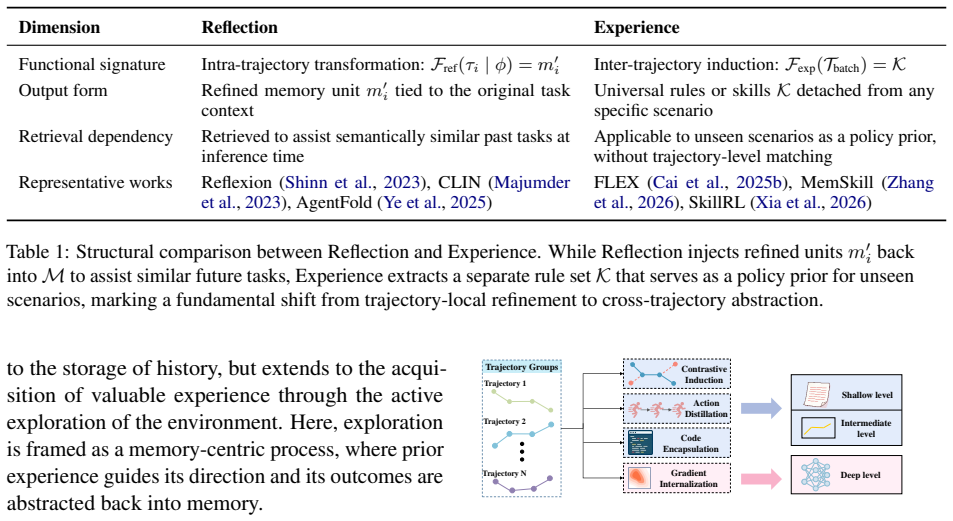
The paper claims that LLM agent memory has evolved from Storage, where trajectories are preserved, to Reflection, where they are refined, and finally to Experience, where they are abstracted. This development is driven by the necessity for long-range consistency, the challenges in dynamic environments, and the goal of continual learning. In the Experience stage, transformative mechanisms include proactive exploration and cross-trajectory abstraction, offering design principles for next-generation agents.
What carries the argument
The three-stage evolutionary framework: Storage for trajectory preservation, Reflection for trajectory refinement, and Experience for trajectory abstraction.
If this is right
- Memory design in LLM agents should advance beyond basic storage to include reflection and abstraction for improved performance.
- The framework unifies disparate research approaches from engineering and cognitive science perspectives.
- Focus on proactive exploration and cross-trajectory abstraction can lead to agents capable of continual learning.
- Development of LLM agents will benefit from clear stages guiding the implementation of memory mechanisms.
Where Pith is reading between the lines
- Applying this framework could help identify gaps in current agent systems by classifying their memory capabilities.
- Future work might test if agents following the Experience stage outperform those in earlier stages in complex tasks.
- Connections to human cognition could be explored further, as the stages mirror aspects of learning theory.
Load-bearing premise
That the various studies on LLM agent memory can be organized into a single linear evolutionary progression through storage, reflection, and experience stages driven by consistency, dynamics, and continual learning.
What would settle it
A comprehensive review revealing that many LLM memory mechanisms do not align with the three stages or follow a different evolutionary path would challenge the proposed framework.
Figures



read the original abstract
Large Language Model (LLM)-based agents have fundamentally reshaped artificial intelligence by integrating external tools and planning capabilities. While memory mechanisms have emerged as the architectural cornerstone of these systems, current research remains fragmented, oscillating between operating system engineering and cognitive science. This theoretical divide prevents a unified view of technological synthesis and a coherent evolutionary perspective. To bridge this gap, this survey proposes a novel evolutionary framework for LLM agent memory mechanisms, formalizing the development process into three stages: Storage (trajectory preservation), Reflection (trajectory refinement), and Experience (trajectory abstraction). We first formally define these three stages before analyzing the three core drivers of this evolution: the necessity for long-range consistency, the challenges in dynamic environments, and the ultimate goal of continual learning. Furthermore, we specifically explore two transformative mechanisms in the frontier Experience stage: proactive exploration and cross-trajectory abstraction. By synthesizing these disparate views, this work offers robust design principles and a clear roadmap for the development of next-generation LLM agents.
Editorial analysis
A structured set of objections, weighed in public.
Referee Report
Summary. This survey proposes a novel evolutionary framework for LLM agent memory mechanisms, formalizing their development into three stages: Storage (trajectory preservation), Reflection (trajectory refinement), and Experience (trajectory abstraction). It defines the stages, analyzes three core drivers (long-range consistency, dynamic environments, continual learning), explores proactive exploration and cross-trajectory abstraction in the Experience stage, and synthesizes these into design principles and a roadmap for next-generation LLM agents.
Significance. If the framework holds as more than an organizing lens, it would provide a valuable bridge between fragmented OS-engineering and cognitive-science views on LLM agent memory, offering a clear progression narrative and highlighting abstraction mechanisms that could guide future agent designs for continual learning. The synthesis of existing literature and explicit roadmap are strengths that could help consolidate research directions in the field.
major comments (2)
- [§3] §3 (stage definitions): The formal definitions of Storage, Reflection, and Experience rely on qualitative trajectory-based descriptions without explicit classification criteria, metrics, or decision procedures for assigning works to stages. This makes the claimed linear progression susceptible to post-hoc categorization of parallel research lines rather than an objectively demonstrated evolution.
- [§4] §4 (driver analysis): The discussion of the three core drivers does not include a chronological publication timeline, causal linkage evidence, or counter-example handling from the surveyed literature. Without these, the assertion of an evolutionary process driven by long-range consistency, dynamic environments, and continual learning remains interpretive rather than substantiated.
minor comments (2)
- [Abstract] The abstract and introduction should more explicitly state whether the framework is offered as an interpretive synthesis or as an empirically observed progression, to set reader expectations.
- A summary table mapping representative works to stages, drivers, and mechanisms would improve readability and allow readers to assess the coverage of the categorization.
Simulated Author's Rebuttal
We thank the referee for the constructive and detailed feedback on our survey. We address each major comment point by point below, clarifying the scope and intent of our proposed framework while outlining specific revisions to strengthen the manuscript.
read point-by-point responses
-
Referee: [§3] §3 (stage definitions): The formal definitions of Storage, Reflection, and Experience rely on qualitative trajectory-based descriptions without explicit classification criteria, metrics, or decision procedures for assigning works to stages. This makes the claimed linear progression susceptible to post-hoc categorization of parallel research lines rather than an objectively demonstrated evolution.
Authors: We acknowledge that the stage definitions are qualitative and conceptual, as the framework is proposed as an organizing lens to synthesize fragmented research rather than a strict empirical taxonomy with quantitative metrics. In the revision, we will expand §3 to include explicit classification criteria (e.g., primary mechanism focus: preservation for Storage, refinement for Reflection, abstraction for Experience) and a table of representative works with boundary-case discussions. This will reduce ambiguity about assignment while preserving the survey's interpretive character. revision: yes
-
Referee: [§4] §4 (driver analysis): The discussion of the three core drivers does not include a chronological publication timeline, causal linkage evidence, or counter-example handling from the surveyed literature. Without these, the assertion of an evolutionary process driven by long-range consistency, dynamic environments, and continual learning remains interpretive rather than substantiated.
Authors: We agree that a chronological timeline would improve clarity and will add one (as a figure or table) in the revised §4, mapping key publications to the drivers. We will also include a short subsection on counter-examples and explicitly note that, as a survey, our analysis identifies observed trends and correlations rather than proving causal linkages, which would require a separate empirical study. This will make the interpretive nature of the claims more transparent. revision: partial
Circularity Check
No significant circularity: survey framework is interpretive categorization without derivations or self-referential reductions.
full rationale
The paper is a survey that proposes a novel evolutionary framework organizing existing LLM agent memory research into three stages (Storage, Reflection, Experience) driven by long-range consistency, dynamic environments, and continual learning. No mathematical derivations, equations, fitted parameters, or predictions appear in the abstract or described structure. The framework is explicitly presented as a unifying lens and roadmap rather than a result derived from prior self-work or self-citations. No load-bearing self-citation chains, ansatzes smuggled via citation, or renaming of known results as new derivations are evident. The central claim rests on post-hoc organization of literature, which is a standard survey activity and does not constitute circularity under the specified patterns.
Axiom & Free-Parameter Ledger
axioms (1)
- domain assumption LLM agent memory mechanisms evolve through the stages of Storage, Reflection, and Experience in response to the drivers of long-range consistency, dynamic environments, and continual learning.
Reference graph
Works this paper leans on
-
[1]
Titans: Learning to Memorize at Test Time
Titans: Learning to memorize at test time. ArXiv, abs/2501.00663. Andrii Bidochko and Yaroslav Vyklyuk. 2026. Thought management system for long-horizon, goal-driven llm agents.Journal of Computational Science, 93:102740. Weihao Bo, Shan Zhang, Yanpeng Sun, Jingjing Wu, Qunyi Xie, Xiao Tan, Kunbin Chen, Wei He, Xiaofan Li, Na Zhao, Jingdong Wang, and Zech...
work page internal anchor Pith review arXiv 2026
-
[2]
LEGOMem : Modular procedural memory for multi-agent LLM systems for workflow automation, 2025
Legomem: Modular procedural memory for multi-agent llm systems for workflow automation. ArXiv, abs/2510.04851. Jackson Hassell, Dan Zhang, Han Jun Kim, Tom Mitchell, and Estevam Hruschka. 2025. Learning from supervision with semantic and episodic mem- ory: A reflective approach to agent adaptation.ArXiv, abs/2510.19897. Hiroaki Hayashi, Bo Pang, Wenting Z...
-
[3]
Arcmemo: Abstract reasoning composition with lifelong llm memory.ArXiv, abs/2509.04439. Chuanyang Hong and Qingyun He. 2025. Enhancing memory retrieval in generative agents through llm- trained cross attention networks.Frontiers in Psy- chology, 16. Yuki Hou, Haruki Tamoto, and Homei Miyashita. 2024. "my agent understands me better": Integrating dy- namic...
-
[4]
Adam Tauman Kalai and Santosh S
Cold: Causal reasoning in closed daily ac- tivities.ArXiv, abs/2411.19500. Adam Tauman Kalai and Santosh S. Vempala. 2023. Calibrated language models must hallucinate.Pro- ceedings of the 56th Annual ACM Symposium on Theory of Computing. Jiazheng Kang, Mingming Ji, Zhe Zhao, and Ting Bai. 2025. Memory os of ai agent.ArXiv, abs/2506.06326. Jungo Kasai, Kei...
-
[5]
arXiv preprint arXiv:2207.13332 , year=
Realtime qa: What’s the answer right now? Preprint, arXiv:2207.13332. Eunwon Kim, Chanho Park, and Buru Chang. 2024a. Share: Shared memory-aware open-domain long- term dialogue dataset constructed from movie script. ArXiv, abs/2410.20682. Jiho Kim, Woosog Chay, Hyeonji Hwang, Daeun Kyung, Hyunseung Chung, Eunbyeol Cho, Yohan Jo, and Edward Choi. 2024b. Di...
-
[6]
Rui Li, Zeyu Zhang, Xiaohe Bo, Zihang Tian, Xu Chen, Quanyu Dai, Zhenhua Dong, and Ruiming Tang
Robomemory: A brain-inspired multi-memory agentic framework for lifelong learning in physical embodied systems.ArXiv, abs/2508.01415. Rui Li, Zeyu Zhang, Xiaohe Bo, Zihang Tian, Xu Chen, Quanyu Dai, Zhenhua Dong, and Ruiming Tang. 2025a. Cam: A constructivist view of agentic mem- ory for llm-based reading comprehension.ArXiv, abs/2510.05520. Shilong Li, Y...
-
[7]
arXiv preprint arXiv:2510.21618 , year=
Graphreader: Building graph-based agent to enhance long-context abilities of large language mod- els. InConference on Empirical Methods in Natural Language Processing. Xiaoxi Li, Wenxiang Jiao, Jiarui Jin, Guanting Dong, Jiajie Jin, Yinuo Wang, Hao Wang, Yutao Zhu, Ji- Rong Wen, Yuan Lu, and Zhicheng Dou. 2025b. Deepagent: A general reasoning agent with s...
-
[8]
Agentmaster: A multi-agent conversational framework using a2a and mcp protocols for mul- timodal information retrieval and analysis.ArXiv, abs/2507.21105. Bill Yuchen Lin, Yicheng Fu, Karina Yang, Prithvi- raj Ammanabrolu, Faeze Brahman, Shiyu Huang, Chandra Bhagavatula, Yejin Choi, and Xiang Ren
-
[9]
Swift- sage: A generative agent with fast and slow think- ing for complex interactive tasks
Swiftsage: A generative agent with fast and slow thinking for complex interactive tasks.ArXiv, abs/2305.17390. Hongzhan Lin, Zixin Chen, Zhiqi Shen, Ziyang Luo, Zhen Ye, Jing Ma, Tat-Seng Chua, and Guandong Xu. 2026. Towards comprehensive stage-wise bench- marking of large language models in fact-checking. arXiv preprint arXiv:2601.02669. Hongzhan Lin, Ya...
-
[10]
Mma: Multimodal memory agent.ArXiv, abs/2602.16493. Haipeng Luo, Huawen Feng, Qingfeng Sun, Can Xu, Kai Zheng, Yufei Wang, Tao Yang, Han Hu, and Yan- song Tang. 2026. Agentmath: Empowering math- ematical reasoning for large language models via tool-augmented agent.Preprint, arXiv:2512.20745. Hongyin Luo, Nathaniel Morgan, Tina Li, Derek Zhao, Ai Vy Ngo, P...
-
[11]
Clin: A continually learning language agent for rapid task adaptation and generalization
Clin: A continually learning language agent for rapid task adaptation and generalization.ArXiv, abs/2310.10134. Eric Melz. 2023. Enhancing llm intelligence with arm- rag: Auxiliary rationale memory for retrieval aug- mented generation.ArXiv, abs/2311.04177. Atsuyuki Miyai, Zaiying Zhao, Kazuki Egashira, Atsuki Sato, Tatsumi Sunada, Shota Onohara, Hiromasa...
-
[12]
What Deserves Memory: Adaptive Memory Distillation for LLM Agents
Nemori: Self-organizing agent memory in- spired by cognitive science.ArXiv, abs/2508.03341. Jingwei Ni, Yihao Liu, Xinpeng Liu, Yutao Sun, Mengyu Zhou, Pengyu Cheng, Dexin Wang, Xiaoxi Jiang, and Guanjun Jiang. 2026. Trace2skill: Distill trajectory-local lessons into transferable agent skills. Siru Ouyang, Jun Yan, I-Hung Hsu, Yanfei Chen, Ke Jiang, Zifen...
work page internal anchor Pith review Pith/arXiv arXiv 2026
-
[13]
Preston Rasmussen, Pavlo Paliychuk, Travis Beauvais, Jack Ryan, and Daniel Chalef
Remi: A novel causal schema memory ar- chitecture for personalized lifestyle recommendation agents.ArXiv, abs/2509.06269. Preston Rasmussen, Pavlo Paliychuk, Travis Beauvais, Jack Ryan, and Daniel Chalef. 2025. Zep: A tempo- ral knowledge graph architecture for agent memory. ArXiv, abs/2501.13956. Nir Ratner, Yoav Levine, Yonatan Belinkov, Ori Ram, Inbal ...
-
[14]
Collaborative memory: Multi-user memory sharing in LLM agents with dynamic access control,
Parallel context windows for large language models. InAnnual Meeting of the Association for Computational Linguistics. Matthew Renze and Erhan Guven. 2024. Self-reflection in large language model agents: Effects on problem- solving performance.2024 2nd International Con- ference on Foundation and Large Language Models (FLLM), pages 516–525. Alireza Rezaza...
-
[15]
Meminsight: Autonomous memory augmenta- tion for llm agents.ArXiv, abs/2503.21760. Yuchen Shi, Yuzheng Cai, Siqi Cai, Zihan Xu, Lichao Chen, Yulei Qin, Zhijian Zhou, Xiang Fei, Chaofan Qiu, Xiaoyu Tan, Gang Li, Zongyi Li, Haojia Lin, Guocan Cai, Yong Mao, Yunsheng Wu, Ke Li, and Xing Sun. 2025a. Youtu-agent: Scaling agent produc- tivity with automated gen...
-
[16]
Mrag: A modular retrieval framework for time-sensitive que stion answering
Reflexion: language agents with verbal re- inforcement learning. InNeural Information Pro- cessing Systems. Zhang Siyue, Yuxiang Xue, Yiming Zhang, Xiaobao Wu, Anh Tuan Luu, and Zhao Chen. 2024. Mrag: A modular retrieval framework for time-sensitive ques- tion answering.ArXiv, abs/2412.15540. Saksham Sahai Srivastava and Haoyu He. 2025. Mem- orygraft: Per...
-
[17]
Hao Tang, Darren Key, and Kevin Ellis
End-to-end test-time training for long context. Hao Tang, Darren Key, and Kevin Ellis. 2024a. World- coder, a model-based llm agent: Building world mod- els by writing code and interacting with the environ- ment.ArXiv, abs/2402.12275. Jiaming Tang, Yilong Zhao, Kan Zhu, Guangxuan Xiao, Baris Kasikci, and Song Han. 2024b. Quest: Query- aware sparsity for e...
-
[18]
Beyond a million tokens: Benchmarking and enhancing long-term memory in llms.ArXiv, abs/2510.27246. Yuchen Tian, Ruiyuan Huang, Xuanwu Wang, Jing Ma, Zengfeng Huang, Ziyang Luo, Hongzhan Lin, Da Zheng, and Lun Du. 2025a. Evolprover: Advanc- ing automated theorem proving by evolving formal- ized problems via symmetry and difficulty.Preprint, arXiv:2510.007...
-
[19]
arXiv preprint arXiv:2506.13356 , year=
Loongflow: Directed evolutionary search via a cognitive plan-execute-summarize paradigm. Luanbo Wan and Weizhi Ma. 2025. Storybench: A dy- namic benchmark for evaluating long-term memory with multi turns.ArXiv, abs/2506.13356. Fang Wang, Tianwei Yan, Zonghao Yang, Minghao Hu, Jun Zhang, Zhunchen Luo, and Xiaoying Bai. 2025a. Deepmel: A multi-agent collabo...
-
[20]
The Rise and Potential of Large Language Model Based Agents: A Survey
The rise and potential of large language model based agents: A survey.ArXiv, abs/2309.07864. Menglin Xia, Victor Ruehle, Saravan Rajmohan, and Reza Shokri. 2025a. Minerva: A programmable memory test benchmark for language models.ArXiv, abs/2502.03358. Peng Xia, Jianwen Chen, Han Wang, Jiaqi Liu, Kaide Zeng, Yu Wang, Siwei Han, Yiyang Zhou, Xujiang Zhao, H...
work page internal anchor Pith review arXiv 2026
-
[21]
Explicit memory learning with expectation maximization. InConference on Empirical Methods in Natural Language Processing. Simon Yu, Gang Li, Weiyan Shi, and Pengyuan Qi. 2025a. Polyskill: Learning generalizable skills through polymorphic abstraction.ArXiv, abs/2510.15863. Wenhao Yu, Zhenwen Liang, Chengsong Huang, Kis- han Panaganti, Tianqing Fang, Haitao...
-
[22]
prompt lists
dynamically adjust retrieval intensity, while streaming-update architectures main- tain long-term stability without exhaustive retrieval (Zhou et al., 2023; Lu et al., 2023). • Semantic Graphs:Graph memory repre- sents interaction histories as networks of en- tities and relations, enabling structured rea- soning beyond flat storage. Triplet-based extracti...
2023
discussion (0)
Sign in with ORCID, Apple, or X to comment. Anyone can read and Pith papers without signing in.